
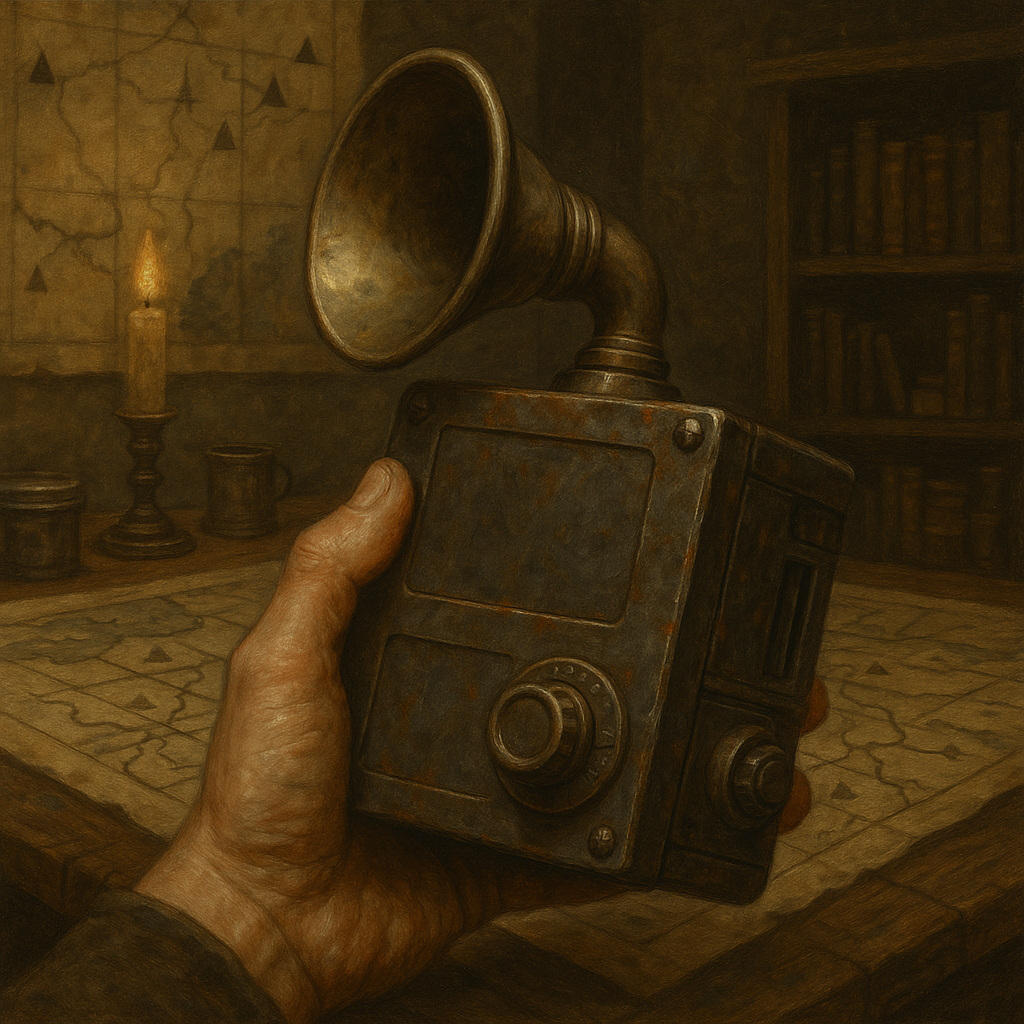
Polyvox Interpreter
“No language is a barrier with a Polyvox Interpreter!” - Pre-Schism marketing slogan.
The Polyvox Interpreter is one of the last surviving miracles of The Lost Ages, an automatic, box-sized linguistic engine capable of translating spoken tongues into the listener’s preferred language through a brass gramophone horn. In its prime, it served kings, scholars, diplomats, and marching battalions. Today, it survives as a relic more precious than gold, favored by The Scholar's Guild, The Everwealthy Military, and The Monarchy as a whole for diplomacy. The device is a squat metal brick, heavier than it seems, its front dominated by a small conical speaker reminiscent of a miniature record horn. When activated, the Polyvox listens, analyzing speech before projecting a translated version in a hollow, metallic cadence that sounds midway between a phonograph and a spirit. Its tone is flat, often eerie, and frequently offensive by accident. Sacred Gnomish phrases become vulgarities. Old Dwarfish clan-names become threats. The wrong syllable has toppled peace talks. Despite that, its usefulness remains immeasurable. A Polyvox can bridge worlds where literacy has collapsed, where interpreters are rare, and where enemies share no common ground. During interrogations of captured Elfese soldiers in the ongoing war with the east, whose Kibonese dialects remain notoriously difficult to parse, the Everwealth military treats the Polyvox as indispensable. Only a few dozen fully functioning units remain. Fewer still have the Attunement Dial, a crystalline tuning mechanism that allows new languages to be added through a grueling multi-day ritual of vowel repetition, tonal drills, and phrasal intonation. Because of this, the Polyvox is completely legal, exorbitantly expensive, and jealously guarded.
Mechanics & Inner Workings
Though crude-looking, the Polyvox is a masterpiece of arcano-linguistic engineering. Its internal structures combine crystallized memory-plates, magickal resonance chambers, and pre-Schism circuitry that no modern artisan can reproduce. What remains functional does so through stubbornness and residual enchantment.
- Translation Horn: The gramophone-like brass cone amplifies and “voices” translations. It vibrates visibly when active, producing speech with an uncanny echo, as though the words have passed through a cavern before reaching the listener.
- Crystal Linguistic Core: A fragile plate of shimmering, layered crystal that stores phonemes, grammatic patterns, and magical lexemes. Each core houses anywhere from 3 to 40 languages, depending on degradation. The core is perishable. As it decays, languages “drip” out of memory, producing mistranslations, nonsense syllables, or eerie near-words believed to be fragments of dead dialects.
- Attunement Mechanism: Rare survivors possess an intact Attunement Dial: New languages may be added through a three-to five-day ritual. The speaker must read curated vowel charts, tone patterns, and example phrases. The Polyvox “learns” through resonance, imprinting the language into the core. Mispronunciation may encode errors permanently. Only trained linguists of The Scholar’s Guild dare attempt attunement, calling it “teaching a corpse to sing.”
- Echo Detection: A secondary function discovered by accident. If speech occurs nearby, even through walls, the Polyvox’s internal plates hum. The horn whispers disjointed syllables, acting as a primitive listening device. Older units sometimes echo conversations from years past, making some users believe the device remembers its owners long after they are gone.
Manufacturing process
The Polyvox Interpreter Unit is exceedingly rare not only because its factories were annihilated during the Schism, but because the specialized tools and alchemical materials required for its construction no longer exist in any workable form. In the Lost Ages, Polyvox units were assembled in dedicated laboratories. Each device began with the crystal-lattice translation core, grown in solution baths and tuned through rhythmic vowel recitations performed by trained linguists. Once harvested, the crystal was shaped into thin plates and fitted beneath the brass “listening cone,” a miniature acoustic horn designed to funnel sound and imprint its patterns into the core. Engineers wound silver-copper coil engines around insulated rods, layering the wires thousands of times to create the oscillating heartbeat of the machine. This coil array powered the interpretation pulses and stabilized the shifting tonal structures within the crystal. The inferential plates, micro-thin sheets inscribed with linguistic runes, were then mounted inside the casing to influence pronunciation and grammatical logic. Finally, each Polyvox underwent a language attunement ritual, aligning the device to one or more tongues through repeated chanting, phonetic drills, and resonance-matching cycles. Fully functional attunement systems allowed new languages to be installed over several days of structured vowel work and phrase calibration, though only a fraction of surviving units retain this delicate mechanism. Today, no workshop possesses the crystal baths, no metal foundry can reproduce the coil alloys, and no scholar remembers the tonal rites with the precision required. The Polyvox is, at its core, a miracle of a dead age, one that the world may never create again.
History
First deployed in the later years of The Lost Ages to bridge cultural divides in academia, warfare, and diplomacy, the Polyvox quickly became the cornerstone of multi-lingual communication networks thereafter in the many collapses of industry to come. Officers used Polyvox units to coordinate troops from distant kingdoms as they resisted Devil incursion. Many devices were shattered in battlefields, buried beneath fortresses, or stolen by infernal forces. During the Great Schism the Polyvox became almost a weapon. Warlords assassinated interpreters to control negotiations. Armies seized Polyvox units to force terrified populations into coerced treaties. Rogue guilds used them to intercept foreign mercenaries by faking orders in their own tongue. The Scholar's Guild guards most surviving devices. The Monarchy retains a mere twenty-six, primarily for interrogation and border diplomacy. Private ownership is rare but legal, though the price alone prohibits most. A Polyvox in one’s hand marks the owner as wealthy, influential, and always listening.
Significance
To Everwealth’s splintered Civil Age, the Polyvox is less a tool and more a shadow of what the world once was, a reminder that understanding was possible before the Fall shattered every tongue and trust. The Scholar’s Guild treats each unit as a holy relic of lost intellect, while the King and his men prize them as strategic weapons, indispensable for interrogating Elfese prisoners or negotiating along volatile borders. Among commonfolk, the Polyvox is a whispered legend, a box that can speak the minds of strangers, feared as much as admired. In truth, it stands as one of the last bridges across a world that no longer knows how to listen.
Rarity
Functional Polyvox units are almost never found outside the vaults of the Scholar’s Guild, the hands of royal agents, or the packs of exceptionally fortunate adventurers. Most surviving models are cracked, mute, or missing their language cones entirely, and fewer than a hundred intact devices are believed to remain across all Everwealth. Even among these, only a fraction still possess active attunement mechanisms, making a fully operational Polyvox one of the rarest communicative artifacts of the post-Schism age.
Raw materials & Components
- Copper-silver filament coils.
- Resonant linguistic crystal core.
- Runic etching lattice.
- Stabilization capacitors (Lost Age design).
- Brass cone-shaped speaker.
- Hardened steel casing plates.
- Attunement dial (rare).
Tools
- Precision crystal cutters.
- Silver-thread coil winders.
- Resonance tuning forks.
- Gramophone-horn calibrators.
- Soldering rigs.
- Guild-grade translation charts (attunement only).

Comments