
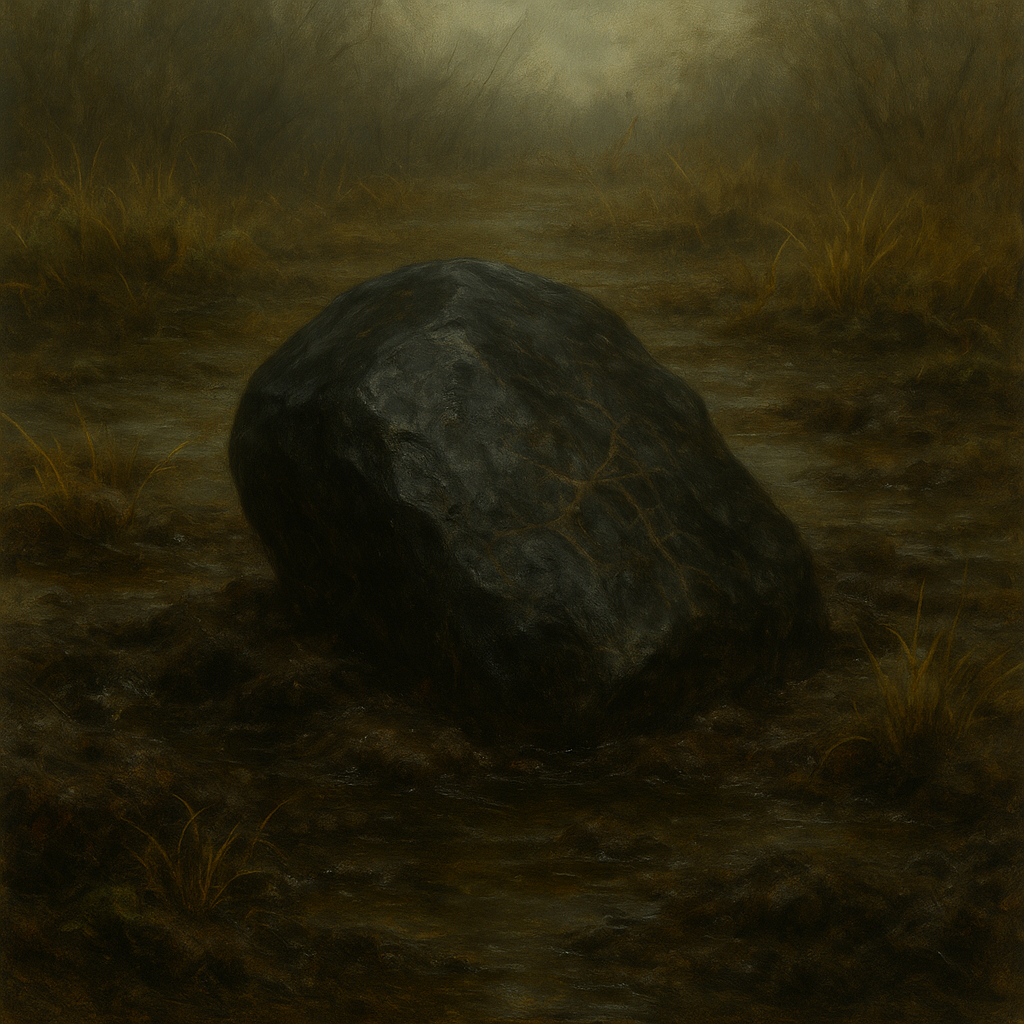
Mire-Iron
"It don’t shine, it don’t sing, and it sure as hell don’t forget what it’s buried with." -Gern Blightspade, marsh scavenger
Mire-Iron is not merely a metal; it is a curse dragged from the muck of the Bog of Lies, a substance so steeped in tragedy and witchcraft that even the bravest smiths flinch at its mention. Where Pyrrhium gleams with star-born fire and Viridite hums with the pulse of magick, Mire-Iron sulks in silence, drinking in all it touches. To look upon it is to see iron that has drowned too long, blackened and slick as though it still remembers the bodies it sank with. Its strength is undeniable, its stability unmatched, yet it is never praised, only feared. For though enchantments slip from its surface like rain, curses seep into it as if the metal were thirsty for malice. Every blade, every nail, every chain forged of it becomes a conduit of ill omen, waiting to betray the hand that dares to wield it. It is said witches of the bog weave Mire-Iron into their rites not for its strength, but because the ore itself listens. Left in the dark too long, it hums faintly, like breath behind a closed door, and those who work it speak of whispers in the silence of their forges, promises or threats they cannot quite discern. Villages whisper that cursed tools fashioned from Mire-Iron do not break so much as they break owners, withered hands, fading memories, black bile in the lungs. To the exorcist, it is a last resort. To the alchemist, a volatile catalyst. To the witch, it is kin. Yet still, demand persists. Mire-Iron is licensed and taxed, guarded like toxin or gunpowder, and sold only to those with permits or with pockets deep enough to buy silence. It is too useful to be banished entirely, and too dangerous to be forgotten. Where it rests, it festers, and where it is used, ruin follows. Among dwarfs it is shunned as “dead metal,” but among the swamp-born, it is respected, even worshiped, proof that the bog remembers, and that the dead beneath it still have teeth.Properties
Material Characteristics
Mire-Iron appears as clumped ore, often encased in sticky bog muck, with surfaces that glisten faintly despite no light source. Once cleaned, it reveals a pitch-black, almost absorbent finish that reflects very little light. Its texture is unnerving, slick, damp, and subtly pulsating with warmthless vitality. Even heated in a forge, the metal’s surface remains oddly cool, as though resisting transformation. Those who’ve spent too long near it report hearing whispers in the ringing silence, as if the ore is trying to speak, or remember.
Physical & Chemical Properties
Resistant to enchantment yet strangely responsive to curses and hexes. Cold to the touch. Slightly corrosive to non-magickal metals when stored nearby, especially iron and bronze, which corrode overnight if not separated. Difficult to smelt, requiring bog oils, corpse ash, and unnatural flames to respond to heat. Emits a low hum when struck, deep, hollow, and mournful, described by smiths as “the sound of a grave being sealed.”
Compounds
Used in cursed weaponry, anti-magick shackles, and slow-bleeding arrowheads. When alloyed with Blackglass Dust or bog-silver, it produces uniquely dangerous instruments of suppression, ritual control, or necromantic intent. A critical base for Hexsteel, where it provides the alloy’s disruptive properties against enchantment and divination. Also mixed in small quantities into bloodletting tools used in marsh-born cult rites.
Geology & Geography
Found mainly in deep, stagnant pockets beneath the trecherous Bog of Lies, especially near drowned ruins or long-abandoned settlements. Sometimes dredged up by sinkholes, more often recovered during corpse retrievals when the land regurgitates what it refuses to keep. Rare outcroppings have been sighted around Lough Shears and the Woodswatch Mountains, but never in meaningful supply.
Origin & Source
Mire-Iron is not mined so much as recovered. It accrues in layers, forming around cursed places like barnacles around a dying ship. Some believe it is the physical manifestation of guilt or failure, drawn from the suffering of those who drowned in the bog or were swallowed by the land. It leeches from bones, blood, and broken wards, making it a kind of sedimented sorrow.
Life & Expiration
Mire-Iron does not deteriorate naturally and remains chemically stable for centuries. However, contact with divine artifacts or radiant fire magick causes it to crack, shriek, or even explode violently as-if rejecting such purity. Legends speak of weapons forged from it that shattered mid-battle the moment they tasted holy blood.
History & Usage
History
Once mistaken for remnants of drowned blades from the Schism, Mire-Iron revealed its true nature only when alchemists attempted to reforge it, and found it screamed under hammer and flame. Since then, it has been associated with bog-witches, exorcists, and forbidden rites. Dwarfs refuse to work it, calling it “dead metal” or “the moaning steel.”
Discovery
First officially recorded by Dwarf-exile Thorman Bruk, who vanished during a post-Schism expedition. His journal detailed the discovery of a “black ore that cries when pulled from the mud.” His final words were, “It’s listening.” His recovered samples nearly destroyed three forges before they were successfully tempered.
Everyday use
Used exclusively by those with purpose; witch-hunters, warlocks, dark alchemists, and assassins targeting magickal foes. Too volatile for domestic or artisanal use. Though some cults have forged household utensils from it as a show of devotion, these are seen more as relics than tools.
Cultural Significance and Usage
Mire-Iron's dual nature as both a valuable resource and a hazardous material has led to varied cultural perceptions. In swamp-border settlements, it is viewed with a mix of respect and caution, recognized for its economic benefits but handled with care due to its inherent dangers. Local festivals sometimes include rituals to appease the spirits believed to reside within the bogs where Mire-Iron is found, acknowledging the metal's deep connection to the land's history and tragedies. Conversely, in Dwarfish culture, Mire-Iron is shunned, considered a tainted material that disrupts the natural order of metallurgy and magick. This cultural divide underscores the complex relationship societies have with Mire-Iron, balancing its tangible benefits against the intangible costs associated with its use.
Industrial Use
Almost entirely absent from regulated industry due to its spiritual volatility and smelting challenges. Used in black-rite forgery, clandestine weaponry, or magical research involving curse-breakers and nullification fields.
Refinement
Requires not just fire but blasphemy. Standard forges reject it. Must be refined with swamp oils, corpse ash, and flame fueled by blackroot or witchwax. Cooling requires blood, preferably from the same source the curse was harvested from, or marsh brine mixed with venom. Many forges built to handle it are themselves cursed.
Manufacturing & Products
Mire-Iron is utilized in crafting specialized items, each serving unique purposes:
- Curseblades: Weapons that inflict wounds which progressively weaken the victim, making each subsequent injury more debilitating than the last.
- Hexsteel Shackles: Restraints forged from Hexsteel (an alloy of Mire-Iron and Blackglass Dust) designed to suppress and nullify a mage's ability to cast spells, effectively dampening their magickal prowess.
- Ritual Daggers for Anti-Magick Rites: Blades employed in ceremonies intended to dispel or ward against magick, often used in exorcisms or the dismantling of cursed artifacts.
- Alchemical Crucibles Resistant to Divine Contamination: Specialized containers used by alchemists to concoct potions or substances without the interference of divine energies, ensuring the purity of the alchemical process.
Byproducts & Sideproducts
Refinement releases psycho-reactive fumes, causes hallucinations, violent sleep paralysis, and chronic migraines in exposed workers. Slag is inert but unnerving, slowly tarnishing metals and dampening magickal auras. Pets and familiars avoid it entirely.
Hazards
Bare contact causes numbness, frost-burns, and necrotic skin discoloration. Inhaled fumes cause coughing up black bile and severe vertigo. Long-term handlers often develop nightmares, memory gaps, or shadowy entities visible only to them.
Environmental Impact
Contaminates nearby water and kills small magickal flora within days. Destroys natural leylines or corrupts them into feedback loops. Said to attract bog beasts and lost spirits that follow its scent like a beacon.
Reusability & Recycling
Extremely difficult to reforge. Only responds to its original smith or their bloodline, though some claim a sacrifice can trick it into submission. Recycled tools tend to shatter unexpectedly, as though the metal itself resents being repurposed.
Distribution
Trade & Market
Mire-Iron occupies a niche yet vital position in the economies of certain settlements. In regions like Halt-Cliffand the districts surrounding Lough Shears, it is a legitimate commodity. Local guilds have established stringent protocols for its extraction, transport, and refinement, ensuring both safety and profitability. Licensed handlers and smiths operate under strict oversight, and the trade is taxed accordingly, contributing to local economies. However, due to its hazardous nature, unauthorized handling or sale without proper documentation can lead to severe penalties, including hefty fines and blacklisting from guilds. In major cities like Opulence, specialized markets exist where regulated quantities of Mire-Iron are traded, often under the watchful eyes of city officials to prevent misuse.
Storage
Wrapped in oiled leather, sealed inside rune-etched lead, and buried beneath salt or ash. Must be stored in complete darkness, away from religious texts, holy artifacts, or enchanted wards. If exposed, it hums, and something in the dark may hum back.
Law & Regulation
Classified as a Forbidden Material in Everwealth. Possession punishable by exile or execution depending on intent. Dwarfish cities will not permit entry to anyone carrying even a sliver. Newforge melts it on sight and salts the ground it touched.
N/AMi
Estimated at 165 amu, but its density varies.
Value
Extremely valuable to specific groups, cultists, alchemists, anti-magick hunters. Worthless to most due to handling risk and limited application. Often traded in pieces no larger than a fist.
Rarity
Rare, found in-bulk only in the trecherous Bog of Lies, scattered loosely elsewhere in the surrounding territories. Even then, recovery is inconsistent due to terrain and threats. Veins are unpredictable and may vanish between expeditions.
Odor
Earthy and acrid, like wet stone left too long beneath a corpse.
Taste
Metallic and faintly sour, with a biting aftertaste like rust dragged through stagnant water.
Color
Deep, matte black laced with subtle brownish-green veins, as if tarnished by rot.
Boiling / Condensation Point
Boils at extremely high temperatures, around 3,700°C. Vapor is thick, foul, and often toxic.
Melting / Freezing Point
Melts around 1,450°C, though it begins to soften before that, bubbling rather than flowing cleanly.
Density
Exceptionally dense, sinks rapidly even in thick mud.
Common State
Solid, though always damp to the touch as if weeping from within.
Related Locations

Comments