
Viridite
“Shape it wrong and it answers twice, once for your enemy, and once for you.”
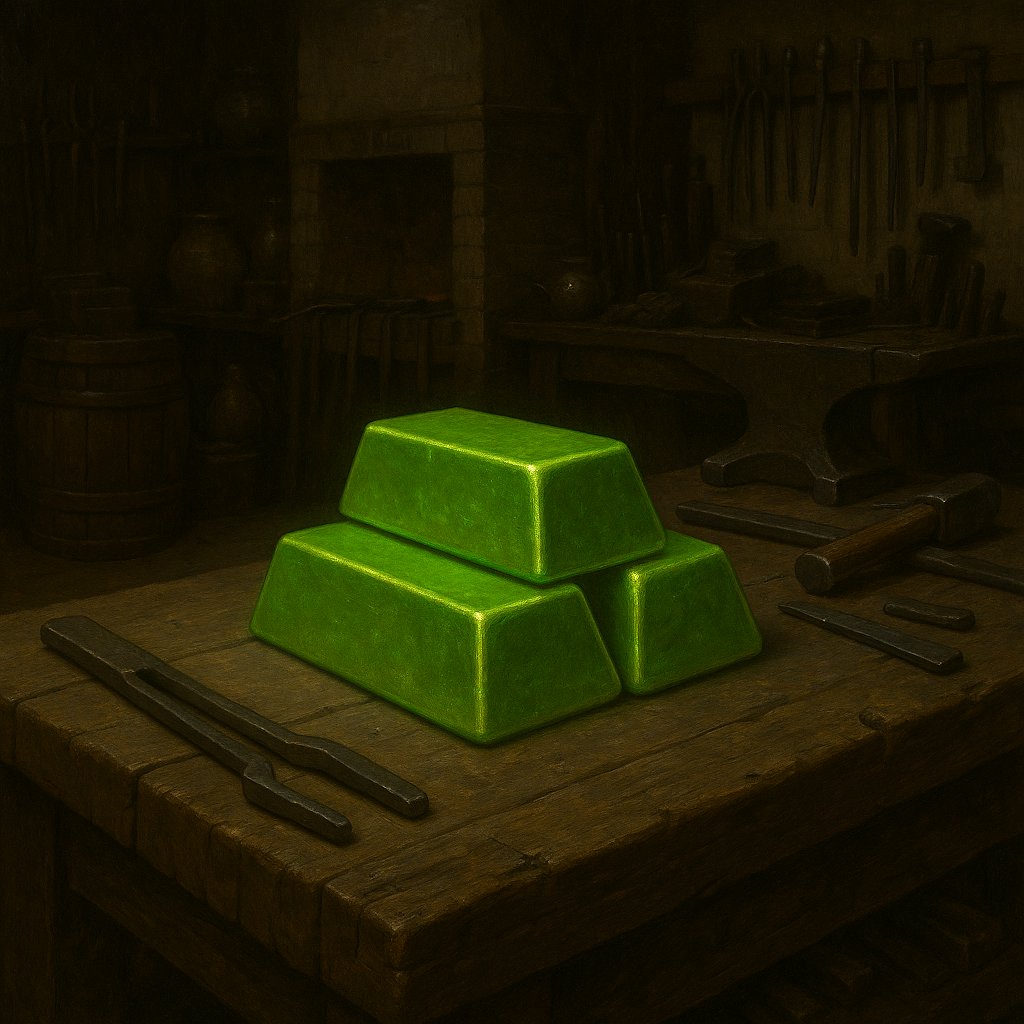
Viridite, screams hammered into steel, a gleaming green metal unlike any other. It is a strange fusion of stone, steel, and magick birthed in the bones of distant Tarmahc. Not fallen from the stars, nor mined from mundane veins, Viridite is a child of catastrophe. Created when The Fall that birthed The Great Schism shattered the leylines, areas where magick swells and flows greatly, beneath the land; The magick of those leylines were in this cataclysm flash-fused into the world's bones, transmuting ordinary iron deposits, into veins of a luminous green alloy in a spark of creation deafened folk for miles around. If it didn't kill them outright, a birth-cry that wrought a thousand deaths. To hold Viridite is to hold the echo of Tarmahc’s dying scream. Its surface gleams faintly, not translucent but alive with a subtle gloss, like wet stone beneath lightning. Properly forged, it is one of the most versatile and potent materials known, capable of amplifying sound, shock, and vibration until the air itself becomes a weapon. A warhammer of Viridite can turn a single blow into an earthquake, a drum capped with it can shatter windows and bones alike, and a blade resonates with every strike until it hums like a living bell. But it is a treacherous metal. Forged carelessly, Viridite does not absorb or direct vibration outward, it recoils. A sword might send a blow screaming back into its wielder’s bones. A shield might shatter both attacker and defender at once, their bones broken beneath a sound like a cymbal cracked by thunder. To master Viridite is to master harmony itself, to balance the resonance of the world’s veins with one’s own heartbeat. Few succeed. Many die trying. To displaced Tarmahcians who call Everwealth home in the present day, the metal is both relic and curse: a fragment of their homeland’s heart, proof of what was lost, and a whisper of what might one day be reclaimed. To others, it is temptation incarnate, promising unmatched strength to those willing to gamble their flesh and sanity against its volatile hum.
Properties
Material Characteristics
Viridite appears as a dense mass of gleaming green metal, brighter than jade and alive with a faint glossiness that seems to catch light unnaturally as if it holds onto light instead of reflecting it. When struck, it resonates like a temple gong, the sound carrying far further than it should, vibrating not just through air but bone.
Physical & Chemical Properties
Viridite is exceptionally hard and durable, resistant to fracture and corrosion. It is an unparalleled conductor of vibration and resonance, magnifying and channeling them along its surface. A properly forged weapon strikes not only with steel but with rippling shockwaves, while armor of Viridite deadens and redirects the force of blows across its whole surface. But when forged improperly, its resonance becomes indiscriminate, lashing out at both wielder and enemy.
Compounds
Viridite is sometimes alloyed with mundane steel or silver to stabilize its resonance. These alloys are prized for instruments and architecture, cathedral bells that can be heard across valleys, theaters whose acoustics make every whisper sharp as glass, and weapons that ring with haunting clarity.
Geology & Geography
Viridite is found only in the shattered remnants of Tarmahc, fused into the crust where leylines once thrummed. It is said that the deepest veins still “sing” faintly, vibrating when storms roll across the land. No other nation boasts natural deposits, though fragments are sometimes scavenged from collapsed ley-pockets elsewhere.
Origin & Source
Unlike Pyrrhium’s fallen-star purity, Viridite is a child of the earth itself. When the meteor struck Tarmahc, the collision ruptured leylines and transmuted the crust, crystallizing raw magick into its very ore. What was once iron or steel was rewritten, becoming the fossilized marrow of a dying land.
Life & Expiration
Viridite does not rust or tarnish, but resonance fractures occur in poorly-forged examples. These are often catastrophic, shattering weapons into shards with an ear-splitting crack that leaves wielder and foe alike deafened, concussed, or dead. Properly forged Viridite can last centuries, growing stronger the longer it is “sung” into by use.
History & Usage
History
Viridite was first discovered in the decades following The Fall, when survivors scavenging Tarmahc’s ruin found weapons that hummed with every strike. Early smiths who attempted to forge it were often killed by its misdirected recoil, but those few who succeeded became legends. In the Civil Age, Viridite blades and warhammers were symbols of authority, but also fear. Many a noble champion fell not to their foes, but to the violent backlash of their own weapon.
Discovery
The first surviving records of Viridite describe it as “green iron that echoes like a distant scream.” Tarmahcian refugees whispered that the metal was their homeland’s curse, the scream of its magi frozen into the world’s bones. Scholars who study leyline collapse claim Viridite is living proof of what happens when the flow of The Arcane itself is broken even for a moment.
Everyday use
Viridite sees little everyday use outside of art, music, and ritual architecture. Grand cathedrals sometimes crown their bells with it, its resonance carrying sermons for miles. Ballrooms of Opulence have Viridite inlays beneath their floors, allowing dancers to feel music not just with their ears, but in their bones. But such use is rare, costly, and dangerous.
Cultural Significance and Usage
To Tarmahcians, Viridite is memory incarnate, the green veins of a dead nation. To smiths, it is both challenge and prize, a material that makes or breaks reputations. Among cults and warbands, it is seen as a weapon of judgment, punishing arrogance with its own backlash. To the Arcane Coalition, it is a volatile resource best hoarded or outlawed.
Industrial Use
Rare and volatile, Viridite is not used in conventional industry. Its presence in instruments, theaters, or fortresses is symbolic, reserved for the powerful or reckless.
Refinement
Forging Viridite requires not only fire, but rhythm. The metal must be hammered in sequence, often to the beat of drums or chanting, its resonance coaxed into alignment with each strike. Failure to match the rhythm results in backlash: shards, ruptured forges, or death.
Manufacturing & Products
- Weapons: Warhammers, maces, and swords that ripple with shockwaves.
- Armor: Suits that absorb blows and resound like a bells' toll, dispersing impact.
- Instruments: Resonant drums, chimes, and bells whose voices can fracture stone.
- Architecture: Floors, walls, or vaults that channel resonance, magnifying voice or footstep.
Byproducts & Sideproducts
Slag from Viridite forging is brittle and unstable, known to detonate with thunderous cracks if struck. Shavings vibrate endlessly if not smelted down, sometimes driving handlers mad with their faint hum.
Hazards
Poorly-forged Viridite is as deadly to its wielder as its target, rebounding resonance with bone-crushing force. Long-term handling without protection can cause auditory hallucinations, migraines, or phantom vibrations felt deep in one’s chest.
Environmental Impact
Viridite deposits often disrupt local leylines, creating regions of distorted sound. Whispers may carry across miles, storms may echo longer, and footsteps may sound twice. Animals avoid these regions, unnerved by the constant hum.
Reusability & Recycling
Viridite is infinitely reusable if reforged properly, but risky. Every remelting must follow strict rhythm and ritual, lest it shatter or destabilize. Some smiths refuse to recycle it, claiming each reforging builds another “scream” into the metal.
Distribution
Trade & Market
Viridite is quite rare indeed, traded only in fragments or finished relics. Black markets prize even small ingots, while nobles commission master-smiths to forge showpieces. Prices are astronomical, but collectors often die before enjoying their prizes.
Storage
Must be kept in vibration-dampening vaults. Even a whisper can stir it into faint hums. Some vaults bury it beneath sand or line coffers with pitch to silence its resonance.
Law & Regulation
Possession is heavily regulated. The Arcane Coalition claims it is “dangerous to civic stability” and restricts its forging to sanctioned smiths under strict supervision. Illegal possession is punished with exile, imprisonment, or conscription.
Vr
Odor
Faint, metallic, and sharp, with an almost ozone-like tang.
Taste
Metallic with a earthy sting, leaving the tongue buzzing as if struck by a note too loud.
Color
A bright but deep green, gleaming faintly under any light, with a subtle gloss as though perpetually wet.
Boiling / Condensation Point
Estimated at 3,800°C, releasing shrieking resonance when superheated rather than vapor.
Melting / Freezing Point
Begins to soften at 1,600°C under rhythmic hammering, refusing to yield under ordinary heat.
Density
Denser than steel, closer to lead, yet feels lighter when in motion, as though the resonance itself assists in carrying it.
Common State
Solid, found in veins fused into stone near collapsed leylines; Also commonly found washed up on shorelines.

Comments