

The Range's Fork
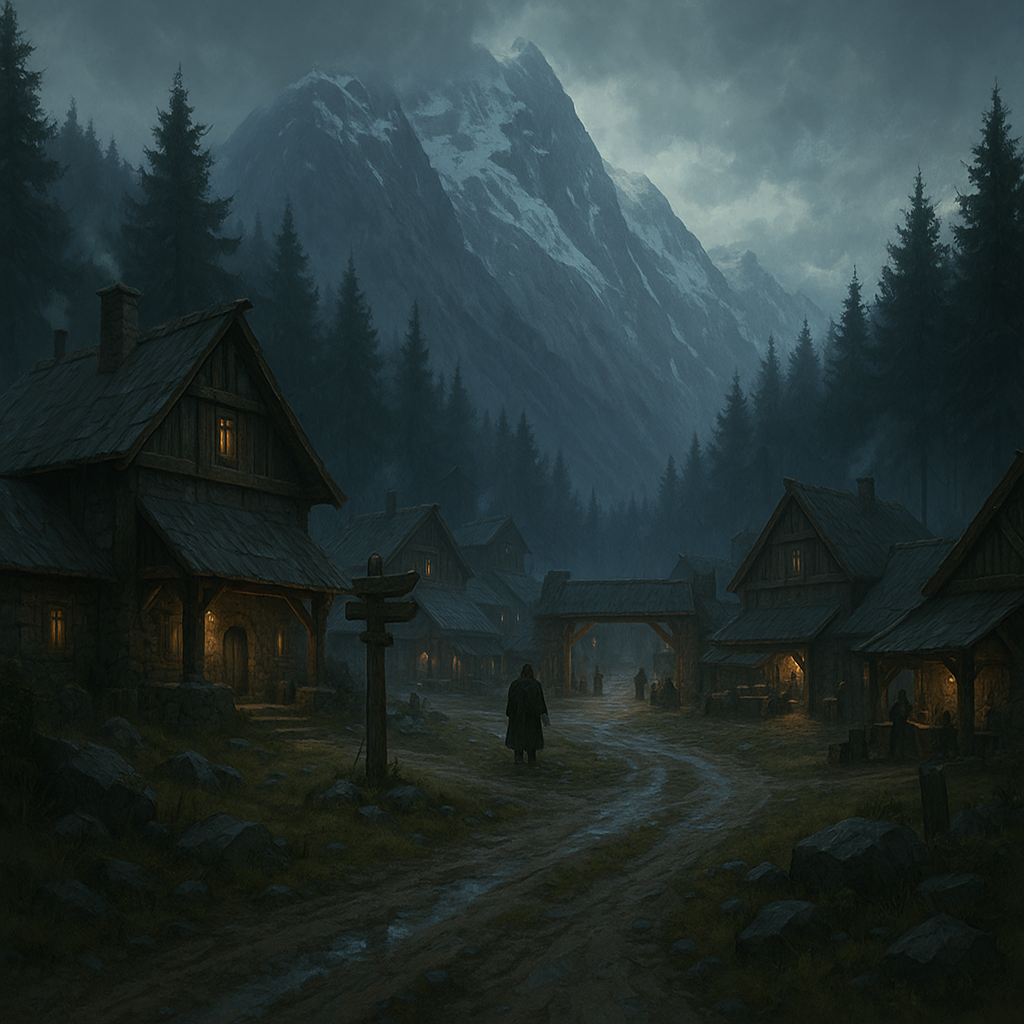
It is said that every soul who walks the roads of the Ridge must, eventually, stand beneath the black pines of The Range’s Fork and make a choice. Westward to the fog valleys, eastward to the gem roads. Nestled at the northern foot of the Azure Ridge’s great spine, The Range’s Fork is little more than a sprawl of timber lodges, waystone cairns, and caravan circles, but its importance far exceeds its size.
This is the place where travelers pause, where merchants wait out snowstorms, and where secrets move as freely as coin. The town exists outside direct control of House Greymutter, operating under a system of local compacts and trade pacts. Its neutrality is respected not out of kindness, but out of usefulness — it is the last quiet breath before decisions must be made, and no one wants to burn the one inn that has a map of both roads ahead.
Demographics
While still majority dwarven (~60%), The Range’s Fork is one of the most diverse settlements north of the mid-Ridge. Humans (15%), halflings (10%), gnomes (5%), and a notable number of dragonborn, and tiefling wanderers (10%) have taken up residence here. It is a place for those who didn’t fit in elsewhere — and for those who don’t want to be found.
Government
There is no formal government — at least, not in the traditional sense. The Fork is run by a loose alliance of elders and merchant captains known as the Compact of the Three Roads, who meet in an open forum at the town’s communal fire circle. Taxes are informal: each business pays into a seasonal protection fund, and trade disputes are settled by neutral vote. No House holds dominion here — not Greymutter, not Thassyran, not even the Soul Trade — though all send eyes and ears.
Outsiders call it lawless. Forkers call it fair.
Defences
The town has no walls, but it doesn't need them. Its defenders are its people: ex-soldiers, mountain rangers, beast hunters, and mercenaries who want no part in distant politics. When trouble comes, it finds itself surrounded — not just by fighters, but by terrain: steep ridges, hidden choke points, and ambush paths known only to the locals.
Rumors claim the Fog Sentinels, a now-disbanded dwarven scout unit, protect the Fork in secret — but no one speaks of them openly.
Industry & Trade
The Fork lives off way-trade. Caravans from the east and west stop here to rest, repair, and resupply before tackling the rougher roads. Its inns, map vendors, wayfinders, and beast handlers are always in demand. It also serves as a grey market exchange, where items not quite outlawed — but not quite legal — often change hands.
A small cottage industry exists for scrimshawed ivory, gathered from deep-forest horned elk, and for smoke-dried game meats. Spiritual services are also offered by the Springwatch Circle, a neutral group of nature-tied clerics.
Infrastructure
True to its reputation, the Fork is sturdy but simple. Roads are well-maintained but unpaved. Waystones carved with runes and trail markers line every approach road. The Three Fires Lodge, a massive communal inn and longhouse, acts as town hall, tavern, shelter, and trading post all in one. The rest of the town is scattered: log homes, cartwright shops, blacksmiths, tanneries, and a modest soul-binding outpost built more for ritual than resurrection.
Water is drawn from a cold, sacred spring, and timber is gathered carefully from the surrounding pine woods under old agreements with local druids.
Districts
The town is not formally divided, but three key zones have emerged over time:
The Fork Circle, where the trade roads meet and caravans make camp.
Backridge, the residential slope built along the foot of the mountain wall.
Stonebar Hollow, a narrow ravine market where less-legal goods are traded under the eyes of no one in particular.
Assets
The Range’s Fork is small, but strategically priceless. It holds the last (and first) trade point for merchants unwilling to brave the mountain passes. It boasts some of the best scouts, mapmakers, and pathfinders in the Ridge. And, most importantly, it offers neutral ground. Messages are passed here, deals struck in whispers, and many a noble exile has vanished down its roads.
Guilds and Factions
The Compact of the Three Roads – the council of respected locals who manage disputes and external negotiations.
The Waybinders’ Guild – a collective of independent trail guides, some of whom have passed through the entire Ridge chain.
The Pale Compass maintains a single outpost here, offering summit-bound gear and warnings.
The Dustroot Hand – a discreet smuggling ring specializing in spiritual contraband and banned alchemical ingredients.
History
The Fork predates the unification of House Greymutter, having been founded by hill-clan wanderers who refused to bend to any one banner. Its location became crucial as the Ridge expanded; eventually, it became the only passable midpoint between the eastern and western valleys of the continent.
Despite multiple attempts by noble Houses to claim it — whether through coin, force, or negotiation — the town remained fiercely independent. The Compact was formed over a century ago to unify the community’s voice. Over time, its neutrality became not just a quirk, but a commodity. Now, even the great houses protect its freedom, knowing that a neutral ground is sometimes the only place deals can be made.
Its legends are quieter than those of grand cities, but many great movements began here — over shared fire, under falling snow, on roads that stretched to fates unknown.
Points of interest
1. The Three Fires Lodge
At the heart of the town lies this immense wooden structure — part longhouse, part inn, part council hall. Named for the three hearths that are never allowed to go cold, the Lodge is where caravans bed down, traders hold court, and the Compact meets. Many deals, marriages, and betrayals have started in its shadowed alcoves. Travelers pay what they can, and in lean winters, no one is turned away.
2. The Stonebar Hollow
A crevice-market that twists through a shallow ravine just west of town. Rope ladders and hanging bridges connect scattered stalls, where dubious items — forbidden relics, soul-ink, black moss — are traded. No formal law governs it, but the Hollow is under an unspoken protection pact: cause trouble here, and vanish quietly. At its lowest point is a runed stone arch, origin unknown, which some claim hums on moonless nights.
3. Springwatch Pool
A sacred spring at the edge of the pinewood, watched over by the Springwatch Circle. The water is said to bring clarity of thought and dreams of one’s future path when drunk beneath the stars. The site is a ritual place for scouts, druids, and those about to take life-changing journeys. Offerings — usually pinecones, carved tokens, or tears — are left in the nearby Wish Cairn.
4. Broken Path Stone
A moss-covered monument marking where a small army from the Southern Houses tried to push through and claim the Fork 150 years ago. The townsfolk didn’t resist — the road did. A rockslide buried the advance and blocked the pass for a season. The stone simply reads: “The road remembers.”
Tourism
The Fork is not a destination — it’s a crossroads. Visitors don’t come here to relax, but to choose a direction. That said, the town’s mix of old stories, sacred places, and mystery markets attracts adventurers, bards, and lore-seekers alike. During Pathlight, a local solstice ritual, hundreds of lanterns are lit and sent down the mountain — symbolizing the choices of all who pass through.
Architecture
Buildings are low and wide, built from local pine and stone, with thick thatched roofs and carved support beams depicting crossroads and journey motifs. Homes are often built in clusters around central firepits. Lanterns hang from ropes strung across paths, glowing soft amber in the snow. Everything feels handmade, a little askew, but undeniably lived-in.
Geography
The town sits at the convergence of three main roads, right where the forest gives way to the open valley beneath the mountain’s foot. Sharp ridges to the west, rolling hills to the east, and the great Azure Ridge looming behind. Thin fog often hangs in the air here — not from weather, but from a quirk of the land’s spirit, locals say. The roads here feel old.
Climate
Cold, but livable. Winters bring snow and long nights. Spring and fall are brisk and stormy. The wind rarely stops, and it carries scents from all three roads: pine, salt, and stone. Summer is short, with only a few months of relative warmth and blooming undergrowth.
Natural Resources
Pine timber, carefully managed under druidic compact.
Mountain game, especially long-antlered elk and dusk-feathered quail.
Stone clay, used in pottery and quick-setting mortar.
Runestone shards, found in scattered places, origins unknown but often used as talismans.
The Azure Ridge Content Tree
- Locations
- Noteworthy Families
Alternative Name(s)
Among locals and traders, the town is also known as: Splitmoor, Fork’s Rest, or Greyroad Junction
Type
Town
Population
The Fork is home to around 1,400 permanent residents, though the number can spike to 3,000 during busy trade seasons or festival migrations.
Inhabitant Demonym
Locals are known simply as Forkers, a name they wear with either pride or smirking irony.
Location under
Owning Organization