

The Foot's Grime Encampment
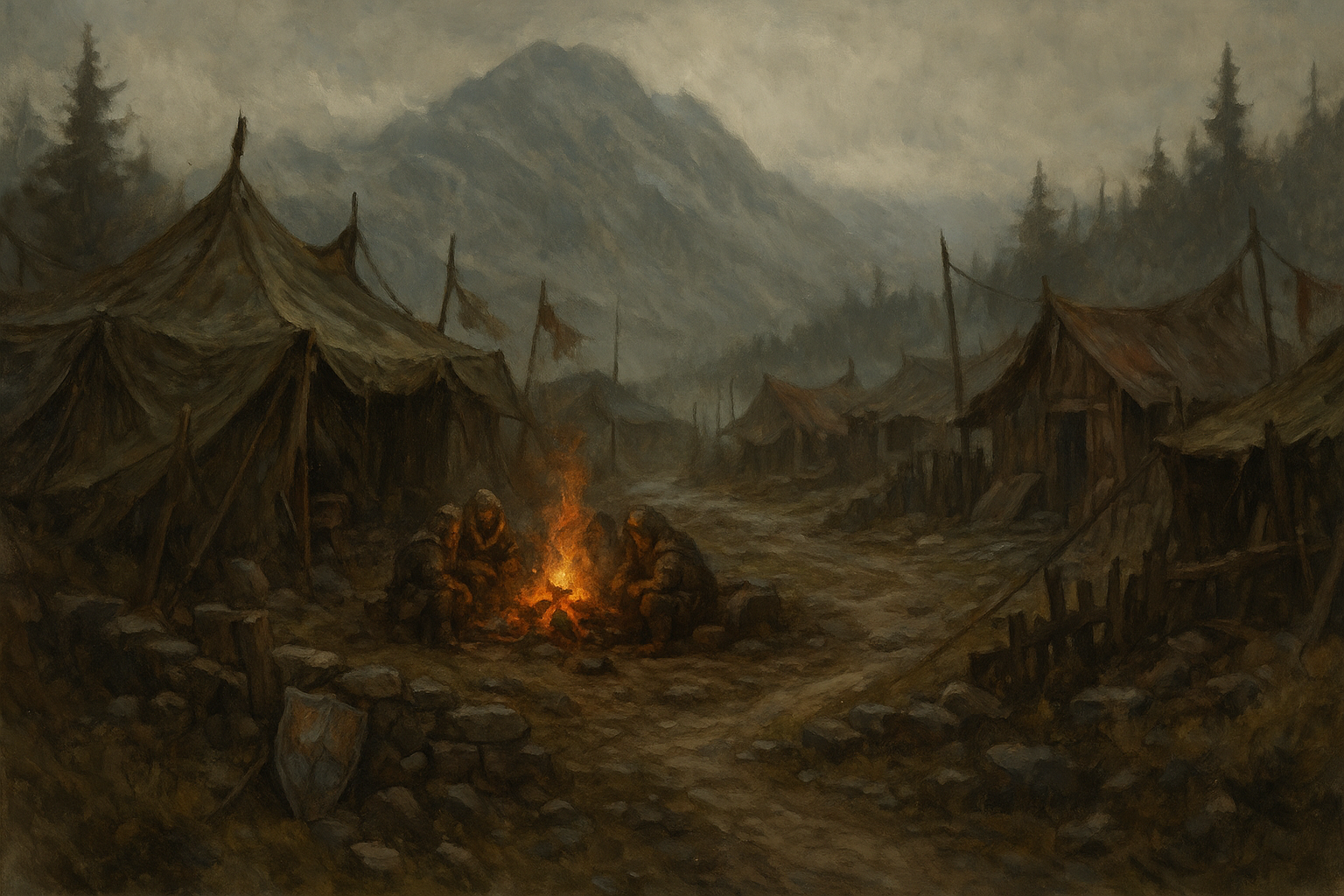
Tucked between a shale hill and the gnarled roots of the southern ridge trail, The Foot’s Grime Encampment squats in the shadow of Highmount — both literally and ideologically. Just a half day’s walk from the capital’s silver-forged towers, this haphazard sprawl of mud-streaked tents and rusted braziers is home to ex-soldiers, disgraced officials, broken oath-takers, and working-class castoffs who once bled for the Ridge and were offered nothing in return.
What began as a pit stop for injured caravan guards eventually became something more permanent — and far more bitter. While no one speaks of it publicly in Highmount, nearly every dwarf in the city knows someone who “vanished into the Grime.”
And now the camp has a leader. A former war-sergeant named Korga Tinebrew, scarred from soul-burn, abandoned after an expedition gone wrong, and charismatic enough to unite the hopeless beneath a single banner:
“We remember who built the Ridge, even if the mountain forgot.”
Demographics
65% Dwarves (mostly veterans, laborers, or former city guards)
20% Humans (former caravaners, ridgefolk)
10% Half-Orcs and Goliaths
5% Others (castaway spellcasters, former servants, banished artisans)
Many residents bear physical or magical scars from prior service — missing limbs, cursed tattoos, war-pox, or soul-burns from failed rituals. Others simply carry documents of dishonor, tattered uniforms, or the weight of injustice.
Government
Korga Tinebrew leads through mutual respect, earned pain, and deep charisma. She operates like a sergeant-at-hearth — not a politician, but a protector. Every decision is made at the Mudfire, the central brazier where voices are heard nightly. Korga has two rules: No lies at the fire, and no blades in the tents.
There’s no taxation — only labor. You eat if you work. You rest if you’ve bled.
Defences
No walls, but the terrain favors defenders. Trip-wire cairns, spike trenches, and mirror-line alarms keep casual threats out. Most Grimers know how to vanish into the shale if a true purge ever comes. Whispers claim that Korga’s oath is bound to the land itself — and if she dies, the Ridge will feel it.
Industry & Trade
The encampment trades in:
Broken steel, reforged into makeshift weapons.
Unregistered soul-infused tools, carved from discarded siege runes.
Memory-pacts — veterans offering retellings of campaigns in exchange for coin or supplies.
Reputation repair — for a price, a Grimer will write or forge a new history for someone trying to leave theirs behind.
Infrastructure
Crude but functional. Most shelters are military tents, collapsed wagons, or stone-leaned huts. A makeshift infirmary built into a former cartwright’s carriage serves the wounded. Water is gathered from a soul-cooled spring nearby, protected by standing stones that predate the Ridge. An old, decommissioned siege-brazier acts as the central firepit.
A few traders from Highmount risk visits, slipping in tools or supplies in exchange for artifacts, secrets, or stolen soultech.
Districts
There are no true districts, but the camp is loosely arranged by function:
The Mudline – tents and shelters for rest and sleep.
The Scorch Circle – central brazier and meeting space.
The Blackbend – a forge cobbled from scavenged steel and broken soulstone.
Ashfolk Corner – spiritual tents where old war-clerics whisper half-forgotten rites.
Assets
Veterans with tactical knowledge, often ignored by city command.
Redacted campaign records, saved from destruction by whistleblowers.
A soul-bleeding hammer, which once belonged to a Greymutter battlemaster — now hidden.
A map of unmarked Ridge tunnels, stolen from a dead surveyor.
Guilds and Factions
There are no official guilds, but several groups have formed:
The Blackbelt Circle, retired soldiers who still train younger outcasts in martial arts and defense.
The Emberwives, spiritual midwives and griefkeepers who bless the dying and counsel the maddened.
The Flinttongues, ex-clerks and scribes preserving forbidden truths in coded song.
The Grimeguard, an informal band of enforcers loyal to Korga and the camp’s survival.
History
The Foot’s Grime began after the Campaign of Four Breaths, a mountain siege that left over 500 dwarven soldiers dead and another 1,000 dishonorably discharged due to command errors that were never publicly acknowledged. Survivors, offered no recompense, drifted away from Highmount — and settled here, where the soil was wet, the fires smoked low, and no one asked what banner you used to wear.
Korga Tinebrew, once a decorated sergeant, was court-martialed for disobeying a soul-command that would have slaughtered civilians. She wandered for two years before returning to the camp, planting her broken badge into the mud, and lighting a brazier with her own blood and stolen soulflint.
That fire has never gone out. And her people remember.
Now, rumors swirl that someone from within Highmount is trying to buy the land for a soul-plant expansion, or worse — quietly remove the encampment entirely. But the Grimers are not so easily scattered.
Points of interest
1. The Scorch Circle
The camp’s central brazier, filled with blood-hardened coals. Every night, stories, grievances, and judgments are shared here. It’s said that no lie survives the heat of the Scorch — or if it does, it leaves a mark on your voice.
2. The Blackbend Forge
A roaring wreck of salvaged machinery where scrap is reborn. The forge master, a silent dwarf called Irn Halfbrow, lost his tongue to soulfire and communicates by beating code into metal. His blades are twisted, strange, and somehow always sharp.
3. Korga’s Tent
Hung with rusted badges, oath-banners, and campaign maps burned at the edges. She greets all equally, sits by the fire rather than above it, and has a habit of sharpening her axe while speaking. Some say her weapon hums when traitors approach.
4. The Memory Grove
A circle of soul-scorched stones where the Emberwives sing the names of the forgotten dead. If one listens too long, memories not your own may whisper their way into your dreams.
5. The Grime Line
The outer edge of the camp, marked by a wall of discarded armor and broken shields. New arrivals must hang something of their past here before being accepted. Some leave medals. Others, wedding rings.
Tourism
None officially. But disillusioned soldiers, curious students, and soul-mourning priests sometimes wander through — either to learn, to confess, or to vanish.
Some nobles from Highmount sneak down disguised, desperate to learn what became of old companions, lovers, or kin.
Architecture
Tents of faded green and rust-red cloth, sagging wooden huts, reinforced lean-tos. Everything has been built twice: once to serve a purpose, and again to survive neglect. Bones and runes are common motifs, often carved with bitter humor or inverted campaign symbols.
Geography
The camp sits in a shallow depression between a shale bluff and a stunted pine grove. Fog clings to the ground most mornings. Ravens and crickets make up the bulk of the local soundscape. The soil is rich but stained from old blood — a fact that locals insist is literal.
Climate
Cool, damp, and often mist-shrouded. Winds from the mountains carry the distant scent of pine resin and forge smoke. Rainfall is heavy during Bloom, and the camp has grown very good at channeling runoff to avoid flooding.
Natural Resources
Scrap steel and soulstone debris, scavenged from old battlefields and broken convoys.
Red moss, used as a mild antiseptic and commonly chewed to ease pain.
Weepwood, a gray bark that cries sap at night — used in pain rituals and warpaint.
Scorchglass, a rare black sand fused by magical blasts, sometimes shaped into mirror-like tokens.
The Azure Ridge Content Tree
- Locations
- Noteworthy Families
Alternative Name(s)
The Grime, Mudstep Hollow, The Forgotten Fire, Korga’s Line
Population
Estimated 300–400 inhabitants
Inhabitant Demonym
They refer to themselves sarcastically as Grimers, though a few wear the term with pride.
Owner/Ruler