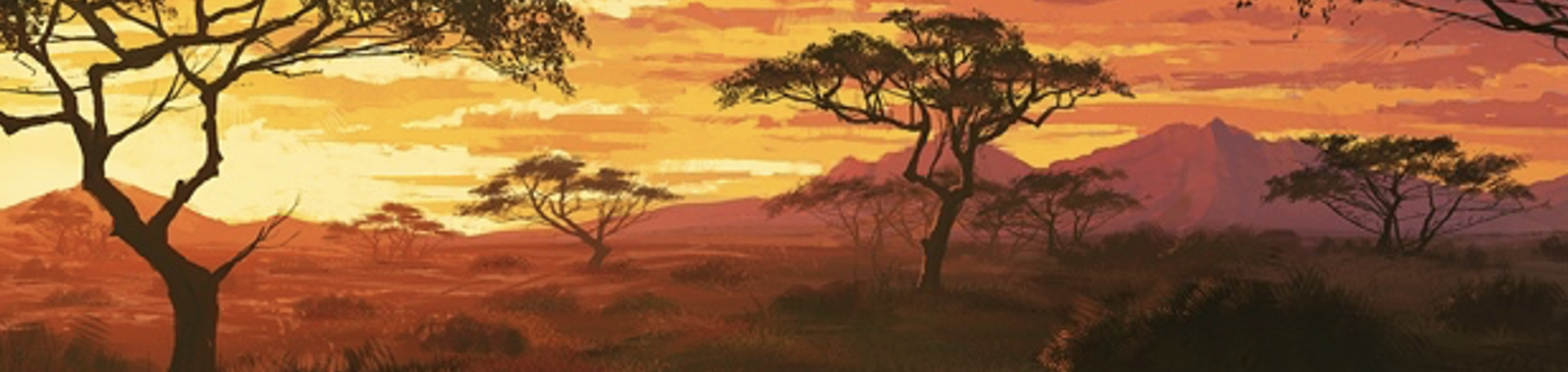
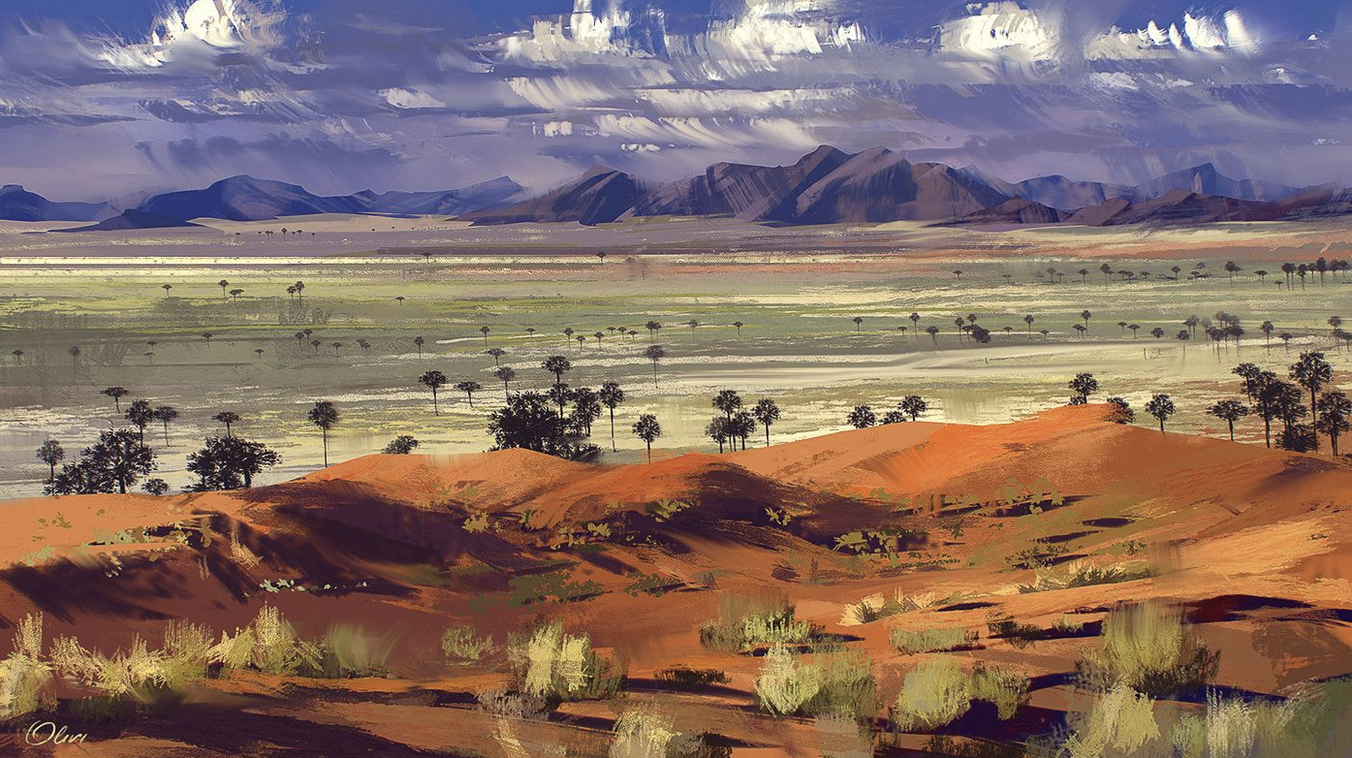
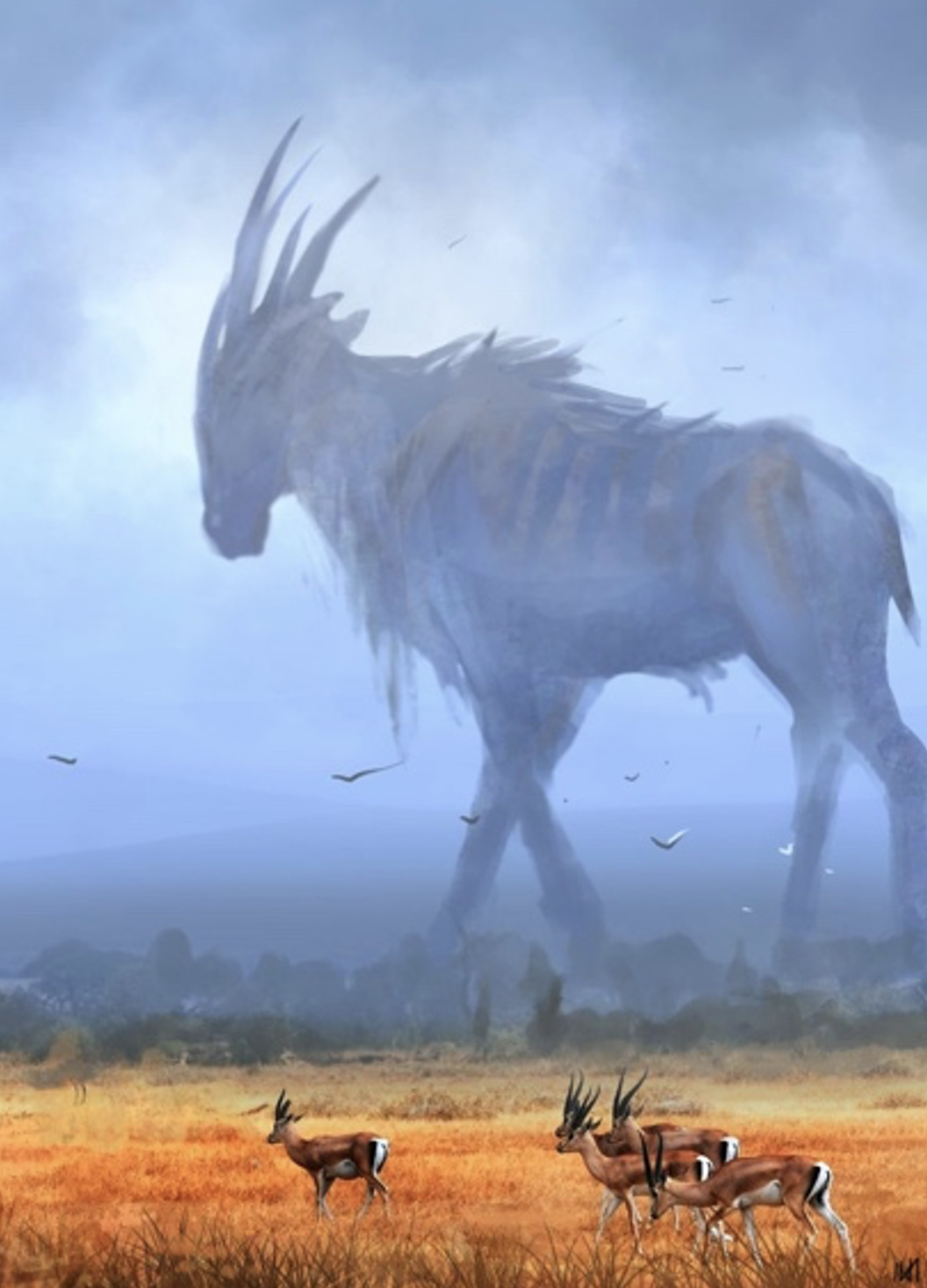
Vast swathes of diverse grasses are disturbed only by the occasional cluster of shrubs or the occasional thin, wiry tree. Concealed by the tall grass, predators stalk, ambush, and pursue. Smaller creatures seek out a reprieve from the heat in the shadow of a passing Colossus. Floods near the rivers and lakes bring a bout of fertility; plants spring forth and the herbivores feast. All is ordered, for nature remains balanced, self-regulated. For every rise is followed by an inevitable fall. Nature understands, but the humanoids that build their settlements along the coast or in the sea of grass… do not. Nature adheres to the food chain. And so intelligent life must similarly yield to the Pride. Once unruly and chaotic, the Pridelands have long since been unified and made orderly, as divinely intended.
Basic History
Era of The One. In the early years of history, the savannahs of Eastern Jalasar were a land of conflict, strife, and the survival of the fittest. According to mythology, the Colossi were the original rulers of the savannas, claiming dominion over the land and all creatures that dwelled there. Their shadows were once the only reprieve from the blazing sun in the dry season. Although slow-moving and peaceful, every step a Colossi took resulted in minor tremors. And when two Colossi clashed, the savannas cracked open, swallowing the unlucky and making space for something new. The flora and fauna of the region knew how to appease the Colossi and bend to their will. The humanoids did not. To the West, where the Colossi were less likely to roam, the people there built cities and walls – seeking a means to isolate themselves from the wrath of nature beyond. In the central and eastern portions of the savannas, roaming bands of Tabaxi and Leonin violently clashed with one another as they fought for territory and for the right to fell a Colossus.
Rise of the Pantheons. The Tabaxi and Leonin peoples were territorial, fierce, and had little tolerance for those they perceived as weak. Children, particularly sons, with any shortcomings were often abandoned – a death sentence. This was most commonly (and brutally) practiced in the Winged Leonin. Partially due to their brutal culling, the Winged Leonin were eventually eradicated; outmatched in sheer number by either the beasts of the savanna or a rival group. But their reputation as fierce, skilled fighters lived on. When the Creator arrived in the savannas, they did not visit the Tabaxi Mansa (“leader”) who had led his band to victory over a Colossus (or any Mansa for that matter). Rather, The One visited the gnomish city of Moralis, bypassing the gnomish scholars to instead bestow a gift upon the last Winged Leonin. Pyrus Fairmane became a god of order, the physical embodiment – the “claws and teeth” – of the Law.
Unification of the Pridelands. Over the course of centuries, Geryon crafted the divine Law from within the secure walls of Moralis, while the conflicts between Leonin, Tabaxi, beast, and Colossi raged in the distance. During this time, the eastern portion of the savannas were believed to be godless, a divinely unclaimed territory where mortals were unchecked. On the day that Geryon immortalized the foundation of his Law, myths claims that every Colossi dropped to a knee, acknowledging the arrival of their god. While some groups have attempted to reframe the mythos to paint their ancestors more favorably, the Tabaxi and Leonin groups fiercely resisted what they viewed as a conquest. The historians and scholars of Geryon refer to this period as the “Necessary Conflict” required to bring about a new era of order and peace. When it was done, all were united under one Pride and the Pridelands answered to the Law of Moralis.
Snakes in the Grass. Internal conflict resolved, the Pridelands prospered under the leadership, tutelage, and honor of Moralis. New settlements sprung up across the grasslands. Towns once plagued by beasts found their numbers bolstered enough to deter all encroachment. The gnomes of Moralis began to mingle with the Tabaxi and Leonin, bringing with them vast stores of knowledge and magic. Yet, the reshaping of the Pridelands did not go unnoticed… or unchallenged. Pyrus’ excursions to other regions were well documented as he sought to bring balance, peace, and order to all of Jalasar. And, in turn, snakes made their way into the Pridelands. Faust’s people were conniving, deceitful, and manipulative; they sought to extort and dominate border towns, smuggling out goods to trade in Fortune’s Coast. This incursion upon the Pridelands shook the balance of the Law, for the venom of Faust’s people was hard to remove. The rise of the Menseya (or Valkyries) heralded in both the return of Winged Leonin and the formation of a group of defenders. The Menseya were as fierce a fighter and as devoted an upholder of the Law as their father. Reinforced by his personal Pride, peace was restored in the Pridelands and Faust’s influence forced back within the confines of his own realm.
Vast Interlude. Over the many years that followed, the Law was changed in accordance with time and circumstance, the Menseya continued their defense of the Pridelands against chaotic and deceitful forces, and settlements grew and prospered. Other regions across Jalasar often requested the services of Menseya in apprehending criminals or requested the advice of Geryon’s scholars in the appropriate interpretation of law or ordinance. While the Law of Moralis was never universally adopted across Jalasar, it was a backbone upon which other laws, ordinances, and accords were constructed. And the Pride remained its teeth and claws.
After The Barrier (>0 YAR). Hostilities rose between the continents of Dremora and Jalasar. In response, the smaller continent put up a magical Barrier to shield themselves from predation at the hands of the larger Jalasar continent. Deprived of their smaller target, the rising tensions on Jalasar turned inward. Conflict and war make people desperate and desperate people often resort to desperate measures. Tensions arose within the Pridelands as Pyrus and the Menseya still enforced the untarnished, “perfect” form of the Law upon their struggling people. This tension was amplified as multiple conflicts revealed that the Menseya, perhaps even Pyrus himself, were far from perfect:
- Valkyrie’s Rampage – Also referred to as the “War of Written Words”, it was a short conflict that was supposedly triggered by a scolding letter from Ira Alexandria’s clergy to the High Scholar of Geryon. A group of Menseya were sent to apprehend the disillusioned clergy. They never returned… and no one ever emerged from the lands of Ira Xand again.
- The War of Many Lands – In his fanatical devotion, Pyrus pursued the snakes of Faust relentlessly. The backdrop of war to the South and West made the justification of his assault of Faust's Yuan-Ti that entered his lands easier. Unpredictable, law-breaking cheaters could not be left alive.
The Pride’s Betrayal (~450-500 YAR). As people were barred from trial and others executed without a moment to plead their case, some Menseya began to lose faith. For millennia, they had followed their father, fully devoted and carrying his entire trust. Yet, as their father pursued Faust’s people relentlessly, they questioned the Law. Who was holding Moralis accountable? And when Pyrus refused to take action, The Menseya did. And the miasma covered the Pridelands that day.
Politics
In the True Pridelands, Pyrus was regarded as the Divine Mansa, the leader of the Pride. In the day-to-day political realm, Pyrus’ role was purely a religious one. The highest political position was held by the Menseya, the daughters of Pyrus Fairmane. They, however, did not hold a permanent political position. Rather, they tended to roam from one settlement to the next, stopping to provide political advice, serve as judge for criminal trials, oversee trade agreements or other treaties, or lend military might if truly needed. The word of a Menseya was practically regarded as Law.
However, Menseya were often not present at all settlements. The actual political structure of each village or town varied, but women commonly filled most leadership positions, while men tended to fulfill roles as scribes, scholars, historians, and various religious roles, such as mystics. By contrast, Moralis was a pure meritocracy with no gender roles assigned. Those who had achieved the highest level of philosophical enlightenment or had the deepest understanding of Geryon’s Law were granted positions of leadership. While most villages in the True Pridelands were not directly overseen by the authority of Moralis, changes made in Moralis eventually spread across the Pridelands.
Economy
Along the waterfront, a major export was agricultural products, which included sugarcane, coffee, various grains and vegetables, and various herbal spell components. Textiles were another large industry, though clothing and other products tended to remain within the Pridelands. Dyes, however, were commonly exported to other regions. Knowledge and philosophical thought flowed from Moralis and the Menseya were, in a way, an “export” as law enforcement.
Ethical Extraction of Materials from Colossi. After the unification of the Pridelands, the hunting of Colossi was outlawed. Over time, a series of ethical practices for resource extraction were proposed and approved. Rare metals (e.g. Iron, platinum, etc.) were commonly found on (or in) some Colossi. A unique material from the joints of Colossi was used to create the flexible, yet sturdy orange-hued armor worn by the Menseya.
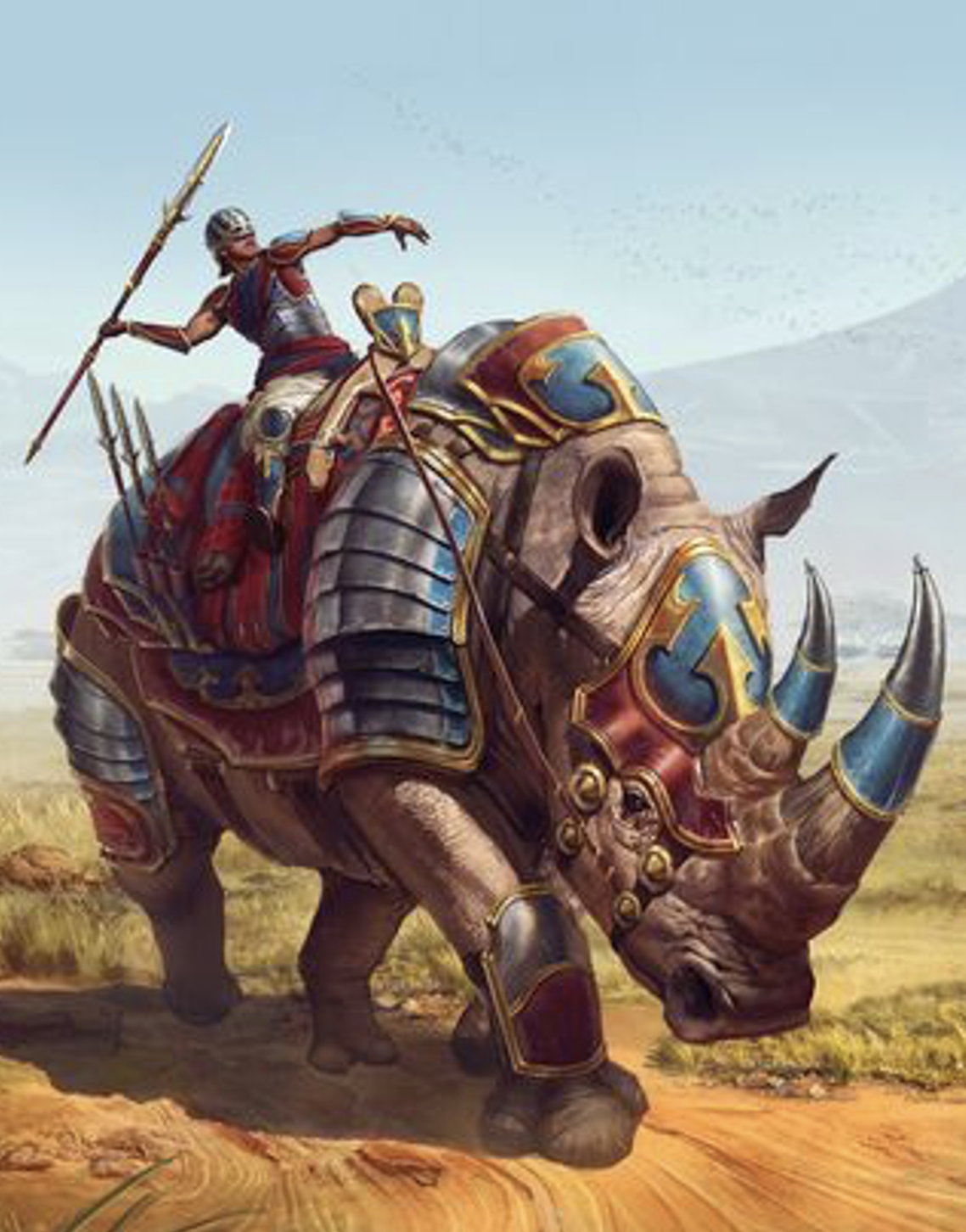
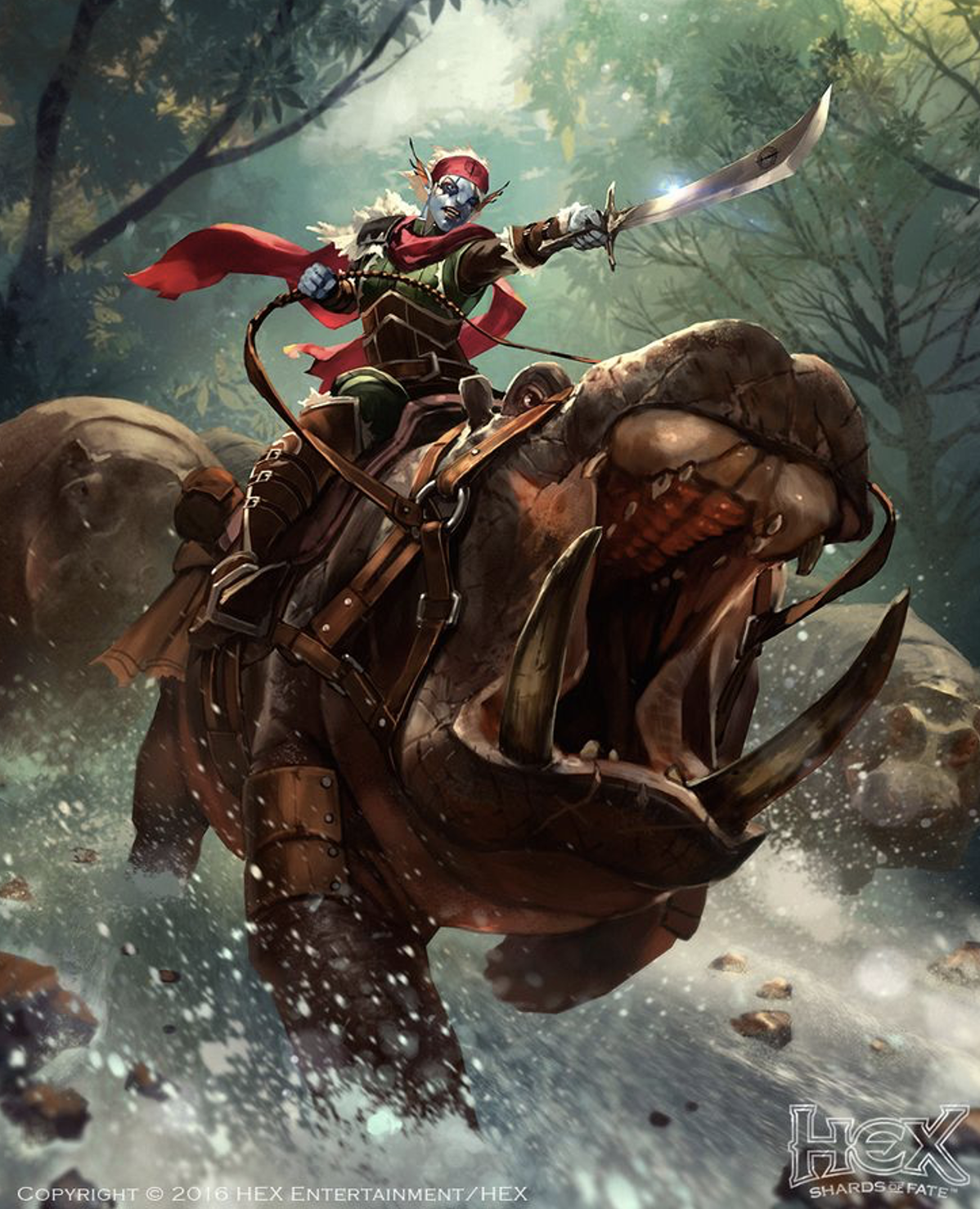
General Animal Products. Besides the Colossi, various beasts were hunted for their meat, fur, leather, or other component. Ivory was a prized export. While it could be extracted from a few of the remaining Colossi, it most commonly came from domesticated Rhinos. As these creatures were used as mounts during travel and hunts, ivory was only taken when the animal had died of natural causes. Poaching (particularly from Faust’s lands) was an issue.
People
The primary residents of Moralis were gnomes, though there was a sizeable minority of halflings (often temporary residents from Orestia). In the True Pridelands, most towns and villages were composed entirely or mostly of Tabaxi (notably cheetah or leopard variants) or Leonin. The children of Pyrus were easily identified as they were the only Leonin who ever grew wings. Notable minorities in towns and villages included humans and various half-species (e.g. half-elves). Along the waterfront, towns were often a mixture of gnomes, Tabaxi, Leonin, Lizardfolk, and Kerselló.
Religion And Culture
The culture of the Pridelands was one of order and honor, and of adherence to law or code. In Moralis, adherence to and the study of the Law of Geryon was a form of religious worship and was expected of all who sought to achieve any notable standing within the city. But the further one traveled from Moralis – into the heart of the grasslands – personal codes of honor and respect became more important. The balance between Law and local codes was often reflected in how locals viewed Geryon, Pyrus, and the Menseya. Among rural hunters, Pyrus was honored for embodying the natural order, or the Law of Nature, as opposed to the Law of Geryon. Across the Pridelands, all locals recognized that chaos and fortune bred madness, but order brought peace while honor bred harmony.
The Local Menseya. In Moralis, Geryon and Pyrus were worshipped in tandem. Geryon represented the creation and understanding of the Law as written. Pyrus represented the law in action and its physical application to the world. Beyond the walls of Moralis, the Menseya were more likely to be worshipped as “goddesses”. Local shrines were often erected in honor of Menseya that were born in the village and the Consorts that gave birth to them. The return of a Menseya to her hometown was met with celebration: ceremonial hunts, feasts, performances, and more.


Comments