
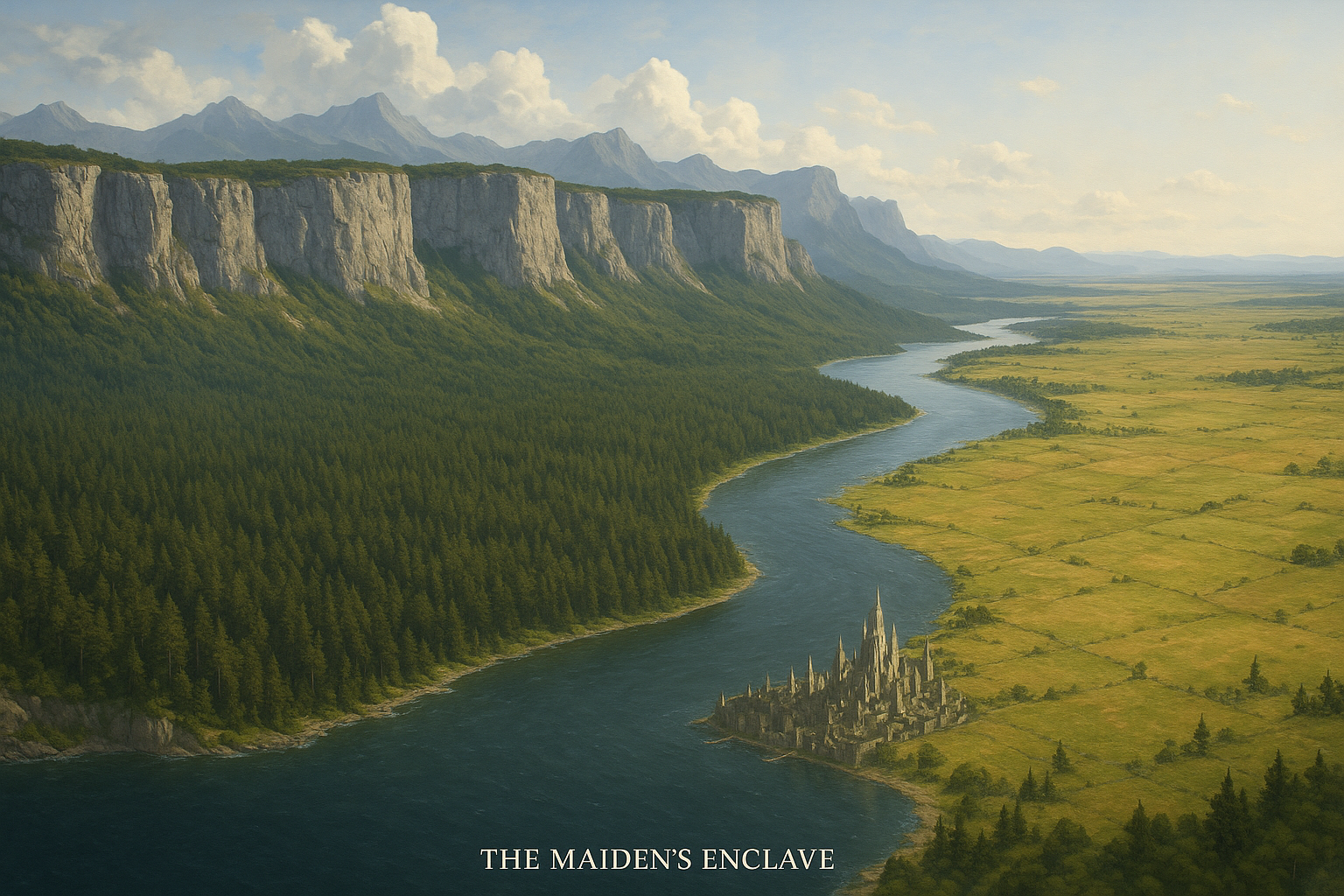
The Elemental Enclaves
Where the story begins, the Elemental Enclaves are a loose federation of towns on the continent's western edge.
Structure
The Elemental Enclaves have a Federalist system of government that developed organically throughout their history.
Top Level: Steward of the Seasons
The Steward oversees the entire Enclave from his seat of power, Mauribon. The Steward generally remains focused on inter-provincial cooperation, foreign affairs, and the valley's defense.
Council of Mauribon
The top advisors to the Steward who help him lead the Enclaves.
- Councilor of the Maiden
- Councilor of Defense
- Councilor of War
- Councilor of Justice
- Councilor of Health
- Councilor of Coin
Middle Level: Winter Warden, Spring Guardian, Summer Keeper, Fall Sentinel
This dates back to the first age, when each 'Providence' was ruled by one of the Ancient Houses of Rylin, Daenor, Calior, or Saelsir, which governed its tribe. These Great Houses, or Liege Lords, are responsible for overseeing their territory like a governor would in other systems, ensuring that each time is productive and helping the Enclave, and mitigating any conflicts within their borders.
The current Great Elven Houses are:
- House Rylin - The Winter Warden
- House Daenor - The Spring Guardian
- House Saelsir - The Fall Sentinel
- House Calior - The Summer Keeper
Bottom Level: City/Towns
Each Noble House rules over one of the Cities/Towns/Settlements throughout the Freeholds and, during peaceful times, is largely left responsible for their governance, with the Steward stepping in as needed. During times of trouble, the Steward takes on a more direct role in governance, particularly when he calls the banners.
Under the Winter Warden: House Deigh, House Faerkey, House Sneha, House Treth, House Uisge
Under the Spring Guardian: House Alkan, House Coran, House Morag
Under the Summer Keeper: House Argrian, House Ranor, House Teine
Under the Fall Sentinel: House Adhair, House Aerlon, House Chaelen
Culture
See: Elemental Elven
History
Formation
In the wake of the Great Storm and the Miaden's disappearance, the four Great Elven Lords agreed to not just continue the Elemental Alliance but to expand it into the Elemental Enclaves. Through the The Elemental Covenant they created a new Federalist system ruled by the Steward of the Seasons and appointed Auradir Rylinneaer as the first Steward of the Seasons.
Demography and Population
Most of the population is Elven, with humans and dwarves settling in the Enclave over the centuries.
Population: 2,256,847
Territories
Maiden's Enclave
Military
The Blue Guard
The Eldar Watch
Technological Level
Energy Production
Core Technology
Water wheels and biomass (wood, charcoal, and seaweed) are conventional methods used for basic power and heat, particularly in their inland communities. The coastal taiga forest of the valley provides a vast, though managed, supply of timber.
Fantasy Technology
Waterstones: These crystals are the primary source of illumination, providing clean, fire-free light in homes and cities, particularly along the coast. This provides the Enclaves a massive advantage in public safety and the ability to work or travel at night.
Elementals: Elementals are used in a joint relationship for specific, heavy-duty tasks where their raw elemental energy can be put to use, and in exchange, they get a long-term and stable home. A Fire Elemental can be used to stoke a forge to incredible temperatures, a Water Elemental can power a large mill or pump water, an Earth Elemental can be used to move heavy boulders and dig tunnels, and an Air Elemental can power a windmill or a ship's sails.
Transportation
Core Technology
The Elves of the Enclave rely on walking, river boats, and sailing ships. Outside of the Earth Providence, horses are rarer and typically only used by the wealthier individuals for transportation purposes. Over the 32,000 years that Elves occupied the valley, a series of primary roads has been developed to travel between major locations. However, between the smaller towns and hamlets, the dense forest can make travel harder.
Fantasy Technology
Elementals: Air Elementals can be employed on specific ships to speed up sailing or even allow it to move slowly against the currents. Earth Elementals can be used to keep parts of the roads clear, but their desire to stick to specific locations limits their usage in developing additional roads.
Relics: Some rare relics offer faster forms of transportation and can be adapted into permanent methods, such as the elevator into the Rylin Mithril Mine. These are more for specialized methods and not fit for mass transportation.
Religion
The Flow of the Maiden - Worship of the Elven Deity, the Maiden, is the primary religion in the Elemental Freeholds.
Worship of the Warrior or the Smith is accepted.
Athesism and Agnositism are tolerated, but many look down on these view points outside of the main cities.
Worship of the Fallen is forbidden
Foreign Relations
The Enclave makes the majority of its wealth through trade and also in accordance with the Maiden's request, seeks to have peaceful relations with any who also seek peace with them.
Laws
Supreme Law: Elemental Covenant
Legal System: Common Law
Governmental Type: Constitutional Monarchy
The Steward of the Season
The Elemental Covenant establishes the Steward with Executive Authority over the Elemental Enclaves, which is equivalent to the King in other societies. Each of the Elven Houses is required to swear allegiance to a new Steward.
Every noble landholder owes solmen fealty and ser5vice to their liege, and ultimately to the Steward. Oaths sworn before the Father, the Maiden, and the Elements are binding and unbreakable.
Right to Life
Edict on the Right to Life
Edict on Lawful Combat
Decree on the Protection of the Vulnerable
Children, the aged, and the infirm are the purest gifts of the Seasons, and their protection is a solemn duty. It is a grave offense to intentionally inflict harm upon those who cannot defend themselves, or to abandon them to the elements without just cause. The Great Houses shall ensure that communal shelters and healing houses are established for such persons, and a person's neglect of their kin who cannot care for themselves shall be judged with the utmost severity.
Purpose: This decree serves as a legal foundation for protecting society's most vulnerable. It outlines not only a prohibition on harm but also a positive duty of care, which reinforces the collective responsibility and moral values of your realm.
Freedom of Self-Defense
By the will of the Maiden and the courage of their spirts, every sapient creature is granted the right to defend their own life and the lives of their family and companions from mortal threat. An act of violence committeed in the immediate and necessary defense against an unjust and deadly aggressor shall not be held as a crimea gainst life. This right is a shield, not a sword.
Purpose: This clearly defines the right to self-defense, distinguishing it from malicious assault.
The Castle Doctrine
A person's dwelling, regardess of its size, shape, or splendor, is their sacred hearth and a place of sanctuary. The Steward's law requires no person to retreat from an aggressor who has unjustly forced their way into a dwelling. Any person who uses force, including deadly force, to repeal an unlawful and forceful instrusion upon their home or lands shall be held to have acted within their right.
Purpose: This provides clear legal protection for a homeowner. It removes the "duty to retreat" and empowers individuals to protect their property and family from intruders without fear of prosecution for defending themselves.
Right to Bear Arms
The bearing of arms, whether of steel, wood, or other material, is the right of any loyal citizen of sound mind for the defense of their life, their family, and their hearth. This does not extend to possession of unique weapons of mass destruction, forbidden alchemical devices, or any relics developed by the Fallen Eldrin Ankow or his Aethils.
Purity of the Land
The land, sea, and sky of the Elemental Enclaves are the treasure of the Maiden, and its health is directly tied to our ow. The use of magical relics, alchemical toxins, or any force or action that would poison a river, blight a crop, or render a land barren for selfish gain is strictly forbidden.
Protecting the Elemental Balance has been the primary charge of the Elves of the Valley since they first settled here over 31,000 years ago. Since the early days of the Enclaves, the occupation of Rangers has developed, with guilds in each Providence, to help monitor and enforce degrees protecting the balance of the Lands.
Protection of Healers
The healing arts are a gift to all of life, and those that pratice them are to be protected. Any who impede a healer's work in a time of need, or who falsely claim to heal for personal gain, shall face punishment. All Elven Houses are charged with ensuring the provision of healing salves, elemental aid, and knowledge of medicine to all people, particularly in times of famine, plauge, or war.
Purpose: This decree establishes a social safety net rooted in the powers of the Great Houses. It protects healers and makes basic healthcare a right of the populace.
Right to Ordered Liberty
Freedom of Passage
All loyal citizens of the Elemental Enclaves shall have the right to travel freely between the Providences and within their borders without undue restrictions. No Elven Lord, Thane, or any appointed officer of any level may unjustly bar a travely from passage, so long as they carry no contagion of body or spirit, nor trespass upon sacred or private grounds without leave, nor have displayed the intent of malice on any life within the Enclaves.
Freedom of Unbound Will
Slavery, forced servitutde, and all forms of magical or physical coercion that would bind a person against their will are declared anathema to the spirit of the Enclaves and are strikly forbidden. The exceptions to this shall be those who are condemned to penal servitude for crimes by the Court of the Steward, or those who have freely chosen to enter into the service of an Elven Lord, Thane, or House for a fixed term.
Purpose: This is a clear prohibition on slavery. The specific exceptions make it more realistic by allowing for judicial punishment and voluntary service contracts, while still preserving the core right.
Freedom of Vocation
A person shall have the right to choose their trade, craft, or master to serve, so long as their choice brings no harm to others and serves the greater good of the Enclaves. No parent may unjustly force a child into a vocation against their will, nor may a guild or master refuse a worthy apprentice without just cause. This freedom of choice is a spark of the Maiden's own creativity within each of us.
Purpose: This decree protects individual freedom of choice in matters of career, a key aspect of liberty, and a common point of contention in feudal societies.
Freedom of Speech
By the will of the Steward, every person is granted the right to hold and express their thoughts and beliefs, to debate matters of policy, philosophy, and the elements, and to share their tales. This right, however, does not extend to words of sedition, which would call for the violent overthrow of the Steward’s rule, or to speech that would knowingly and maliciously spread lies that corrupt the elemental heart of the realm or stir one province to unjust violence against another. Such speech shall be held as treason, for a thoughtless word can cause a kingdom to rot from within.
Purpose: This decree grants a broad right to free speech while also setting a clear line. It protects against sedition and dangerous misinformation that could threaten the peace of the Enclaves, which is a common and practical limitation in any pre-modern society.
Freedom of Inquiry and Discovery
The quest for knowledge and the spirit of discovery are blessings of the Maiden, and all people are free to pursue research, scholarship, and exploration within and beyond the Enclaves. However, all such pursuits must be undertaken with wisdom and a reverence for life. Any experiment or exploration that places the lives of innocents or the balance of the elements at an unacceptable risk is hereby forbidden without the direct, explicit sanction of the Steward and the oversight of the Councilor of the Maiden.
Purpose: This decree encourages learning and progress while establishing that dangerous magical or alchemical research is not a right but a privilege that requires central approval. The involvement of the Steward and the Councilor of the Maiden reinforces the sacred and serious nature of such power.
Prohibition on Anti-Matter Research
Certain truths are best left untouched, for they bring only ruin. The study of Void Matter, the intentional creation of corrupting celestial decay, and all forms of magical experimentation that would seek to unmake or undo the elemental fabric of the world are forbidden on pain of death. The possession of texts detailing such practices, or of relics corrupted by this forbidden knowledge, is likewise an act of high treason. The Councilor of the Maiden and the Councilor of Justice are charged with the absolute eradication of this corruption, wherever it may be found.
Purpose: This decree establishes a clear, unassailable line for what is considered an existential threat to the realm. It not only forbids the acts themselves but also the possession of knowledge about them, highlighting the extreme danger involved. The dual oversight ensures that this law is enforced from both a spiritual and legal perspective.
Right to Property
A person's possessions, whether they be land granted by the Steward, a home built with one’s own hands, a fishing boat, or the fruits of a season's labor, shall be considered their rightful property and shall not be seized without just cause and fair compensation. Any act of theft or vandalism shall be treated as an assault on the owner's means of living.
Purpose: A clear and broad definition of protected property, from the grand (land) to the small (tools), with a strong prohibition on theft.
Freedom of Inheritance
All property, including the ancestral lands of Thanes and the cherished heirlooms of commoners, shall pass to a person’s chosen heir upon their passing. The Steward's courts will resolve all disputes of inheritance, and any attempts to wrongfully seize a rightful inheritance shall be met with the full force of the law.
Purpose: This ensures the stability of family lines and property, a cornerstone of feudal society. It also establishes the Steward's court as the ultimate authority on such matters.
Communal Assets
That which is owned by all is the responsibility of all. The communal fishing grounds of a village, the sacred grove of a valley, or the public square of a town shall be protected from private claim or damage. Any who seek to profit from the common good without the consent of the people, or who damage such shared spaces, shall be judged by the local Thane or the court of the Great House.
Purpose: This is a crucial fantasy adaptation of property law, acknowledging that in this world, some resources are held by the community and are equally protected. It gives a legal basis for protecting key areas of the world.
Prohibition of Uneven Scales
Commerce shall be conducted fairly and honestly. Guilds recognized by the Steward are honor bound to regulate their crafts to ensure fair treatment of all parties, both their own artisans and the customers. Those who cheat or defraud through the use of uneven scales, false information, thinned or altered materials, or other provable means of dishonest trade shall face restitution and public censure.
Crimes Against the Crown
High Treason and Sedition
The act of treason is a sin against both the divine and the state. It shall be considered High Treason for any person to attempt the life of the Steward of the Seasons, their heir, or their appointed Councilors. Likewise, any person who raises arms against the throne, or who plots in secret to sow rebellion, subvert the Steward's rule, or incite one province against another, shall be deemed a traitor to the Enclaves. The penalty for this betrayal is death, and their name shall be forever stripped from the annals of the realm.
Purpose: This law establishes the most serious crimes against the state and its leadership. The inclusion of the heir and Councilors protects the entire line of succession and the government's stability. The punishment of death combined with being "stripped from the annals" is a form of civic death, erasing the traitor's legacy entirely.
Usurpation of Authority
The Steward's authority is a sacred trust, and its symbols are not to be profaned. Any person who forges the Steward's Seal, or falsely issues a decree, writ, or command in the Steward's name, shall be deemed a usurper. The theft or illegal possession of a major relic, the Crown of Winter, the Rod of Harmonious Elements, or any other sacred accoutrement of the Steward's office is likewise a grave act of treason, for it is an attempt to steal the very power of the throne itself. The penalty for this crime is the severing of the hand that committed the act, followed by death or exile.
Purpose: This decree goes beyond physical violence to protect the intangible power of the state. It makes crimes of deception and forgery treasonous, showing how seriously the Enclaves view the legitimacy of the Steward's rule.
Oathbreaking
All oaths of fealty sworn to a lord or a Great House are binding, and a broken oath is a stain upon the soul. To willfully betray one’s liege-lord, or to conspire against the elemental balance and the Covenant that binds the Enclaves, is an act of high treason. The penalties for such a betrayal shall not be limited to the individual but may be extended to the forfeiture of their lands, titles, and ancestral heirlooms. Their house shall be held to have failed its sacred duty to the seasons, and their lineage shall be dissolved by order of the Steward’s court.
Purpose: This is a classic feudal law that codifies the importance of loyalty. Linking oath-breaking to the "Elemental Covenant" makes the crime a spiritual betrayal as well. The punishment of attainder—the dissolution of an entire noble house—is a powerful deterrent, showing that the fate of a family is tied to the loyalty of its head.
Laws of the People and Personal Conduct
"False witness, slander, and malicious deception that impugn the honor of another shall be met with restitution and public disgrace."
"Whosoever disrupts the natural balance of the elements, whether through reckless magic, excessive mining, or wilful pollution, should be held accountable for any imbalance created."
"The sacred groves, hallowed waters, sky temples, and fiery hearts of the Enclaves are to be protected. Desecration of these holy sites or disruption of seasonal rights is a grave offense."
"All citizens and landholders shall render their duties to their respective liege lord through due tithes and taxes, who shall in turn deliver the agreed portion to the Enclave's treasury, as is right and just for the common good."
"In cases where earthly evidence is wanting, or the accused's innocence is proclaimed against heavy odds, the accused may appeal for judgment by the elements, as determined by the Steward or their appointed Councilor of Justice."
"All relics, being imbued with divine energy from the Maiden and her siblings, are ultimately sacred and thus a privilege. No relic shall be treated as a common chattel or be used for profane purposes. The Steward and his council reserves the right to declare those convicted of any offense have forfeited their rights to own and use any relic while in the lands of the Enclave."
"Any citizen discovering a relic, or becoming aware of its location but unable to claim it, is duty-bound to report its existence to their local lord for cataloguing. Unless the Steward and his council have previously handed down judgment, no liege lords can claim another's artifact without due compensation."
"Relics shall only be employed for purposes that serve the welfare of the Elemental Enclaves, its people, and the degrees of the Maiden and the Steward."
"Only individuals explicitly sanctioned by the Steward, having undergone rigorous training and proven their devotion to the Maiden's mission, may bear and utilize relics against another living being."
"Relics are considered heirlooms to be passed by birthright, unless otherwise stated by the current or previous owner of the relic."
"The theft, deliberate damage, or destruction of a relic shall be considered an act of sacrilege against the Maiden and the Steward's divine mandate, punishable by the severest penalties, including dissolution of lineage or death."
Agriculture & Industry
The Enclaves have a litany of industries, from multiple types of agriculture (farmers, shepherds, fishermen, and foresters) to trading to manufacturing (smiths, mining, etc.).
Mauribon is largely a trading city with top-quality smiths and artisans.
Eileamaid is a large farming settlement that plants crops and raises animals.
Gwenerh is a series of mining settlements, and largely mines and refines ores and minerals
Glasarin and Pineburgh is a forested settlement where lumberjacks work on planting and cutting down trees for exporting outside the Enclaves
Cuanaur is a large fishing city that makes a living from marine exports.
Trade & Transport
Mauribon is one of the largest trade cities in Eldux, and as such, helps the Enclave with a strong trading industry. With six coastal cities having 10 ports among them, and rivers running throughout the valley, many resources found in the Enclave can be shipped out. The Enclaves have trade deals with the League of Valtameric, the Republic of Cerania, the Duchy of Malainn, the Siorain Empire, and the Kaulainia Isles. These various deals allow for a litany of imports into the Enclaves.

Telos Aur Sar Vala Vael
Tiered System
- Whisp (Copper Coin)
- Terra (Silver Coin) [Worth 12 Whisps]
- Cinder (Silver Coin embedded with stone) [Worth 8 Terras]
- Glint (Mithril Coin) [Worth 16 Cinders]
Timber and Processed Wood Products
- Raw Timber
- Lumber/Plans
- Pulpwood
- Naval Stores
- Speciality Wood Products
Fish and Seafood
- Dried / Smoked Fish
- Salted Fish
- Fish Oil
- Shellfish
Minerals from the Limestone Cliffs
- Lead Ore
- Zinc Ore
- Silver Ore
- Limestone
Furs and Hides
Freshwater
Speciality Forest Products
Agricultural Staples
- Grains: Wheat or Rice
- Warm-Weather Produce: Fruits such as Apples, citrus, and grapes, vegetables such as corn, beans, and squash
Iron - To Supplement the Northern Mines
Copper/Bronze
Tin
Precious Medals: Such as Gold
The council of Mauribon, which the Steward leads, has the authority to make laws and regulations for the common good of the Enclave, granted to him by the Covenant of the Elves.
Each Great House has the authority, through ancient rite, to establish law and order in each elemental providence
The third level of legislative authority lies with the liege lords who oversee local areas throughout the enclaves.
Council of Mauribon
Local aldermen and liege lords serve as the initial judicial power in the enclaves, though citizens are free to appeal to the Great Houses any judgment received. The Counselor of Justice hears any case between the various provinces and serves as the judge in the Steward's Court when it is called.
Each Liege Lord is responsible at the local level, the Great House at the Providence level, and the Steward across the Enclave.
Ancient Allies
Ancient Allies
Ancient Allies
Ancient Allies
Trade Partners
Non-aggression Pact
Argader Raids
The relationship of the two countries was originally hostile during the 92-year conflict. It was ended with an official ceasefire.
Intermittent Raids
Over the next few thousand years, this peace was only disrupted by the occasional raids, mostly performed by young warriors seeking to gain glory.

Comments