
Infernal Court
The Infernal Court is the ruling pantheon of the Seven Hells, a conclave of seven arch-infernals who embody the primal vices of existence. These lords are the twisted remnants of the Luciferians cast from the High Heavens during the Divine Civil War , reshaped by the Infernal Abyss into sovereigns of sin. Each rules a demiplane of torment fashioned in their own image, and together they preside over the Citadel of Saal from the heights of the Tower of Envy. To mortals, they are as gods, offering bargains, promises, and pleasures, but unlike the divine, their blessings are poison, binding souls into eternal servitude.
The Court is a body of rivalry, rather than unity. Its seven lords meet in the Infernal Assembly to plot, deceive, and wage their eternal contest for supremacy, their alliances shifting as quickly as they are made. They share one law alone: none may overthrow Mephistus, the Prime Evil, who sits the highest throne. Beyond that frail accord, the Court is a tempest of lust, pride, avarice, gluttony, wrath, and many other vices. Its members scheme not only against the Heavens and the Materium but also against one another. The Infernal Court is a circle of tyrants, parasites, and tempters, waging their war for mortal souls through indulgence and corruption.
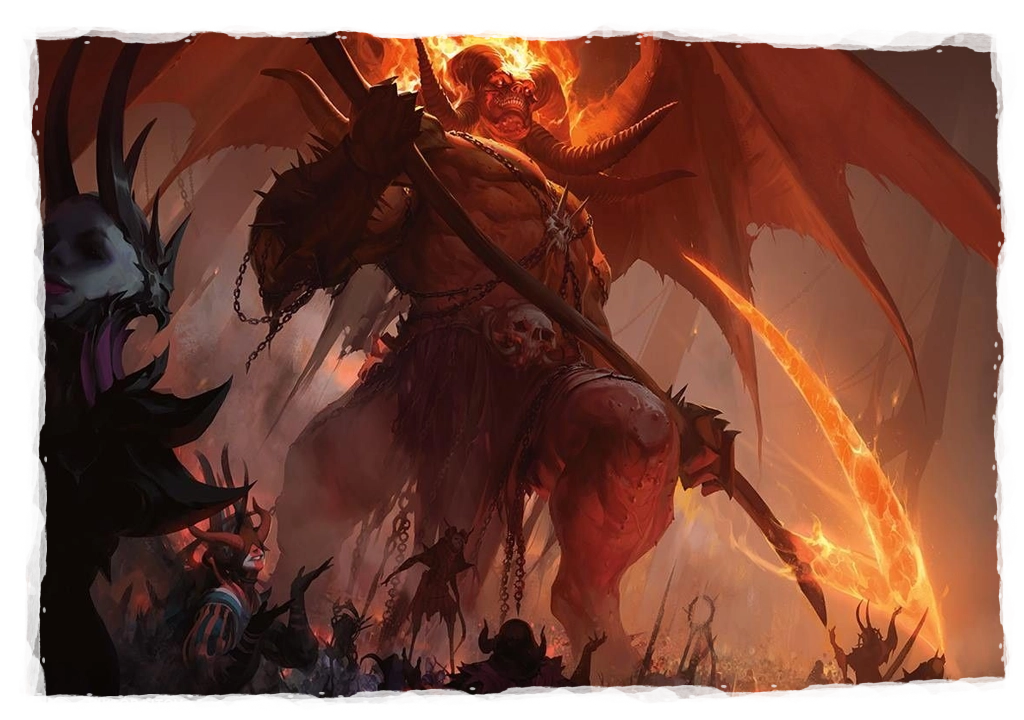 The Infernal Abyss itself supplies much of this hierarchy with endless monstrosities birthed from its chaos. From writhing hordes of chittering fiends to titanic war-beasts, these creatures are corralled and shaped by infernal law into armies. Some remain barely contained, seething with the chaotic malice of the Infernal Abyss; others are hammered into rigid obedience by infernal contracts. This unstable mix ensures the Hells are never static: every army is both a weapon and a powder keg, every duke both a servant and a rival.
At its widest scope, the Hierarchy is a fractal reflection of the Court above. Petty nobles scheme against their masters, generals betray allies mid-battle, and cults in the Materium mimic infernal fealty while plotting their own ascension. Just as the Seven Thrones vie for supremacy yet cannot destroy each other, so too do their servants wage endless rivalries that never truly resolve. Order and chaos grind together in this vast machine, feeding the eternal cycle of intrigue, rebellion, and bloodshed that sustains the Seven Hells.
The Infernal Abyss itself supplies much of this hierarchy with endless monstrosities birthed from its chaos. From writhing hordes of chittering fiends to titanic war-beasts, these creatures are corralled and shaped by infernal law into armies. Some remain barely contained, seething with the chaotic malice of the Infernal Abyss; others are hammered into rigid obedience by infernal contracts. This unstable mix ensures the Hells are never static: every army is both a weapon and a powder keg, every duke both a servant and a rival.
At its widest scope, the Hierarchy is a fractal reflection of the Court above. Petty nobles scheme against their masters, generals betray allies mid-battle, and cults in the Materium mimic infernal fealty while plotting their own ascension. Just as the Seven Thrones vie for supremacy yet cannot destroy each other, so too do their servants wage endless rivalries that never truly resolve. Order and chaos grind together in this vast machine, feeding the eternal cycle of intrigue, rebellion, and bloodshed that sustains the Seven Hells.
Nature of the Court
The Infernal Court does not draw its strength from prayers, offerings, or temples as true divinities do. Instead, its power is measured in the sins of mortals; their envy, pride, lusts, and appetites. Every oath broken, every indulgence embraced, every cruelty inflicted in the mortal world feeds one of the Seven Thrones. In this way, the Court has no need for worshippers; mortals who fall to temptation become fuel for its dominion whether they acknowledge the lords or not. Though each arch-infernal commands its own demiplane, none rule unopposed. Every decree, every campaign, and every scheme must pass through the shifting intrigue of the Infernal Assembly. This endless struggle keeps the Court in a state of violent equilibrium: too fractious to collapse, too venomous to ever unite. The Citadel of Saal thus stands as the paradox of the Hells. It is a seat of absolute sovereignty, yet also the most dangerous arena of betrayal in all existence.The Assembly
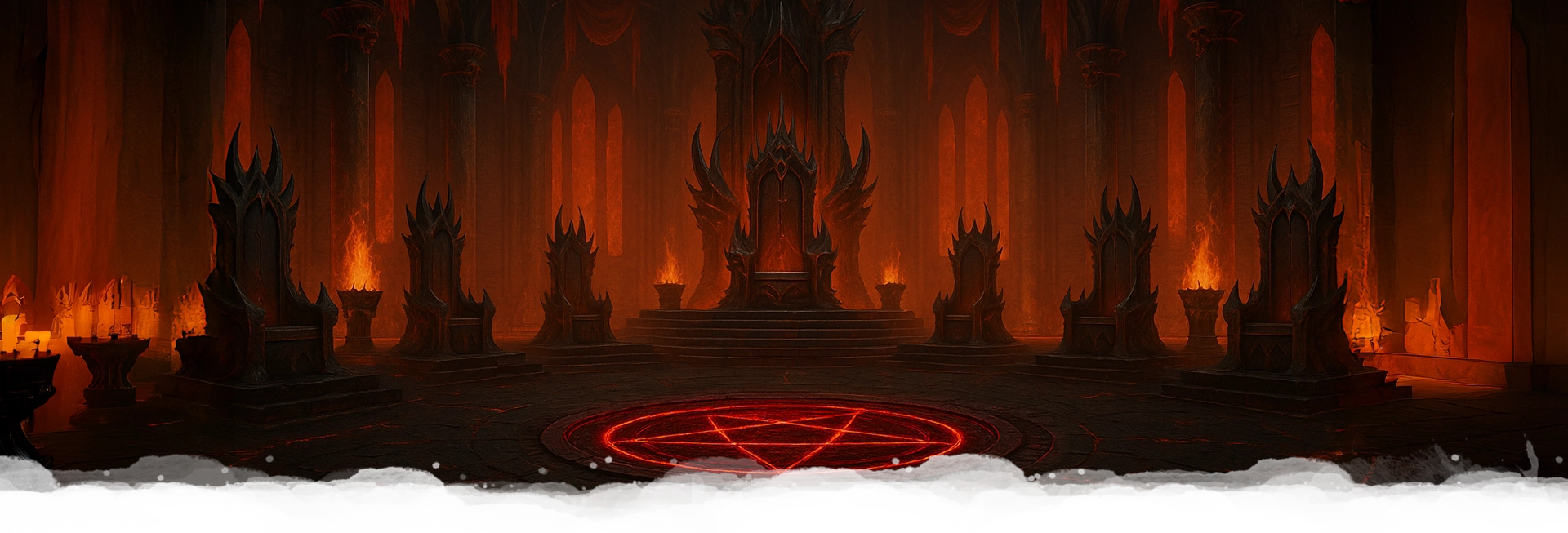
Atop the Tower of Envy lies the Infernal Assembly, the only chamber where all seven lords convene in one place. The hall itself is a vast, spiraling amphitheater of Obsidian and iron, its walls veined with molten Fire, its floor a shifting mosaic of screaming souls pressed flat beneath glassy stone. From here, Mephistus presides upon the highest throne, with the other six seated below in a ring that mirrors their stations. The Assembly is less a council and more a theater of rivalry, where every word drips with double-meaning, every promise masks a threat, and every pact is a weapon waiting to be turned. No mortal law governs these proceedings, save one: none may strike down Mephistus or claim his throne while he still endures. This singular accord is the iron chain that binds the Court, though it has not prevented countless plots to circumvent it. Alliances are made and broken within a single session; bargains of souls, armies, or territory are brokered only to be betrayed before the echo of the agreement fades. Yet from this chaos comes the semblance of order, for it is here the lords decide upon their harvests of mortal souls, their wars in the Chaotic Dark, and their endless contests for supremacy. The Infernal Assembly is a crucible where the sins of the lords themselves are forged into the decrees that shape all of the Hells.The Seven Thrones
The Infernal Court is shaped by seven thrones, each occupied by a sovereign of vice. These lords are more than rulers of their demiplanes. They are living philosophies, each sin given form and dominion. Mortals who fall to their temptations do not merely indulge in weakness; they are drawn into a worldview that reshapes the soul, binding it to Hell.- Mephistus, the Prime Evil. The First Throne, the Prime Throne, belongs to Mephistus. He is the Alpha and Omega of damnation, Mephistus embodies Sin itself. He is no mere patron of a single vice, but the font from which all corruption flows. His throne stands higher than all others within the Tower of Envy, a seat none may contest. Where the others war for supremacy, Mephistus watches, the architect of their rivalries and the hidden hand behind the corruption of mortal souls.
- Asmodia — Lust. The androgynous sovereign of the Houses of Lust proclaims that desire is dominion. To Asmodia, the body is a weapon, and longing is a leash. Lust is not confined to flesh alone, but extends to the craving for beauty, sensation, and control. Their philosophy holds that to enslave another’s will through longing is the purest form of conquest, and thus the surest path to supremacy.
- Beelzebaar — Gluttony. The swollen tyrant of the Halls of Gluttony teaches that appetite is virtue. To consume without end is, to Beelzebaar, the highest expression of freedom. His philosophy is that all things—food, flesh, Magic, even souls—exist only to be devoured. Gluttony is thus not mere indulgence but the sanctification of excess, an ideology that reduces all creation to fuel.
- Belphegara — Sloth. The hive-queen of the Pits of Sloth embodies stillness as sovereignty. To Belphegara, effort is folly, and motion the illusion of lesser minds. Her philosophy teaches that decay is the true end of all things, and that in surrendering to inertia one ascends beyond struggle. Sloth, in her creed, is not weakness but inevitability: the universe itself will rot into stillness, and those who embrace it early find peace in her embrace.
- Legion — Wrath. The general of the Fields of Wrath is not one but many, a host in one body, and a body made for war. To Legion, destruction is purity, and rage is the truest language of existence. Wrath, as philosophy, is the rejection of restraint: the belief that only through unbridled violence can falsehood and weakness be burned away. His throne is the forge of armies, and his word is fire.
- Leviathoss — Envy. The serpent architect of the Tower of Envy, Leviathoss is the embodiment of hunger for what one does not and cannot have. His whispers turn mortals against brother, lover, and king alike, binding them to his service as slaves in his impossible works. To Leviathoss, envy is not a flaw but the engine of progress, for only those who covet can be driven to surpass.
- Mammorr — Greed. The jailor of the Dungeons of Greed whispers that possession is power. His philosophy is the creed of ownership: what is held is what is real, and all value is defined by possession. Greed in the eyes of Mammorr is not a flaw but the only truth; to own is to exist, and to lose is to die. His throne is the golden measure by which all bargains in the Court are weighed.
- Sartan — Pride. The lord of the Arenas of Pride declares that worth is proven only through contest. Pride is not vanity, but the assertion that one stands above all others by right of strength, wit, or triumph. Sartan’s creed is that weakness is the only sin, and victory the only virtue. His throne is the crucible of champions, and his followers are those who crave glory above all else.
Hell's Hierarchy
Beneath each arch-infernal sprawls a court of lieutenants, often called the Dukes of Sin. These beings embody refinements of their lord’s philosophy, acting as living extensions of their master’s creed. A duke of Mammorr might oversee labyrinths of gilded vaults, while one of Asmodia might reign over brothels of torment. Each commands hosts of infernal knights, creatures twisted into exemplars of their patron vice, and ranks of lesser demons and devils that form the bulk of the Hells’ armies. The loyalty of such retainers is tenuous at best, bought by favor, fear, or the promise of power in some distant betrayal.Infernal Bargains
The Infernal Court does not send champions or avatars to walk the mortal world. They have no need to bless chosen heroes, nor to bind their power within a single vessel. Instead, the lords of the Hells reach into the Materium through whispers, visions, and pacts. To mortals they offer power, wealth, beauty, vengeance, or forbidden knowledge; always in exchange for something of greater worth. The most common coin is the soul itself, though oaths, bloodlines, or entire lineages may be claimed in their place. Infernals corrupt through bargains that poison from within. Their contracts are as much chains as they are promises, binding mortals into servitude that often extends beyond death. Some bargains are written in infernal script upon blackened vellum, others are sealed by a whispered word in the dead of night, and some are struck without the victim realizing until too late. Whatever the form, an Infernal bargain is a covenant of corruption: the more it is honored, the more the mortal becomes a vessel of sin, until nothing remains but an echo of the Infernal lord who claimed them.Relations Beyond Hell
The Infernal Court is not content to reign solely within the Seven Hells. Their schemes reach into the Materium and beyond, seeking dominion over mortal souls and vengeance upon the High Heavens. Unlike the celestial hosts who march openly, the lords of Hell move in whispers and bargains. Kingdoms fall not to their armies but to temptation: a single pact may topple an empire, ignite a war, or damn a bloodline for generations. Beyond the mortal realm, the Court’s greatest struggle is fought in the Chaotic Dark, where their legions wage the endless war of Armageddon against the Aberrations of the Realm of Insanity. This nightmare battlefield is a void of colliding stone fragments, storms of raw magic, and horrors locked in eternal combat. For the infernals, it is both a crucible of vengeance and a proving ground for their armies. Through the Rift, a vast wound in the Cosmic Etherium that spills into the Chaotic Dark, this conflict bleeds into the wider multiverse. Angels and champions rally in vain attempts to stem the tide, even as the lords of Hell exploit the chaos to weave new bargains with mortals far from the battlefield. Here war and corruption converge, and so long as the Rift endures, the ambitions of the Seven Thrones will never be contained.Table of Infernal Lords
| Lord | Alignment | Doctrine of Sin | Seat & Signs | Depiction |
|---|---|---|---|---|
| Mephistus | LE | Treachery — every oath is a chain, every betrayal a liberation | The Seven Hells; whispering contracts, bleeding quills, masks that smile and weep | A cloaked figure with a thousand shifting faces, each whispering promises |
| Leviathoss | NE | Envy — nothing belongs to any but those cunning enough to seize it | Tower of Envy; shattered mirrors, stolen crowns, false heirs | A gaunt serpentine creature with rows upon rows of forever-grasping hands |
| Beelzebaar | CE | Gluttony — all things exist only to be devoured | Halls of Gluttony; swarms of flies, endless rotting feasts | A bloated tyrant with a mouth that never closes |
| Mammorr | LE | Greed — to own is to exist; to lose is to die | Dungeons of Greed; gilded cages, clinking chains of gold | A blindfolded jailor clutching keys of molten gold |
| Asmodia | CE | Lust — longing is a leash; desire is dominion | Houses of Lust; perfumed airs, phantom lovers, flames that caress | An androgynous figure of shifting beauty veiled in living silks |
| Sartan | LE | Pride — weakness is sin; victory is virtue | Arenas of Pride; thunderous applause, phantom duels, blazing banners | An armored champion wreathed in banners of fire |
| Belphegara | CE | Sloth — stillness is sovereignty; all things rot to silence | Pits of Sloth; spreading mold, oppressive silence, crumbling stone | A swollen hive-queen enthroned on carrion husks |
| Legion | CE | Wrath — rage is purity; only fire cleanses | Fields of Wrath; wildfires, endless war drums, rivers of blood | A many-faced warrior of shifting forms, wielding countless weapons |

Type
Religious, Coven
Leader
Location

Comments