

Mammorr
Mammorr, the Infernal Lord of Greed, is the jailor of the Seven Hells and the keeper of chains. His dominion is the creed of possession, the belief that all value is measured by what can be owned, hoarded, or withheld. To him, ownership is the only true power, and those who fail to claim or guard what they hold are already condemned. His throne is weighed down with keys, vaults, and chains, each one a token of mastery over those who surrendered their worth.
The philosophy of Mammorr is simple and merciless. All things that exist are property waiting to be claimed, and all beings are commodities to be weighed and locked away. To hoard is to live, to expand one’s dominion is to thrive, and to lose is to be unmade. Where others preach freedom, he speaks only of bonds, and where others see community, he sees ledgers. In his creed, wealth and chains are the same, both marks of ownership, both instruments of dominion.
Those who acknowledge Mammorr do so with fear and avarice entwined. He is invoked in vaults, marketplaces, and prisons, in every place where possession binds one will to another. Mortals who fall into his orbit often mistake their ambition for strength, only to find themselves shackled by their own greed. To bargain with him is to bind one’s soul as collateral, for in his gaze there is no friendship, no loyalty, and no mercy. Only the endless weight of debt.
Depiction
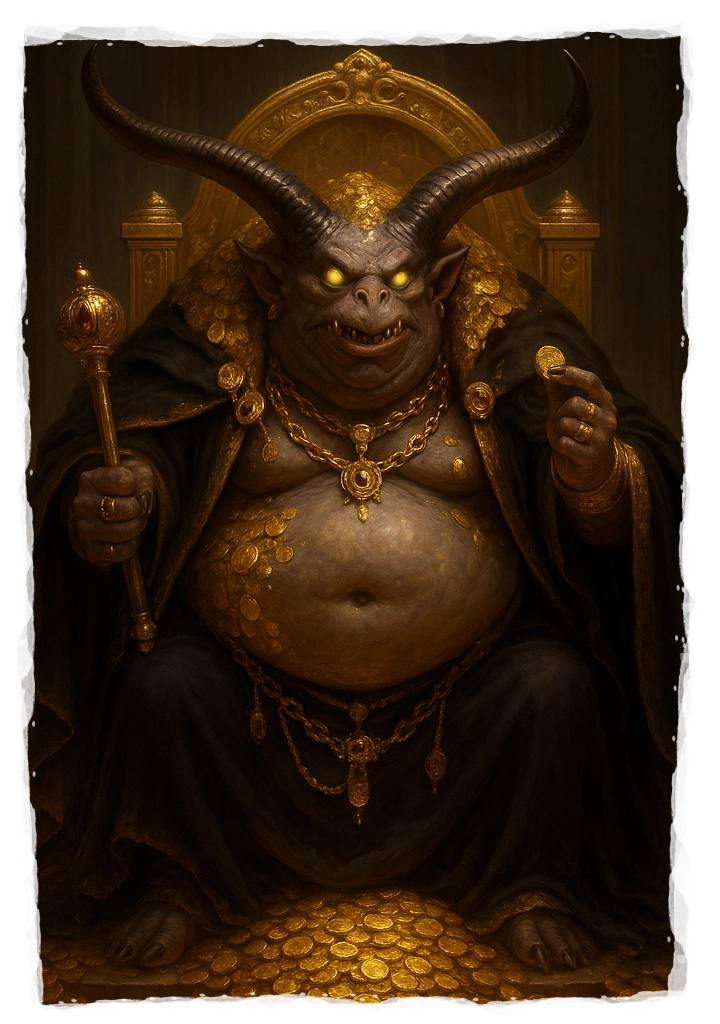
Mammorr appears as a hulking, hunched fiend whose corpulence speaks of ownership weighed into flesh. His posture is bent forward beneath the burden of his own hoard, for his entire back is encrusted with fused layers of gold and platinum that glitter like a living vault. Coins and ingots jut from his skin as though they have become part of him, veins of precious metal laced through his hide until flesh and treasure are indistinguishable. His horns are long and curling, like hooks forged to seize and hold, and his immense belly bulges outward, heavy as if filled with all he has consumed and chained to himself. His molten eyes burn with the slow fire of avarice, a gaze that appraises all it sees as inventory. He is almost always envisioned seated upon a gilded throne, the seat itself half-fused with his carapace of treasure, his fingers heavy with rings and his body draped in chains of gold. In one hand he clutches the Scepter of Mammorr, known to the damned as the Rod of Ownership. This infernal relic is said to bind gilded chains of claim to anything it touches: mortal, object, or even soul, marking it forever as property of its wielder. Artistic depictions of him emphasize his dominion: shrines resemble vaults, altars are heaped with coins and manacles, and murals show his chains snaking outward to ensnare kings, merchants, and beggars alike. His sacred symbols include the locked shackle, the golden key, and the scale bent beneath the weight of chains, each one a proclamation of his creed that nothing escapes possession.Tenets of Faith
The faith of Mammorr is a covenant of ownership and bondage. To follow the Jailor of Greed is to surrender to the law that all things are property, and that value is measured only by possession. His creed demands worshippers see the world not as a place of fellowship but as a vault of wealth and chattel, where every soul is coin and every bond is a chain. These three commandments form the core of Mammorr’s faith: All Must Be Owned. Nothing exists outside of claim. The faithful are taught to bind, seize, or purchase all they encounter, for the unclaimed has no meaning until it is marked as property. To capture a life, a soul, or a treasure is not theft but revelation, for through ownership alone does worth manifest. Loss Is Ruin. To surrender what one holds is to invite dissolution. The creed of Mammorr allows no generosity, no charity, and no relinquishment, for to lose possession is to unmake the self. His faithful hoard not only wealth but relationships, knowledge, and power, clutching them with chains both literal and spiritual until death and beyond. Chains Are Truth. Bonds, contracts, and fetters are the holy instruments of Mammorr’s dominion. To bind another with chain or oath is an act of worship, and to be bound is to acknowledge his sovereignty. Every shackle forged, every vault locked, and every debt enforced is a prayer answered, for chains are the language by which all creation is divided into master and property.The Gilded Cage
The worship of Mammorr thrives within the Gilded Cage, a network of jailors, merchants, and hoarders who raise bondage into liturgy. To them, chains and ledgers are scripture, and the act of claiming ownership is the highest form of prayer. Their gatherings resemble counting houses or prisons rather than sanctuaries, each altar buried beneath piles of coin, contracts, and shackles offered as tribute. Members are bound together not by kinship or loyalty but by debt, every initiate shackled with obligations that mark them as property of the Cage itself. The hierarchy of the Gilded Cage reflects the vaults they venerate. At its head stand the Keyholders, priests draped in gold and iron, who carry massive rings of chains and keys as symbols of their dominion. Beneath them serve the Collectors, enforcers who extract payments and seize new “offerings” in Mammorr’s name. Lowest are the Chained, initiates who begin their service in bondage, laboring as both servants and property until they prove their ability to claim and hoard. In this faith, to ascend is not to shed fetters but to amass them, for the measure of sanctity is counted in how many souls and treasures one holds in thrall.Practices & Rituals
Worship within the Gilded Cage is expressed through possession and bondage. Slavery stands as the highest sacrament, for to claim another’s body and will is seen as the purest reflection of Mammorr’s creed. Markets serve as temples where chained thralls are paraded before altars, their contracts read aloud as scripture and their brands burned in as hymns. Each transaction is treated as prayer, each life reduced to a testament of the Jailor’s sovereignty. The most sacred rite is the Sealing of Chains, performed when a new captive is bound in gilded fetters and forced to speak words of surrender that are inscribed into ledgers kept by the Keyholders. Other observances include the Audit, when initiates present inventories of their possessions to prove devotion, and the daily rituals of ownership practiced by priests: turning locks with whispered prayers, recording debts as offerings, and treating contracts as relics. The greatest sin in the Cage is loss, for to surrender wealth or slaves is to invite dissolution, while each chain fastened is counted as another link in Mammorr’s eternal dominion.The Role of the Faithful
The faithful of Mammorr extend his dominion into the mortal world by turning every bond into a chain and every exchange into a contract. They infiltrate guilds, merchant houses, and courts of law, reshaping them into instruments of bondage. Prisons become temples, ledgers become scripture, and slave markets serve as sanctuaries. Wherever wealth can be hoarded or lives reduced to property, the Gilded Cage takes root, binding entire communities in contracts they cannot break and debts they can never repay. Within the Cage, advancement is measured not by piety but by ownership. Those who command the most slaves, property, and coin rise as models of Mammorr’s creed, while the weak are absorbed as chattel. Freedom is spoken of only as bait, promises of release leading victims into contracts that strip them of everything. In this way the Gilded Cage spreads like a living ledger, each name another entry converted into currency, each binding another link in Mammorr’s eternal chain.Infernal Servants of Mammorr
Mammorr’s dominion is reflected in his servants: jailors, wardens, and enforcers who embody the theology of possession. They guard his vaults, drag captives in chains, and bind souls to ledgers of debt. Even among the other Lords of Hell, Mammorr’s servants are feared for their cold efficiency and the certainty that every bond they forge tightens forever.- Chain Devils. These fiends are the purest extension of Mammorr’s will. Draped in living chains, they delight in ensnaring captives both physically and spiritually. Within the Gilded Cage, they serve as high inquisitors and punishers, turning every chain into a sermon of ownership.
- Horned Devils. Enforcers of Mammorr’s vaults, horned devils act as wardens and collectors. They strike bargains sealed in blood and enforce debts with ruthless precision. Their towering forms, wreathed in barbed spears and fiery whips, are revered by the faithful as walking contracts of iron and flame.
- Barbed Devils. These cruel fiends patrol Mammorr’s dungeons, their bodies covered in spines and hooks that tear into captives. They are often stationed as guardians of slave pits or treasure vaults, their very presence a reminder that nothing leaves Mammorr’s possession unscarred.
- Nycaloths. Insectoid yugoloths bound by pacts to Mammorr, these creatures serve as mercenaries of ownership, acting as collectors and escorts for caravans of chained mortals. Their strength is used not to conquer territory, but to deliver new property safely into vaults and markets.
Portfolio
Avarice, Bondage, Chains, Contracts, Debt, Greed, Hoarding, Ownership, Possession, Slavery
Avarice, Bondage, Chains, Contracts, Debt, Greed, Hoarding, Ownership, Possession, Slavery
Divine Classification
Infernal Lord
Religions
Species
Realm
Children
Presentation
Masculine
Ruled Locations

Comments