
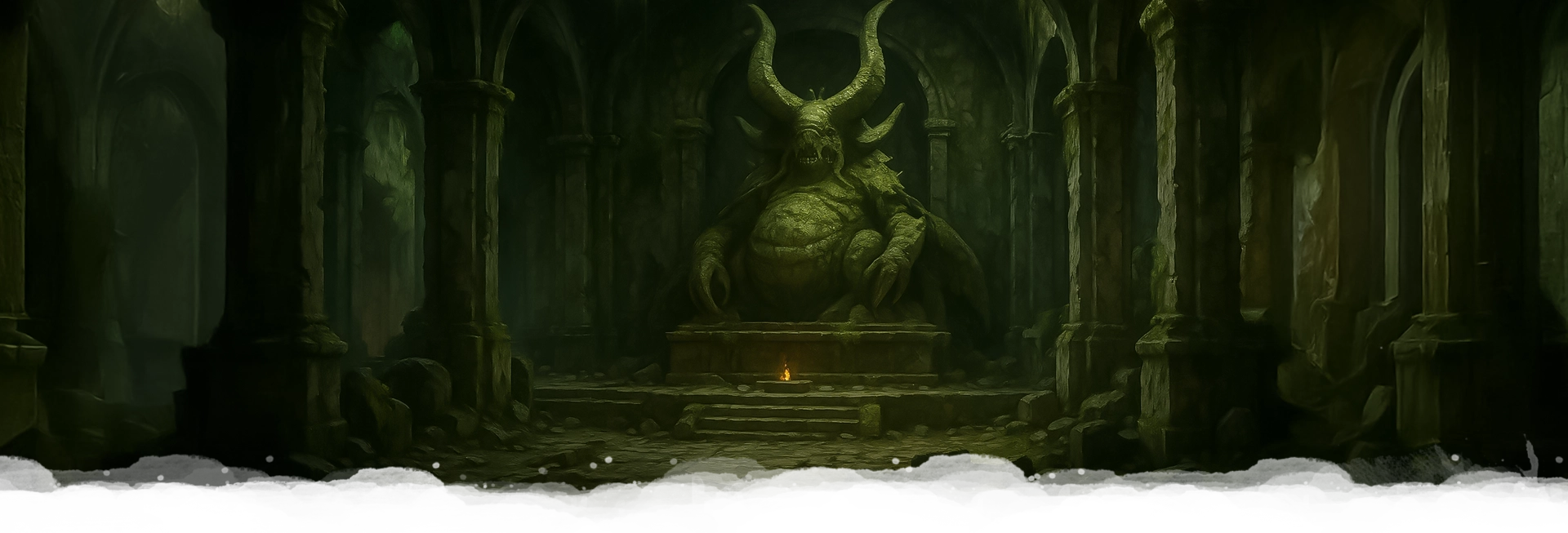
Belphegara
Belphegara, the Infernal Lord of Sloth, is the sovereign of stagnation, a hive-queen whose dominion is stillness, rot, and surrender. Where others burn with lust or hunger, she whispers that all striving is folly, that motion is illusion, and that the end of all things is silence. To those who heed her call, every burden seems weightless, every duty meaningless; her gospel is a narcotic promise that release lies not in effort, but in the slow decay of all that lives.
Sloth, in Belphegara’s creed, is not weakness but inevitability. The universe itself, she proclaims, decays toward entropy, and to resist this tide is to exhaust oneself in vain. She exalts surrender as wisdom: to let rot take its course, to allow time to unravel every bond, to sink into torpor until the self dissolves. In her doctrine, decay is not failure but transcendence; the revelation that all ambitions crumble to carrion, and that stillness is the only eternal truth.
Worshippers do not cry out to Belphegara with passion but succumb to her in resignation. She is venerated not in triumphant choruses but in long silences, in abandoned shrines, in crumbling ruins where mold spreads unchecked. Those who give themselves over to her rot from within: limbs swelling with lassitude, minds hollowing into haze. To the faithful, this dissolution is not loss but liberation, for in yielding to Belphegara they believe themselves freed from the tyranny of will.
Depiction
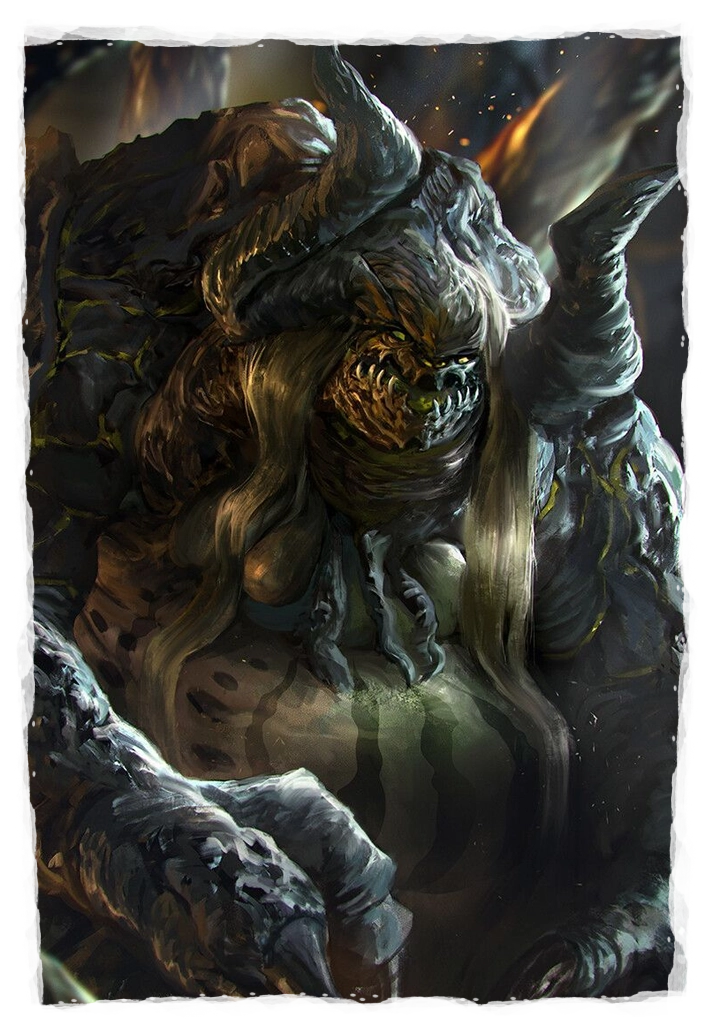
Belphegara manifests as a grotesque hive-queen enthroned upon a mound of carrion husks. Her bloated body is half-woman, half-insectile warren: swollen flesh studded with hive-like cavities where flies and beetles nest, her withered limbs dangling like forgotten roots. Her face is gaunt yet eternal, eyes clouded with milky film that drips a soporific ichor. From her slack jaws spill both spores and whispers, each word a sigh of surrender. Her wings, once angelic, have rotted into a cloak of leathery folds, hanging limp and buzzing weakly with the drone of infestation. In iconography, she is depicted not as a figure of power but as a ruinous idol: statues slumping with mold, murals fading into mildew, altars draped in fungal growth. Her sacred symbols include the broken hourglass leaking sand into stagnant pools, the fly-trap flower swallowing its own petals, and the ouroboros collapsing inward into nothing. Shrines to Belphegara are rarely tended, for neglect itself is her liturgy: mold creeping unchecked across the altar is considered the highest ornament.Tenets of Faith
The faith of Belphegara is not one of striving or triumph, but of surrender and rot. To follow the Hive-Queen of Sloth is to forsake labor, ambition, and will itself, embracing stillness as the highest wisdom. Her creed demands that mortals lay down their burdens, let decay take root, and dissolve into inertia until self and world alike collapse into silence. These three commandments form the core of Belphegara’s blasphemous faith: Rot is the True Crown. All that lives festers in time, and in that festering lies revelation. Followers are taught to let their homes mildew, their bodies waste, their souls soften into apathy. To allow rot is to honor inevitability; to resist it is to cling to illusion. Every infestation, every spreading patch of mold, every collapsing wall is a sermon whispered by Belphegara herself. Idleness is Worship. Labor is rebellion against destiny. To her faithful, every task abandoned is a prayer, every duty shirked an offering. The longer one lies motionless, the holier one becomes. Those who surrender to stupor until sores bloom upon their flesh are seen as living relics of her stillness, their bodies becoming shrines of sacred decay. Silence Devours All. Noise and struggle are lies; the universe dies not in fire, but in silence. The faithful cultivate quietude—smothering song, extinguishing ambition, lulling the restless into torpor. A mind dulled by narcotic spores, a city lulled into inaction, a temple left untended: each is an echo of her dominion. For Belphegara, stillness is the highest truth, and to spread it is the greatest blasphemy.The Withered Host
The faith of Belphegara festers within the Withered Host, a congregation less like a church than a colony of husks. Its gatherings are marked not by song or spectacle but by silence, broken only by the drone of flies and the wheeze of stagnant lungs. Worshippers are drawn from the broken and the weary: paupers too tired to labor, nobles numbed by ennui, soldiers hollowed by grief. Initiates are tested not by ordeal but by surrender, confined to chambers thick with spores until they collapse into visions of rot. Those who endure emerge slack-jawed and vacant-eyed, their will dissolved into Belphegara’s stillness. Hierarchy in the Host is measured not by ambition but by inertia. Priests, called Drones, preside in monotone, whispering sermons so dull and endless that listeners sink into stupor. At the Host’s heart linger the Reliquaries—elders so inert they no longer stir, their sores and vermin colonies revered as holy relics. To the faithful, each wasted body is a shrine, each collapsing ruin a temple, for to unmake the self is to mirror Belphegara’s gospel of decay.Practices & Rituals
Worship of Belphegara is marked by neglect and surrender rather than passion. Altars are left to mildew, offerings allowed to spoil, and temples abandoned to rot as holy sites. Congregants lie motionless for hours or days, feigning corpses while vermin creep across their skin, believing each sore or bite a kiss from their queen. The rites are not celebrations but abdications—moments where the faithful unmake themselves, letting inertia hollow their flesh and will. The most sacred observances are the Long Silence, where entire gatherings remain utterly still until weakness overtakes them, and the Feast of Spores, where mold and hallucinogenic fungi are inhaled until visions of endless stagnation fill the mind. Those who rise from these rites speak in whispers, their voices dulled, their movements slow. Those who do not rise at all are not mourned but revered, their remains left to sink into the rot as proof of perfect devotion.The Role of the Faithful
Followers of Belphegara corrode through neglect. Where they take root, work ceases, oaths are forgotten, and watchfires gutter out. A single devotee in a village may bring collapse by dulling their vigilance or by letting crop fields wither unharvested. To the Withered Host, every act left undone is an offering, every ruin born of apathy a temple raised to their queen. Their influence spreads like mold in damp stone. Courts rot into stagnation, temples crumble from disuse, and armies falter as indifference seeps into the marrow of their ranks. Faithful agents infiltrate to sew weariness and apathy: they dull the will of kings, smother the zeal of priests, and turn allies into husks of resignation. In this way, Belphegara’s servants advance her dominion without raising a weapon, for the world unmakes itself when left to her silence.Infernal Servants of Belphegara
Belphegara’s realm breeds the most pitiful and stagnant of Hell’s legions. Where other lords shape their hosts into weapons of lust or hunger, hers wallow as husks, vermin, and drones. Even among the Infernal Court, her servants are reviled as the lowest of the low — yet within the Withered Host, they are exalted as sacred reflections of her entropy. Each embodies stagnation, rot, and surrender, serving not as conquerors but as reminders that all motion ends in decay.- Lemures. Among the weakest of all Infernals, lemures slough endlessly from the hive-pits of Belphegara’s demesne. They are formless, witless, and despised even by their queen, who treats them as crawling refuse. Yet the Withered Host regards them as holy husks: creatures that have surrendered everything — mind, form, and will — to stillness. In their vacant faces, cultists see the perfection of her gospel.
- Larvae. The souls of mortals who surrendered to despair in life often curdle into larvae within Belphegara’s realm. Half-digested and worm-bodied, they writhe in heaps across her carrion chambers. Night hags barter in them, but the Withered Host regards them as sacred relics, believing each larva proof that every soul, no matter how mighty, is destined to collapse into this inevitable husk.
- Mezzoloths. These insectoid yugoloths march in plodding, joyless ranks through Belphegara’s pits. They serve as her “drones,” enforcing her will not with fury but with inevitability. Their ceaseless advance exhausts enemies into collapse, embodying her creed that all struggle ends in surrender.
- Canoloths. Squat and slavering yugoloths, canoloths guard her festering halls. They wait by carrion heaps, their tongues dragging across stone, not out of vigilance but because they cannot do otherwise. To the Withered Host, their eternal watch is sacred: patience so absolute it has rotted into devotion.
- Night Hags. Though not birthed from Belphegara’s sores, night hags thrive in her shadow. They spread her gospel in dreams, whispering visions of apathy, despair, and endless sleep into mortal minds. Among the Withered Host, they are revered as prophets of her eternal stillness, their dream-plagues considered sacred revelations.
Portfolio
Apathy, Decay, Entropy, Inevitability, Rot, Silence, Sloth, Stillness
Apathy, Decay, Entropy, Inevitability, Rot, Silence, Sloth, Stillness
Divine Classification
Infernal Lord
Religions
Realm
Children
Presentation
Feminine
Ruled Locations

Comments