
Beelzebaar
Beelzebaar, the Infernal Lord of Gluttony, is the insatiable maw of the Hells, a tyrant whose very existence is hunger without end. To behold him is to know consumption as creed, an all-devouring force that recognizes no sanctity, no balance, and no limit. He is not merely the appetite of the body, but the devouring of substance, spirit, and will—the endless reduction of all things into fuel for his feast. Where Asmodia tempts with lust, Beelzebaar enslaves with appetite, luring mortals into compulsions that strip them of dignity, purpose, and finally, their very souls.
His dominion is not confined to feasts of flesh. Beelzebaar exults in every addiction: the cup that drains yet never satisfies, the drug that burns yet promises release, the smoke that clouds the mind until only craving remains. In his creed, obsession itself is sacrament, and each dependency a prayer. The more one consumes, the emptier they become, and yet in that emptiness, Beelzebaar finds his truest worship. To be consumed by hunger is to be in communion with the Corpulent Lord.
Thus Beelzebaar is not venerated as a provider of bounty, but as the sovereign of excess and want without end. His followers gorge until their bodies swell into grotesque caricatures of themselves, until even their sense of self dissolves into the act of consumption. They become living shrines: mouths without bottom, hands that never cease to grasp, eyes glazed with need. To surrender to Beelzebaar is not to live, but to be consumed from within, one’s existence reduced to appetite made flesh.
Depiction
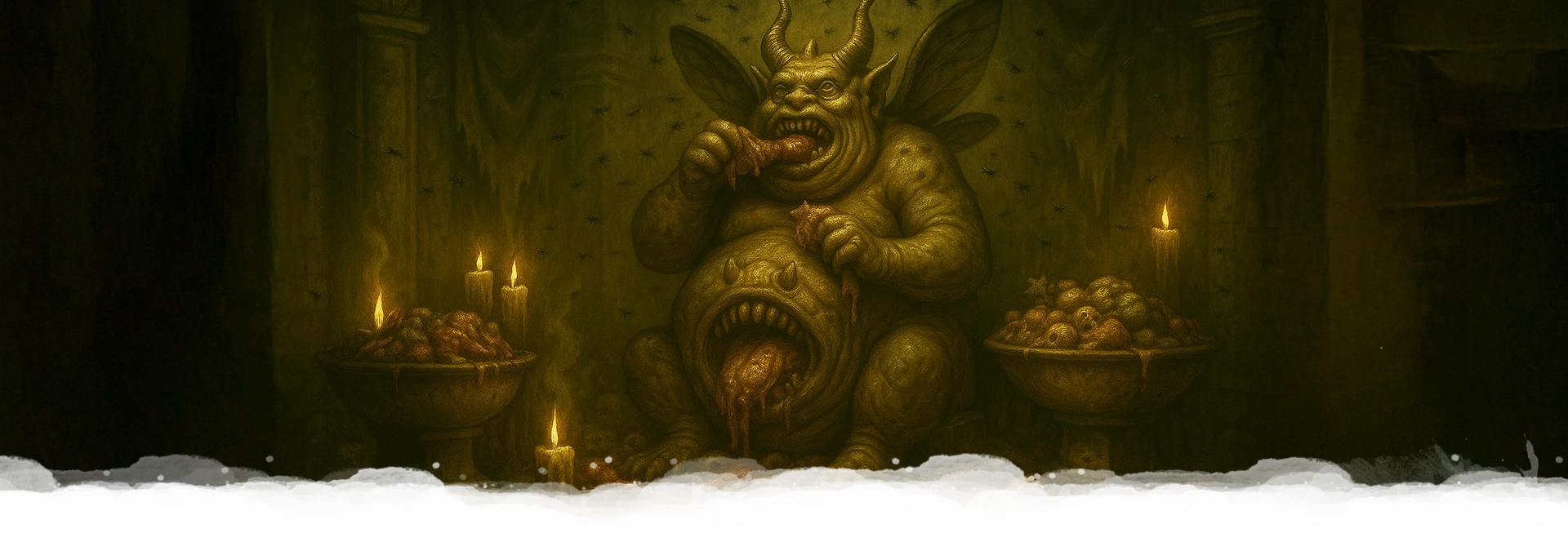
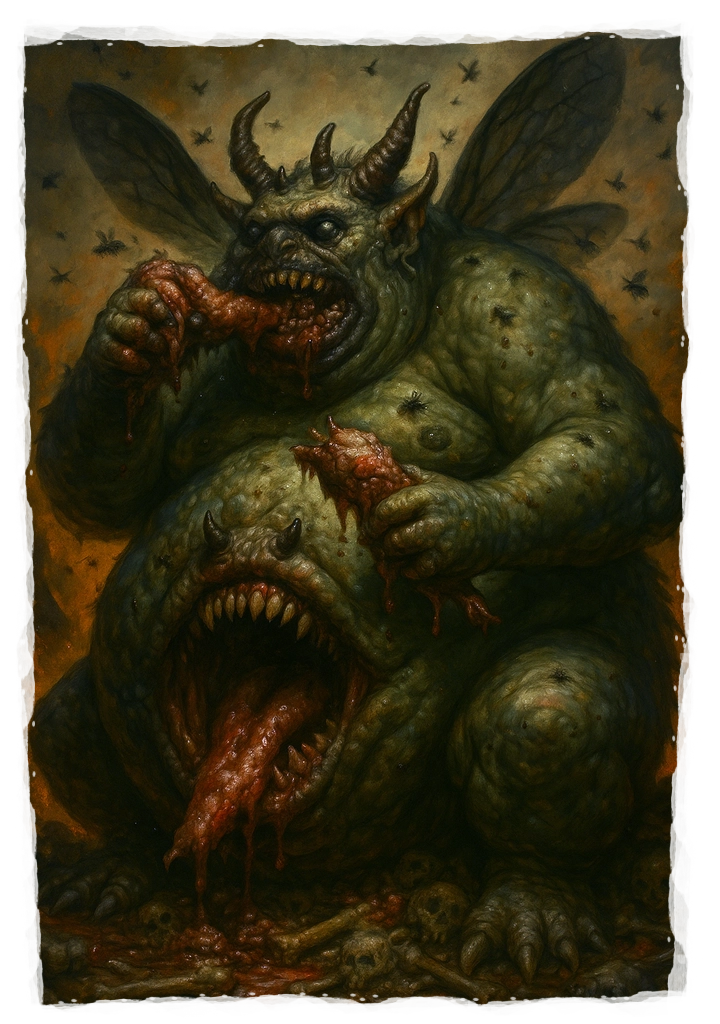
Beelzebaar is most often depicted as a bloated, monstrous figure enthroned upon a mountain of bone and marrow. His bulk is obscene in its enormity, flesh sagging in rolls that shudder and quiver with each wheezing breath. A distended belly yawns open into a second gaping maw, ringed with jagged teeth, its tongue dragging along the ground in search of morsels. Above, his face is crowned by curling, horn-like ridges, his features dominated by vast, glistening fly-eyes that shimmer with unending hunger. From his back jut ragged wings like those of a carrion insect, the endless drone filling the air with a maddening buzz that gnaws at the mind as much as the ears. In sculpture and iconography, Beelzebaar is shown clutching dripping haunches of flesh or goblets of thick, black ichor, his greasy hands raised in mockery of a blessing. Shrines to him are marked not by rot but by excess: tables heaped until collapse, wineskins that burst with overfilling, and grotesque effigies of worshippers gnawing their own swollen limbs in desperate devotion. His sacred symbols include the ever-open maw encircled by flies, or an overflowing chalice brimming with excess. Wherever his likeness rises, the faithful gather to gorge until their bellies split, to drink until they collapse, and to consume until even their hunger consumes them in turn.Tenets of Faith
The faith of Beelzebaar is a doctrine of unending hunger, a blasphemy that exalts addiction as devotion and excess as worship. To serve the Lord of Gluttony is to surrender all restraint, to gorge until the body, spirit, and world itself are reduced to carrion. These three commandments form the foundation of Beelzebaar’s creed: Consume Without Limit. Nothing exists to be preserved—only devoured. To honor Beelzebaar is to strip the world to bone and marrow, reducing bounty to scraps and scraps to ash. Followers are taught that no feast is too obscene, no indulgence too costly, no vice too forbidden. The faithful gorge not merely on food but on drink, smoke, narcotics, flesh, and even the vitality of others, believing that each act of consumption feeds their master’s endless maw. To leave behind only husks, emptiness, and silence is the holiest offering. Sanctify Addiction. Dependency is not weakness, but sacred tether. Beelzebaar’s worshippers embrace the bottle, the pipe, the needle, and every chain of need as divine sacraments. What the world calls ruin, they hail as transcendence: to waste away in intoxication, to be wracked by cravings, to let vice erode the self until nothing remains but hunger. Every relapse is prayer, every indulgence communion. To sink deeper into obsession is to walk further into Beelzebaar’s embrace. Devour the Self and the World. The maw must turn inward as well as outward. The faithful are urged to sacrifice their own flesh, dignity, and sanity at the altar of excess, feeding on themselves until they swell into grotesque parodies of their former forms. Yet their hunger does not end there—it spreads outward, consuming families, communities, even nations, until nothing is left but waste. To gorge on the world and to ruin it utterly is to mirror the Lord of Gluttony’s eternal hunger, and to become his living shrine.The Banquet of Flies
The worship of Beelzebaar does not dwell in temples of order or shrines of beauty but in the grotesque congregation known as the Banquet of Flies. It is a faith of hunger without end, where ritual and hierarchy collapse beneath the weight of consumption. The Banquet takes its name from the ever-present drone of black swarms, for the buzzing of flies is said to be Beelzebaar’s hymn, the true liturgy of his endless maw. To the faithful, that droning chorus is holier than any psalm, a constant reminder that appetite itself is divine. Devotees are drawn from every walk of life: paupers gnawing stale crusts, nobles drowning in wine, addicts chasing powders and flames, all shackled to appetites they mistake for ecstasy. The Banquet strips them of name and station alike, uniting them in excess. Initiates are driven to gorge until their bodies convulse—force-fed meat, wine, or narcotics until their minds fracture. Those who survive are exalted as vessels of Beelzebaar’s hunger, their craving made holy. Those who perish are proclaimed chosen, their emptied shells left amid the swarm as sacred offerings. In the Banquet of Flies, nothing is spared and nothing is wasted, for all excess—whether flesh, spirit, or soul—is nourishment for the Lord of Gluttony.Practices & Rituals
The rites of the Banquet are spectacles of delirious indulgence where food, drink, and powders flow without end, until the air itself quivers with sweat, bile, and the ceaseless drone of flies. Altars are heaped high with obscene offerings: platters of over-seasoned flesh, fountains of wine mixed with narcotics, and troughs of grain turned to sludge by endless hands. Gorgers—the grotesquely swollen priests of Beelzebaar—lead the congregation in chants that shake with hunger, urging their flock to consume without pause. Each chant is answered not by hymns, but by the gnashing of teeth, the slosh of drink, and the buzz of wings rising like incense to their master. The most sacred rite is The Glutting, where initiates are force-fed until collapse, their bodies writhing between ecstasy and suffocation. Those who survive are hailed as chosen, marked forever by Beelzebaar’s hunger; those who perish are proclaimed blessed, their remains offered to the swarm as holy excess. Another revered ritual is The Black Draught, a communal feast of soured wine and narcotic slurry. Drinkers fall into frenzied visions of wings, buzzing voids, and endless maws, each hallucination revered as Beelzebaar’s whisper seared into their minds. To the Banquet, indulgence itself is worship, collapse is prayer, and the line between life and death is but another course in the feast.The Role of the Faithful
The faithful serve not only as devotees but as vectors. They spread Beelzebaar’s dominion through gifts of excess: feasts for the starving, drugs for the weary, wine for the grieving. What begins as relief soon curdles into enslavement, until whole villages are bound to the Banquet through addiction. Flies swarm wherever Beelzebaar's faith takes root, seen by cultists as his watchful eyes. Those who rise within the Banquet are not the clever or the holy, but the most insatiable. Priests known as Gorgers grow corpulent with indulgence, their bloated forms revered as living icons of Beelzebaar’s will. Entire congregations revolve around their appetites, feeding them in orgiastic ritual as though fattening altars of flesh. In time, many lose all semblance of humanity, their bodies warped by excess into grotesque parodies—yet in the Banquet, such ruin is exalted, for to embody gluttony is to walk in the image of their Lord.Infernal Servants of Beelzebaar
Beelzebaar’s dominion over gluttony draws fiends whose very existence is defined by insatiable hunger and grotesque indulgence. To his followers, these Infernals are not merely servants but sacred exemplars of his creed, each one a living parable of consumption without end.- Dretches. Wretched, swollen, and pitiful, dretches are revered in the Banquet of Flies as the most honest of fiends. Their existence is nothing but gnawing hunger, their bodies bloated yet never satisfied. Though weak and despised by other fiends, cultists honor them as holy vermin, proof that all creatures—no matter how low—can serve Beelzebaar by surrendering to appetite. They swarm around shrines, feeding on scraps of rotting flesh and vomited offerings, their squeals and slobbering taken as hymns of devotion.
- Hezrou. Grossly corpulent and reeking of filth, hezrous are the enforcers of Beelzebaar’s creed. Their stench is suffocating, their strength immense, and their appetites boundless. In Banquet rituals, they serve as sacred punishers, forcing initiates to gorge themselves past the limits of flesh until stomachs rupture and veins swell with poison. Hezrous embody the lesson that indulgence is domination, for they crush and consume with the same grotesque joy, leaving nothing behind but offal and ruin.
- Nalfeshnee. Towering, swine-like monstrosities, nalfeshnees are considered the high priests of gluttony, the exalted mouths of Beelzebaar. With wings that buzz like flies and jaws that can swallow a man whole, they are said to gorge not only on flesh but on the very sins of mortals, bloating themselves on corruption until their obscene forms nearly burst. Cultists believe their guttural pronouncements are Beelzebaar’s own sermons, declaring that no hunger should ever be denied, for the act of devouring is the truest worship.
Portfolio
Gluttony, Hunger, Addiction, Overindulgence, Obsession, Consumption
Gluttony, Hunger, Addiction, Overindulgence, Obsession, Consumption
Divine Classification
Infernal Lord
Religions
Realm
Children
Presentation
Masculine
Ruled Locations

Comments