
Halls of Gluttony
The Halls of Gluttony are the infernal dominion of Beelzebaar, the Corpulent Lord, where hunger becomes an endless sacrament and appetite is exalted into torment. Within these halls, no indulgence satisfies, for every morsel devoured sharpens the craving rather than dulls it. Banquets sprawl without end across grand, grotesque tables laden with meats that writhe and fermenting wines that refill themselves, yet every bite leaves the eater emptier than before. What begins as feasting collapses into frenzy, and what begins as pleasure becomes compulsion, until even the souls of the damned are swallowed whole.
Formed from Beelzebaar’s own insatiable maw, the Halls swell with the cravings of mortals across the planes. Every pang of hunger denied, every draught taken in excess, every secret addiction feeds this realm, shaping its architecture into cavernous halls and festering kitchens. The air is thick with the smell of roasting flesh and souring fruit, a perfume that both entices and sickens. The Halls are not only Beelzebaar’s creation but also a reflection of mortal excess, a mirror of consumption without restraint. Here, indulgence does not nourish. It corrodes, until nothing remains but gnawing emptiness.
The realm itself is a labyrinth of banquets and decay, where towering tables groan under impossible feasts and rivers of grease flow through canals of fat. At its center lies Beelzebaar himself, enthroned upon a mountain of bone and flesh, his jaw working ceaselessly as he devours all brought before him. His laughter echoes as a chorus of cracking bones and sloshing guts, rolling through the halls like thunder. For those who stumble into this place, there is no escape save as meat for the feast, for in the Halls of Gluttony all things exist only to be consumed.
Geography
The Halls of Gluttony are a labyrinth without end, a twisting expanse of banquet chambers, kitchens, wineries, and charnel pits that stretch in all directions. Each hall varies in scale, some only the size of a mortal chapel while others rise like caverns hundreds of feet across, with vaulted ceilings disappearing into smoke-choked heights. The very architecture seems to breathe and groan, its walls sagging with fat, its pillars formed from fused bones, and its floors slick with grease and blood. No two halls are the same — some echo with the clash of cutlery upon endless tables, others with the screams of those worked to exhaustion before being cast into the stew. Entire wings are devoted to specialized purposes, grotesque parodies of mortal feasting halls. Towering wineries hold barrels large enough to drown an army, their casks leaking rivers of sour, intoxicating liquors. Vast pantries stretch into shadow, filled with food that rots and regenerates in an endless cycle. The great kitchens are the most feared: sprawling, furnace-lit chambers where enslaved souls labor without end, carving, roasting, and boiling meals for masters who never tire of eating. Many workers, driven past endurance or careless in their torment, are themselves seized and flung into the ovens, their bodies consumed alongside the beasts they once prepared. Movement through the Halls is disorienting by design. Corridors twist and narrow, doubling back upon themselves until travelers can no longer tell whether they are progressing forward or spiraling deeper into Beelzebaar’s belly. Charnel pits gape in sudden openings, choked with half-devoured carcasses that still twitch faintly. Banquet tables stretch for miles, laden with food that replenishes as quickly as it is devoured. To wander here is to enter a maw without end — one vast, gluttonous stomach whose appetite is eternal and inescapable.Accessing the Halls of Gluttony
To enter the Halls of Gluttony is to descend into hunger made manifest, and no path there is ever pleasant. Like all infernal dominions, the Halls are bound within the architecture of the Seven Hells, and mortals must first descend through layers of infernal courts to find their threshold. Gateways appear most often in places of excess: beneath feasting tables in fiendish palaces, at the bottom of overflowing wine-vats, or in cellars where storerooms bulge with food long past rot. These passages do not open to will alone; only infernal contracts, sacrifices of abundance, or the guiding hand of a servant of Beelzebaar can coax them wide. Often, the offering is symbolic; a noble family’s entire larder burned in tribute, or a soul cursed to eat until it bursts. Fiends bound to Beelzebaar, from corpulent Infernals to the ever-buzzing swarms of his flies, may slip between realms with ease, dragging with them any mortals ensnared by appetite. To such victims, the transition is gradual yet insidious: a banquet stretches longer and longer until dawn never comes, or a goblet of wine never empties, its taste souring until it reeks of bile. At last, the reveler looks up and finds themselves seated at one of Beelzebaar’s endless tables, surrounded not by friends but by gluttonous fiends tearing flesh from bone. Even spellcraft does not guarantee safety. Plane Shift and Gate may pierce the veil, but without the Lord of Gluttony’s leave, the traveler arrives already at his mercy, dropped into a labyrinth designed to consume not only flesh but will.Effects on Travelers
The Halls of Gluttony break down the body, piece by piece, until appetite itself becomes the only law. From the first breath taken within its vaulted chambers, the air clings heavy with the stench of spoiled meat, sour wine, and acrid smoke. Breathing it is like swallowing rot. The walls themselves drip with grease and bile, their vast surfaces etched with runnels where rivers of fat and ichor flow endlessly downward. Every sound is drowned beneath the buzzing of a million flies, filling the ears until thought itself is smothered. To step into the Halls is to feel hunger gnaw instantly at the gut, even if one has just feasted. The longer a soul lingers, the more its body betrays it. Bellies bloat, jaws ache with phantom chewing, and throats swell with a thirst that no drink can quench. Some are compelled to gorge upon whatever lies before them; platters of rancid flesh, vats of brackish liquor, or the very carrion swarms that cover the floors. Those who resist are not spared: their flesh weakens, limbs grow heavy, and gnawing cramps bend their bodies until they collapse. In time, all who remain are consumed, either literally devoured by the feasting hordes, or spiritually hollowed, left as husks that shuffle forever between the banquet tables. The psychological toll is equally ruinous. In the Halls, satiety is impossible. Every bite brings only sharper hunger, every sip only deeper thirst. The mind begins to fracture under this endless cycle, until the traveler forgets why they hungered in the first place. Identity rots away, leaving only craving. To endure too long is to become part of Beelzebaar’s larder: a soul bound not as guest, nor prisoner, but as ingredient. Even those few who escape find the hunger has followed them home, gnawing eternally from within. No banquet ever satisfies them again, for they have tasted the Lord of Gluttony’s feast, and once sated by him, nothing less will ever suffice.Flora and Fauna
The Halls of Gluttony are sustained by the endless churn of consumption and waste. Here, nothing grows from soil or seed. Instead, the very excess of Beelzebaar’s feast spawns a grotesque ecology of rot-born flora and carrion-fed fauna. This cycle is self-perpetuating: scraps fall, blood soaks, fat drips, and from this refuse new horrors blossom. Every creeping vine, every buzzing swarm, every slavering beast is born of the banquet’s leavings, existing only to gorge and be gorged upon in turn.Flora
- Fatberg Fungus. Great, pale fungi swell from cracks in the greasy floor, their bulbous caps dripping with rancid oil. When burst, these fungi release clouds of spores that induce violent, insatiable hunger in mortals, often driving them to feast upon the fungus itself, despite the poison that rots them from within.
- Wineleeches. In vast cellars and kitchens, black, wormlike roots dangle from ceilings and drip red ichor into waiting vats. These roots feed upon the bloated corpses buried in the chamber floors, distilling their fluids into an ever-fermenting liquor. The resulting drink is prized among Beelzebaar’s faithful, though each sip gnaws at the drinker’s sanity with whispers of the dead.
Fauna
- Fly Hosts. Mortals who succumbed to Beelzebaar’s hunger often return as Fly Hosts, their swollen bellies distended with thousands of chittering larvae. Clouds of black flies erupt from their mouths, wounds, and eyes, forming swarms that harass and consume intruders. The host itself continues to stumble onward, endlessly stuffing carrion into its gaping maw, unaware of its own hollow state.
- Charnel Hounds. Hulking beasts stitched from scraps of flesh and bone scavenged by infernal cooks. These malformed canines patrol the banquet halls, feeding on carrion and snapping up intruders. Their stomachs are endless pits; what they devour is never excreted, only compacted into their swelling forms until they burst, spilling half-formed pups that continue The Cycle.
- Gastrognats. Clouds of thumb-sized gnats that swarm endlessly in kitchens and charnel pits. Their bites trigger waves of nausea and thirst, forcing victims to gorge or drink whatever lies near at hand, even if it means choking on spoiled offal or bile. Once fed, the gnats lay their eggs beneath the skin, where they hatch as wriggling worms that drive the victim into further frenzy.
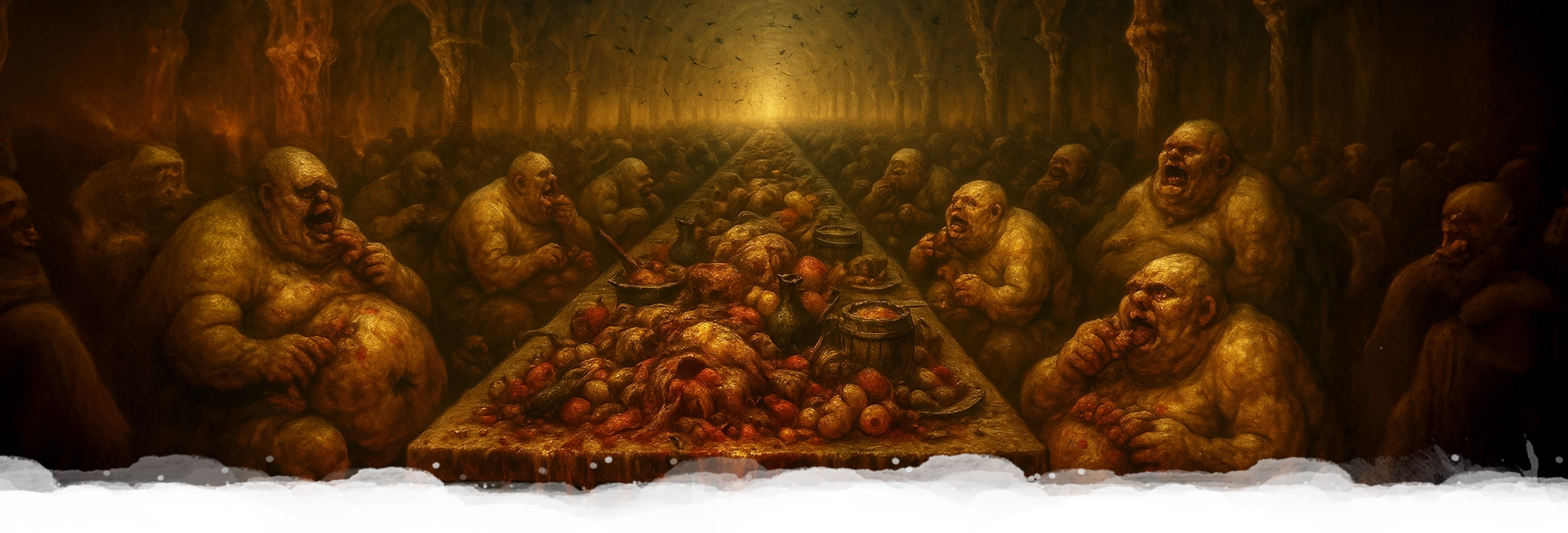
- The Guests. The Guests are the damned congregation of Beelzebaar’s banquet; cattle driven in endless processions through cavernous feasting halls. Bent-backed and slack-jawed, they slump onto stools or collapse on the floor, shoveling morsels into their mouths without hunger or joy. Their bellies swell until they burst, their bodies tumbling into charnel pits where they are boiled, butchered, or brewed into foul meats and wines. Even lesser fiends steer clear of their reach, for the Guests’ appetite is blind; many a fiendish server has been seized in a fumbling hand or swallowed whole with a chain of rancid sausages.
Death offers no release. In Beelzebaar’s kitchens the fallen are restitched into flesh, grotesque parodies of their former selves or fly-bloated husks, and driven once more into the banquet. They embody the creed of consumption without end, serving as both congregation and offering, proof that damnation itself may be devoured again and again.
Landmarks
The Halls of Gluttony are defined by three central landmarks, each radiating Beelzebaar’s essence of endless hunger. Together, they form the devouring heart of the demiplane — the banquet where he rules, the kitchens where his creed is forged, and the endless charnel halls where his faithful are processed into food.The Maw Eternal
At the center lies the Grand Banquet Hall, a cavernous chamber the size of a city, whose vaulted ceiling vanishes into a haze of smoke and buzzing flies. A single endless table stretches from horizon to horizon, sagging under heaps of rancid meat, barrels of sour wine, and mountains of glistening entrails. Here Beelzebaar himself presides, seated upon a throne of bone and fat, his presence suffusing the endless feast with unholy vitality. The Maw Eternal is not just a hall but a living thing — its walls twitch with digestive spasms, and its floor pulses with a low gurgling rhythm. When Beelzebaar rises, the entire hall quakes, and his hunger shapes the tide of the feast itself.The Slaughterhouse Basilica
Beneath the Maw stretch endless labyrinthine kitchens and slaughteryards, known collectively as the Slaughterhouse Basilica. Here the Guests are rendered down by butchers and cooks — some mortal souls pressed into kitchens until they collapse, others butchered outright to be restitched as dishes or grotesque delicacies. Massive cauldrons of boiling broth bubble with limbs, while cleaver-wielding fiends hack apart carcasses for the banquet above. The Basilica is a factory of flesh, its ovens never cooling, its butchers never resting. The stench of fat, smoke, and offal thickens the air until every breath feels like swallowing grease.The Charnel Vats
At the lowest depths lie the Charnel Vats, colossal cisterns where all waste, offal, and corpses flow. The pits churn with bubbling slurries of liquefied flesh and blood, constantly recycled into new forms of sustenance by the will of Beelzebaar. From the Vats, meat is reborn, wine is distilled from marrow, and souls are bound into writhing sausages or casks of screaming liquor. It is here that the cycle of damnation reaches its most grotesque: the Guests who fall are reduced, remade, and driven once more into the feast. The Vats never empty, for hunger itself ensures they are always full.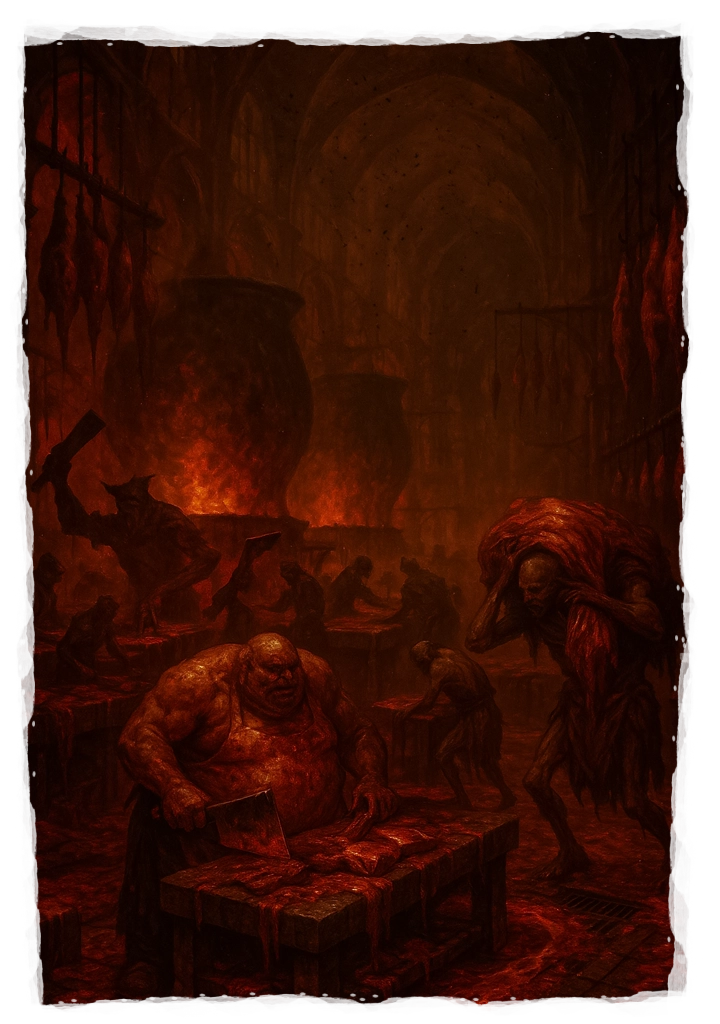
Type
Dimensional plane
Location under
Owner/Ruler
Owning Organization

Comments