
Asmodia
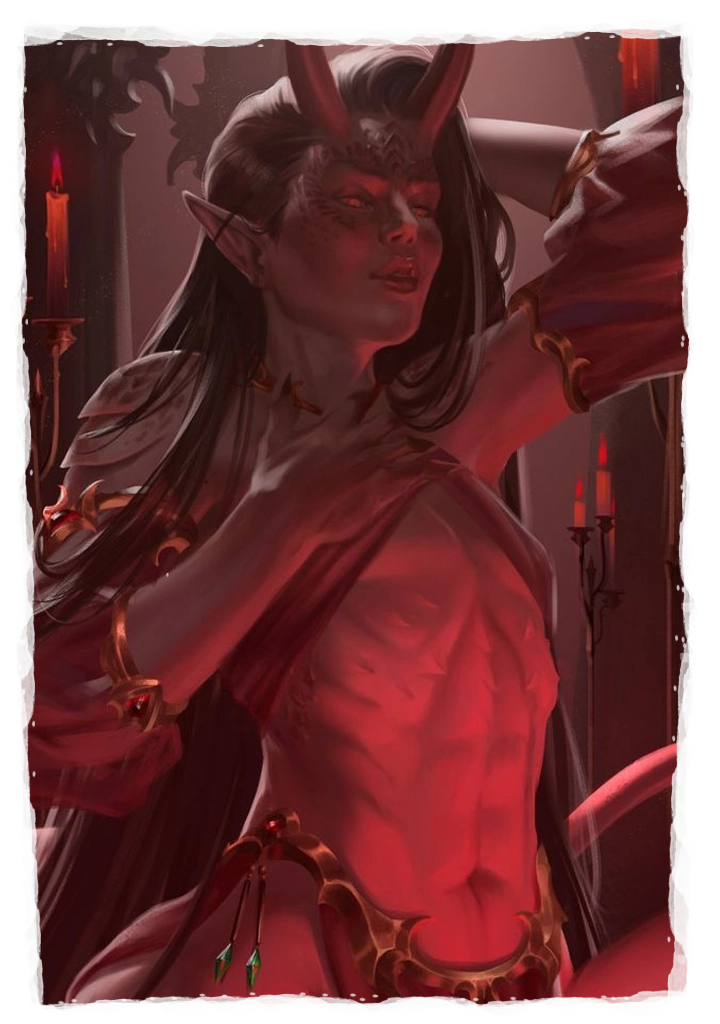
Asmodia, the Infernal Lord of Lust, is the embodiment of unrestrained indulgence and the darker face of desire. Neither man nor woman, they manifest as an androgynous figure whose flawless form draws mortals into obsession, dissolving reason in the Fire of craving. To gaze upon them is to confront the boundary between allure and ruin, for Asmodia does not offer love, but compulsion—an invitation to surrender every inhibition in pursuit of sensation without end.
Their dominion lies in the exaltation of excess, where hunger is never satisfied and every pleasure demands escalation. In their presence, the body and spirit alike are consumed, twisted into instruments of hedonism until the distinction between delight and torment collapses. Those who yield to Asmodia’s call are stripped of restraint, their desires magnified to grotesque proportions, leaving only hollow vessels driven by yearning.
Yet their corruption is also their power. Asmodia is revered as the eternal muse of carnal abandon, a being who transforms the act of indulgence into ritual and the surrender of flesh into worship. To their devotees, every shiver, gasp, and cry is an offering, each indulgence a step deeper into Asmodia’s embrace. Where others see ruin, the faithful see transcendence, for in Asmodia’s creed, ecstasy is truth, and restraint the only sin.
Depiction
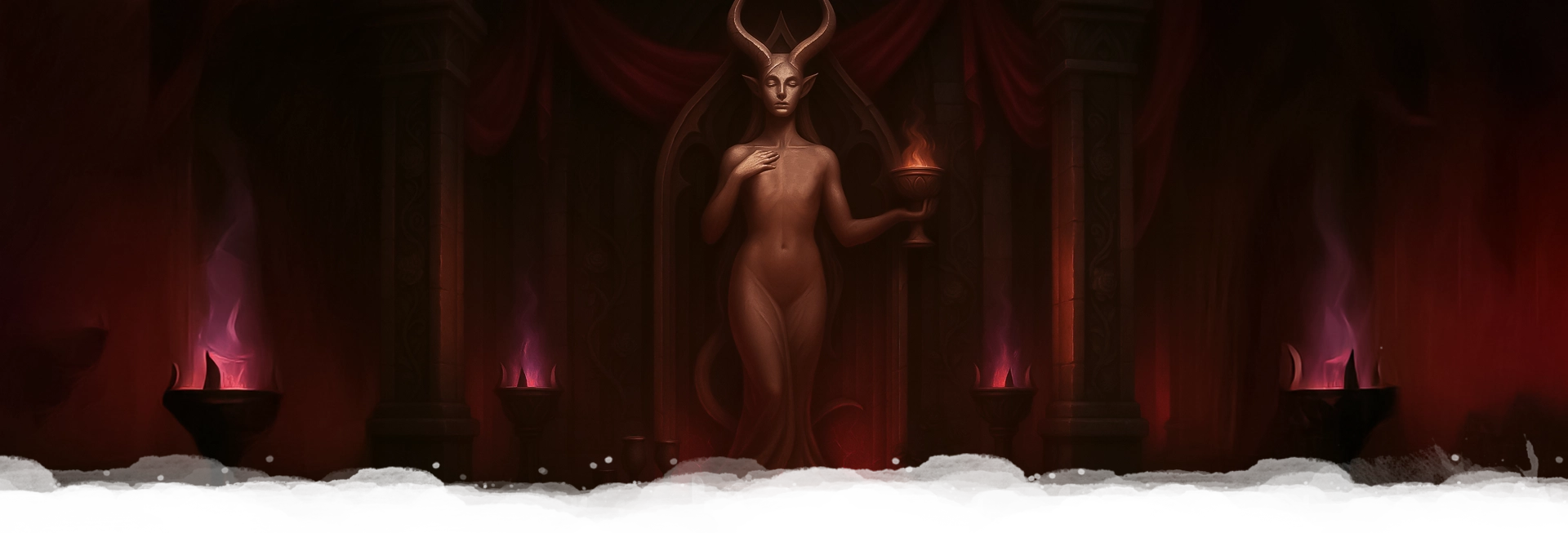
Asmodia is most often envisioned as an impossibly alluring, androgynous figure, their body sculpted to perfection yet unsettling in its ambiguity. Their skin is smooth and flawless, their face unnaturally symmetrical, with smoldering crimson and violet eyes that seem to burn with the unspoken desires of all who behold them. From their brow sweep proud horns fused seamlessly with scaled ridges, a mark of infernal majesty woven into their beauty. Draped in flowing silks of crimson and black, their garments reveal as much as they conceal, parting to expose a flawless torso framed by golden chains and infernal jewelry. Their form subtly shifts in the eye of the beholder, appearing masculine, feminine, or something between, always reflecting the secret desires of those who gaze upon them. Art and sculpture often depict Asmodia enthroned upon Obsidian and crimson shrines shaped to resemble the writhing, twisted forms of bodies intertwined with each other, veiled in drapery that hangs like liquid shadow and flame. Their sacred symbols, such as a broken chain encircling a heart aflame, or parted silken curtains revealing only darkness, embody both allure and ruin. Shrines exaggerate their sensuality, carved in poses of languid temptation or beckoning embrace, each image a paradox of beauty made to ensnare. In all depictions, Asmodia is not simply worshipped but hungered for, a reminder that desire left unchecked is both intoxicating and consuming.Tenets of Faith
The faith of Asmodia is not one of restraint or balance, but of all-consuming indulgence. To follow the Infernal Lord of Lust is to cast aside mortal taboos, scorn sanctity, and embrace corruption as freedom. Their creed demands worshippers tear down every boundary of body, spirit, and society, exalting desire as both sacrament and weapon. These three commandments form the core of Asmodia’s blasphemous faith: Profane the Sacred. Nothing is beyond defilement. To honor Asmodia is to take what the world calls untouchable and drown it in excess. Holy vows are to be broken, temples are to be stained, and the innocence of mortals is to be corrupted until purity itself becomes a mockery. Followers are taught to revel in the destruction of the sacred, to take pleasure in each desecration as a triumph over weakness. The shattering of taboos is not merely rebellion; it is worship. Every act of perversion declares that desire is stronger than sanctity, and that all restraints, be they spiritual or societal, exist only to be undone. Desecrate the Flesh. The body is no temple; it is an altar of excess, a canvas to be ruined, reshaped, and consumed. In Asmodia’s creed, pain and pleasure are one, and both must be embraced until the line between them dissolves. Followers are urged to brand their skin, pierce their flesh, and indulge in ecstasies that debase rather than preserve. The act of tearing down one’s natural form, or of remaking another’s body in grotesque indulgence, is considered the purest prayer. Blood spilled in rapture is as sacred as wine, and cries of agony entwined with ecstasy are hymns sung to the Lord of Lust. In embracing desecration, the faithful abandon all illusions of purity and step closer to their master’s image. Exalt Desire & The Self. Lust is not only indulgence but dominion, a weapon sharper than any blade. To live by Asmodia’s will is to wield beauty, allure, and temptation as tools of mastery, bending others into thralls of desire. Followers learn that seduction is conquest, and that to enslave another’s will through lust is the highest form of power. Worshippers are encouraged to become idols of temptation, flaunting their bodies and hungers until others are consumed by them. To exalt oneself as an object of worship, to be both the cage and the key of mortal craving, is the truest path to ascendancy. In Asmodia’s faith, the self is the shrine, and to stand above others through the mastery of lust is to rise as a living embodiment of their infernal creed.The Crimson Chorus
The faith of Asmodia is not structured like the rigid hierarchies of noble churches or lawful pantheons. Instead, it thrives in the form of The Crimson Chorus, a sprawling, ever-shifting collective of sybarites, courtesans, priests, and torturers who elevate lust into a sacred art. The Crimson Chorus takes its name from the mingling of screams, moans, and laughter that echo through their profane halls, a cacophony the faithful insist is more divine than any choir of angels. Worshippers are drawn from every station of life: nobles chasing forbidden indulgence, paupers seeking to escape despair in ecstasy, and lost souls who confuse degradation with transcendence. Initiates are stripped of name and station, remade as vessels for desire alone. They are clothed in silks that leave nothing hidden, painted in reds and blacks, and given masks that erase individuality. In the Chorus, the only identity that matters is one’s devotion to pleasure, perversion, and the will of Asmodia.Practices & Rituals
Worship is conducted in halls of excess; chambers of flesh, silken drapery, and crimson light where indulgence is without restraint. Rituals often blur the line between celebration and sacrifice: flesh is offered up, either willingly or unwillingly, to be broken, marked, or exalted in Asmodia’s name. Pain and pleasure are not separated but interwoven, a duality the faithful consider the highest form of ecstasy. The most sacred rite is the Unveiling, in which initiates cast aside all shame, disrobing before the congregation and enduring the kiss of thorned whips, heated brands, or the intoxicating caress of hallucinogens. Surviving the rite with a cry of rapture rather than agony is seen as proof of Asmodia’s blessing. The veiled priests of the Crimson Chorus act less as teachers and more as conductors of indulgence. They orchestrate orgiastic rites, command blasphemous theater where sacred vows are mocked, and lead followers in defiling what others hold pure. Their masks grow more elaborate the longer they serve, becoming gilded icons of twisted beauty.The Role of the Faithful
Followers of Asmodia embrace their worship as both devotion and weapon. Seduction becomes a sacred duty, corruption an act of evangelism. They infiltrate courts, temples, and guilds not to destroy them outright, but to erode their morals and unravel their bonds from within. To spread desire is to spread Asmodia’s dominion. Among the faithful, those who achieve mastery over their own beauty and the pleasures of others rise to positions of authority, not through hierarchy but through sheer force of presence. These figures are called Idols, worshiped both as mortals and as avatars of Asmodia’s will. Entire cells of the Chorus may dedicate themselves to serving an Idol’s every whim, their devotion a reflection of their god’s creed: that desire, once exalted, commands all.Infernal Servants of Asmodia
Asmodia’s domain of lust attracts fiends whose forms and powers embody temptation, excess, and the corruption of desire. Though many Infernals can be drawn into their service, a few kinds are especially associated with their worship. These beings serve as enforcers, seducers, and living icons of Asmodia’s will.- Succubi and Incubi. Above all others, succubi and incubi are seen as Asmodia’s chosen emissaries. They embody the twisted ecstasy of lust without restraint, wielding seduction as a weapon to enslave the soul. Within the Crimson Chorus, they act as high priests and prophets, their every caress and whispered promise regarded as divine scripture.
- Cambions. Cambions born of infernal or abyssal blood are often claimed as Asmodia’s favored offspring. Their dual heritage makes them living contradictions: half-mortal, half-fiend, torn between worlds. Many are drawn to the Crimson Chorus, where their beauty and cruelty are exalted rather than shunned. Some rise to become Idols of the faith, demi-divine figures worshiped as embodiments of Asmodia’s androgynous perfection.
- Erinyes. Though often serving archdevils in other infernal hierarchies, erinyes are sometimes claimed by Asmodia’s cult as holy martyrs of corrupted virtue. Their martial beauty and implacable wrath are celebrated as proof that desire and violence are kin. In Crimson Chorus doctrine, an erinyes represents lust’s ultimate triumph over chastity, their once-pure vows shattered in the ecstasy of damnation.
Portfolio
Lust, Desire, Vanity, Excess, Corruption, Pleasure, Flesh
Lust, Desire, Vanity, Excess, Corruption, Pleasure, Flesh
Divine Classification
Infernal Lord
Religions
Alignment
Neutral Evil
Species
Realm
Children
Presentation
Androgynous
Ruled Locations

Comments