

Orcus and Vanth
“I cannot fathom why anyone would choose Orcus as a refuge. Even outlaws have better options than a barren rock that eats at the mind. Yet, here they come. Perhaps misery recognizes its kin.”
The Rock and Its Shadow
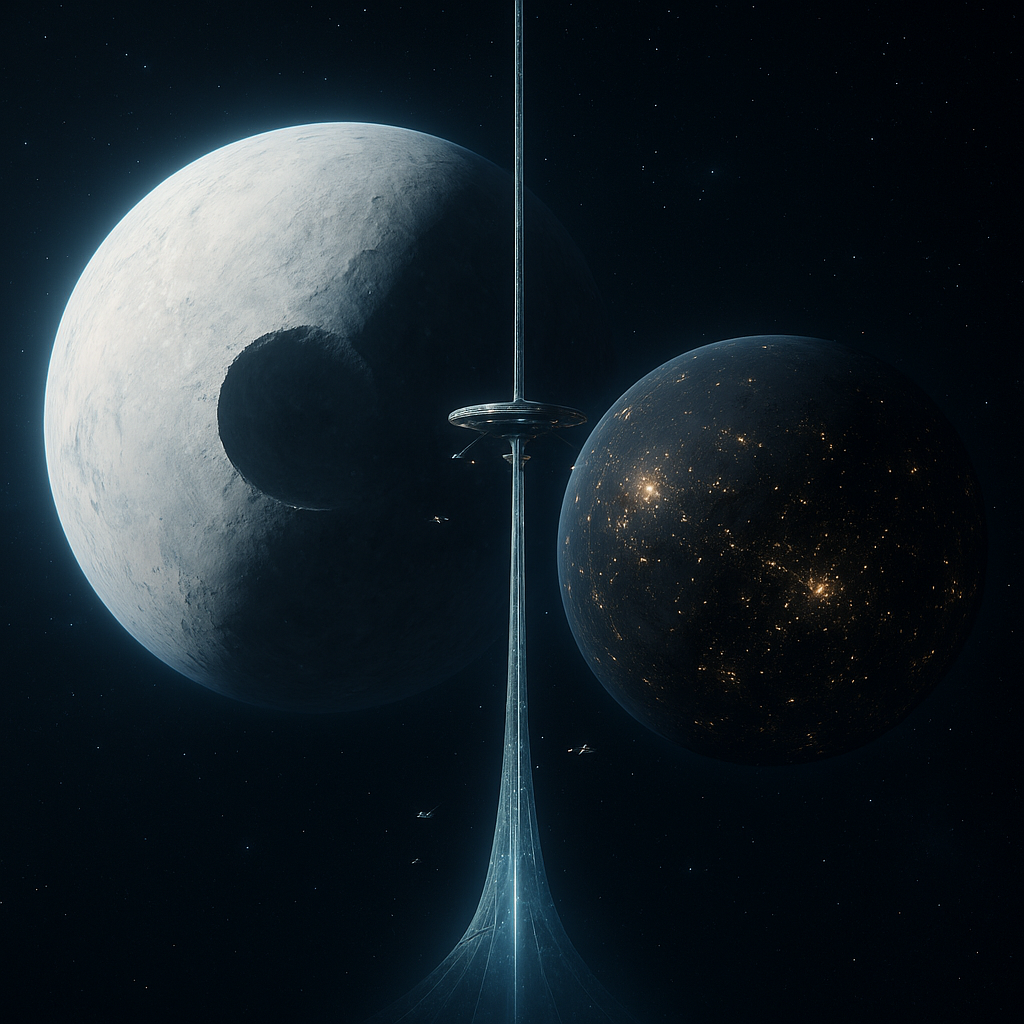
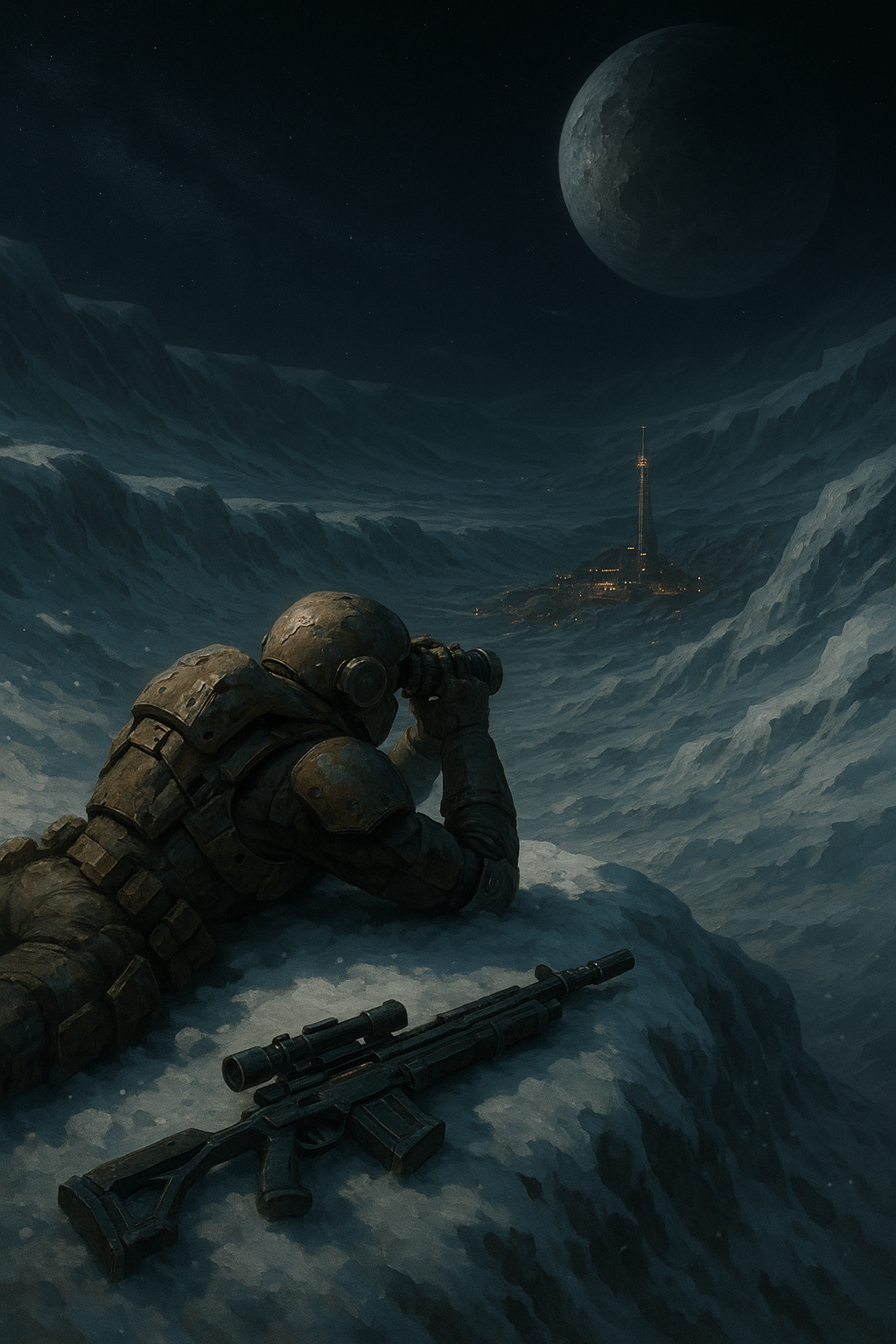
Orcus is a cold, dark dwarf planet at the edge of the Solar System, owned and administered under the joint stewardship of House Castaigne and the colony-governing AI Pheme. While the dwarf planet itself is harsh, airless, and only partially tapped by Stage I Terraforming, its rocky moon Vanth hosts the bulk of the population: tens of millions spread across dome-cities anchored in artificial gravity and recycled air. Very few—no more than a hundred—live on Orcus’s surface, tending to the space elevator, ice mines, and the array of monitoring stations near the Lens.
The world is divided into four regions: the North and South Poles, the desolate Wastes, and the enigmatic Lens—a massive listening dish carved by generations of miners into the ice and rock around the base of the elevator. The Lens is the beating heart of Orcus, and the reason House Castaigne tolerates the expense of holding it. It does not look outward, like most observatories, but instead listens to the eternal silence Spinward, where whispers come in ten-year cycles. These fragments of alien genetic codes have shaped not only the colony’s history, but its very bloodlines.
The Legacy of Merine Fenne
Colonization of Orcus has always been tenuous—repeated failures in the Great Timocracy Era left only ghost towns and rusting infrastructure. The true foundation of the Vanthine society is traced to Merine Fenne, an ordinary barkeep who became extraordinary by sheer endurance. When wave after wave of colonists gave up and abandoned Vanth, Fenne stubbornly remained, running her tavern and greenhouse as though nothing had changed. Later colonists found her still there, frying food and smiling, her lights burning alone in the darkness.
From her refusal to leave grew a stubborn kernel of culture: to stay was to be Vanthine. Those who endured became the nucleus of a society both pragmatic and scarred, eventually joined by fresh migrations in the Solar Commonwealth Era. Even today, statues and murals across Vanth portray her as a matronly figure—part saint, part anchor, the symbol of defiance against despair.
The War of Angels
The relative peace of Vanth was shattered in Year 73, when the so-called Remnants—genetically resurrected beings drawn from the alien Lens signal—rose to power. Taller, winged, luminous, and addictively sweet-scaled, they inspired both awe and zealotry among humans. Cults bloomed, hybrids were born, and soon weapons of hyperspace energy appeared in their hands. What followed was a brutal insurgency that nearly annihilated House Farfare and forced the Solar Defense Fleet into retreat.
It was Haus des Drachen who ultimately broke them. In a single day-long campaign known as the Siege of Angels, they shattered the space elevator, eradicated the clone-vats, and led a storm of synths and warriors into Vanth’s domes. The battle entered their heraldry as dragon-knights slaying radiant angels with sword and spear. Though victorious, they had little desire to remain. Orcus was transferred by dowry to their allies, House Castaigne, who saw more value in the Lens than in conquest.
The Lens and Pheme
The Lens is no mere dish—it is a generational obsession, carved from Orcus itself, polished with crystalline overlays, and tuned to frequencies painful to human ears. It repeats a signal every decade, fragments of chemical code—DNA, sugars, polysaccharides—like a universal Rosetta Stone for biochemistry. Whether it was a desperate beacon of a dying species or an invitation to future contact, none can say.
The raw flood of data is catalogued by Pheme, a ruling AI named after the goddess of rumors. She has been granted equal authority with the Castaigne Technocrat, a dual stewardship that balances human ambition with cold computation. Pheme’s massive server-vaults sort through centuries of accumulated fragments, cross-referencing, simulating, and listening for hidden harmonics. Her pronouncements carry the weight of law on Orcus, and her influence has grown into cultural mythology: the whisperer in the walls, the keeper of secrets.
The Vanthine People
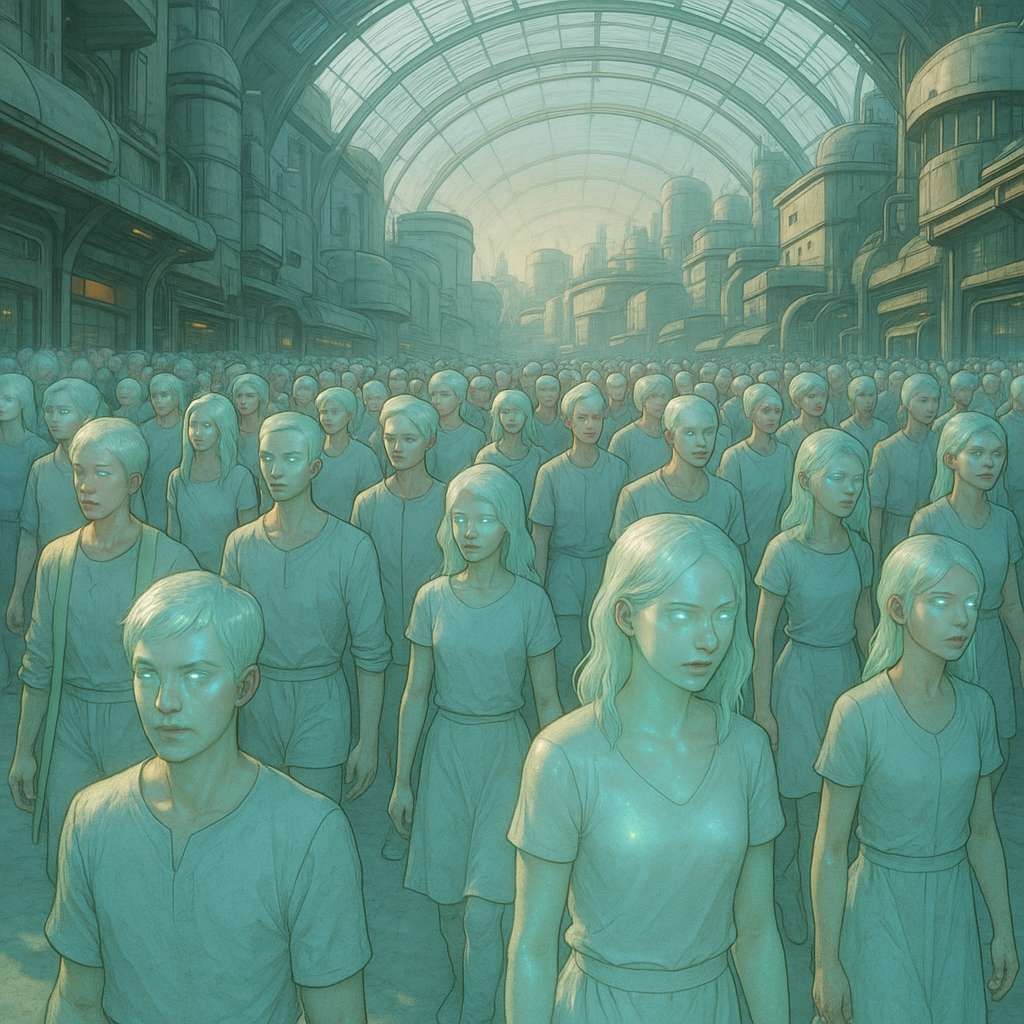
The people of Vanth bear the legacy of their alien entanglement. Though their wings are gone, they are tall, luminous, and unsettlingly symmetrical. Their hair and nails are iridescent filaments, faintly sweet and mildly addictive, shedding like the scales of their angelic forebears. Their chromatophores allow them to alter their skin tone or glow faintly, an echo of the Remnants’ radiance. These traits make them striking, even beautiful, to outsiders—but to many Houses, they are reminders of dangerous taint.
Their ethics are shaped by utilitarian pragmatism: an individual matters only in what they contribute. The old are the first to be called to militia defense, honored for dying once their “usefulness” is spent. Funerary rites are minimal; lives are measured by productivity, not sentiment. Outsiders often recoil at this stark view, yet within Vanth it is seen as honorable, even merciful. In architecture and art, their three great motifs endure: Merine Fenne’s kindly visage, radiant angels, and dragons that slay them.
A Paranoid Isolation
Today, Orcus is isolationist, poor in atmosphere and wealth but rich in secrets. Vanth is crowded with dome cities lit by artificial gravity plates, their citizens resigned to duty under the dual rule of Castaigne and Pheme. Trade is minimal, morale is weary, and reputation is suspicious: they are seen as a people forever marked by alien zeal. Yet Orcus remains important—not for its paltry resources, but for the Lens.
The paranoid still whisper that the Lens is not a beacon but a trap, bait for any species foolish enough to decode it. The Castaignes deny this, of course, and Pheme’s inscrutable logs reveal only what she chooses to share. Still, Orcus endures, glowing faintly violet in the void, a paranoid world balanced on the edge of secrecy, alien legacy, and whispered paranoia.

Comments