

Rome
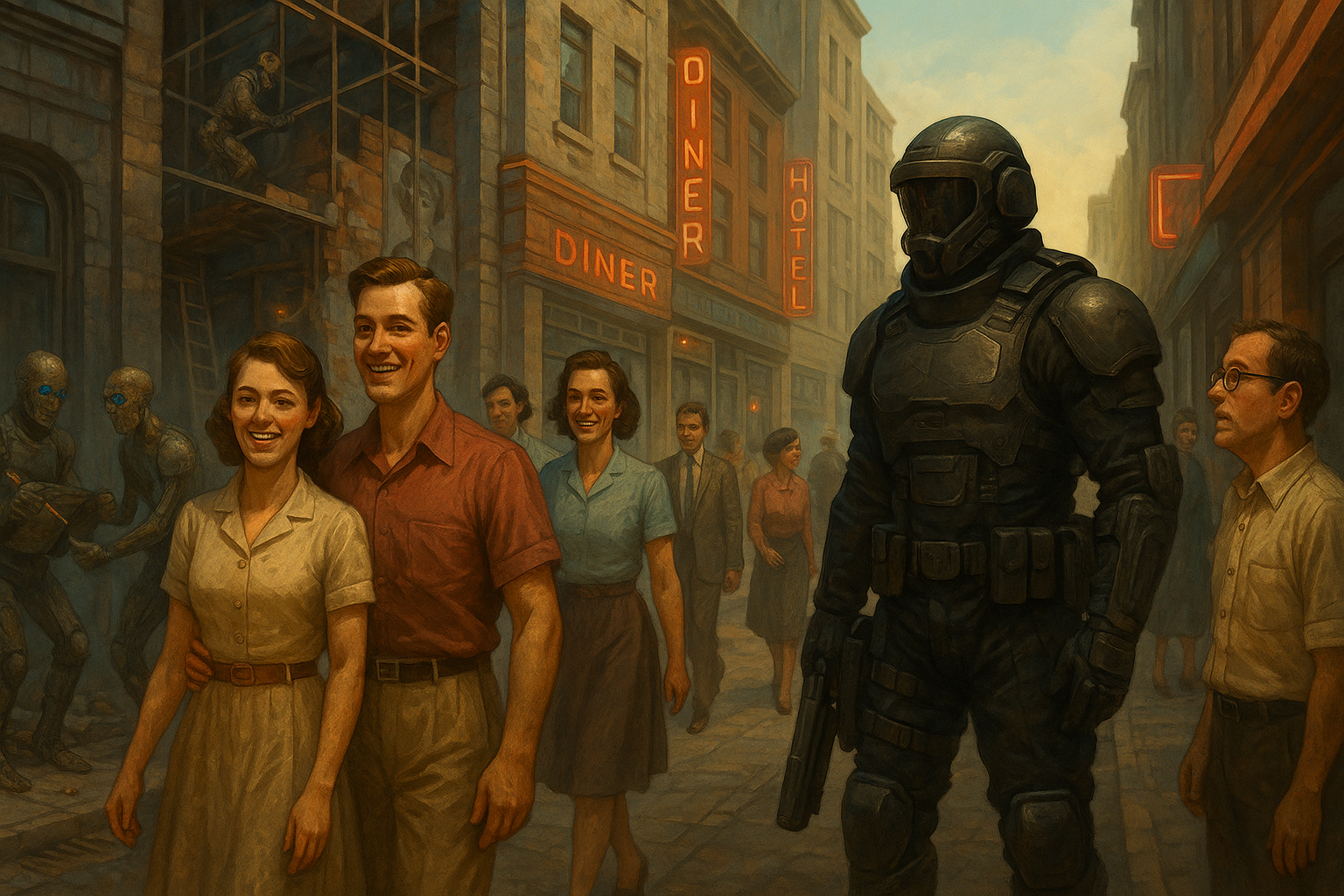
"It’s a strange place, Rome. You’ll see families in clean jumpsuits sipping coffee on neon-lit balconies, then walk three blocks and find a man nerve-stapled and marched off like it’s nothing. Everyone’s polite, but it’s not decency—it’s terror, dressed up in civility."
The City of the Veil
Rome sprawls across Eris’s western hemisphere in concentric rings of neighborhoods, boroughs, and administrative hubs, all built with cold precision around purpose. At its heart lies research into the deepest horrors of Redspace: Tillinghast Resonators that thin the veil, cells where Redspace Adversarial Intelligences are trapped and interrogated, and surgical suites where Perfect Vessels are cultivated or dissected. Every road, every rail, every Necroid servitor’s motion serves these ends. The city’s culture is not anarchic like Ixion’s slums or flamboyant like Reme’s sprawl—Rome runs with eerie order, the kind of order enforced by omnipresent fear.
Surveillance and Submission
Citizens of Rome live in neighborhoods that feel superficially “normal.” They rise for work, attend civic meetings, and even participate in modest festivals. But this veneer hides suffocating control. Every resident is required to log their thoughts and feelings daily, either in real time or in a written submission. Failure to comply—or worse, deceit—is met with invasive cerebral implants that record emotions and cognition directly. These “nerve staples” transform citizens into nodes of the surveillance state, their private selves stripped away and their every thought commodified.
The Law of Volkert
Justice in Rome is quick and absolute. House Volkert enforcers serve as investigator, judge, and executioner in equal measure. Trials, appeals, or juries do not exist; instead, a single Enforcer examines evidence and delivers one of three sentences: a rare warning, immediate execution, or nerve stapling. The logic behind this brutality is framed as necessity. Any Criminal act, no matter how small, might stem from subspace contamination rather than ordinary vice, and in a city where the veil between worlds is thinnest, Volkert claims it cannot afford to hesitate.
The Polite Mask of Terror
To outsiders, Rome may seem almost utopian—its avenues clean, its citizens orderly, its markets well-stocked, its Necroid servants eerily efficient. Visitors might think the residents naïve or unworldly compared to the schemers of Ixion or the mercenaries of the Wolf System. But this “naivety” is only the product of omnipresent fear. Citizens smile, not from kindness, but because they know one wrong expression, one careless word, can end their lives. The politeness of Rome is not courtesy—it is survival.
The Heart of Contamination
Rome sits at the most dangerous nexus of subspace corruption on Eris. The city’s very foundations tremble with Redspace bleed, and hallucinations, whispers, or sudden fits of violence are common. Volkert insists its controls are effective, but the truth is Rome is perpetually on the edge of a breakdown. Necroid patrols march in armored ranks, enforcing the calm. Tillinghast fields hum in the background, warping physics. Citizens trade rumors of experiments gone wrong, of things seen out of the corner of the eye. For the outside world, Rome is a fortress of research. For its people, it is a cage built on the fault line of reality itself.
Role in Eris
Rome provides House Volkert with its most valuable intellectual capital: discoveries in Redspace manipulation, Necroid engineering, and the subversion or study of Perfect Vessels. It is Eris’s crown jewel of horror, the place where the future of humanity might be redefined—or destroyed. The bureaucracy of Volkert ensures Rome functions like a model city, but beneath the surface it is a laboratory first, a community second, and a prison always.

Comments