

Scientific Conclave
"At my last Conclave presentation, I unveiled a new synthetic design, anticipating a spirited critique from my peers. What I did not expect was a Université de Vénus theater major—present as someone’s guest!—to interrupt with a scathing counterargument about neural aesthetics. After a... brief detente we started the argument right back up over coffee the next morning. That’s the Conclave for you—more chaos than congress, but somehow we stumble toward progress."
A Disorganized Guild of Necessity
The Scientific Conclave is less an institution than an ecosystem, a chaotic ‘guild’ that arose out of necessity rather than deliberate planning. In the Age of Convergence, science is not confined to laboratories and universities—it is spread across corporate research divisions, planetary academies, independent museums, freelance scientists, scientifically-coded cults, and lone eccentrics armed with half-brilliant, half-deranged theories. All of these find common ground in the Conclave.
Though it claims no headquarters and has no permanent council, the Conclave functions as a recognizable body. It maintains credentialing, offers a 0+S License (granting trusted members access to restricted Materials for research), and convenes conventions where debates are settled, alliances forged, reputations built—or destroyed.
The Nature of Membership
Membership is simple in concept, but difficult in practice. To join, a scientist must be recognized by peers already within the Conclave, a peer-review process that is as much about politics as merit. Corporate and university researchers are sponsored easily; freelancers and cultists often claw their way in through spectacle, memetic campaigns, or sheer persistence.
To maintain standing, one must contribute regularly—publishing, presenting, or at least attending conventions. Falling silent is grounds for quiet removal, while misconduct risks public disgrace. Despite its looseness, social pressure and reputation serve as the Conclave’s enforcement mechanisms.
The Conventions
Conventions are the lifeblood of the Conclave.
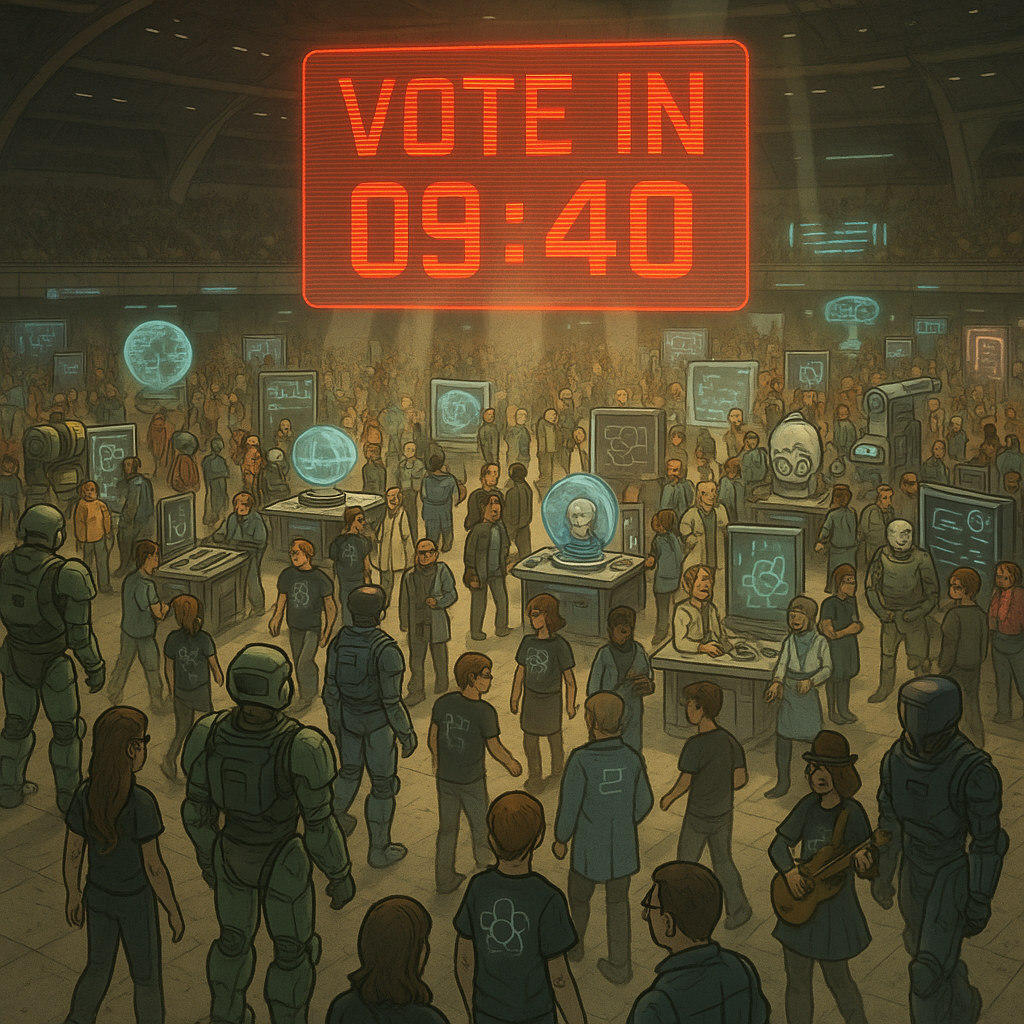
- Planned Conventions are scheduled years in advance, typically hosted by planetary universities or major cities. These gatherings resemble vast scientific carnivals: central halls where serious debate unfolds, surrounded by expos where engineers unveil new devices, mathematicians chalk out proofs, biologists show off strange specimens, and cults proselytize with the fervor of revivalists. Corporations, militias, and military envoys attend to quietly poach discoveries for weapons or infrastructure.
- Emergency Conventions—billed as breaking conventions—are assembled when discoveries are too dangerous or important to be left to one body. Always hosted in planetary universities, these gatherings prioritize speed and access over pomp. They are intense, combustible events where rival factions scramble to frame consensus before governments or corporations seize control.
Both types of conventions carry a festival atmosphere. After the serious debates, streets fill with scientists, academics, and engineers on holiday—eager to sample the host city’s food, music, and nightlife. For local economies, a Conclave convention is a windfall of tourists with generous stipends and obsessive interests.
Skullduggery and Competition
The Conclave’s unity is more fragile than it appears. Behind the open displays of cooperation, skullduggery abounds. Corporations send agents to sabotage rivals; cults insert sleeper members to Twist debates in their favor; freelance researchers attempt intellectual theft. Sabotage may be as simple as a misplaced data core or as dramatic as a memetic countertheory launched mid-presentation.
At its best, the Conclave is a crucible of ideas. At its worst, it is a circus where theatrics outweigh rigor. Yet, despite all of this—or perhaps because of it—it endures as humanity’s most essential engine of shared knowledge.
The Value of a License
A 0+S License (Omniscient + Scientific) is the Conclave’s most valuable service. This credential marks a member as trusted not only by their peers but by society at large. With it, one can requisition almost any substance or tool—from antimatter samples to Redspace-tainted Materials—for sanctioned study.
Earning such a license requires years of trust, sponsorship, and demonstration of responsibility. Those who hold one are simultaneously envied, resented, and watched closely, for the abuses of a single license-holder could imperil the credibility of the Conclave itself.
Reputation of the Conclave
To outsiders, the Scientific Conclave is a mess of clashing egos, anarchic debates, and occasional brawls in cafes. To insiders, it is the only space broad enough to allow all branches of human curiosity—corporate, academic, freelance, cultic, or mad—to collide in one chaotic whole.
Progress is not always clean. Sometimes, as Academician Jall suggested, it begins with a punch thrown over coffee.

Comments