An immense school situated in a remote part of the
Rhegev Desert, Tulara University has resisted political influence and remains much the same, culturally, as it has for the last few centuries. It is a very conservatively bent settlement, with people inclined to wear concealing clothing that can even include veils for women, and traditionally patterned
keffiyeh for men.
The city that grew up around the core university buildings has encompassed and overgrown the original campus to the point that the entire city is considered "The School" to alumni. Any hovel, building, workshop or warehouse may, at any time, be part of a school project, or filled with school records while a storeroom is being painted, etc. The university is the landlord, owning all of the buildings in the city.
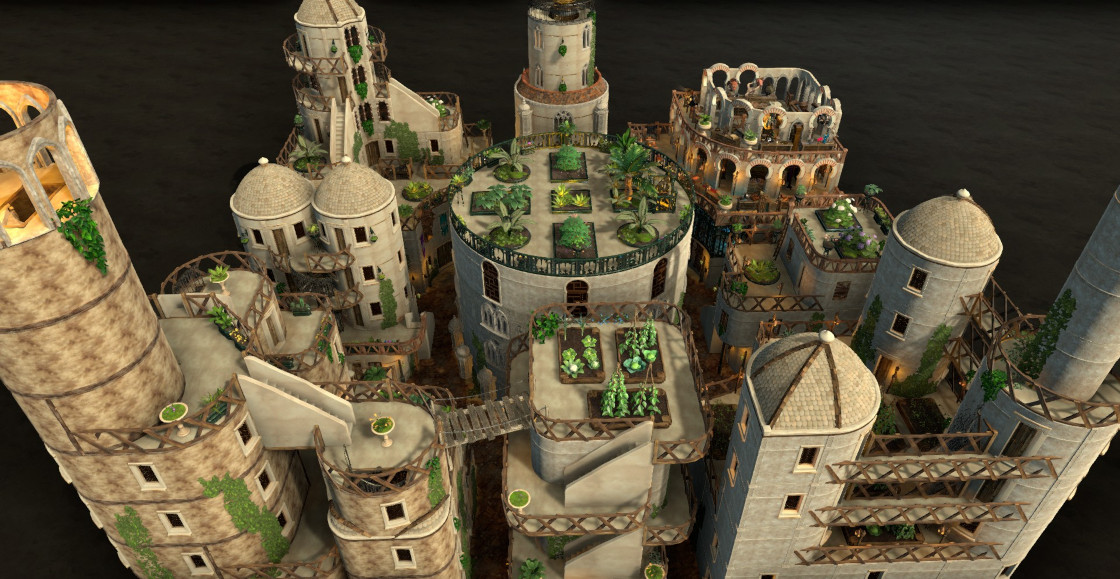
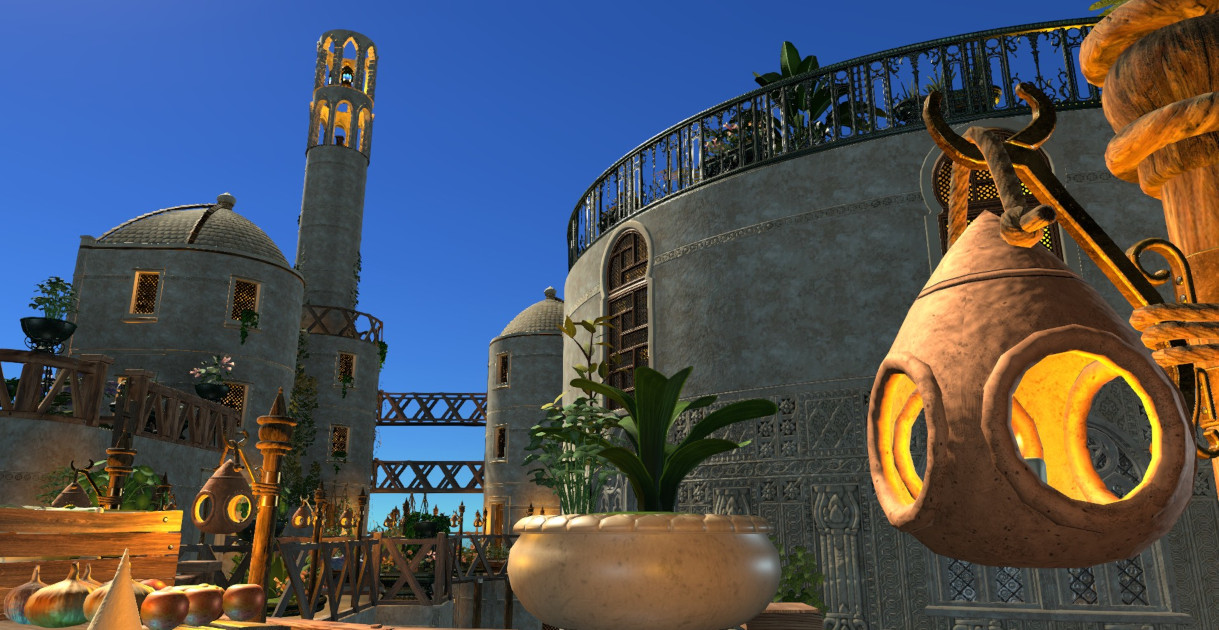
The city is built to a design, for the most part, and constructed with the comfort of its residents in mind. To this end, many of the buildings sport rooftop gardens that keep the interior of the construction cool while simultaneously providing fruits, vegetables, and herbs to supplement their diets. Fruit trees are common throughout the city; date and banana palms proliferate freely by the sides of roads and people are encouraged to eat from them. Beans, squash, and corn are grown together in patches that grow to be tall pyramids, with the beans growing around the stalks of the corn, shading the squash beneath.
The city has grown skyward as much as, or maybe even moreso, than it has outward. The need for residential space became such an emergent situation at one point, that students were being housed in laboratories and workshops. The housing crisis, as it was called, was resolved by building upwards; towers and multi storey apartment complexes, accessed through myriad means, were built. Within the space of five years there was no more housing crisis; and, in fact, the city provides housing free of charge to its students.
Tulara is one of the most diverse conglomerations of people on the planet, featuring a healthy mix of humans, elves, tieflings, lizardfolk, and yes even gnomes! Every race on
Tellus has been represented here, at one point or another in the school's vast history.
Ostensibly led by
Sheherizade the Temptress, the Sultana nevertheless spends much of her time at her
Palace deep in the desert. The day to day affairs of the school are run by the
Circle of Fyfths, a council of five advisors who have been entrusted with various governmental tasks about the city and school.
Buried golems, ancient traps, and rumored magicks all protect the city in various ways and means.
Scholarship and teaching: The University itself is an “industry”: it brings in tuition tributes, foreign students who bring familial wealth, and scholarly commissions from governments and other universities.
Manuscript production: Copyists, illuminators, and binding workshops churn out texts for nobles and scholars across Taisha.
Glasswork and Sandcraft: The city is renowned for clear desert glass, blown into lamps, lenses, and intricate vessels. The science involved in making it is quite precise.
Brass and precision metalwork: Astrolabes, compasses, surgical instruments, and clockwork; all examples needfully blending artistry with science.
Incense and Perfume distillation: Local Sealgair Glainne traders refine desert resins into perfumes and prayer incense, highly sought after abroad.
Salt Processing: The desert’s “white gold" is blocked, cut, stored, and sold in bulk.
Supporting / Everyday Industries
Oasis Farming: Dates, figs, and olives from carefully irrigated gardens. Herbs and mineral spices are also gathered near oases.
Herbal Apothecaries: Desert remedies, tinctures, and medicines are sold by everyone from chemists to witchwives.
Stonecutting & Masonry: Essential for building and maintaining sun-resistant housing and shaded courtyards.
Textile Weaving: Robes, turbans, and veils made from desert cotton and imported silks, often dyed in subtle sands and golds.
Ceramic & Pottery Wares: Heat-resistant vessels for storage, often etched with geometric motifs.
Imports
Grain: Too arid to produce in bulk, so it flows in by caravan.
Timber: Rare in the desert, brought from distant riverlands.
Beasts of Burden: Camels are bred locally, but fine horses and mules must be imported.
Luxury Cloth: Silks, velvets, and deep-dyed fabrics for the wealthy.
Paper: Though some is made from desert reeds, high-quality parchment and foreign papers are imported.
Exports
Scholarly Works: Copied manuscripts, legal codices, maps, and philosophical tracts.
Desert Glass: Highly prized by collectors and foreign courts.
Incense & Perfume: Burned in temples and palaces across Tellus.
Salt & Minerals: A steady trade staple, keeping caravans coming and wealth flowing.
Knowledge Contracts: Foreign rulers “sponsor” their heirs at Tulara, creating webs of allegiance that act like trade deals.
Trade Partners
The Unified Kingdoms of Craysilt
Imports to Tulara: Grain, timber, fine textiles, and finished steel.
Exports from Tulara: Manuscripts, incense, desert glass, and salt.
Relationship: Formal but tense. The wars in @Pax have cooled trade significantly, forcing prices up.
The Dwarven East Mercantile Company
Imports to Tulara: Master-forged tools, weaponry, and structural metals.
Exports from Tulara: Rare perfumes, desert crystals, contracts for scholarly works.
Relationship: Mutually cautious. The dwarves see the Circle of Fyfths as overbearing but useful gatekeepers; Tulara sees the dwarves as indispensable but dangerously independent.
Coastal cities of Taisha
Imports to Tulara: Sea silk, coral dyes, luxury items, exotic foods.
Exports from Tulara: Salt (especially for preserving fish), desert glass, scholarly records of navigation and astronomy.
Relationship: Competitive. Taishan merchants try to bypass Tulara’s middlemen whenever possible, but the Circle controls key caravan routes.
Nomadic tribes of the Rhegev Desert
Imports to Tulara: Camels, desert horses, survival skills, and raw desert lore.
Exports from Tulara: Coin, crafted goods, food reserves during drought.
Relationship: Complicated. The Circle views them as semi-barbaric but necessary. Many tribes see the University as parasitic yet still offer tribute.
The Kingdom of Greynor
Destroyed in 5802NG, Greynor had been a supplier of fine silks, delicately colored dyes, and exquisite wines. These things have all become terribly expensive in Tulara.
The city's infrastructure is vast, including circulation tunnels and cisterns that are not common knowledge. It owns all of the land that has been built upon, and contracted the construction crews that fabricated the homes, businesses, and towers.
The city is built with space in mind, with most people living in relatively small quarters, those environs getting smaller and smaller the further up one goes. Everything is built of mud over stone frameworks, lending a thick layer of insulation to each building. Air catchers and rooftop gardens help keep each house stay temperate, while cool, circulating air provided by the city completes the air conditioning process. The city also provides water and food for each person living within its confines, although many people grow their own herbs and vegetables to supplement their diets. Fruit trees are grown roadside by the city, and people are encouraged to pluck and eat of them.
Garden District
Candlewright District
Tanners Row
Cartwrights Block
Sandgate
Lanternveil
Scholars Quarter
The Old Cistern: Vast subterranean water reservoir, both lifeline and potential point of sabotage.
The Cooling Shafts: Ancient mechanical system that ventilates and cools whole streets in summer heat.
Sandgate Caravanserai: Enormous walled rest-stop for caravans, with stables, wells, and trade courts.
The Stonebridge: An engineering marvel spanning a dry gulch, doubling as a bustling market street.
Desert Watchtowers: Beacons at the edge of the city that light signal-fires to warn of raiders.
Economic Assets
The Brassworks Foundry: Produces precise tools, locks, and desert instruments (astrolabes, compasses).
Salt Vaults: Cavernous storage for processed desert salt, the region’s “white gold.”
Incense Bazaar: Market hub for rare resins and perfumes, traded to distant courts.
Sandglass Guildhall: Artisans who craft delicate glass from desert sands; highly sought after abroad.
Water Rights Registry: The city’s most lucrative bureaucratic office, controlling access to cistern draws.
Cultural & Intellectual Assets
The Grand Archive Annex: Public-facing wing of the University library (scrubbed of forbidden texts).
The Garden Courts: Walled oases used for scholarly debate and public lectures.
Hall of Orators: Amphitheater where rhetoric, law, and philosophy are performed before audiences.
The Lantern Festival Grounds: Place of rare festivity where colored lanterns mark the solstice.
Circle Hall: Imposing stone chamber where the Circle of Fyfths addresses the town in formal convocation.
Controversial Assets
The Ashuun Seal: An artifact buried beneath the cistern, rumored to bind something ancient.
The Whispering Galleries: Collapsed tunnels said to carry voices of those who speak in the University’s vaults.
Djinni Pacts: Old contracts inscribed on stone, giving the Circle leverage over elemental beings.
The Red Ledger: Secret accounts tracking bribes, tributes, and payments from foreign powers.
Forgotten Wells: Sealed, buried access points to deep desert water. These are both dangerous and priceless.
Respectable Guilds
The Sandglassmakers’ Guild: Makers of glassware, lenses, and delicate sandclocks. Jealously guard their techniques; apprentices swear oaths of secrecy. Known for sponsoring scholarships to curry favor with the Circle.
The Copyists’ Confraternity: Hundreds of scribes who copy manuscripts for the University and foreign patrons. Split by quiet rivalries over accuracy, calligraphic beauty, and the “truth” of translation, their hall smells permanently of ink and newly sanded parchment.
The Saltwrights’ Guild: Control trade in desert salt; both preservation and coin of the realm. Brutal in enforcing monopoly; smuggling salt without their mark is punishable by exile.
The Caravan-Bearers’ Fellowship: Guild of camel-drivers, muleteers, and caravan guards. Equal parts mercantile and martial, since the desert is full of raiders and djinn. Rumored to run a shadow-network of news and contraband.
Academic & Esoteric Factions
The Circle of Sand & Star: Astrologers and desert navigators who provide services to caravans, but also whisper predictions in court. Distrusted by the Circle of Fyfths, but tolerated for their accuracy.
The Custodians of Ashuun: Secret sect within the University, sworn to keep the seal on the ancient cistern intact. They pose as archivists or janitors; in truth, they are guardians of a hidden danger. Individuals occasionally disappear mysteriously.
The Lantern Bearers: A civic fellowship that organizes the Lantern Festival and maintains Tulara’s night-lights. Outwardly benign, but they also operate as information-brokers, trading rumors under cover of lantern-lit gatherings.
Underworld Factions
The Dustjackets: Street children and young runaways who haunt markets, inns, and lecture halls led by a charismatic older boy known as Rafael the Reed. They wear patched cloaks dyed with cheap desert dye, looking like layers of dust — hence the name. They operate through theft and distraction, and fence their goods through sympathetic tavernkeepers. Some whisper the Circle knows of andtolerates them, using them as an informal spy network.
The Red Veil Society: Masked duelists who enforce grudges between students and nobles. Their duels are technically illegal but tolerated as “tradition.” Membership is a half-open secret; some join for honor, some for bloodsport.
The Veinbinders: Smugglers who siphon off water from the cistern and sell it at inflated rates. Feared but hard to stamp out; they know the tunnels better than most scholars. Their symbol is a blue cord knotted around the wrist.
Founded by
Sheherizade the Temptress and
al-Adin the sailor, far back in the deeps of time. The school has been a mainstay of Taisha's Rhegev Desert for literal eons.
Comments