

Satyr
Satyrs are wild, hedonistic fey, creatures of revelry, rhythm, and relentless appetite. Found in the untouched wilds of Tanaria, they embody the raw, chaotic pulse of nature unbound by morality or restraint. Satyrs are exclusively male and resemble stout, muscular men with the shaggy legs, cloven hooves, and horns of goats. Their faces are often bearded, their smiles mischievous, and their laughter infectious, or alarming.
They are born of indulgence itself, ancient companions of the god of wine and excess (often believed to be Igmut, or one of his more primal incarnations). Satyrs haunt deep forests, mossy glens, and mountain groves, anywhere civilization has not yet tamed the world. They are creatures of impulse, driven by lust, music, and the thrill of sensation. Whether crashing a midsummer festival or luring a minstrel away with the promise of forbidden delights, a satyr never walks quietly. Where they pass, laughter and chaos tend to follow, sometimes delightful, sometimes destructive.
Their carnal nature is infamous. Satyrs pursue beauty with reckless abandon, whether mortal, fey, or beast. Their desires are not limited by the boundaries of polite society, and many cultures warn of their lewd habits in hushed tones or cautionary tales. They are not inherently malicious, but their lack of inhibition can lead to troubling encounters, especially with those unprepared for their brazen charm or animal hunger.
Despite their vices, satyrs are deeply tied to the living world. They serve as reminders that joy and wildness have a place in the natural order, that not all spirits are guardians or monsters. Some mortals even revere them, calling upon their essence in rites of fertility, wine, and dance. Others shun them, posting iron charms and silent wards at the edge of their vineyards.
Every band of satyrs has one who carries enchanted panpipes, an instrument capable of stirring magic through melody. These songs can entrance, disorient, or inspire, often shaping the revels around them, but music is merely another tool in their arsenal of indulgence.
To understand a satyr is to grasp that pleasure, chaos, and hunger can live in one skin. They are not evil, but they are dangerous, especially to those who deny the wildness in themselves.
Basic Information
Anatomy
Satyrs possess a hybrid physiology that merges humanoid and caprine features. From the waist up, they resemble stout, muscular human males—broad-chested, thick-necked, 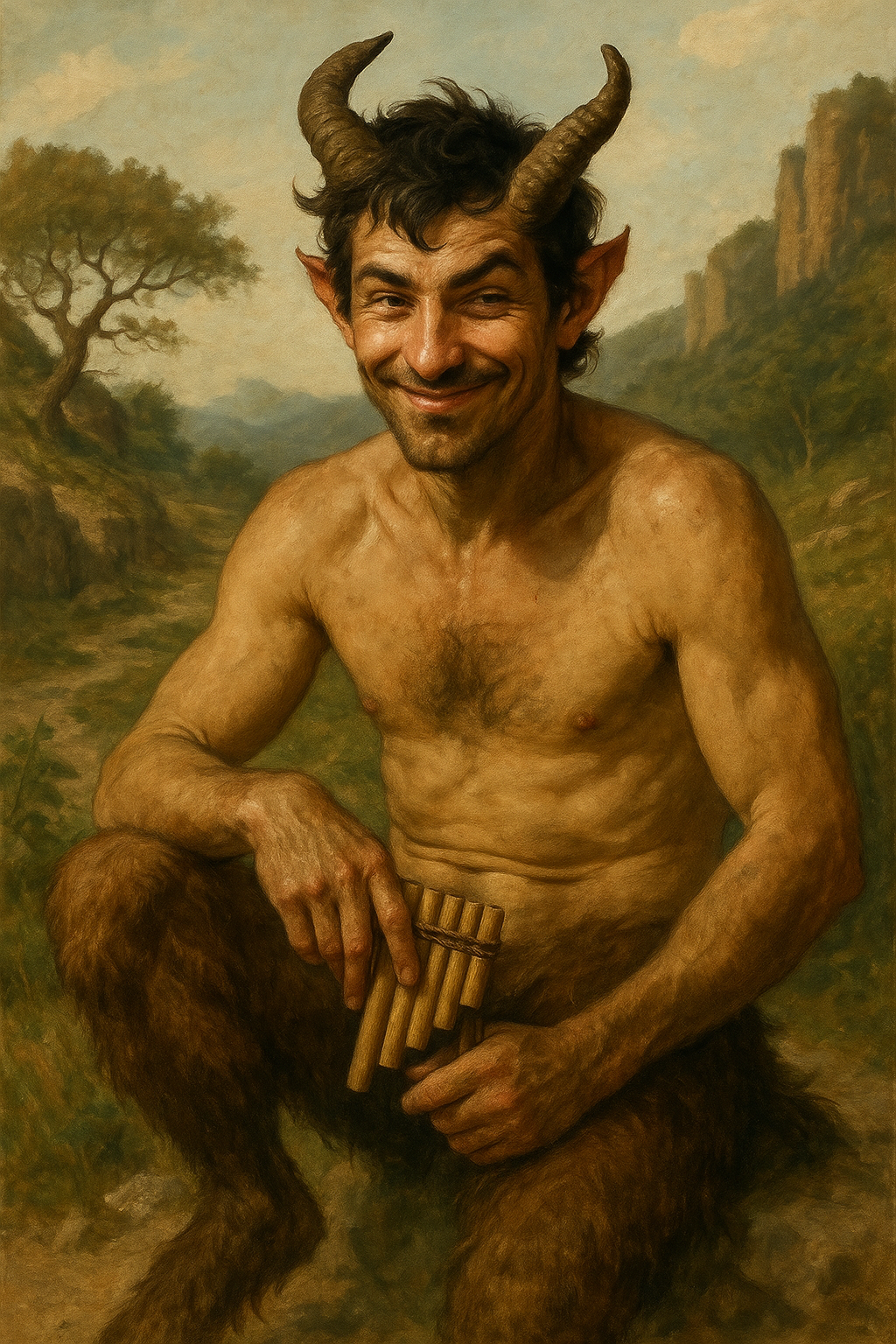 and often covered in a light dusting of hair. Their faces are rugged and expressive, with strong jawlines, pointed ears, and prominent brows. Most grow thick facial hair, often wild and unkempt, lending them a roguish or feral appearance. Their eyes are typically golden, hazel, or deep brown, gleaming with mischief or intoxication.
From the waist down, their bodies are entirely goat-like: covered in coarse fur (ranging in color from earthy browns to ashen greys), ending in powerful, backward-jointed legs and large cloven hooves. This gives them incredible agility on uneven terrain, and their leaps are prodigious—used equally for dance, chase, or escape.
Distinctive to satyrs are the horns crowning their heads. These vary wildly between individuals: some sport modest nubs or short, twisted points, while others grow massive, curling rams' horns used in headbutting contests or mating displays. Their bone structure and skull shape support this, with thickened craniums and dense neck musculature.
Internally, satyrs have a metabolism tuned for indulgence—they can process large quantities of alcohol, strong herbs, and even certain magical hallucinogens with minimal lasting effect. Their vocal cords are capable of imitating panpipes and other instruments, and a small subset of satyrs possess an anatomical adaptation that allows them to channel minor enchantments through music, often using flutes or panpipes they craft themselves. Only one satyr in a given group typically develops this "bardic spark," and it is viewed as a divine gift (or a cruel joke, depending on the village).
and often covered in a light dusting of hair. Their faces are rugged and expressive, with strong jawlines, pointed ears, and prominent brows. Most grow thick facial hair, often wild and unkempt, lending them a roguish or feral appearance. Their eyes are typically golden, hazel, or deep brown, gleaming with mischief or intoxication.
From the waist down, their bodies are entirely goat-like: covered in coarse fur (ranging in color from earthy browns to ashen greys), ending in powerful, backward-jointed legs and large cloven hooves. This gives them incredible agility on uneven terrain, and their leaps are prodigious—used equally for dance, chase, or escape.
Distinctive to satyrs are the horns crowning their heads. These vary wildly between individuals: some sport modest nubs or short, twisted points, while others grow massive, curling rams' horns used in headbutting contests or mating displays. Their bone structure and skull shape support this, with thickened craniums and dense neck musculature.
Internally, satyrs have a metabolism tuned for indulgence—they can process large quantities of alcohol, strong herbs, and even certain magical hallucinogens with minimal lasting effect. Their vocal cords are capable of imitating panpipes and other instruments, and a small subset of satyrs possess an anatomical adaptation that allows them to channel minor enchantments through music, often using flutes or panpipes they craft themselves. Only one satyr in a given group typically develops this "bardic spark," and it is viewed as a divine gift (or a cruel joke, depending on the village).
Genetics and Reproduction
Satyrs are exclusively male and cannot reproduce with one another. Their continuation relies entirely on unions with other species—typically fey women, nymphs, dryads, or humanoid females. Despite their relentless sexual appetite and legendary efforts, successful reproduction is rare and often unintentional. When conception does occur, the offspring is always a male satyr, as if the species forcibly imprints its nature upon the bloodline.
This quirk of biology has led some scholars to believe satyrs are not a naturally evolved species but the byproduct of divine or chaotic magic—perhaps a creation of a god of indulgence or wild nature, cursed or blessed to persist through seduction alone. Their seed seems to carry an overwhelming genetic dominance, ensuring that no matter the partner’s race or features, the child will be born a satyr: cloven-hoofed, horned, and overflowing with carnal energy.
Female children are either impossibly rare or outright impossible—none have ever been recorded in Tanarian history. Theories abound, ranging from magical sterility to metaphysical imbalance, but no verifiable case has disproved this all-male rule. In cases of attempted magical intervention or divine fertility rituals, the resulting offspring has always conformed to satyr norms, or the pregnancy simply fails.
Because of this reproductive limitation, satyrs are drawn to fertile, enchanted regions where fey populations thrive. They are opportunistic breeders, often attempting to woo, charm, or overwhelm potential partners with song, drink, and overwhelming sensuality. This behavior is biologically driven, but not always successful—many fey and humanoid cultures have learned to avoid or outwit their advances. When raised by non-satyr mothers, young satyrs often leave their homes at adolescence, drawn by instinct toward the nearest grove, revel, or fey commune where their kind roam wild and free.
"He was a night I should have resisted—amber-eyed, sweet-tongued, and drunk on moonlight. I thought it a dream, a dalliance with madness. But come spring, I birthed horns and hooves, and the forest laughed with him."
Growth Rate & Stages
Satyrs mature at a pace quicker than most humanoid races, a trait likely tied to their fey origin and the instinctive drives that define their behavior. A satyr is weaned and walking within weeks of birth, speaking and climbing within months. By the age of 5, they are physically equivalent to a human adolescent, and by 10, they are fully grown in both body and temperament—horns sprouted, hooves hardened, and mischief fully awakened.
Adolescence is short and chaotic. Young satyrs are fiercely independent and rarely remain with their mothers past early childhood. By age 7 or 8, they often strike out into the wild, drawn to revelry, song, and their own kind. It is in this stage that most begin experimenting with panpipes, intoxicants, and flirtation—testing the boundaries of pleasure, danger, and freedom.
Adulthood spans the bulk of a satyr’s life, beginning around age 10 and lasting into their mid 200s. While their physical appearance remains youthful—lean, muscular, and vibrant—well into their later years, their personalities only deepen in eccentricity and excess. Most do not "settle down" or slow with age, but rather become more entrenched in their habits and indulgences, often taking on the role of revel-leader or trickster elder in a forest glade or fey court.
Elder satyrs, those who live past 250, are rare but not unheard of. These individuals tend to be less wild and more whimsical—still prone to antics but guided by centuries of experience. Their horns may grow larger, curling wildly with age, and their fur may silver, though their eyes never lose their gleam. Death often finds them in the midst of revelry, from accident, misadventure, or simply dancing themselves into the ground beneath a moonlit sky.
Ecology and Habitats
Satyrs thrive in wild, untouched landscapes where civilization’s order does not reach—dense forests, sun-dappled glades, craggy hills, and lush valleys soaked in moonlight and myth. Their presence is often a sign that the land is steeped in fey magic or has been claimed by the influence of chaotic nature spirits. They prefer regions where music carries well, where wine flows freely, and where no one is around to complain about noise or nudity.
Despite their rowdy nature, satyrs do not damage the land they inhabit. In fact, their revels often invigorate the wilds. Fey-touched flora may bloom where they dance, and the echo of their panpipes can stir growth in sleeping groves. They do not build structures or clear land, instead sleeping beneath trees, in caves, or in natural shelters, often piling soft moss and flowers into makeshift beds.
Satyr groups—called frolics—are loosely organized and transient, gathering only when there’s reason to celebrate, seduce, or stir up trouble. These gatherings may swell around solstices, lunar eclipses, or the blooming of rare forest flowers. Between such events, satyrs roam alone or in pairs, driven by wanderlust and appetite.
They coexist—sometimes tensely—with dryads, nymphs, fauns, and other fey creatures, though their antics often get them banished or scolded. Mortals who dwell near satyr-infested woods often speak of strange music at night, mysterious lovers glimpsed in moonlight, or the occasional goat-hoofed trickster stealing wine from their cellars. Some villages treat them as ill omens, others leave offerings in hopes the satyrs will bring luck, music, or fertility to their fields.
They are an invasive influence in cultivated spaces, as their presence invites chaos and undermines control. In contrast, they are natural stewards of untamed beauty, ensuring the wild remains wild through endless dance, decadence, and delight.
"If the wine goes missing or the fiddler wakes up in someone else's boots, you can bet the horned bastards had a hand in it. Gods help you if there's a festival—they’ll drink your cellar dry, charm your patrons, and vanish before dawn with your best silver and someone’s daughter laughing in their arms."
Dietary Needs and Habits
Satyrs are opportunistic omnivores with a heavy preference for indulgence over balance. Their diets reflect their hedonistic nature, rich, flavorful, intoxicating, and often excessive. They favor ripe fruits, sweet berries, fermented grains, roasted meats, exotic herbs, and anything soaked in wine. If it smells strong, tastes sweet, or carries a kick, a satyr will likely devour it.
They do not farm or preserve food in any meaningful way. Instead, they forage, hunt, or steal what they need. They are known to raid mortal villages or wander into harvest festivals just to gorge themselves. Satyrs have an instinctive ability to find naturally fermenting fruit or stumble upon hidden stills and wineries. Some believe this to be a magical trait, others call it drunken luck.
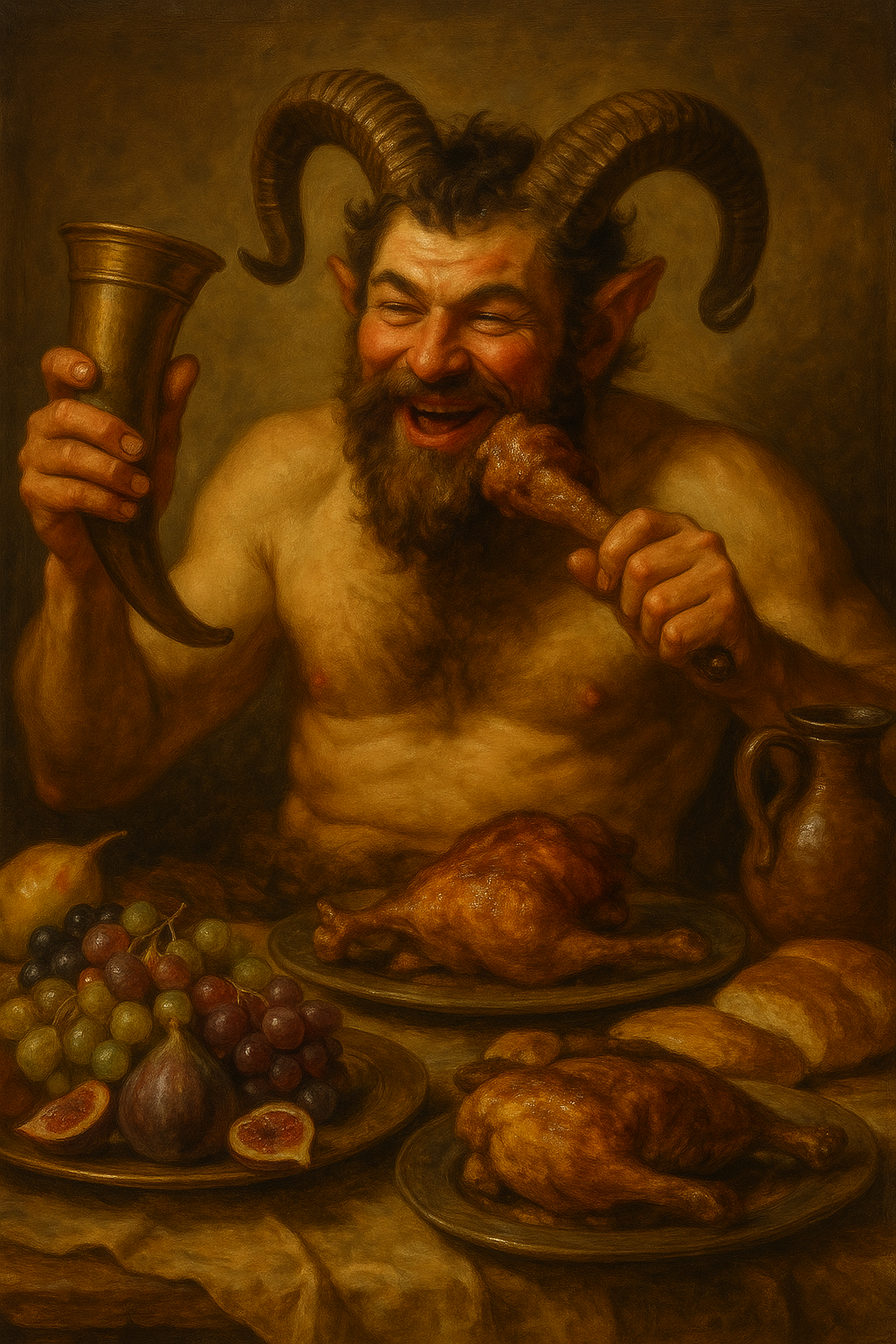 While capable of eating vegetables and grains, they rarely do so unless seasoned heavily or made into stew. They have a pronounced sweet tooth and can be lured with honey, candied nuts, or spiced pastries. When meat is consumed, it’s usually the result of opportunistic hunting or scavenging. They prefer cooked meat over raw and will happily roast small game over an open fire if they’re not distracted by music or mischief.
Satyrs also consume large quantities of alcohol, not just for sustenance, but for pleasure, ritual, and inspiration. Wine is sacred to them, often poured out in offerings or used to anoint lovers and friends. It’s not uncommon for a satyr to drink until unconscious, only to wake with no memory and immediately start the revelry again.
They can survive on surprisingly little when necessary, thanks to fey resilience, but left to their own devices, satyrs will eat and drink until the table is bare, the wine is gone, and someone’s lost their pants.
While capable of eating vegetables and grains, they rarely do so unless seasoned heavily or made into stew. They have a pronounced sweet tooth and can be lured with honey, candied nuts, or spiced pastries. When meat is consumed, it’s usually the result of opportunistic hunting or scavenging. They prefer cooked meat over raw and will happily roast small game over an open fire if they’re not distracted by music or mischief.
Satyrs also consume large quantities of alcohol, not just for sustenance, but for pleasure, ritual, and inspiration. Wine is sacred to them, often poured out in offerings or used to anoint lovers and friends. It’s not uncommon for a satyr to drink until unconscious, only to wake with no memory and immediately start the revelry again.
They can survive on surprisingly little when necessary, thanks to fey resilience, but left to their own devices, satyrs will eat and drink until the table is bare, the wine is gone, and someone’s lost their pants.
Behaviour
Satyrs are creatures of impulse, revelry, and instinctive cunning. Their behavior is defined by an irrepressible hedonism, gleeful seekers of pleasure, freedom, and indulgence in all its forms. They thrive in environments that allow for spontaneity and rarely concern themselves with long-term consequences, which makes them appear reckless or immature to more structured species. However, beneath their mischief lies a primal intelligence and a strong herd instinct rooted in survival and social cohesion.
Psychologically, satyrs are emotionally expressive and tactile. They form strong attachments to those who accept their nature and are loyal to kin and companions, though they often struggle with monogamy or conformity. Curiosity is a driving trait, whether it's toward a new song, scent, drink, or lover. Many display hyperactive energy, flitting from one fascination to another, rarely lingering unless deeply emotionally invested.
While they’re not inherently malicious, satyrs often lack an intuitive grasp of boundaries unless taught through experience or cultural norms. They communicate largely through body language, music, and tone rather than formal speech, and they’re known to use laughter and pranks as both social bonding and emotional masking. Their psychology blends childlike wonder with adult appetites, making them seem naive and wise in equal measure. When threatened, however, their instincts shift rapidly from revelry to raw aggression, especially if their territory or companions are endangered.
They are also deeply affected by natural rhythms, lunar phases, seasonal changes, and environmental shifts influence their moods and behaviors, with spring and summer bringing heightened libido and energy, while winter often lulls them into reflective or withdrawn states. This cyclical nature, paired with their inherent wildness, makes them both enchanting and unpredictable.
Additional Information
Social Structure
Satyrs possess a loosely organized, anarchic social structure driven more by impulse and proximity than by hierarchy or leadership. They gather in small, ever-shifting bands known as revelries, where camaraderie is built on shared indulgence rather than obligation. These revelries rarely exceed a dozen members and often splinter or merge depending on mood, season, or the availability of wine, music, or companionship.
There are no formal leaders, but elder satyrs or particularly charismatic individuals—often the best musicians, storytellers, or lovers—may naturally become focal points of a revelry. These figures hold no real authority but are granted deference in matters of entertainment and pleasure. Conflicts within a revelry are resolved through games, contests, seduction, or outright avoidance rather than force or dominance.
Satyrs do not form families or raise offspring communally; instead, young satyrs are left in the care of nature spirits or nymphs until they’re old enough to fend for themselves—usually by the end of their first decade. Blood relations carry little meaning in satyr culture, and most do not even know their sires.
They are fiercely independent, but they revel in companionship, especially with nymphs, dryads, and other fey. Long-standing bonds are rare, but some revelries will develop close-knit identities, complete with traditions, songs, or shared territories. While they thrive on chaos and whimsy, satyrs possess an unspoken social code: protect the party, protect the wild, and above all, never let the joy die.
Geographic Origin and Distribution
Satyrs are found primarily in warm, temperate regions where wilderness still thrives, lush forests, secluded valleys, overgrown ruins, and sun-dappled glades far from civilization. Their presence often signals ancient, untamed magic, and their domains are usually marked by vibrant plant growth, natural springs, and the echoes of music drifting through the trees.
In Tanaria, satyrs are most densely concentrated in southern Eithwin and southern Tharnis, particularly the wildwood borders of Hornhaven and the Sylvaren groves that remain untouched by logging or expansion. Scattered pockets can be found in Vaalden and Aeldoria where warmer climates and natural springs persist year-round, and on the fringes of Vyrewood, though they rarely enter its deeper reaches due to the realm’s sentient hostility. Isolated clans also dwell in parts of Necai and the jungle-rich Klo’karr Islands, though they tend to be more reclusive and wary of outsiders in those regions.
Satyrs avoid harsh, arid environments, as well as areas under heavy divine or arcane influence, which tend to dull their senses and weaken their connection to natural revelry. While not territorial in the traditional sense, they do not tolerate intrusions that threaten their festivities, forests, or freedom, often turning playful mischief into dangerous harassment until the offender leaves, or becomes part of the party.
Perception and Sensory Capabilities
Satyrs possess acute sensory perception, especially attuned to scent, sound, and subtle shifts in atmosphere—traits likely inherited from their fey lineage and animalistic physiology. Their sense of smell rivals that of woodland predators, able to pick out pheromones, herbs, alcohol, and arousal from impressive distances. They can track a revel or romantic encounter like a bloodhound tracks prey, and many have an uncanny knack for finding hidden stores of wine, blooming flowers, or lovers’ trysts.
Their hearing is exceptionally keen, particularly when it comes to music. Satyrs can distinguish individual instruments in a cacophony, recognize rhythms and melodies with perfect recall, and can sense mood or emotional tone purely from tonal variation. This sensitivity also makes them vulnerable to sonic magic, which can either enthrall or enrage them depending on context.
In low-light or dappled forest conditions, their night vision allows them to move confidently even at dusk or dawn, though they do not see in full darkness. Their eyes are adapted more to motion and contrast than color, which is why they rely on other senses for identifying detail or beauty.
Satyrs are also sensitive to magical auras—especially enchantments or glamours tied to emotion, indulgence, or charm. While not inherently magical themselves, most satyrs have an instinctual resistance to charms and compulsions, likely as a survival trait against the very powers they often try to exploit or seduce. Those born with the "bardic spark" (usually marked by an affinity for the panpipes) can lightly touch this magic themselves, often unknowingly invoking minor illusions or emotional enchantments when they play or dance.
While not psychic in the traditional sense, satyrs can be eerily perceptive when it comes to reading intent, desire, or discomfort. This intuitive social awareness, combined with their relentless pursuit of pleasure, makes them disarming, manipulative, or infuriating—depending on the target and the mood.

Genetic Descendants
Scientific Name
Satyricon lascivus
Lifespan
300–400 years, with the first century spent in youthful chaos. They rarely show signs of aging until late in life, and even then, most die due to reckless behavior rather than natural causes
Conservation Status
Not Endangered.
Satyrs thrive in fae-touched forests and wildlands, especially where the boundary between material and fey planes is thin. Their numbers remain stable due to their aggressive reproduction efforts and tendency to avoid long-term consequences.
Satyrs thrive in fae-touched forests and wildlands, especially where the boundary between material and fey planes is thin. Their numbers remain stable due to their aggressive reproduction efforts and tendency to avoid long-term consequences.
Average Height
5'0" to 5'8"
Average Weight
150–200 lbs. Despite their compact stature, they are powerful and quick-footed, favoring leaping and charging over finesse.
"He chased me through the glade, all horns and hooves and laughter—reeking of wine and wickedness. I fled, yes—but not because I feared him. I fled because I knew if he caught me, I'd never want to leave his embrace."


I generally don't like satyr mythos, as they're a bit too rape-y for my taste, but I like your version of them. You've emphasised the better traits of them much more.
Explore Etrea | WorldEmber 2025
Well. I agree, but you can't just have the "good parts" when worldbuilding. I feel satyrs would be pretty similar in Tanaria, but I've been keeping my articles pretty PG. I've been considering putting some of the more unsavory bits of my articles behind a specific follower role some something. Though I haven't decided yet.
"Every story is a thread, and together we weave worlds."
The Origin of Tanaria
I more meant that I enjoyed you didn't focus *only* on that aspect of them, but they are a much more well-rounded species the way you've written them. :)
Explore Etrea | WorldEmber 2025
Ah thank you, I appreciate that. Like I said, I don't particularly like the whole bad or evil for the sake of it. I like understanding why people/creatures do what they do.
"Every story is a thread, and together we weave worlds."
The Origin of Tanaria