Elven Age
In the tales of the
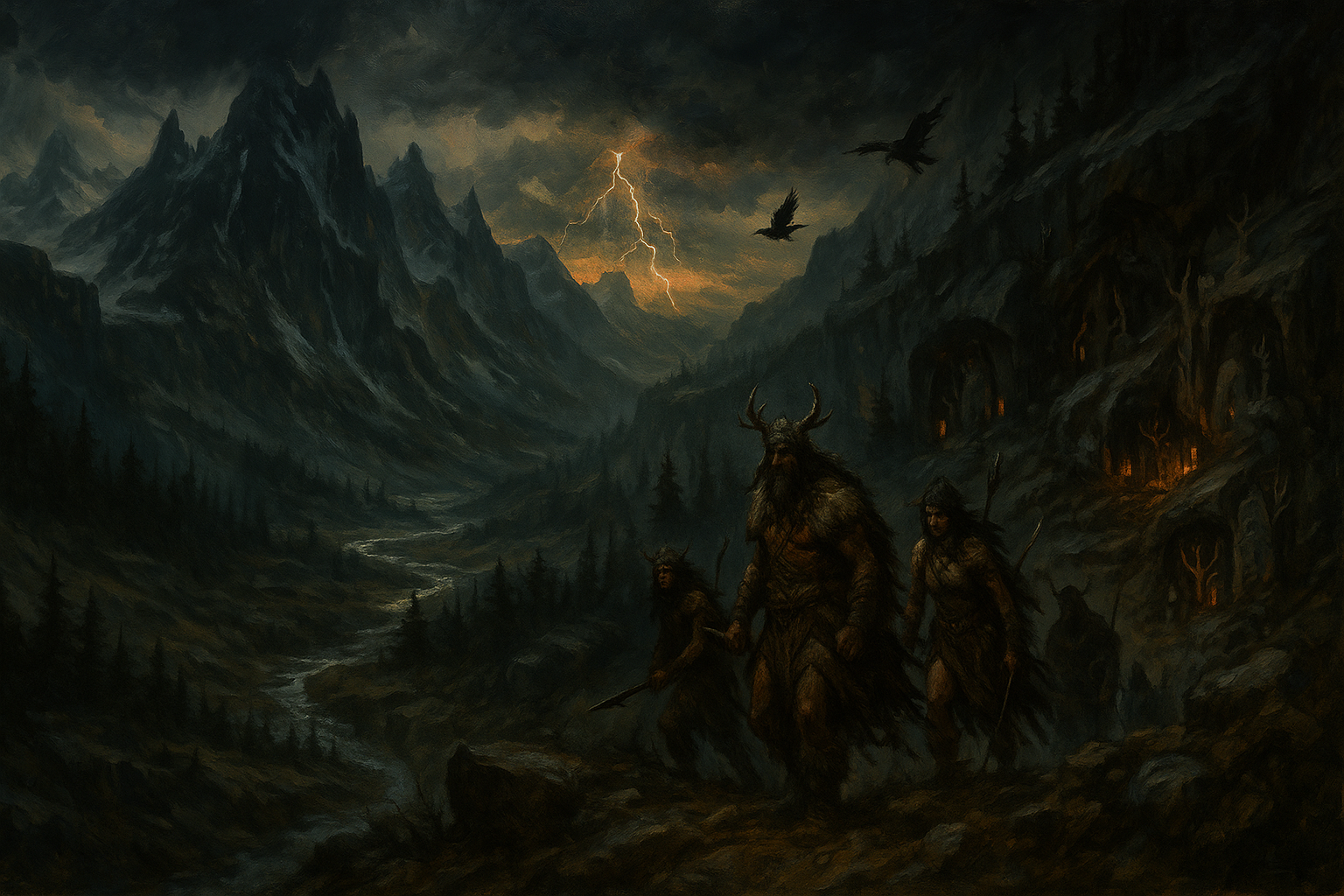
Athrukar, the Khelreach was the first land raised from the waters when the world was young. They speak of Athru, the storm-goat whose stamping hooves split the valleys and whose horns struck the clouds to call down lightning. From his blood, they say, flowed the rivers. From his breath came the storms. From his bones, the ridges of the mountains. In these stories, the ancestors of the Athrukar already walked the caves and ridges, guided by the spirits of soil and storm.
Elven histories tell a different tale. The annals of
Halentha and
Lorintha insist that mortals in this age were confined to the cradle of civilisation in the far east in the land now remembered as the
Wastes of Harlak. They claim no non-dwarven being had yet reached the western marches, which they describe as untamed wilderness. To Elven chroniclers, Athrukar myths of an ancient presence are the boasts of backward tribes who would place themselves at the dawn of time. However, carved stones deep in the caves of the Khelreach bear spirals, handprints, and fire-markings believed older than any known kingdom. Whether these truly date to the Age of Gods is uncertain, but they remain powerful symbols to the Athrukar. Siarlander kings of later centuries interpreted this ambiguity in ways that suited their politics. The rulers of the
Kingdom of Farraige dismissed Athrukar claims as superstition, while some scholars of
Upper Siar quietly suggested that the mountain clans may indeed have stood apart from Harlak’s dominion, enduring in their caves even when the gods perished.
With the death of Harlak and the retreat of the gods, the north entered the age of mortal dominion. In Northern Siarland this was not an age of cities or crowns but of survival. Scattered clans took shelter in the caves and valleys of the Khelreach, hunting elk and goat, foraging roots, and raiding one another’s redoubts. Unlike the plains of southern Siarland, which slowly adopted agriculture, the harsh marches resisted cultivation. The soil was thin, the winters long, and so life remained semi-nomadic. Every valley became its own world, every redoubt its own hearth. Alliances were fleeting, wars frequent. In this fragmentation the Athrukar identity took shape. A people bound to redoubt, spirit, and storm, mistrustful of distant kings and enduring only through the strength of clan and the guidance of their ancestors.
Elven records are silent on these centuries, regarding the region as irrelevant to their wider struggles with early
human civilisations. Later Elven chroniclers would describe the Interregnum clans as “half-made, scratching at the roots of trees while their kin to the south learned the plough.” The Athrukar themselves remember it instead as an age of freedom, where no outsiders threatened their ancestral lands. When the Elven kingdoms reached their zenith, the Khelreach stood at their margin. Elves saw little to covet in Northern Siarland. The land was poor for farming, the winters cruel, and the people hostile. At most, Elves exacted tribute of hides or forced the clans to provide guides through the mountain passes. Some Athrukar learned Elven metalcraft, others copied their farming of hardy barley in sheltered valleys, but most remained cautiously distant. It is in this age that the term
Wildmen entered the record. Elven scholars wrote of “untamed mountain tribes, clad in fur and bone, dwelling in caves, savage in custom and law.” The label endured, framing Athrukar as barbarians on the edge of civilisation.
The Imperial Era
When Alerio rose in the east, the rebellion reached even the mountains. For the Athrukar it was an opportunity to strike old enemies. Warbands swept from the Khelreach, falling on Elven outposts, burning caravans, and liberating human thralls. Alerio’s chroniclers record “wild tribes descending like storm, their war-songs echoing through the ridges.”
Though never united under a single banner, Athrukar warbands contributed to the wider collapse of Elven authority in Siarland. Their role was not decisive in great battles, but their raids drained Elven strength. When the war ended and the Elves fled across the sea, the Athrukar were proud to claim they had never been slaves.
The rebellion gave birth to new polities in Siarland: the Kingdom of Upper Siar and the Kingdom of Farraige. Both sought to extend their rule into the north. Both failed. Expeditions sent to demand tribute found themselves lost in the passes, ambushed in valleys, their banners hung as offerings at sacred stones. Upper Siar chronicles often speak of the Athrukar with reluctant admiration, of a people that submit to no king. Farraige, steeped in Elven inheritance, condemned them as irredeemable savages. For the Athrukar, these centuries confirmed what they already knew: that no crown forged in the lowlands could bind them. The brief unity of
The Imperial League meant little in the north. Athrukar clans offered no tribute to the Imperial Senate, and no legion dared mount a campaign into the Khelreach. Traders came, mercenaries passed through, but the clans endured unchanged. When Skyreach was destroyed and the League fell into civil war, the Athrukar scarcely noticed.
By the second century IE, Northern Siarland remains as it has always been: Perilous, isolated, and ungoverned.


Comments