

Kúr-Ïžït
Kúr-Ïžït, or Chresit, was a component of the larger Ïšš-Ðahŋú metropolis, and the farthest from the coast. It sat on a particularly stable ledge on the series of cliffs that separated Ïšš-Ðahŋú from the inland territories of Këhóš-Ýïr. During the Khólteðian Wars, these settlements and the ledge they were sitting on were destroyed in the first major battle of between Këhóš-Ýïr and Ýbašý-Ýïr, that is, the Battle of Kúr-Ïžït (Battle of Chresit Cliffs), which led directly to the establishment of the Khlúkúrmïr and a formal Këhóšian military system, the Ëŋšïk.
Background
Këhóš-Ýïr during the Crisis
Kúr-Ïžït's history, like the rest of the Këhóšian cities, is tied to the history of the tribe itself. Këhóš-Ýïr is one of 32 tribes that sprung up out of the Crisis of 24982 AYM and one of 14 Arðor-Kýï, or sparse, independently-minded tribes that sought their own personalized goals irrespective of those of the Arðor-Tal and Arðor-Úŋï. For Këhóš-Ýïr, this personalized goal was and still is ill-defined; however, like a lot of other Kýïan Tribes, it involved a concerted effort to reach the Ëzó-Rhažóval, the familial seat of power, that sat relatively unoccupied due to the Crisis. However, it had another objective, to compete with these other tribes and mount campaigns and offenses to keep them from doing so. This dual-mandate was maintained and pursued by the army of the Këhóš-Ýïr, and simultaneous led by Ðrhuvëškal who, in addition to assuming the role of supreme general, also had a massive influence on civil duties and the everyday workings of the tribe. Despite his devotion to these many roles, Këhóš-Ýïr never was able to advance much in their struggles towards the Ëzó-Rhažóval, and Ðrhuvëškal himself would die in a fateful skirmish in the final days of the Crisis. With the end of the Crisis came the 24982 AYM Ultimatum, in which all 32 tribes were expelled from the Ïlýrhonid Tribe, forced to sail southwards. All of these would eventually drift to the Tayzem Region's east coast, where the entire extent of the Tayzem Desert was subsequently surveyed and territories for each of the tribes delineated.
The Geography of the Tayzem Desert
These delineations were based on the Desert's peculiar geographic formations; being highly windswept and very high in elevation, the once-smooth curve of the hill had been eroded by these winds to form a stepped-pyramid shape, whereby different winds would act upon different elevations. Those at the top stood upon a horizontal platform, which dropped suddenly to larger and similarly plateau-like formation, which also dropped after a certain distance, and so forth. The following image shows the different stepped layers to the Desert, from red (highest elevation) to green (lowest).
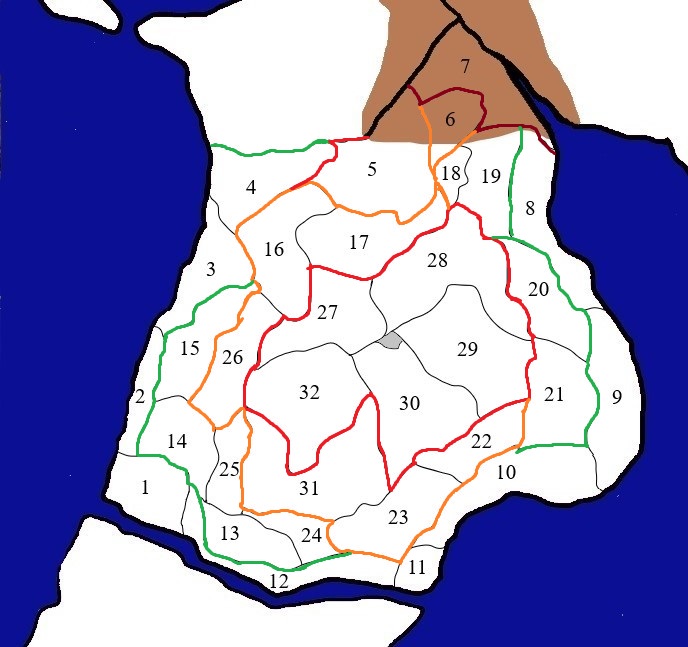
Note that this does not include the coastal cliffs; in all the coasts, there is a final set of cliffs that produces a sharp drop ranging from 5 to 40 meters right down to sea level. (Këhóš-Ýïr is labeled with the number 1 in the image.)
History
In the initial settlement period,

Comments