

Glaviankin
Officially recorded as extinct during the Alderian Founding Wars approximately 250 years before the Era of Enchantment. Their elimination was systematic and state-sanctioned. Most surviving records were destroyed by Alderian authorities.
Basic Information
Anatomy
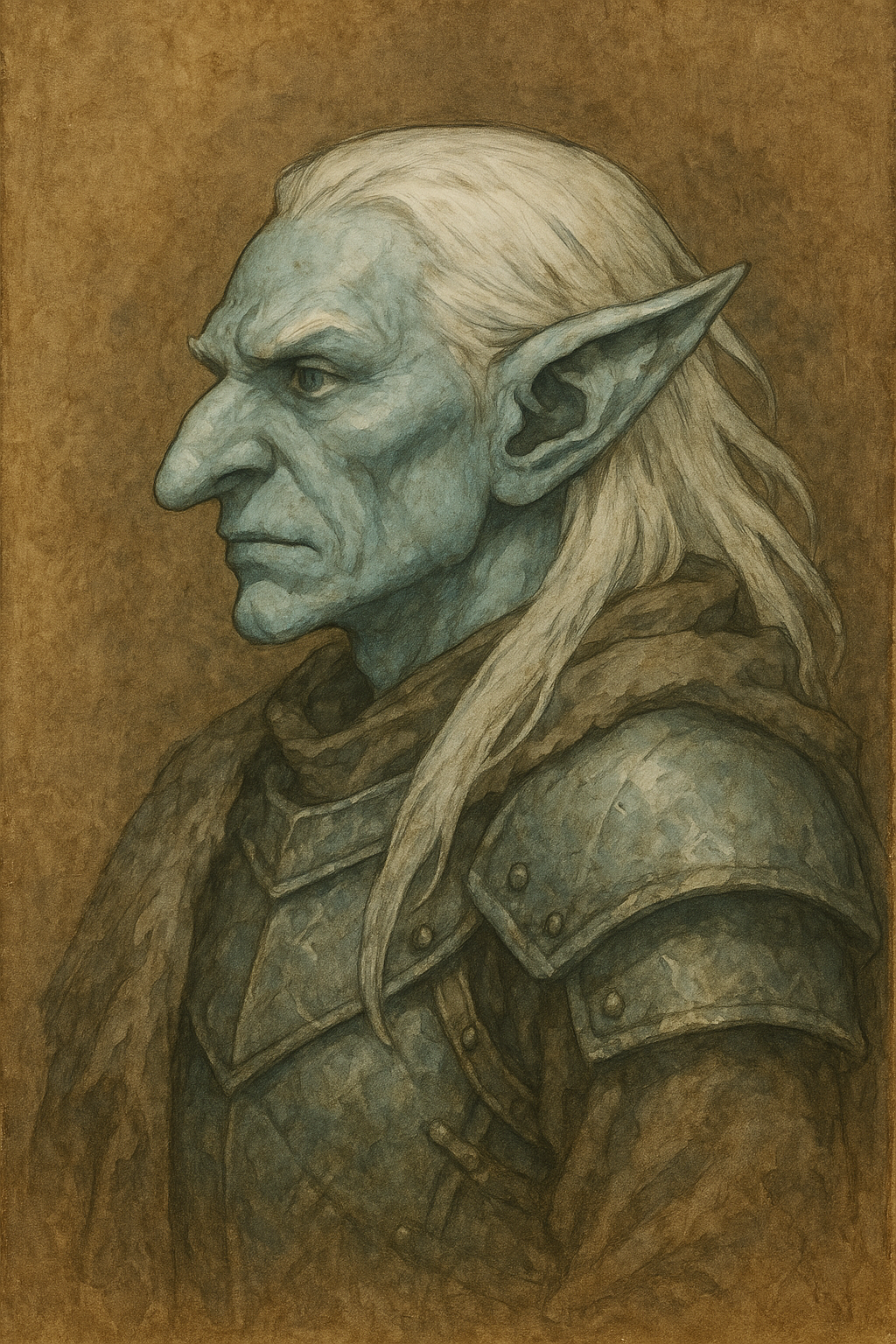
The Ice Goblins, or Glaviankin, were humanoids of near-Alderian height, though leaner and more angular in build. Their physiology reflected adaptation to extreme cold and subterranean environments. Skin was pale to the point of translucence, often tinted with shades of blue or grey from the circulation visible beneath. Eyes tended toward silver, white, or pale blue, highly sensitive to light but capable of seeing clearly in near darkness. Hair was sparse and fine, usually white or ash-blonde, adapted to preserve heat rather than display colour.
Distinct goblinoid features remained evident: elongated ears with a slightly serrated edge, giving heightened auditory perception; strong, dexterous hands with toughened fingertips suited to both toolwork and climbing; and sharp, fine teeth adapted to a mixed carnivorous diet. Their metabolism was slow, conserving warmth and energy, allowing survival in conditions that would kill most warm-blooded races.
Skeletal studies and surviving depictions suggest dense bone structure despite their wiry frame, granting durability and resilience in harsh terrain. They combined the cunning of goblins with the endurance of Alderians, forming a rare hybrid balance of intellect and instinct. The result was a race physically fragile in appearance but remarkably hardy.
Biological Traits
The Glaviankin are widely believed to have possessed a natural affinity for ice magic, an ability now regarded as lost or mythologised following their extinction.
Genetics and Reproduction
The Glaviankin reproduced sexually, following the biological framework inherited from their Alderian and goblin lineage. Available records indicate a gestation period of roughly seven to eight months, intermediate between the two parent species. Birth rates were low, and child survival depended heavily on environmental stability, suggesting limited reproductive capacity under harsh conditions.
Reproduction appears to have followed a monogamous or seasonal-pairing system, with family groups organised around protection and communal upbringing rather than extended kin structures. Females typically bore one or two offspring per cycle.
Ecology and Habitats
The Glaviankin are believed to have originated in temperate and arid regions rather than the frozen north often associated with their later mythology. Archaeological evidence, including ancient sandstone ruins found across the northern deserts and high plains, suggests they were skilled builders who adapted naturally to dry, sun-bleached climates long before being driven into colder territories.
Their settlements were typically carved directly into sandstone cliffs or constructed from layered stone blocks reinforced with mineral mortar. The architecture displays an advanced understanding of heat regulation, using narrow corridors, angled vents, and reflective surfaces to control light and temperature. This engineering sophistication indicates a civilisation deeply attuned to its surroundings rather than subjugating them.
Interaction with their environment was practical and symbiotic. The Glaviankin used available resources efficiently, developing early irrigation systems and mineral extraction methods without significant ecological disruption.
Dietary Needs and Habits
The Glaviankin were omnivorous opportunists, their diet reflecting the adaptability that defined their civilisation. Food storage was a matter of both survival and symbolism. Underground granaries were sealed with sandstone and mineral salt to deter pests, while communal stores were guarded and rationed collectively. Control of food was a foundation of authority
Behaviour
The Glaviankin exhibited behavioural patterns broadly comparable to early Alderian societies, balancing cooperation with competition within a structured social framework. Among their own kind, interaction was defined by mutual obligation and pragmatic hierarchy rather than open emotional expression. Loyalty was extended to kin and settlement before individual friendship, and conflict was typically resolved through mediation or ritualised duelling rather than uncontrolled violence.
Toward predators and external threats, the Glaviankin displayed caution rather than aggression. Their survival strategy relied on planning, fortification, and environmental manipulation.
Additional Information
Perception and Sensory Capabilities
The Glaviankin, or Ice Goblins, were noted for exceptional sensory adaptation to low-light and subarctic environments. Contemporary accounts describe acute hearing facilitated by elongated ears capable of detecting subtle shifts in wind and vibration, allowing limited spatial awareness underground and in dense snow. Their vision was highly sensitive, adapted for darkness and reflective terrain, though daylight exposure is believed to have caused discomfort or temporary blindness.
Historical records and folklore frequently attribute elemental abilities to the Glaviankin, most notably a form of ice manipulation or “frost-binding.” Modern scholarship regards these accounts as either symbolic or exaggerated, likely derived from environmental adaptations and the use of alchemical or ritual practices now lost. Some fringe studies propose that these abilities may represent a primitive form of psionic or sensory resonance with cold environments, though no direct evidence has been recovered.
In summary, the Glaviankin appear to have relied on a combination of heightened sensory awareness and environmental attunement rather than conventional magic. Their reputation as elemental beings likely arose from the intersection of myth and observed survival skill within the frozen north.
Civilization and Culture
Major Organizations
The Federation Mandate
Common Myths and Legends
Myths surrounding the Glaviankin occupy a contested place in Alderian history, blending fear, reverence, and guilt into a single narrative. Most surviving tales depict them as beings of ice and silence. Alderian folklore, shaped heavily by conquest-era propaganda, casts them as sorcerers who defied the sun and wielded forbidden frost-magic to challenge the rising human kingdoms.
Later legend transforms their destruction into divine retribution: a moral cleansing by Starlous Alderian, whose cavalry charge supposedly shattered their frozen cities and brought warmth back to the land. In modern retellings, this act is portrayed as the founding moment of Alderia.
Interspecies Relations and Assumptions
Believed to be a stabilised hybrid lineage between Alderians and goblins, though exact ancestral patterns are debated due to missing records and deliberate historical erasure.
EXTINCT
Lifespan
85
Average Height
5'6"–6'2"
Geographic Distribution
Related Organizations

Comments