
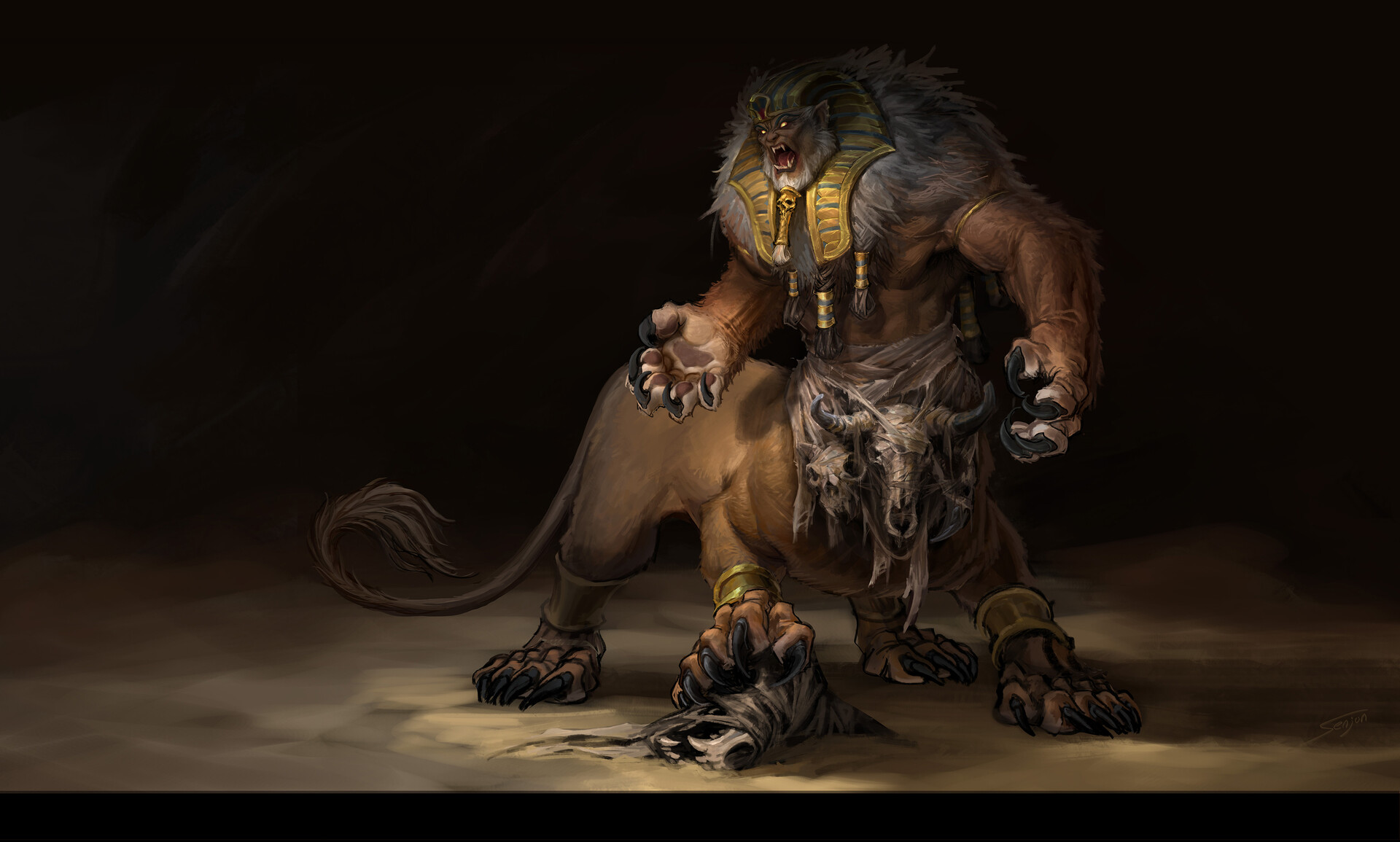
Akasha-Palla, The Claw-Carver
Ruatiwangan Sky God of the Dawn, Dusk, and Battle
"You monster - your kind don't deserve to live as men! You don't deserve the civilization we've built!" "Grrrr...what makes you think we want to, little whelp?!" "W-Wha? How can you say that?!" "We never asked for your civilization! We never asked for your ideals of equality, nor the endless laws and rules foisted up us like shackles - we never asked to have our every action and our every hunt restricted! To be told what to do by lords who have never seen our villages or how we live - to be told that, suddenly, all races are blessed equals under god which must not be hunted like animals! We never asked for these indignities - yet they arrived all the damnable same!" "But-" "I am hardly finished! We never asked to be party to your grand delusion - you spit in our faces and mock the equality we provide, call us blasphemers and heretics who are undeserving of this "Great Age of Enlightenment"...pah! Things were truer in the olden days - where death reigned freely. Life was harsh, but at least it was fair - now, equality under God no longer means equal opportunities to defend oneself; No longer means equal opportunities to fight and die and live - No! Times change, words change, and now my people are made villains for our faith! My people drown themselves in the pleasures and indulgences of your damnable civilization - I've watched good men, honest men, family men - forgo the hunt forever to live in your cities of steel and stone, to eat and feast in halls they never earned glories in, or sung songs in...your civilization makes men into animals and calls them greater than us, who live by the old ways. What good blood comes of life inside your walls? What good blood comes of teaching every blasted child the great lie of equality? God's glories and wonders should fill the minds of every man, not blind them to the truth - not fill their heads with lies!" "So self-righteous...and what of the Children of Sun and Moon? What of your own kinsmen who brand my people as animals and hunt us like beasts - butcher us in our homes, call us less than animals?!" "We are all animals, you blasted fool! My people simply have no qualms accepting it. There will always be divisions - there will always be those who denigrate others for their very nature - and it is not my place to call them right or wrong. But you are an even greater fool if you think yourself a man - you are a beast, plain and simple! And beasts hunt and are hunted in turn!" "What an incredibly miserable life you lead, then." "Miserable to you perhaps, but honest! You may despise him, but The Claw-Carver is every bit a Sky-God as the likes of The Thought-Giver - and his teachings are every bit as valid! To live in service to your fellows...to race together as cubs towards the pinnacle...to fight and die and prove your worth in the hunt...the Claw-Carver teaches us that the best must always rise to the top; But now, the best are lost within your cities - swallowed wholesale by the indulgence and allure of an easy life. Glory and greatness are stunted - the truly great cannot rise, for you would sooner kneecap a Great man and see his worth distributed across the masses than allow him to rise to the top!"Title(s): The Claw-Carver, The Morning Wind, The Evening Wail, The Father in the Fire, The Spirit in the Standard, The Unconquered Brother, The Lord of Good Blood, The Mighty Mighty Madmane Alignment: Lawful Evil Favored Weapon: Hunga Munga Obedience: Spend an hour while the sun rises or sets burning incense, fragrant wood or plant matter, or other ritualistic or pleasant-smelling items or those known to have hallucinogenic effects when burned and inhaled. During this hour, daub yourself with blood or red war-paint along your forehead, cheeks, and meridian pathways(Focusing on your arms, neck, and torso, but painting as much as you are able) while taking time to care for your weapons either natural or manufactured. Once the hour is up, use the paint or blood to paint the symbol of the Claw-Carver on your forehead(Or ideally, have a spiritual leader or other respected figure of greater religious authority than you do it for you) and speak aloud the Claw-Carver's Mantra of either Dawn or Dusk(Depending on the time of day). Effect: You grant one weapon or piece of armor you are wearing or wielding during the performance of this obedience a total enhancement bonus equal to 1 +1 at 5HD and every 4HD afterwards(Max +5). This enhancement bonus can stack with existing enhancement bonuses, and can be used to apply weapon or armor special qualities such as keen, impact, etc, instead of flat enhancement bonuses. These bonuses revert and vanish after 24 hours. Every weapon or armor you wield or wear is automatically considered masterwork so long as you continue to wield or wear them.
Divine Domains
Strength, War, Madness, Glory, Sun, Fire, Darkness, Nobility
Artifacts
Though by and large the faithful of the Claw-Carver tend to have an averse relationship with "Divine Artifacts" in general, considering them crutches often used in the hands of the unworthy which, more often than not, make one less worthy of the Gods' attention, there are exceptions to this general attitude - listed below for ease of reading.
- Dawn Altars: Also known as Dusk Altars, these ancient altars are constructed by the faithful and are often small enough to be carved into man-sized rocky alcoves, small boulders or cliff-faces, or into standing stones near villages or battlefields. These altars, containing a handcarved effigy of the Claw-Carver or his holy symbol as well as a small incense and/or offering bowl as well as other accoutrements that vary from culture to culture and region to region, are powerful relics used to bless soldiers before they enter battle or combat - when created and sanctified properly, a true Dawn or Dusk Altar gains a mighty power that emerges only during Dawn, Dusk, and very special exceptions such as Solstices and Equinoxes that allow them to infuse those who dedicate themselves at the altar with incredible power that can vary from specific Altar to Altar. Most Commonly, these altars are used to reinforce the morale of warriors, to grant their weapons supernatural sharpness, to grant them protection in battle, or any other number of minor but useful powers. Occasionally, when a grand enough Altar is constructed and stands for long enough periods of time, it may gain greater power and evolve into a Boundary Altar - where it becomes a potent protective ward for an entire region, and gains greater power during transitionary periods such as the changing of seasons or even cultural transitions such as the changing of chieftains and the like.
- Armor of the Numeral Knight: This gorgeous, full suit of bronze armor covering the chest, shins, waist, arms, and head is said to have once belonged to the first and mightiest champion of Akash-Palla - and is said to grant its awesome power to any who dare to wear it and survive the trials of mind and body that ensue. Said to grant its mightiest boons exclusively to Shersūra, this suit of armor is said to enhance their racial ability to empower themselves during certain time periods and is capable of expanding and contracting dynamically to fully encapsulate its wearer as if a suit of Platemail Armor - rendering them all but invincible during the hours of peak sunlight and possessed of near bottomless strength, while making them unrivaled masters of water control during the hours of peak moonlight. Said to be enough to allow a single warrior to end entire wars by themselves, this suit of armor is currently located deep below Akash-Palla's central temple known as The Clawcarver's Bastion, located within the heart of Saganaoa, the City of Steel, where it awaits the next worthy champion to don it and prove worthy of infinite power.
Holy Books & Codes
As perhaps the most 'book-averse' and 'writing-averse' faith of any of the Six Sky Gods of Haako-san-tara, the faith of The Claw-Carver considers the "holy book" of their god to be The Edicts of the Claw-Carver - the original set of commandments and tenets issued by Akash-Palla before living memory that, even now, sit carved onto the very top of Mount Siwazuri - located in the Ndege'aji Mountain range. These edicts and the tales that have grown up around them in the times since, passed down via word of mouth amongst shamans and village elders across Ruatiwanga, make up the "holy book" of the Claw-Carver.
Divine Symbols & Sigils
A clawed hand grabbing a half-circle inside a crescent moon
Tenets of Faith
Chase the Pinnacle. Always seek prosperity for yourself and your pack, dominance over those who challenge you, and more than what you have.
For Glory and Greatness. Chase them at any cost, and never turn down a chance to gain them. Use what you earn to see to the prosperity of they who saw to yours.
Humility in Defeat. Serve your betters with honesty, loyalty, and earnestness, and hold no grudges against those who best you. There can be no grudges when the best rise to the top.
Apathy is death. Thou shalt avoid the sins of indulgence, indolence, and apathy wherever possible - for such are the hallmarks of the weak. Never hold others to a standard you would not hold yourself to.
Seek the good blood. Never pass up a chance for a good hunt, never show mercy to a foe, and never give anything less than your best. The measure of a man is taken by the blood he has spilled and the hunts he has finished.
Holidays
Akash-Palla often has many regional holidays depending on the tribe or area in question, but the one constant Holiday he possesses is the first day of the first month at the start of the year - where his followers engage in raucous celebration at the coming of the new year and engage in a grand hunt in the hopes of finding a worthy beast or hunting target that they can hunt to bless the coming of the new year with. This day is often one full of mirth, celebration, battles, hunts, and feasting - and is often one of the few days where followers of Akash-Palla celebrate and rejoice with others no matter their usual relationships or station. However, bloodshed and death is not entirely uncommon on these holidays - though the exact lethality varies from tribe to tribe and location to location, as different cultures and tribes place different emphasis on which aspects of Akash-Palla are to be celebrated during the holiday.
Divine Goals & Aspirations
To encourage mortals to live pure and true lives.
To oversee hunts and good battles.
To help direct mortals on their shared path.
Followers and Priesthood
Though the continent of Ruatiwanga and its people are a polytheistic culture who venerates each of the Six Sky Gods of Haako-san-tara as a collective pantheon, it is not usually uncommon for the particularly devout to dedicate themselves to one such deity within the pantheon - and in the case of Akash-Palla, better known to the citizens of Ruatiwanga as The Claw-Carver or The Lord of Good Blood, First of the Sky Gods of Haako-san-tara and Brother to Trishna-Kapur(Sister Moon, Goddess of the Rain, Storms, and Community), this typically entails those who find themselves entering the field of battle often, who delight in what others would deem the "horrors" of war, or any who care so deeply about their tribe or pack that they would devout themselves wholesale to their growth at any cost. Ultimately, the reasons one may dedicate themselves to The Claw-Carver will vary wildly from one creature to another, but most all creatures on Ruatiwanga come to know the Claw-Carver at some point in their lives, even in passing - for while all creatures give prayers and offerings to the Claw-Carver that he may bless their hunt, bless their battlefield, and grant them protection on their path to the pinnacle, only a select few find the steel enough in their souls to dedicate themselves to the eternal hunt and the unending chase for glory, greatness, and prosperity; to devote themselves to the great race amongst all living creatures started at the dawn of reality where the reward is ultimate dominance and the price for failure is death(Or worse, dishonor). Unlike many other Sky Gods, however, the reasons one might join the faith of the Claw-Carver are often very grounded in reality and commonplace - whether it be finding faith on the battlefield in the thrill of violence, a personal oath to chase glory at any cost, or born from a deep love of one's tribe, family, or pack such that they would devote their entire lives and spiritual beings to chasing their prosperity at any cost - all these reasons and more can and have led countless creatures all across Ruatiwanga into the faith of the Claw-Carver, though not all stay in it for their entire lives. Though many of the followers of the Six Sky Gods of Haako-san-tara can come from nearly all walks of life - which holds true even for the likes of the Claw-Carver - the Claw-Carver's faith is somewhat unusual as it is one of the two faiths that are largely Shersūra dominant; that is, Shersūra make up a larger than is usual number of followers when compared to other deities. However, this by no means is to say that other species cannot or have not joined the Claw-Carver's faithful - simply that Shersūra have a cultural predisposition to Akash-Palla and his ideals that most other races simply lack. Regardless, the followers of the Claw-Carver can and have come from nearly all walks of life - though they are comparatively rarer in more highly civilized areas - and can be found amongst all species and ages, though followers of the prime ages are much more common than any other. Obsessed with glory and the thrill of the hunt, the faithful of the Claw-Carver decorate themselves in dark reds and stark whites - delighting in the contrast of blood and purity - and almost universally adorn themselves with the trophies of their past hunts and glories. As a proud and sometimes even arrogant people, the Claw-Carver's followers dress in whichever ways best show off not only their personal achievements, but their tribal affiliations, lineages, and histories - proudly displaying as much of their past glories and accomplishments as possible at any given time. As a result, they tend to dress lightly and daub themselves with red or yellow or white paints - decorating their fur or skin with ritualistic lines along their vital meridians or arteries as a baseline "tattoo" done to honor Akash-Palla, which is added to over the course of their lives with small symbols or paintings which depict the events they are most proud of during their lives. To this end, they often wear large necklaces or other adornments bearing trophies of past conquests - tooths and skulls or body parts being the most common - though worn pelts and furs are another very popular method of accomplishing this as well. They are rarely subtle, ultimately, in their dress and depictions - often preferring to paint the symbol of the Claw-Carver upon their bodies or clothing and display as much of their glory as is possible without reaching into the realm of the impractical(As they may delight in battle at a moment's notice). Of note, however, white paint is usually reserved for religious figures or those in the faith with the highest authority or glories. Though his followers can be rare inside more civilized areas, they are nonetheless commonplace everywhere across Ruatiwanga - often serving as warriors, generals, hunters, and proud leaders of communities in the outlying fringes or wilds far from the reaches of civilization. Virtually any who seek glory or delight in the spilling of blood may well be found in the faith of the Claw-Carver - making them one of the most ubiquitous and widespread faiths on Ruatiwanga, though also one of the most divisive for their often unapologetic and ruthless natures.Ethics
Increasingly vilified as savages and monsters in the modern era of Ruatiwangan "Enlightenment" and often viewed as ruthless villains or outdated relics who cling to the "old ways" without merit, the followers of the Claw-Carver are a lot whose ethics and morality often seems plainly cut-and-dried on first glance but which often reveals its subtle depth only upon a closer inspection. Ultimately, however, they are a faith whose beliefs make them easily despised and hated - believing ardently in the purity of the hunt, followers of the Claw-Carver hunt because, quite simply, they believe that one's worth is measured in the blood he has spilled. Battle and the hunt, to the followers of the Claw-Carver, is a holy act - the original way men prayed to the Gods, showed their Piety, and proved the surety of their ideals to both their fellows and the Divine. This belief is no mere allegory, either - the followers of the Claw-Carver view battle as their first, last, and greatest test of mettle and of worth, and the way by which their lives are measured both by their tribe, their pack, and by the Gods themselves; The means by which they claim their fate, the means by which they earn respect, and the means by which all issues worth arguing over are settled. However, it is important to understand that it is not just the killing blow or the hunt itself which proves so spiritually significant to them, but the acts which one undertakes while on the Hunt that define them - a good hunt, they believe is a measure of one's nature as a beast, and the means by which two souls are pitted against each other in every way that matters; to place one's honor, one's beliefs, and one's very nature on the line and on full display and to bear everything about yourself to another in a battle whether it be to the death or not - that is the means by which they believe their worth is measured. Ultimately, to the followers of the Claw-Carver, a good hunt is an almost religious experience - a display of utmost respect for another to put everything on the line, to not dishonor them by going easy or not trying one's best, almost an expression of divine love to both the hunter, the hunted, and the Gods which watch. One can imagine then, that the trophies the faithful so often enjoy showing off on their body either in physical trophy form or in the tapestries painted upon their fur may well paint the picture of not only their glories, but their character - a monument to their actions, to their character, to the ways they conduct themselves, to how they act when death is right behind them; the measure of their life, painted on their skin and beared for the world to see and marvel at as if to say "Here I am, world - marvel at my nature and know the beauty of my body, my spirit, and my glories". To bring dishonor onto a hunt or the spilling of blood is, ultimately, one of the most shameful acts a follower of the Claw-Carver can do - whether it be by treating his foe lightly, not taking them seriously, to show mercy to one's target, or to in some way bring dishonor upon the hunt in ways which can often vary from faithful to faithful(Sometimes including things such as ganging up on a foe, not giving their foe last words, to win via overly treacherous or tricksy means, and so on). To this end, it is easy to despise a follower of the Claw-Carver, for they are often brutish, combative, and confrontational - especially his Shersūran followers - as a way of making "spot-judgements" of another's nature and making determinations for another's character in situations where true open Combat may not be acceptable or reasonable. Though this habit goes quite far to giving them their reputation of brutish thugs and murderers, in truth this confrontational nature is often followed by jovial laughing or compliments if the target of their harsh words spits back in their faces or is quick to accept their challenge and give as good as they got; all worthy signs of one's character that followers of the Claw-Carver find agreeable. To those who shy away or fear such words, they are often marked by the follower in question as an easy mark or target of a future hunt. Ultimately, followers of the Claw-Carver are ambitious and avaricious by their very nature - believing in constant motion in life in the pursuit of greatness and glory, and in the race towards the pinnacle of all things which is often referred to by many contemporary scholars as "The Survival of the Fittest". Holding one's pack or tribe in the highest regard, seeking more than what you have, giving your best and proving your dominance over any who would challenge you - these are the core values of the Claw-Carver's faithful and those which they hold in the very highest regard; Believing in one hand that ruthless and merciless competition inevitably fosters the greatest and mightiest beings while on the other hand holding firm that one must never hold grudges or grow hateful in defeat, as it is a natural part of the race of life, followers of the Claw-Carver see intrinsic value in struggle and competition - often going to great lengths to win or prove themselves the best yet often the first to forgive after a loss or to swear themselves to those who prove themselves their masters, they believe almost religiously in "The Survival of the Fittest" and the idea that, so long as the best rise to the top, there cannot and should not be any grudges or hard feelings along the way - for such is merely nature itself running its course, and the Will of God made manifest. Firm believers in duty and honor, followers of the Claw-Carver shun and decry the selfish ruler or warrior - believing that those who rise to the top have a duty to use that power and the authority it brings to see to the responsibility of those they rose past on the path to the top, and any who in turn helped see to their prosperity. For, ultimately, while the best must rise to the top, what matters most of all to them is one's pack, tribe, or other "community" structure - which they attribute an almost spiritual sentience to; a thing which is due the glories of those who make it up, and functions only when all work to make it happen. Ironically, this makes followers of the Claw-Carver natural "family men" - for while their own glory and greatness is always amongst their greatest concerns, a lion is nothing without his pack, and his glories meaningless if those who know of them are not around to speak of them. Lastly and perhaps most crucially, followers of the Claw-Carver are firm believers in a moderated lifestyle - seeing the sins of Indulgence, Indolence, and Apathy as the greatest threats to life itself that must be avoided at all costs, and hallmarks of the weak and unworthy. This is not to say, of course, that they do not believe in enjoying a good meal or taking a good rest - simply that, as a child of God who has a duty to chase his own glories and thus the glories of God, one cannot reach that greatness if one is too blinded by worldly pleasures to have the discipline and drive to succeed. Equity, Balance, and Equality are thus, as one may expect, critical values to them - and are at the core of why so many of their rank have come to despise civilization and the current "Era of Enlightenment" that Ruatiwanga has now found itself in. For while so many across the continent concern themselves with the idea of "Equality" and the notion that all races are entitled to life, protection, and freedom from wanton hunting, followers of the Claw-Carver hold a very different notion of equality - one that holds all creatures as little more than beasts. To them, the only equality that matters is equality of opportunity - all men, as children of god, are afforded only a scant few things: The Right to Live, the Right to Die, and the Right to fight for one's self and others. Equality, ultimately, is holding true to these ideals - giving each creature a chance to live, to die, and to fight - and most importantly of all, equality amongst standards; The notion of not holding one creature to a standard one would not hold one's self to is important to followers of the Claw-Carver, and often lies at the heart of their complaints with modern Ruatiwangan life - as those who so deeply concern themselves with the rights of other "prey" and "predator" species and issuing laws to protect one from the other, to them, inherently create divisions and distract life from its true, simple purpose: to live, to die, and to fight in defense of the previous two rights.
Divine Classification
Major God
Children

Comments