

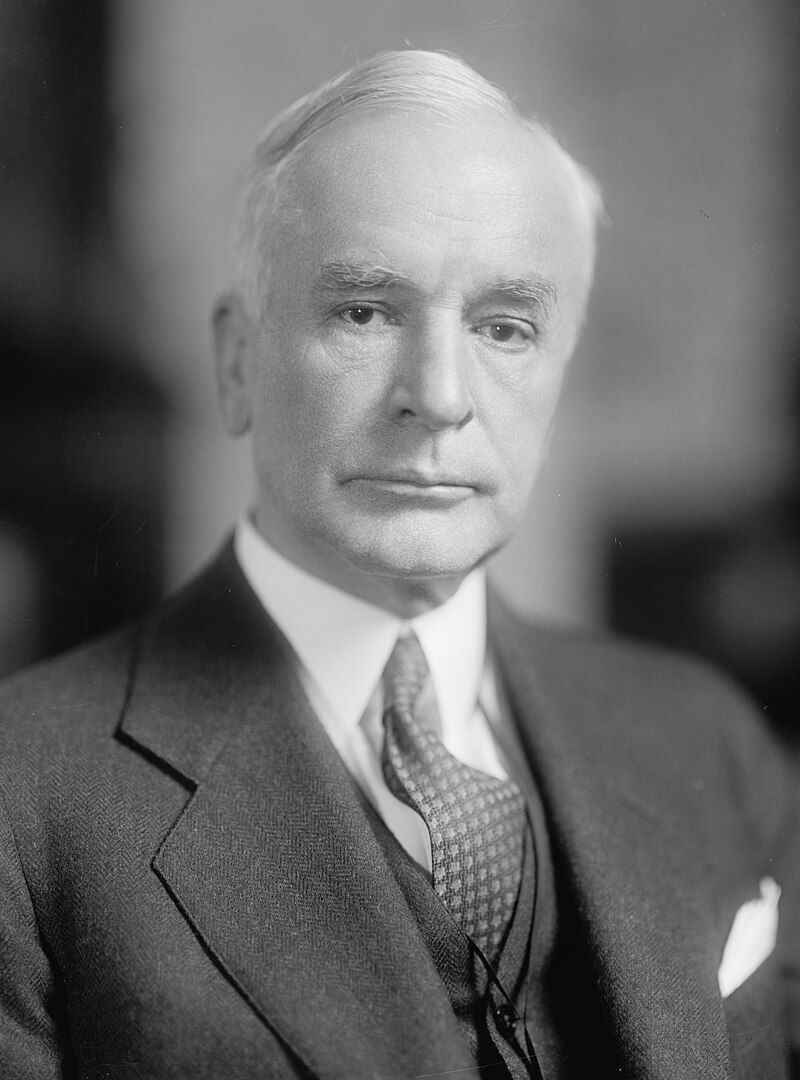
Cordell Hull
Cordell Hull was an American politician who served as the thirtieth Chancellor of America from 1942 to 1954. He was the only Chancellor to serve three terms. Hull originally served as the Secretary of State for Chancellor Henry L. Stimson before running for selection of Chancellor himself for the Unionist Party. A moderate Southern Unionist, Hull was backed by Secretary to the Monarch Franklin D. Roosevelt. While he was Secretary of State, he helped negotiate the Japanese-American Naval Treaty, a point he campaigned on heavily.
Hull became Chancellor at a time when relations between America and its neighbors were deteriorating. As a result, he developed what was known as the "Good Neighbor" policy, attempting to lower tariffs and bolster trade among the nations in the Americas. He also developed good relations with Gran Colombia, a historic rival to America. Unlike his predecessor, Hull supported the formation of the Pan-American Confederation, but believed it should be used for economic benefit rather than a strictly military alliance. Hull's approach to Europe was likewise different than Whig Party Chancellors before him as he saw Great Britain as the larger threat than the German Empire, particularly threatening to resign his earlier post in the State Department following the reconquest of Egypt should Stimson not denounce it.
When it was discovered that the Empire of Japan had been constructing additional naval vessels, including past the limit on battleships and aircraft carriers, and using them to arm their allies, Hull agreed to further discussions with greater allies. Hull supported the leasing of Guam from the German Empire, receiving protests from Japan. Hull wished to send a reply to the protest back to Tokyo, but the Battle of Guam took place before he was able to. Hull joined King James I in requesting a declaration of war on Japan. Hull also recieved a declaration of war from Great Britain, engulfing America into the World War
As a wartime Chancellor, Hull worked to cross party lines in order form what was in his mind the best government for America at the time. Hull also made the controversial decision to recognize the French Socialist Republic as a legitimate nation in 1945 in order to release security efforts from the Comintern Union towards Great Britain in what was deemed the "Europe First" strategy. Dwight D. Eisenhower and Douglas MacArthur were named the Supreme Commanders of the European Theater and Pacific Theater respectively.
During the peace deals ending the war, Hull oversaw the transfer British African colonies on the west coast to America. This move drew great criticism at domestically and internationally, as it was seen as breaking the Continental Ordinance. However, Hull asserted the regions were not to be controlled as colonies, but as mandates for eventual independence, citing the chaos in South Africa. The colonies, renamed Liberia and Freedonia, were subsequently established as a means to assert American values in Africa.
Social
Reign
Preceded by: Henry L. Stimson
Succeeded by: Dwight D. Eisenhower

Comments