

Sceptrum Imperiale
“A crown may be inherited, but the sceptre must be earned — for it answers only to a ruler whose will does not waver.”
The Sceptrum Imperiale is the supreme emblem of imperial authority, commissioned by Empress Lucilla Marcellia Aurelia roughly fifty years after the Human Rift. Daughter of the First Emperor and a rare imperial mage in her own right, Lucilla sought to create a symbol that reflected not only the legitimacy of her lineage, but the deeper truth of the Imperium Novum: that humanity’s fate was now inseparably entwined with the elder peoples brought to this world long before them.
To that end, she assembled an unprecedented collaboration between the Dwarrow master-smiths, the Collegium Arcanum, and the imperial arcane ateliers. Together they undertook a feat previously deemed impossible — fusing Rift-glass from two separate Rifts whose arrivals were separated by more than a millennium. The sceptre’s core contains paired shards: one harvested from the Human Rift Scar, and the other from the Dwarrow Rift Scar, the second-oldest Rift known after the arrival of the Elder Courts. Elven Rift-glass proved unsuitable for work, its ancient mana stabilised beyond safe manipulation, making the dwarven shard a natural and politically meaningful choice.
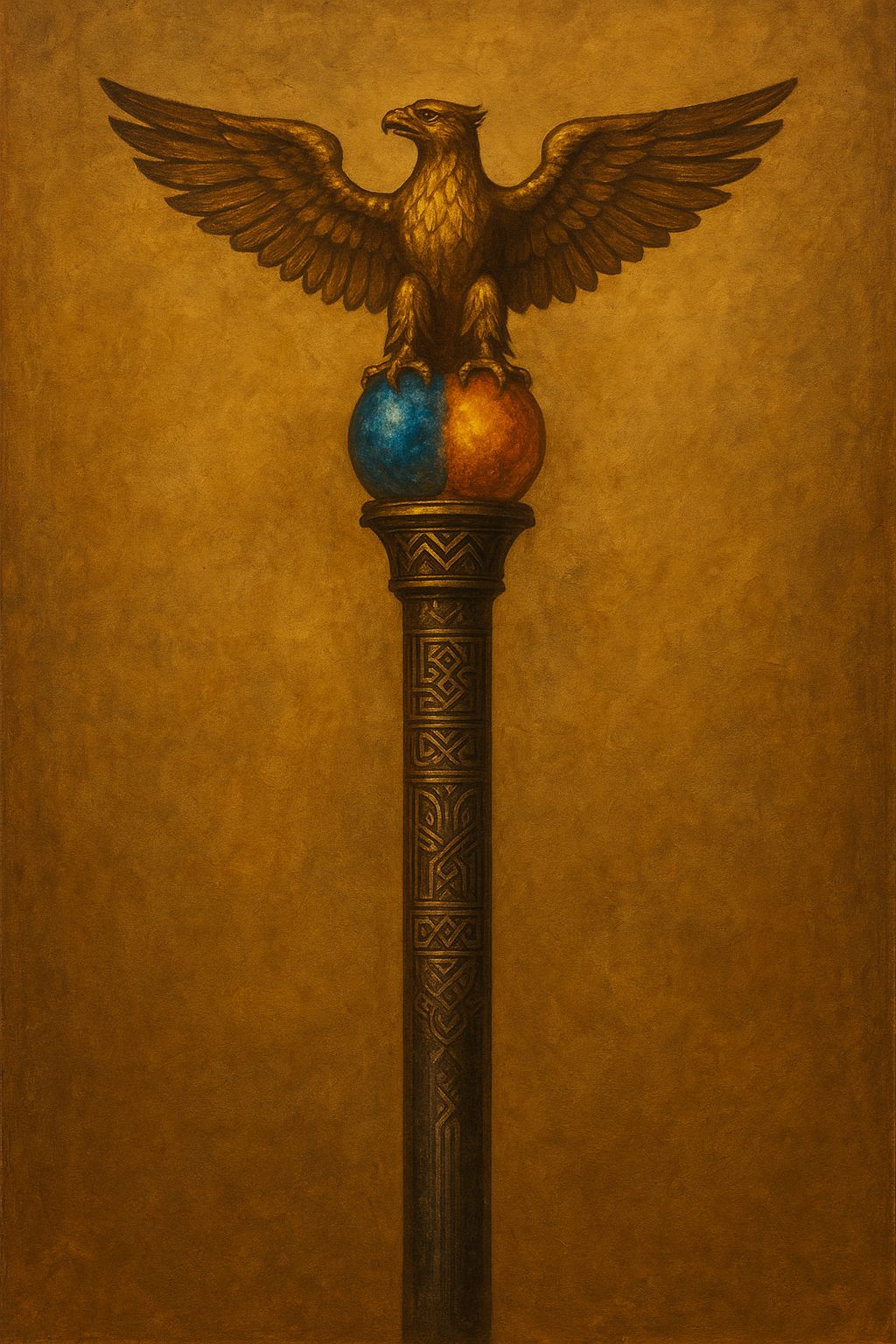
When dormant, the sceptre appears as a stately rod of dark imperial alloy, chased with dwarven knotwork and Lucilla’s own arcane sigils. When invoked, the twin Rift-cores awaken in mirrored resonance — the human shard pulsing in cold aether-blue, the dwarven shard answering in ember-gold. This harmonic interplay enables the sceptre to interface with the Empire’s growing spell-law lattice. In senatorial sessions, it asserts the Emperor’s binding mandate; on the field of war, its flare remains visible even amid aetheric storms, giving the legions an anchor of certainty in the chaos of Rift-born magic.
More than a ceremonial relic, the Sceptrum Imperiale stands as a living testament to the Empire’s founding ethos: that strength arises not from isolation, but from the deliberate union of worlds thrust together by the Rift. It encapsulates the shared craft, shared struggle, and shared destiny of both Human and Dwarrowkind — and the enduring vision of the Empress who understood that unity must be forged, not assumed.
Mechanics & Inner Workings
At its heart, the Sceptrum Imperiale operates as a stabilised arcano-legal conduit — a device that bridges the Emperor’s will, the Empire’s spell-law lattice, and the ambient aether shaped by past Rift events. Its function relies on the paired Rift-glass core, whose two shards resonate in counterpoint: the Human shard responds keenly to intent and spoken authority, while the Dwarrow shard anchors and amplifies that intent through structured sigils engraved into the sceptre’s internal channels.
When the Emperor raises the sceptre, a sequence of glyphs — some visible, most buried beneath the casing — activates in a cascading pattern known as the Lucillan Circuit. This ritual-engineered pattern converts the Emperor’s deliberate command into a measurable aetheric signal. In senatorial settings, this signal threads through the Capitol’s spell-infrastructure, asserting primacy during formal decrees and preventing magical interference or countermanding enchantments.
On the battlefield, the mechanism shifts. A separate set of war-sigils awakens, causing the Rift-glass core to flare with layered pulses of light. These pulses cut through fog, smoke, magical distortion, and even moderate aether-storms, allowing legionaries to locate their ruler — or their ruler’s appointed standard-bearer — with unerring certainty. The pulsing pattern also harmonises with legion shields and other imperial arcane marks, creating a faint but perceptible “sense of direction” felt as pressure behind the eyes or a tug toward alignment.
Critically, the sceptre does not cast spells in the traditional sense. It cannot project force, heal, conjure, or destroy. Its potency lies instead in amplification and assertion: it magnifies authority, stabilises doctrine, and ensures that the Emperor’s command echoes cleanly through the magical architecture of the Imperium. The Rift-glass core is inert without a sovereign’s deliberate focus, making it useless — and utterly inert — in the hands of pretenders.
Manufacturing process
The creation of the Sceptrum Imperiale was a singular undertaking, blending disciplines that had never before been combined. Empress Lucilla oversaw the project personally, insisting that every stage reflect both the Empire’s ascendant identity and the alliance she sought to cement with the Dwarrow.
The process began with the harvesting of the two Rift-glass shards. Human Rift-glass was collected from the still-active scar at Novaium’s outskirts, where its raw aetheric turbulence required Lucilla’s magic to stabilise it long enough for extraction. The Dwarrow shard, by contrast, was carefully quarried from their ancient Rift Scar under strict ritual conditions; their smith-priests prepared it with runic lullabies meant to calm the volatile glass before transport.
Once brought together, the shards were placed within a containment forge deep beneath the Capitol. This forge — a dwarven design adapted by Collegium Arcanum scholars — flooded the chamber with controlled aether pressure. Lucilla then wove a binding lattice around both shards, coaxing them into harmonic resonance without allowing them to fracture or repel one another. This fusion became known as the Lucillan Pairing, a technique no artisan has successfully reproduced since.
With the core stabilised, the dwarven smiths forged the sceptre’s outer casing from imperial dark-alloy, folding thin layers of metal over the nascent core while leaving microscopic channels for sigil-lines. Collegium engravers carved the runic and arcane pathways that carry the Emperor’s intent, while Lucilla inscribed the final sigil — her personal mark — into the innermost ring of the sceptre.
The last stage was consecration. Representatives from the Imperial temples, the Dwarrow priest-smiths, and the Collegium gathered to anchor the sceptre within the Empire’s spell-law lattice. When Lucilla first raised it, the twin cores ignited in blue and gold, and the sigils along the casing pulsed in perfect synchrony — a sign that the binding had taken, and that the sceptre recognised its monarch.
From extraction to consecration, the entire process spanned nine months, and its methods have never been replicated. The sceptre remains a one-of-a-kind artefact, not merely crafted but witnessed into being through the cooperation of two civilisations and the will of a visionary Empress.
History
The Sceptrum Imperiale was created during the reign of Empress Lucilla Marcellia Aurelia (28–63 NE), the second ruler of the Imperium Novum and the daughter of its founder, Gaius Marcellus Aurelius. Unlike her father, whose rule focused on stabilising the newly Rifted province, Lucilla sought to define a more enduring and unified imperial identity — one that acknowledged the intertwined destinies of humanity and the elder peoples long rooted in Exilum Novum.
Lucilla’s magical aptitude, honed through study at the Collegium Arcanum, convinced her that imperial authority required a focus capable of interfacing with the Empire’s developing spell-law lattice. This conviction led her to imagine a sceptre that would embody both legitimacy and unity. In 50 NE, she initiated a diplomatic venture that would make such a creation possible.
Relations with the Dwarrow had slowly normalised since the Hammerfall clashes of the early Nova Era, and Lucilla’s combination of firmness and sincerity earned her their respect. In a gesture never repeated, the Dwarrow granted her permission to harvest a shard of crystallised Rift-glass from their ancient Rift Scar — a relic originating from Rift II in –1200 BR, the second-oldest Rift in recorded history.
This dwarven shard was brought to Novaium under solemn guard, where Lucilla paired it with a newly stabilised shard taken from the Human Rift Scar. The fusion of these two pieces — separated by more than a millennium and born of different worlds — became the core of the sceptre. Achieving this union required the combined mastery of dwarven smith-priests, Collegium Arcanum scholars, and Lucilla herself. Their technique, later called the Lucillan Pairing, has never been replicated.
The sceptre was consecrated in 51 NE, in a ceremony involving imperial clergy, dwarven artisans, and arcane representatives. Upon its first activation in the Senate, the twin cores flared in mirrored hues of blue and gold, projecting the Empress’s mandate through the Capitol’s spell-infrastructure and marking the moment when imperial command and magical authority became formally intertwined.
Long after Lucilla’s death in 63 NE, the sceptre continued to shape imperial history. It has been present at every coronation since, carried in the funerary processions of eleven emperors, and borne during major diplomatic signings — most notably the Twin Rivers Treaty with the Centaurs (244 NE), in which its presence served as a visible guarantee of imperial sincerity.
Across the centuries, the Sceptrum Imperiale has endured as the single most recognisable symbol of rightful rule. Revered by the Dwarrow, acknowledged by Elven emissaries, and treated with ritual respect by Centaur shamans, it stands as a testament to Lucilla’s vision: that the Empire’s future would be secured not through dominance alone, but through unity forged across worlds.
Significance
The Sceptrum Imperiale holds a place of unparalleled importance within the Imperium Novum. More than a relic or emblem, it serves as the material expression of the Emperor’s mandate to rule — a mandate rooted not solely in lineage, but in the shared histories of the peoples drawn together by the Rift. Its dual-core design, forged from Human and Dwarrow Rift-glass, signals a legitimacy built upon unity rather than isolation.
Politically, the sceptre is indispensable. Its activation in the Senate affirms the Emperor’s authority in matters of state, stabilising the aether within the chamber and ensuring that decrees, edicts, and formal pronouncements cannot be magically distorted or contested. No coronation is considered valid without the sceptre’s presence, and no imperial funeral is complete until it is lowered in mourning.
Militarily, the sceptre functions as a rallying standard unlike any other. When raised in the field, its paired cores flare through smoke, storm, and sorcery, providing an unmistakable locus for the legions. Even veteran soldiers speak of the peculiar calm that settles over a battle line when the sceptre’s light cuts through the chaos, as though the Empire itself has drawn breath.
Diplomatically, its meaning is profound. The Dwarrow regard the inclusion of their ancient Rift-glass as a permanent testament to the pact between their peoples. Centaur shamans treat the sceptre’s twin radiance as a sign of balanced rulership, recognising it as an omen of good faith during negotiations such as the Twin Rivers Treaty. Even the Elder Courts of the Elves, whose Rift predates human history, acknowledge its symbolism as an artefact of rare shared craftsmanship.
Culturally and spiritually, the sceptre is woven into the Empire’s collective imagination. To most citizens, it is the Empire made visible — the embodiment of continuity from Gaius Aurelius to the present sovereign. To scholars, it represents an unparalleled feat of early Nova Era cooperation and arcane innovation. To the legions, it is reassurance incarnate.
In every sphere of life — political, magical, martial, and symbolic — the Sceptrum Imperiale endures as the singular object that defines imperial legitimacy. As long as it shines, the Empire stands.
Unique

Comments