

Gaius Marcellus Aurelius
"Order is the shield of the weak, and the burden of the strong."
"Order is the shield of the weak, and the burden of the strong."
Father of the Imperium
Gaius Marcellus Aurelius, Legate of Legio XIII at the moment of the Rift and co-author of the Constitutio Novae Imperii, stands as the revered founder and first Emperor of the Imperium Novum. More than a commander, he became the steady fulcrum around which a disoriented people stabilised. In the first desperate months after the Rift, when food dwindled, morale faltered, and the very laws of nature appeared uncertain, Aurelius' presence offered Romans something they had nearly forgotten: continuity.
Neither visionary mystic nor conquering autocrat, Aurelius embodied the quiet discipline of the old Republic fused with the sober responsibility of imperial command. He navigated a world of elves, dwarves, arcane forces, and unknown frontiers not with arrogance, but with the practised caution of a veteran officer who understood that survival was achieved through order, structure, and unity. His authority grew not from divine mandate or ambition, but from the trust of soldiers and citizens who witnessed him bear the burdens of leadership without flinching.
His reign (10–28 NE) laid the bedrock upon which the entire Imperium Novum would rise: civic law rooted in Roman tradition yet adapted to a foreign world; the establishment of Novaium as a political and cultural capital; the first treaties that prevented early annihilation; and the beginnings of regulated arcane oversight. Later generations would mythologise him as the Father of the Empire, yet even his most reverent chroniclers acknowledge that his greatness lay in his humanity — a commander who never sought glory, only stability. For Aurelius, the Empire was not destiny fulfilled but duty endured.
Physical Description
General Physical Condition
Aurelius carried the unmistakable bearing of a lifelong soldier—broad-shouldered, steady-footed, and built with the durable strength of a man forged by decades of marching, drilling, and campaigning. Even into his later years, when the burdens of rule weighed heavily upon him, he maintained the posture and stamina of a commander who refused to yield to age. His movements were deliberate rather than swift, shaped by efficiency rather than flourish, and his presence conveyed a quiet authority that needed no declaration.
Though time inevitably slowed him, he remained physically formidable well into his sixties. His endurance surprised many; he continued to ride long distances during inspection tours, often outlasting younger officers unaccustomed to his relentless discipline. Only in the final years of his reign did fatigue become visible—subtle at first, manifested in slower steps and longer pauses, and then unmistakable during his final journey along the frontier. Yet even then, observers wrote that he never appeared frail, merely worn, like an old shield that had seen one campaign too many but still held firm.
Identifying Characteristics
Aurelius bore several marks that became iconic in later imperial portraiture. The most recognisable was a diagonal scar running from his cheekbone to the line of his jaw, a relic of a skirmish in his early career that he never allowed to be tidied or concealed. Chroniclers often remarked that the scar, though not disfiguring, lent his features a severity that perfectly matched his temperament.
On his right forearm he carried the legionary tattoo of Legio XIII, inked in deep blue-black and weathered by time. Even after ascending to the throne, he refused to let it fade or be altered, insisting that it marked the only title he had ever truly earned. In private moments, he was known to trace the edges of the tattoo with his thumb—a gesture half-habit, half-remembrance.
In the final decade of his life, a subtle stiffness settled into his left knee, the lingering consequence of an old campaign injury. Though not often mentioned in official accounts, it shaped his gait just enough for those familiar with him to recognise his footsteps anywhere in the palace halls.
Together, these features became part of the visual language of the early Imperium. Sculptors immortalised the cheek-scar as a symbol of endurance, the tattoo as a declaration of service, and the measured gait as the mark of a man who had carried a nation’s weight long before he wore its crown.
Physical quirks
Aurelius’ physical habits were shaped by a lifetime of military discipline and the quiet burdens of command. He was known for a distinctive habit of folding his hands behind his back whenever he settled into contemplation—a posture that became so associated with him that later emperors imitated it during official inspections. This stance, rigid yet reflective, conveyed both vigilance and restraint.
He also possessed a tendency to pace in measured, deliberate lines when confronted with difficult decisions. Unlike anxious pacing, Aurelius’ movements were almost ritualistic—each step evenly spaced, each turn precise. Observers believed this habit helped him order his thoughts, aligning internal dilemmas with external structure.
During moments of frustration or deep concentration, he would sometimes tap his thumb against the inside of his palm, a small, rhythmic gesture only those closest to him ever noticed. In council chambers, this subtle motion often preceded decisive action, becoming an unspoken signal that his thoughts had crystallised.
A final quirk, remarked upon by his personal guard, was his habit of watching the horizon during travel or outdoor councils. Even as Emperor, he carried the instincts of a frontier officer—scanning for threats, measuring distances, and mentally assessing terrain. To Aurelius, a leader’s gaze always extended beyond the immediate moment.
Apparel & Accessories
Aurelius’ attire reflected the disciplined austerity of his character, even after he ascended to the throne. He rejected ostentation, refusing the gilded extravagance that later emperors would embrace, and instead favoured garments that bridged his past as a soldier with his role as a statesman.
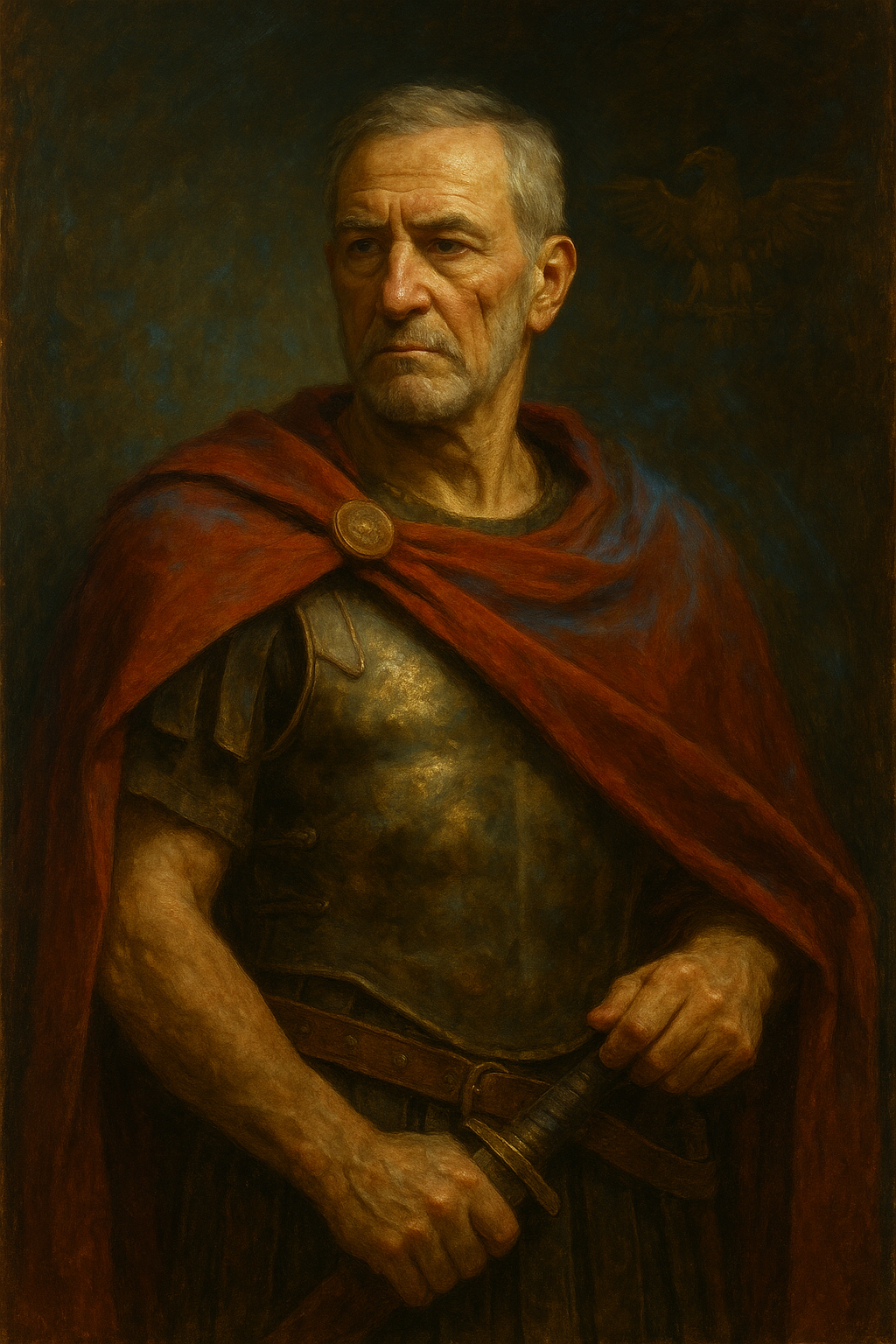
His most recognisable garment was a crimson paludamentum, clasped at the shoulder with a simple bronze fibula shaped in the form of the Imperial eagle—an early prototype of the regalia that would later become formalised. The cloak’s colour, traditionally reserved for commanders, symbolised not imperial privilege but perpetual readiness. Court painters noted that he wore it not draped in theatrical folds, but with the crisp, utilitarian fall of a field officer.
Beneath the cloak, he typically wore a modified legionary cuirass, polished but undecorated, paired with a dark wool tunic marked by narrow bands of Imperial purple. The cuirass was more ceremonial than functional by the end of his reign, yet he insisted upon it during public appearances as a reminder of his origins and obligations.
On his hands he wore no rings save one: a plain iron signet engraved with the early crest of the Imperium Novum. The simplicity of the metal was intentional; Aurelius considered gold garish and unfitting for a servant of the state. Even in formal settings, he preferred iron or bronze over precious metals.
His sandals and boots remained those of an officer—well-kept but unadorned, built for distance rather than parade. During campaigns and inspections, he wore a weathered travelling cloak of heavy grey wool, its edges patched several times. When questioned by senators about replacing it, he famously replied, “A cloak does not rule an empire. A man does.”
In council, he often carried a wax tablet and stylus, tools that became emblematic of his governance. Observers described him idly weighing the stylus between his fingers as he listened, a gesture that conveyed both attention and an unspoken reminder: decisions would be recorded, measured, and held to account.
Specialized Equipment
Unlike many rulers who succeeded him, Aurelius refused to adopt a ceremonial weapon. He wore his original legionary gladius, the same sword he had carried through decades of service in Legio XIII. Its grip was worn smooth by use, its fuller darkened with age, and its edge meticulously maintained even in the years after he ascended to the throne. To Aurelius, this blade symbolised not martial display but the unbroken continuity of duty—the tool of a soldier, not the ornament of a sovereign.
When he appeared in public, the gladius hung at his left hip in a plain leather scabbard reinforced with bronze. It was neither gilded nor jewelled, a deliberate rejection of ostentation that became one of his most enduring personal statements. Court chroniclers note that foreign dignitaries were occasionally startled by the Emperor’s decision to carry a weapon that was plainly functional rather than ceremonial; Aurelius’ response, recorded in an aide’s journal, was simply: “A sword speaks most honestly when it remembers work.”
In addition to his gladius, Aurelius kept close the original wax tablets of the Charter drafts, worn at the corners from years of revision. These, too, he treated as instruments of governance rather than relics, consulting them frequently as if to remind himself that law—like steel—required constant upkeep.
Mental characteristics
Personal history
Born into the Aurelius gens in Mediolanum, Aurelius entered the world neither marked for greatness nor destined for obscurity. His early years were shaped by the quiet austerity of northern Italia—its disciplined households, its provincial pride, and its long tradition of producing officers rather than orators. From his father, a minor magistrate, he learned the rhythms of civic duty; from his mother, the value of restraint. The death of his wife shortly before the Rift would become a private sorrow he never fully laid down.
Aurelius distinguished himself early in military service, not through spectacular victories but through an unwavering reliability that endeared him to superiors and subordinates alike. He became known as a commander who rarely erred, who planned meticulously, and whose soldiers trusted him even when circumstances grew desperate. By the time he earned the rank of Legate, he had already built a reputation as a man who understood both the machinery of war and the machinery of governance.
When the Rift tore Nova Provincia from Earth and flung it into Exilum Novum, Aurelius found himself not simply a commander of troops but the steady centre of a civilisation suddenly unmoored. Overnight, familiar landscapes, laws, and expectations dissolved. Supply lines vanished, communication with Rome was cut forever, and the people—soldiers, farmers, artisans, magistrates—looked for direction. It was Aurelius who imposed order where panic threatened to take root. He organised rationing, re-established command structures, oversaw the mapping of the new land, and initiated the first contact protocols with the indigenous and Rift-born civilisations.
The months following the Rift forged Aurelius into the figure later generations would revere: a man whose authority was not seized but given by those who recognised his competence in a world suddenly hostile and unknown. Though reluctant at first to assume political control, he understood that without a unified hierarchy, their transplanted province would fracture under the pressures of scarcity, fear, and external threats. His collaboration with early senators, magistrates, and the nascent Collegium Arcanum culminated in his most enduring legacy—the Constitutio Novae Imperii, a document that blended Roman jurisprudence with the pragmatic needs of a magically charged world.
By the time he was acclaimed Emperor in 10 NE, Aurelius had already become the architect of Roman survival. His reign was not one of grand conquest but of deliberate consolidation—fortifying borders, codifying laws, negotiating coexistence with elves and dwarves, and tempering military ambition with diplomatic prudence. His leadership was defined not by personal glory but by the sober understanding that the Empire's future depended on stability, structure, and the careful regulation of arcane forces they scarcely understood.
Aurelius' life ended as it was lived—quietly, dutifully, without theatrics. His final inspection of the frontier became his symbolic farewell to the world he had shaped. Returning to Novaium weary but resolute, he passed away in his study, stylus in hand, during what historians now call The Last Watch of the Legate. Though later chroniclers would embellish his final moments, the truth remains simple: he died as he had lived, a servant of order.
Education
Aurelius received a disciplined and thoroughly provincial Roman education—one that valued utility over ornamentation. His early schooling in Mediolanum centred on the traditional trivium: grammar, rhetoric, and logic. Yet unlike the sons of more aristocratic families, he was not groomed for senatorial life; his family's modest means and civic background directed him instead toward a career of service.
He studied rhetoric not to sway crowds but to command clarity in issuing orders. He learned law with the expectation that he would administer it rather than write it. Mathematics and logistics, often overlooked in higher Roman education, became central to his training and later defined his administrative strength. His instructors noted that he excelled not in flamboyant oratory but in precise argumentation—a trait that would later shape the austere, almost architectural prose of the Constitutio Novae Imperii.
Upon entering military service, Aurelius continued his education through the harsh but effective tutelage of veteran officers. Campaign life taught him field engineering, supply management, and the subtle art of balancing discipline with morale. He absorbed lessons from every quarter—tribunes, centurions, engineers, even the quartermasters whose work kept the legion fed and equipped. In time, his breadth of practical knowledge rivalled that of the Empire's finest bureaucrats.
By the time of the Rift, Aurelius was more than a soldier; he was a scholar of governance in all but name. His education, though unadorned and never formally celebrated, became the intellectual backbone of his later reforms. When circumstances thrust him into leadership of a dislocated province, he possessed not only the discipline of a commander but the cultivated judgement of a statesman.
Employment
Aurelius’ career unfolded in deliberate, disciplined stages, each building upon the last with the quiet inevitability of a man who never sought advancement yet never failed a duty. He began as a junior officer in a provincial cohort, where his talent for logistics and clarity of command quickly distinguished him from his peers. Superiors noted that he possessed none of the theatrical ambition common to Rome’s rising stars; instead, he approached leadership as an engineering problem—one solved through precision, reliability, and the steady cultivation of trust.
His early assignments involved frontier patrols, settlement security, and the often-ignored administrative work that kept Nova Provincia functioning. It was here, in the unsung labour of provisioning garrisons, negotiating with local magistrates, and maintaining internal order, that he developed the skills that would later save thousands. Promotions came not through battlefield heroics but through consistent excellence: first to centurion, then to tribune, and finally, after years of flawless service, to Legate of Legio XIII.
As Legate, Aurelius oversaw not only military operations but the broader civil stability of the province. He became adept at balancing the demands of senators, provincial governors, and local landholders—an experience that later proved invaluable when the Rift severed all ties to Rome. His leadership style was marked by calm authority; he earned the loyalty of his soldiers and the grudging respect of political elites who found his plain-spoken competence difficult to manipulate.
The Rift transformed his role overnight. Cut off from the Empire and thrust into an alien world, Nova Provincia needed a stabilising force, and Aurelius became that anchor by simple necessity. He directed the reorganisation of the legion, coordinated civilian protection, and established provisional governance structures that would evolve into the earliest form of the Imperium Novum. What had once been the administrative burden of a frontier Legate became the foundation of a new civilisation.
Upon the ratification of the Constitutio Novae Imperii in 10 NE, Aurelius—despite initial reluctance—accepted the acclamation of Emperor. His imperial tenure reflected the same disciplined pragmatism that had defined his military career: measured expansion, cautious diplomacy, careful oversight of emerging arcane institutions, and the continual reinforcement of order in a land still reshaping itself around its new inhabitants.
Accomplishments & Achievements
Aurelius’ achievements form the bedrock upon which the Imperium Novum stands, each shaped not by ambition but by the relentless discipline that defined his character. His most enduring legacy is unquestionably the Constitutio Novae Imperii, drafted in collaboration with senators, magistrates, and the earliest arcane scholars. Though written in the crucible of post-Rift uncertainty, the Charter bears the unmistakable imprint of his mind: concise, pragmatic, and unyieldingly focused on civic order. It became the spine of Imperial governance, ensuring continuity in an age when collapse seemed far more likely than rebirth.
His unification of the Roman populace after the Rift remains one of the great feats of statesmanship in recorded history. Faced with panic, scarcity, and the disorientation of being torn from their native world, the people looked for a figure to anchor them. Aurelius provided that anchor. His clear directives, strict rationing systems, and unwavering insistence on structure prevented fragmentation at a moment when even trained soldiers wavered. Historians frequently note that he did not seize power during this period — it accrued to him naturally from those who recognised his competence.
The establishment of Novaium as the new imperial capital stands as another of his transformative contributions. Rather than clinging to the remnants of Nova Provincia’s original administrative centres, Aurelius chose a site suited to the realities of Exilum Novum: defensible, resource-rich, and placed at the crossroads of emerging trade and diplomatic routes. Under his guidance, Novaium evolved from a provisional encampment into the beating heart of a new civilisation.
His diplomatic efforts with the elves and dwarves set the stage for centuries of relative stability. Though neither alliance was warm, both were functional, built on the Roman virtues of clarity, consistency, and mutual benefit. Aurelius understood that in a world filled with powerful non-human civilisations, arrogance was a luxury the fledgling Imperium could not afford.
Finally, his reforms within the legion ensured that Roman military doctrine adapted to the peculiarities of their new world. He standardised responses to arcane phenomena, reorganised auxiliary structures to integrate non-human specialists, and preserved the core discipline that defined Roman arms for centuries. These reforms not only strengthened the Imperium’s defences but also prevented early disasters born of ignorance or magical miscalculation.
Together, these accomplishments forged the foundation of the Imperium Novum — a state durable enough to weather future Rifts, wars, and the ever-shifting landscape of Exilum Novum. For this reason, Aurelius is not merely remembered as its first Emperor, but as its architect.
Failures & Embarrassments
Though later generations would elevate Aurelius to near-mythic stature, his private writings and the correspondence of his contemporaries reveal a man acutely aware of his own shortcomings. His earliest and most enduring regret concerned the first winter after the Rift, when his provisional rationing orders—based on Roman agricultural expectations rather than the realities of Exilum Novum—unintentionally deepened a famine already brewing. Though external forces were largely to blame, Aurelius carried the weight of those miscalculations for the rest of his life, often revisiting them as cautionary lessons in humility.
Another source of embarrassment, seldom acknowledged in official histories, was his initial misreading of elven diplomatic customs. Accustomed to Roman directness, Aurelius approached early negotiations with a forthright clarity that the elves perceived as brusque, even hostile. The resulting tension stalled crucial talks for months. Only after extensive counsel from proto-Arcanii advisers did he recalibrate his approach, ultimately securing the pragmatic coexistence that would define the early Imperium’s diplomatic posture. Aurelius later described this episode as the moment he realised that Exilum Novum demanded not only new laws but new ways of thinking.
His third and most personal failure was one of temperament. Aurelius struggled with delegation, often insisting on overseeing matters personally—even minor ones. This habit, admirable in a commander, occasionally hindered the developing civilian bureaucracy of the emerging Imperium. Several early senators complained (discreetly) that the Emperor’s perfectionism slowed reform, while younger administrators found themselves paralysed by his exacting standards. It was only in the final years of his reign, under pressure from trusted advisers, that Aurelius began relinquishing responsibilities to others.
Despite these shortcomings, Aurelius’ failures humanise rather than diminish him. They illustrate a truth often lost in the glow of later hagiography: the Father of the Imperium was not infallible. He was a man who erred, recognised his errors, and—crucially—adapted. In doing so, he laid not only the foundations of a state, but the foundations of its humility.
Mental Trauma
Though Aurelius was revered for his discipline and composure, his private journals—preserved in fragments within the Imperial Archives—reveal a man who carried profound and enduring wounds beneath his austere exterior. The death of his wife, occurring only months before the Rift, left a fissure in his emotional life that he never truly allowed to heal. He threw himself into duty not merely out of obligation but as a refuge from grief, burying sorrow beneath the rigid structure of command. Those closest to him noted that he avoided speaking of her entirely; even the simplest mention of her name would cause him to fall into long, silent pauses.
The dislocation caused by the Rift inflicted another, subtler trauma: the irreversible severing of his connection to Rome. Aurelius never publicly mourned the loss of his homeland, but the weight of that cultural orphanhood pressed heavily upon him. Letters to his most trusted tribune describe dreams in which he walked the streets of Mediolanum, only for them to dissolve into the strange landscapes of Exilum Novum. He interpreted these not as omens, but as reminders of the impossible task before him—rebuilding identity from the ruins of displacement.
Most haunting of all were the memories of the first winter after the Rift, when famine and panic claimed lives despite his best efforts. He internalised every death as a personal failure, even when rational analysis proved otherwise. The faces of those he could not save lingered with him, resurfacing during moments of quiet or fatigue. He seldom confided in others, but one preserved account from a senatorial aide recounts finding the Emperor awake before dawn, studying casualty lists from years past, tracing the names as though committing them to memory.
Aurelius also struggled with the emotional toll of leadership in a world suffused with arcane forces he did not fully understand. While the Collegium Arcanum offered counsel, he harboured a private unease toward magic—less fear than distrust of its unpredictability. The thought that he must govern a realm in which unseen energies could invert logic and destabilise order weighed heavily on him. In his writings, he described this as “holding a torch in fog thicker than night.”
These traumas did not break him, but they shaped him. They hardened his resolve, sharpened his focus, and forged the stoic exterior that became synonymous with his legend. Yet beneath the armour of duty lived a man who bore scars unseen—scars that defined not only the Emperor he became, but the Empire he built.
Intellectual Characteristics
Aurelius possessed an intellect shaped not by academic indulgence but by the disciplined pragmatism of a lifelong officer. His mind worked with the precision of a military engineer: methodical, structured, and intolerant of ambiguity. He approached every problem—be it logistical, diplomatic, or existential—with a craftsman’s instinct to deconstruct it into its smallest moving parts. Contemporaries often described him as "thinking in straight lines," not in the sense of simplicity, but in the sense of unwavering focus.
He had little patience for speculative philosophy or rhetorical flourishes, yet he displayed an extraordinary capacity for synthesis. Faced with unfamiliar cultures, magical phenomena, and the disorienting realities of Exilum Novum, Aurelius adapted with surprising speed. His journals show a man constantly observing, categorising, and seeking underlying patterns—whether in elven diplomatic ritual or in the erratic behaviour of Rift-touched flora.
Aurelius possessed a deep respect for law, not as an abstract ideal but as a functional scaffold for civilisation. He excelled at identifying weaknesses in institutional structures, crafting reforms that were both realistic and sustainable. His intellect was inherently conservative—not resistant to change, but committed to ensuring that change did not erode order.
Those who served with him often remarked on his capacity for silent contemplation. He was not a man who filled quiet moments with speech; instead, he allowed ideas to settle, refine, and sharpen like a blade on a whetstone. This reflective nature made him an exceptional strategist. He anticipated consequences several steps ahead, a trait that spared the early Imperium from numerous crises.
Despite this formidable clarity of thought, his intellect bore the imprint of his inner wounds. He was prone to bouts of self-scrutiny so intense they bordered on doubt, especially when weighing decisions that might cost lives. Yet it was this very tension—between the unyielding rationalist and the man who felt too deeply—that granted his leadership its rare balance of firmness and humanity.
Morality & Philosophy
Aurelius’ moral framework was forged in the strict clarity of Roman civic virtue and tempered by the existential upheaval of the Rift. He believed without compromise that order is the highest mercy a leader can give, for chaos—whether born of fear, famine, or magical aberration—preys first upon the vulnerable. This conviction did not emerge from ideology, but from lived experience: he had seen too many communities collapse under their own uncertainty to place trust in anything but structure.
His philosophy was a synthesis of Stoic discipline and pragmatic governance. He valued restraint, self-command, and the suppression of personal desire in service to the collective good. Aurelius held that a ruler must be the first to sacrifice and the last to indulge, a principle he lived so rigorously that even his detractors admitted he asked nothing of others he did not demand of himself.
Aurelius distrusted grand visions and abstract theories. To him, moral worth was proven through action—not intention. He rejected the idea that destiny or divine favour played any meaningful role in leadership; a ruler’s legitimacy was earned through competence, consistency, and the willingness to bear the weight of responsibility without complaint. In his private writings, he warned against leaders “who seek the crown for its brightness and not its burden.”
Yet despite his rigid exterior, Aurelius’ morality was not cruel. He believed deeply in justice tempered by clemency, especially for those who erred from ignorance rather than malice. Hardship had taught him empathy, though he seldom expressed it openly. This balance—unyielding order paired with quiet compassion—became the moral foundation of the early Imperium.
Ultimately, Aurelius saw himself not as a master, but as a custodian: a guardian responsible for preserving stability until a future generation could inherit a world less precarious. His philosophy can be summarised in a line attributed to him by later chroniclers: “Power is not held. It is carried.”
Taboos
Aurelius held an uncompromising disdain for anything that eroded the foundations of order and civic virtue. Foremost among his taboos was corruption, which he viewed not merely as a personal failing but as a contagion capable of collapsing institutions from within. He refused to tolerate bribery, favour-trading, or the quiet manipulations common in late Roman politics; officers and senators alike learned swiftly that even the rumour of such behaviour could end a career under his administration.
He harboured an equally strong aversion to political theatrics. Aurelius considered grandiose displays of emotion, public self-promotion, and appeals to mob sentiment to be dangerous indulgences—symptoms of a leader who valued popularity over stability. His philosophy held that authority should be exercised with clarity, not spectacle, a principle that shaped both his speeches and his governance.
Perhaps most personally, Aurelius despised any misuse of authority, whether through cruelty, negligence, or ambition untethered to duty. He believed that power existed solely to uphold order and protect the vulnerable; to wield it for self-interest was, in his eyes, a betrayal of the very purpose of leadership. This conviction often placed him at odds with ambitious senators or overzealous officers who mistook their positions for license rather than responsibility.
A more subtle taboo, noted by those closest to him, was his discomfort with superstition and arcane fatalism. Though he respected the Collegium Arcanum and valued ritual for its cultural role, he distrusted any claim that destiny or magic could absolve individuals of accountability. To Aurelius, surrendering judgement to omens or aetheric forces was a form of cowardice—a refusal to act with reason in a world already burdened by uncertainty.
These taboos, though strict, formed the ethical spine of his rule. They ensured that the Imperium’s early decades were defined not by excess ambition or mystical disorder, but by the steady, disciplined pursuit of stability.
Personality Characteristics
Representation & Legacy
In the centuries following his death, Aurelius became more than a historical figure—he became the axis upon which Imperial identity turned. Early chroniclers wrote of him with measured admiration, emphasising his discipline and restraint, but as generations passed, the narrative shifted from record to reverence. To many citizens of the Imperium Novum, he is not simply remembered; he is invoked, a symbol of steadfast leadership in an unpredictable world.
In art, Aurelius is almost always depicted in the same iconic form: standing tall in his modified cuirass, crimson paludamentum draped across one shoulder, his worn legionary gladius at his side. Sculptors exaggerated neither his stature nor his features, preferring to convey dignity through posture rather than idealisation. The diagonal scar on his cheek became an emblem of perseverance—proof that the Empire was born not from divine intervention but from the endurance of ordinary humanity.
Political theorists of the early Second Century NE referred to him as the "Imperium’s Measure", meaning that all rulers after him were judged by the clarity of his example. His Charter became the philosophical spine of governance, copied, amended, argued over, and ritualised. Even emperors who diverged from his ideals found it necessary to cloak their policies in the language of Aurelius, lest they appear to dismiss the moral authority of the Founder.
The military embraced him even more fervently. Legionaries swore informal oaths invoking "the steadiness of Aurelius’ hand," and his maxims became foundational teachings in officer academies. His refusal to adopt a ceremonial sword became a cultural touchstone—a reminder that the Imperium’s strength lay not in pageantry but in disciplined resolve.
Among non-human allies, his legacy is complex but respected. Elven historians acknowledge him as a leader who learned humility after early missteps, while dwarven chronicles praise his practicality and unwavering honour in diplomatic dealings. Even cultures that never met him firsthand were influenced by the political structures he established.
Yet perhaps the clearest mark of his legacy lies in the civic consciousness of the Imperium. Citizens across provinces, generations removed from the Rift, speak of him as the Father of Order, a figure who transformed catastrophe into civilisation. His death is commemorated each year with quiet vigils in Novaium, where citizens retrace the Emperor’s final walk through the palace corridors.
In the Senate, an empty seat—untouched since 28 NE—remains symbolically reserved for him during the opening session of each legislative year. No emperor, however powerful, has ever claimed it.
Through these rituals, monuments, and unspoken cultural expectations, Aurelius endures not as a mythic conqueror nor a divine figure, but as the ideal against which all leadership is measured.
Social
Reign
Aurelius’ reign, spanning eighteen formative years from 10–28 NE, is universally regarded as the bedrock upon which the Imperium Novum was constructed. His governance was defined not by expansionist ambition, but by the sober, methodical establishment of institutions capable of sustaining a civilisation uprooted from its world of origin and thrust into an arcane frontier.
The First Years (10–13 NE): Reconstruction and Codification
Upon his acclamation as Emperor, Aurelius prioritised stabilising the fractured remnants of Nova Provincia. He oversaw the drafting, ratification, and implementation of the Constitutio Novae Imperii, transforming provisional crisis-management structures into coherent civic frameworks. During these early years, he formalised the Senate’s advisory role, established magistracies adapted to Exilum Novum’s realities, and instituted strict census and rationing systems to prevent renewed famine. His focus was internal: rebuilding trust, restoring order, and ensuring that panic never again threatened the Empire’s survival.
The Middle Years (14–20 NE): Diplomacy, Defence, and Arcane Integration
With internal stability secured, Aurelius turned outward. Recognising that isolation would doom the infant Imperium, he negotiated pragmatic coexistence with neighbouring elven courts and dwarven holds. These early treaties—often tense and fragile—laid the groundwork for centuries of uneasy but functional diplomacy. Simultaneously, he restructured Legio XIII and the auxiliary cohorts to account for the unpredictable arcane phenomena of Exilum Novum. It was during this period that he authorised the formation of the Collegium Arcanum as a regulated body, ensuring magical practitioners served the state rather than destabilised it.
Aurelius also established the first frontier fortifications, survey routes, and long-range patrol systems. These measures protected settlements from both mundane threats and Rift-touched anomalies, while mapping the surrounding territories for future generations.
The Later Years (21–28 NE): Consolidation and the Burdens of Legacy
In the final phase of his reign, the Emperor focused on refining governance rather than expanding territory. He introduced judicial reforms to harmonise Roman law with the realities of a multi-species world, strengthened provincial administration, and encouraged the development of local councils under senatorial oversight. Though physically slowing, his mind remained sharp, and he continued to preside over councils with the same disciplined clarity that had defined his early career.
This final decade saw Aurelius begin to shape succession and institutional continuity. He worked closely with his adopted heir, preparing him not for glory but for responsibility. At the same time, he increasingly withdrew from public ceremony, preferring quiet study, discussion with advisers, and meticulous refinement of policies intended to outlast him.
The Last Watch (28 NE)
Aurelius’ final act as Emperor was a months-long inspection of the frontier bastions—a symbolic affirmation that the Empire’s first duty was vigilance. Returning to Novaium waning in strength but unshaken in resolve, he died in his study, stylus in hand, leaving behind a state not defined by conquest, but by cohesion.
His reign is remembered as an era of foundation rather than flourish. Everything that followed—senatorial law, military reform, arcane regulation, diplomacy, civic identity—rests upon the architecture he constructed. Later historians would come to call the period of 10–28 NE the Aurellian Era, a testament not to spectacle or ambition, but to the quiet, relentless labour of a man who believed that stability itself was the greatest imperial achievement.
Contacts & Relations
Aurelius moved within a tight constellation of individuals whose counsel and loyalty shaped the early Imperium. His relationships were rarely personal in the familiar sense; they were built on shared duty, mutual respect, and the hard pragmatism of survival in an unfamiliar world.
The Senate (Early Imperial Senate)
Though not yet the powerful institution it would later become, the Senate served as Aurelius’ most consistent advisory body. He relied on its senior members for legal expertise, administrative oversight, and civic organisation. Relations were cordial but disciplined—Aurelius listened, considered, and decided, and the Senate learned quickly that persuasion lay in reason, not theatrics.
Tribunes and Officers of Legio XIII
His closest circle came from the legion he once commanded. Tribunes, centurions, and veteran officers formed a martial backbone around him, advising on matters of defence, logistics, and frontier control. Many served as intermediaries between the Emperor and the common soldier, reinforcing the perception that Aurelius remained, at heart, a commander among his men.
The First Archon of the Collegium Arcanum
Though initially cautious of arcane practitioners, Aurelius cultivated a productive—if careful—relationship with the Collegium’s first Archon. Their collaboration established protocols for magical regulation, battlefield arcana, and civic safety. Mutual respect eventually grew, grounded in shared recognition that unchecked magic posed as great a risk as external foes.
Diplomatic Contacts with Elves and Dwarves
Aurelius maintained measured but functional relations with neighbouring powers. Elven emissaries valued his eventual mastery of their diplomatic etiquette, while dwarven envoys regarded him as a man of unembellished honour. Though never warm, these relationships prevented early conflict and laid the scaffolding for long-term treaties.
Civil Administrators and Magistrates
Aurelius depended heavily on a cohort of diligent clerks, archivists, and magistrates who transformed his directives into functioning institutions. These civil servants were not famous, but they formed the administrative spine of the early Imperium. Aurelius treated them with the same seriousness he applied to military officers.
Family Ties
Aurelius’ familial world was small, shaped more by loss and duty than by bloodline continuity. Born into the modest but respected Aurelius gens of Mediolanum, he inherited neither wealth nor political influence, only the quiet expectation of service that defined his lineage. His parents died before the Rift, and Aurelius’ only sibling—a younger sister—passed in childhood, leaving him without surviving close kin by the time he reached command.
His marriage, formed early in his officer years, was one of quiet affection rather than political strategy. His wife, Livia Marcellina, came from a similarly modest provincial family and shared his instinct for restraint. Her unexpected death mere months before the Rift marked Aurelius deeply; though he seldom spoke of her, those who knew him before and after noted a lasting change in his reserve and contemplative silence.
With no biological children, Aurelius later adopted a promising young officer as his heir—Marcus Aelius Varro, a disciplined, sharp-minded tribune shaped in part by Aurelius’ own mentorship. Their relationship, though not paternal in the emotional sense, was built on mutual respect and a shared commitment to the stability of the Imperium. Varro became the nucleus of the early dynastic structure, continuing Aurelius’ policies and ensuring political continuity after his death.
Extended relatives of the Aurelius gens existed within Nova Provincia, but most perished during the First Winter after the Rift or faded into the broader populace. Those who survived did not form the power blocs common in later imperial dynasties; Aurelius never promoted his distant kin, believing that office should be earned, not inherited.
Thus, the familial legacy of Gaius Marcellus Aurelius was not built through blood, but through institutional inheritance. His true family became the Imperium itself—its soldiers, magistrates, and citizens who carried forward the architecture he constructed.
Religious Views
Aurelius’ religious outlook was shaped by the quiet pragmatism of a Roman raised in a provincial household—devout in practice, restrained in interpretation, and deeply sceptical of superstition. He honoured the traditional Roman civic rites with diligence, believing that ritual served as a social scaffold rather than a mystical contract. To him, the gods were symbols of order, continuity, and civic virtue, not beings who intervened capriciously in mortal affairs.
After the Rift, Aurelius continued to observe the rites of Jupiter, Mars, and Vesta, yet he did so with a subtle shift in emphasis. Cut off from Rome and thrust into a world where arcane forces were tangible and unpredictable, he regarded religious practice primarily as a means of preserving cultural identity among a displaced people. Public ceremonies were opportunities to maintain cohesion; private devotion was a source of discipline, not comfort.
His writings reveal a lingering discomfort with the more mystical aspects of Exilum Novum. While he respected the Collegium Arcanum and tolerated the emergence of new cults shaped by Rift energies, he resisted any suggestion that divine or magical forces should dictate policy. He was particularly wary of seers and augurs whose interpretations veered toward fatalism, warning that leaders who surrendered decisions to prophecy abdicated responsibility.
Yet Aurelius was not hostile to belief. He attended elven solstice ceremonies as a gesture of diplomatic respect and permitted dwarven honour-rites within Imperial lands, recognising that religious plurality was essential for peaceful coexistence in a multi-species world. His tolerance was measured, practical, and always anchored in the greater need for civic stability.
In later centuries, theologians described Aurelius as “pious in form, sceptical in substance”—a ruler who upheld the gods because society required them, not because he claimed their favour. His restraint set the tone for early Imperial religious policy: reverent but not zealous, orderly but not oppressive, and always wary of those who confused divine will with personal ambition.
Speech
Aurelius spoke with the controlled precision of a man who believed language was a tool of governance, not a stage for performance. His voice was low and steady, carrying more weight through restraint than force. He rarely raised it—even in battle—believing that clarity, not volume, compelled obedience. Officers often remarked that his commands cut through chaos “like a plumb line through dust,” straight, unadorned, unmistakable.
His diction was formal but never florid. He avoided metaphor except when absolutely necessary, preferring statements built on absolute terms: order, duty, consequence, structure. This linguistic austerity shaped the tone of early Imperial law; jurists studying the Constitutio Novae Imperii often note that the document reads as though carved, not written.
Aurelius’ speech patterns contained subtle rhythms inherited from his military years. He tended to pause mid-sentence—brief, deliberate silences that forced listeners to consider his words before he continued. These pauses became characteristic of his council meetings; advisers learned to recognise them as moments of turning, when the Emperor’s thoughts sharpened into decision.
When addressing soldiers, he favoured blunt, steady truths over inspiration. He did not promise victory or glory—only purpose. His battlefield exhortations were often a single line, delivered quietly but with unwavering conviction: “Hold the line,” “Stand your place,” “Endure.” Legionaries came to revere his minimalism, finding reassurance in his refusal to indulge in false hope.
In diplomatic settings, Aurelius adopted a measured politeness, speaking slowly and choosing vocabulary with meticulous care—especially with elves, whose etiquette demanded linguistic respect. Dwarves admired him for the opposite reason: his directness, free of the embellishment they found tiresome in other human leaders.
Despite the gravitas of his manner, Aurelius’ speech was not cold. Those close to him described rare moments of quiet warmth—usually in private, usually brief—when he allowed a trace of dry humour or weary honesty to enter his tone. These glimpses of humanity became cherished memories for those few permitted into his inner circle.
To later generations, the cadence of Aurelius’ speech became synonymous with Imperial authority: steady, sparse, measured, and utterly unshakeable.
Imperator Primus — Granted upon his acclamation in 10 NE, marking him as the first Emperor of the Imperium Novum. The title denoted precedence rather than splendour: he was the measure against which all later emperors would be judged.
Legate of Legio XIII — His original title and the one most personally meaningful to him. Even as Emperor, soldiers continued to call him Legatus, a reminder of his origins among their ranks.
Father of the Imperium — Bestowed posthumously by senatorial decree in 41 NE. This epithet acknowledged that the Empire was not merely ruled by Aurelius—it was shaped by him at its foundation.
Aurelius was not a man of florid oratory, but when he spoke, his words carried the weight of stone foundations and iron discipline. His sayings became touchstones of early Imperial doctrine, repeated by officers, magistrates, and tutors for generations.
"Order is the shield of the weak, and the burden of the strong."
His most famous maxim, first spoken during the famine of the First Winter. It later became inscribed above the entrance to the Hall of Magistrates in Novaium.
"Duty ends only when breath leaves the body."
A statement given to a wavering tribune after the Rift. In later centuries, it was recited as an informal oath among legionaries.
"A ruler is not obeyed for his voice, but for his consistency."
Attributed to him during a dispute between two early senators. Historians cite this as the core of his administrative philosophy.
"Strength is not in the sword, but in the hand that does not tremble to use it well."
Frequently quoted in military academies of the Imperium; intended not as glorification of violence, but of disciplined restraint.
"Power is not held. It is carried."
A late-life reflection preserved in his private journals—now a guiding principle taught in civic leadership schools.
"The Empire survives because someone rises each day willing to bear its weight."
Traditionally recited in Novaium on the anniversary of his death.
Aurelius was a native speaker of Lingua Imperialis, the refined evolution of classical Latin preserved by the Rift Romans. His command of the language was precise and economical, reflecting his broader intellectual disposition. He spoke the High Imperial dialect used in legal, military, and senatorial contexts with effortless authority, and his writings display a clarity of syntax that later jurists would emulate for generations.
His exposure to the cultures of Exilum Novum broadened his linguistic repertoire. During diplomatic exchanges and early negotiations, he acquired a functional proficiency in the Dwarrow trade tongue, enough to conduct matters of logistics, treaty terms, and resource agreements without reliance on interpreters. Though never fluent, he approached the language with the same practical intent he brought to all unfamiliar systems: to understand just enough to communicate effectively and avoid missteps.
Aurelius made a deliberate effort to learn key formalities and ritual phrases of Elven High Speech, recognising that respect for elven etiquette was crucial to diplomatic stability. While he never conversed in it with ease, his willingness to pronounce ceremonial greetings personally—even haltingly—was noted by elven chroniclers as a mark of sincerity.
In private correspondence, Aurelius lamented the loss of Rome but acknowledged that mastering the tongues of Exilum Novum was essential to survival. For him, languages were not curiosities but tools—bridges to understanding in a world where misunderstanding could ignite war.

While girthy, you get my first bonus readability point of the year - with those bolded little segments allowing the eyes and mind to be drawn to focus where it is needed.
Thanks, all my articles this year are going to be pretty solid pieces of work.