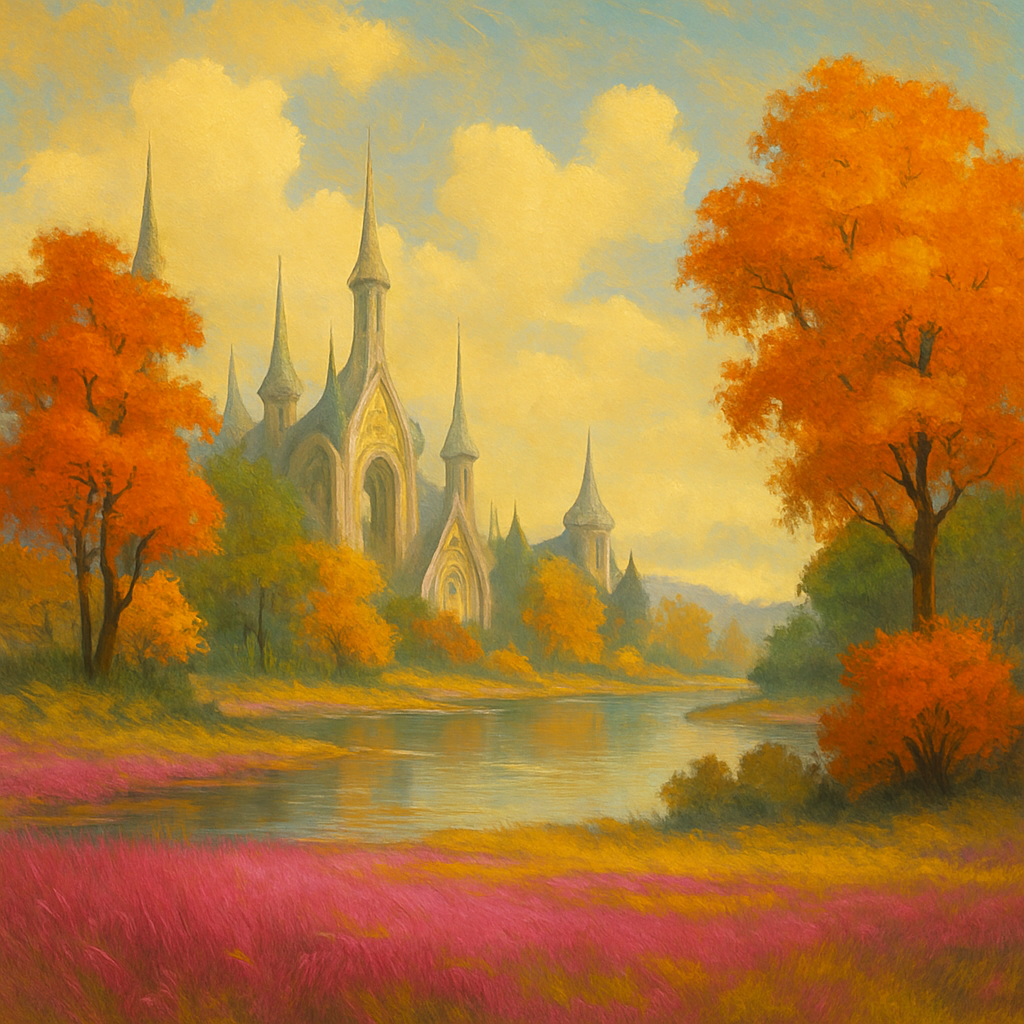
"The air in the Otherworld feels alive, humming with an energy that prickles your skin. Pink grasses sway in a breeze that whispers secrets you can’t quite catch, and the greenish-yellow sky stretches endlessly above, an eternal sunrise casting strange, flickering shadows. Trees, their bark glinting like gold, seem to watch you as you pass, their leaves shifting to follow your movements. A sudden laugh, high-pitched and mocking, rings out from nowhere, and a swarm of shimmering dragonflies scatters like startled birds. It’s beautiful, intoxicating even, but there’s something else here too, something darker. The weight of unseen eyes presses against you, warning of danger should you misstep. A single, glowing fruit hangs low from a nearby branch, so tempting in its perfection, but you hesitate. Somewhere, deeper in the woods, a guttural growl echoes faintly, and the trees seem to lean closer. You realize then: this place is no mere forest. It is alive, sentient, and it is watching."
No map holds it for more than a moment. No compass finds it for long. And yet, those who wander too far into the fog, or fall asleep beside certain rivers, sometimes wake to skies of green-gold and hills that hum beneath their feet. Here, mushrooms sing lullabies. Jewelry grows like fruit. Trees stare with large judging eyes. A fox might ask your name, and a raccoon may carry your letter of apology, if you wrote it in rhyme. Some say it is paradise, others a trap set by the children of The Hollow Crown, an old whispered thing whose name is spoken only by those who rule in his absence. The opulent Aetherial claim to know his will and speak it to the masses. Gnomish philosopher-pranksters claim to have drunk wine from his antlers in reward for his amusement at their dubious ways. Most who visit forget what they saw. A few remember too much and are never quite right again. Everything here listens. Some things answer. The rest simply wait for you to turn your back for just, one, second. In less whimsical terms unlike what its denizens may prefer, the Otherworld is, and has always been a peculiar place of magick and mystery. A place we have known of for a long time, before The Great Schism, before The Fall that set-it-off, before maybe even The Lost Ages in their entirety; Yet by most folk, if they do not wind up there by accident, avoided at-all-costs.
The lands magickal and practically unbound by normal laws of physics and time, presenting many dangers only to those who dwell within, their forms naturally adapted to the land's wild magickal unpredictability by instinct; The rest, say the races of
Humans or
Dwarfish as many folk-tales go, are often hopeless victims of forces they have no idea how to understand without a fae to guide them, guides which are often prolongued and elaborate ruses. Say a man who steps in the wrong puddle, who may find himself in a field of tall pink grass that stretches for miles, the doorway he came through closing behind him, only to wander aimlessly for days before finding another to take him back home. Only to find his family has actually been looking for him as-well, but for the last 50 years. During The Fall, the Fae Wilds bristled for invasion, thorn-walls like iron, roads that turned armies back, moon-nets for anything with a Hellish true-name, but Vile never opened a second front. When his betrayal of Xaethra ended his campaign, the Wilds exhaled and then sealed their bridges. Through the Schism, they stayed behind their own barricades: not from fear, but because their greatest arts wither outside their soil.
The Otherworld is an extravagant land of surreal beauty and exaggerated landscapes. Rolling hills of vibrant pink grass stretch as far as the eye can see, interrupted by crystalline rivers glowing faintly in shades of sapphire. Vast forests of towering trees with bark like polished silver and leaves in hues of iridescent amber dominate much of the horizon. The sky is an eternal dawn, glowing teal with clouds of shimmering gold drifting lazily across it. Floating islands hover precariously above the land, some slowly rotating as waterfalls spill endlessly from their edges into mist-laden lakes below. In the deeper regions, labyrinthine caves filled with bioluminescent fungi pulse faintly, creating an otherworldly hum that seems to emanate from the land itself. It is whispered that at the center of all things lies the Court Without Name, a hidden glade said to house the will of
The Hollow Crown, if not the crown itself, then its echo carried by the Aetherial who speak in his silence.
The Otherworld's ecosystem is a delicate yet magical balance of whimsy and chaos. Every plant and creature seems tied to the land’s innate magick, moving and thriving with an unpredictable rhythm. Trees sway as if in conversation with the breeze, flowers bloom and wilt in moments, and animals like iridescent foxes or multi-winged birds flit about, their movements seeming almost theatrical in nature. The denizens of the Otherworld,
Faerie,
Gnomish,
Satyr,
Changelings,
Bugbeari , and the regal
Aetherial, serve as both caretakers and stewards, ensuring that the land's unique harmony remains intact. Their humor, however, often comes at the expense of any intruder who dares upset this balance, frequently escalating to cruel "lessons" if their warnings are ignored. Beyond their borders, Fae craft thins to the common weave, glamours, oaths, small miracles. Inside, orchards ripen by rhyme and aqueducts sing water uphill. This imbalance, abundance within, austerity without, shaped their Schism stance, keep the Wilds whole so something wondrous survives.
Time flows irregularly within the Otherworld, rendering traditional seasons meaningless. The land shifts unpredictably, with one area experiencing lush growth while another seems locked in a frost-like stillness. The inhabitants adapt accordingly; faeries might hibernate in stasis-like states for decades in one part of the realm while, mere steps away, an eternal spring blossoms. The Otherworld’s magick weaves through this unpredictability, ensuring its balance despite its chaotic appearance. The Aetherial, some say, walk unchanged between these temporal tides, neither aging nor withering, merely shifting. Courts learned to bank time, storing spring in song-vaults, tithing dusk to winter, preparations first made for devils and then hoarded through the Schism. The Aetherial cross these tides like dry stones in a river, neither hurried nor delayed.
The Otherworld is a place where reality is malleable. Travelers often find that paths taken may change behind them, and a step in the wrong direction can send one decades into the past or future on Gaiatia. Strange, protective forces seem to watch all who enter, enforcing the Fae's strict but often baffling rules. For instance, picking fruit from a tree without planting a seed in return may summon an angry storm of magickal beasts or twisting vines to drive the thief away, or worse. Some whisper these phenomena are not natural, but willful, guided by The Hollow Crown, or by the Aetherial interpreting his wishes. These safeguards were sharpened during the Fall and never fully relaxed. The land itself enforces etiquette, what mortals call “tricks” the Wilds call manners with teeth.
The Otherworld’s climate is as unpredictable as its inhabitants. The sky may glow with a balmy sunrise one moment, only for a sudden burst of icy mist to roll in, chilling travelers to the bone. Rain falls infrequently, but when it does, it shimmers like liquid gold and disappears almost instantly upon touching the ground. The air carries a faint, sweet fragrance, like honey and wildflowers, but with an edge of something metallic and sharp, unsettling to those who linger too long. Certain changelings claim to feel the air itself whispering to them here, as if the land remembers every face they have ever worn. The air’s sweet-metal tang grows harsher near sealed crossings, a warning that the bridges remain closed until mortals stop burning one another.
The flora and fauna of the Otherworld are as whimsical as they are dangerous. Trees bear glowing, jewel-like fruits, while mushrooms the size of wagons hum softly in rhythmic tones. Strange flowers with shifting colors release spores that sparkle in the air, often causing disorientation or vivid hallucinations to those who breathe them in. Wildlife ranges from seemingly harmless, like translucent hares with antlers, to predatory, such as massive, serpentine cats with fur that appears to shimmer like starlight. Faeries are said to live in harmony with these beasts, riding foxes or raccoons into battle, while gnomes have even fashioned squirrel-pulled sleds for transport. Specimens taken across the veil sour or sleep; even cuttings prefer to die rather than be farmed abroad. The Wilds do not export themselves, only stories about themselves.
The Otherworld teems with resources of immense value, if one dares to take them. Crystalline waters, radiant fruits, and magickal herbs could enrich a kingdom, but each comes with a price. A tree will curse the thief who steals its fruit without leaving a seed. A stream that grants clarity of mind may drown the one who drinks without permission. These resources are fiercely guarded by both the land itself and its inhabitants, who see any exploitation as a grave insult to their realm.
The Arcane Coalition has formally outlawed the harvesting of Faerie Dust, a shimmering byproduct of faerie wings and hair, alledly, once, ground into illegal flight elixirs. These resources exact payment, seed for fruit, song for water, memory for medicine. The Arcane Coalition has outlawed harvesting faerie dust after early Schism-era abuses; reputable alchemists now treat any “flight elixir” as contraband and any dust-bearing charm as a lie that wants to be believed.
The Otherworld’s origins are shrouded in mystery, but it is widely believed to be an ancient manifestation of Gaiatia’s magickal essence, a realm born of unbridled creativity and chaos. It existed long before the Gods revealed themselves, and its connection to the Arcane is undeniable. The Otherworld’s denizens claim it was once a haven for free spirits and forgotten dreams, though centuries of incursions and theft by mortal adventurers have hardened its borders and its people.When The Fall began, the Wilds fortified for a war that did not arrive, Vile would not split himself between worlds. After his ruin, the Schism made the choice plain, the Fae closed their markets, folded their bridges, and kept their armies at home. Their greatest arts are place-bound; abroad, they are merely brilliant. Deprived of mortal bronze and pigment, satyr artisans and gnomish tinkerers turned inward; faeries and bugbeari withdrew to deeper groves; the Aetherial ceased parley and spoke only in edicts and dreams. If the Hollow Crown ever ruled openly, his will now travels by whisper and gesture, interpreted by those who wear no head and all masks.
Few venture into the Otherworld willingly, for its dangers far outweigh its allure. However, desperate scholars, thrill-seeking adventurers, and ambitious alchemists occasionally brave its borders in search of rare artifacts or knowledge. Those who survive return with stories of beauty and terror, often changed, some aged decades, others unable to speak of what they saw. The Fae offer hospitality to respectful visitors, though their hospitality often comes at a hidden cost. Many find themselves the subject of elaborate pranks or bound by cryptic bargains. Inns and shelters are rare, usually carved into the trunks of massive glowing trees or hidden within sparkling caves. The Aetherial rarely grant audiences, when they do, it is in dreams, riddles, or through impossible doors that vanish once passed. The Hollow Crown, of course, is never seen. The Fae still buy adventurers the way jewelers buy light, performance as currency, gasps as coin. Hospitality is real, but always metered, a bed for a memory, a guide for a promise that pricks a little. The Aetherial grant audience only when the Wilds wish to be seen; the Hollow Crown remains unseen, yet somehow everyone keeps the appointment.


Comments