
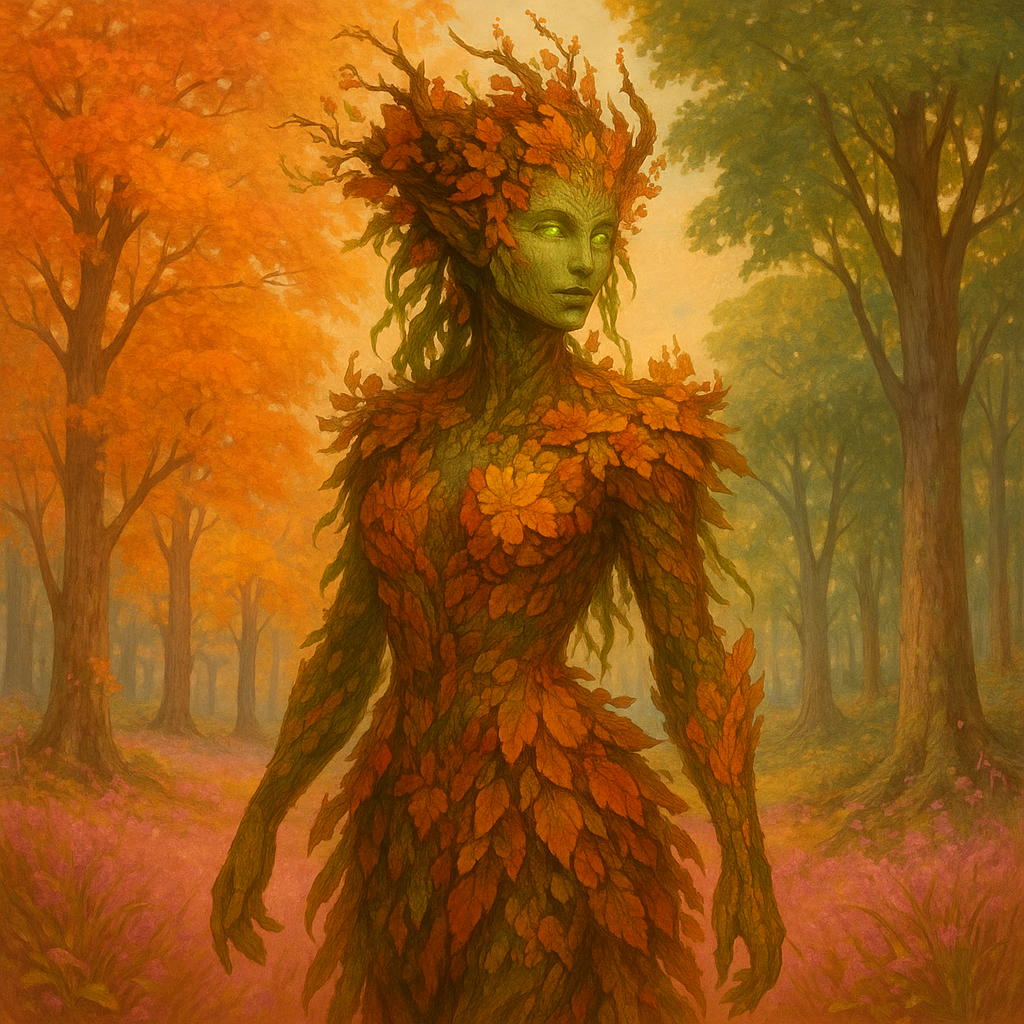
Dryads
"The trees remember how we scream."
The Dryads are the rooted souls of The Otherworld's forests, living spirits bound to the trees and the blood soaked into their roots; A whimsical, almost aloof people but far from the gentle fables sung in human halls. They are the breath of all that is green, sentient extensions of woodland sentience, birthed from sap, sorrow, and light filtered through endless leaves. In their native groves they are serene, wise, and eternal, their bodies carved of bark and silk-veined wood, faces aglow with the bioluminescence of living resin.. They speak through the wilds, they feel them and all they have ever felt; Yet beyond their world, on Gaiatia, where forests have been burned, salted, and scarred a thousand times, Dryads stranded here for long descend into madness. Every tree felled, every root severed, every patch of soil turned to grave-dirt sings a dirge only they can hear. It is said they no longer walk the mortal realm by choice, for the pain there is too vast, and too loud. Those few who remain are broken, weeping conduits of the land’s grief, half divine, half deranged folk desperate to return home to The Hollow Crown's embrace before the endless pain rots their minds forever.
Naming Traditions
Feminine names
'Aelwyn', 'Brissal', 'Thirae', 'Mossira, Vellin'.
Masculine names
'Drath', 'Oren', 'Thessel', 'Brann, Koryn'.
Unisex names
'Veer', 'Silv', 'Nym', 'Ashael', 'Thorne'.
Family names
Dryads do not name as mortals do. They identify by their trees or groves, of the Fallen Copse, of the Ironbark Vale, of the Silent Bloom. Their names shift with the forest’s fate: when a tree dies, so too does the name.
Other names
'Sapborn' (common), 'Woodwives' (human term), 'Rootkin' (archaic).
Culture
Major language groups and dialects
The Dryads speak Sylvan, an ancient, tonal language composed of rustles, creaks, and pulse-sounds in the bark that can only be fully understood within forest acoustics. Among mortals, they use soft Common, lyrical and slow, like wind filtered through leaves. A true Dryadic phrase cannot be written; it is sung by roots and echoed in the heartwood of trees.
Culture and cultural heritage
Each Dryad is both person and ecosystem. Their bodies, though humanoid, are manifestations of the trees that birthed them, bark-flesh, sap-veins, hair of moss or willow thread. Their society is decentralized, no cities, no empires, only groves connected through vast, living root networks that whisper thoughts and memories. They do not trade, they exchange essence, sap, pollen, spores, and dreams carried through branches. In the Otherworld, their groves are alive with eternal spring, music, and quiet laughter. In The Folklands, the laughter curdles. They feel the agony of every poisoned stream, the silence where bird song should be. Many who remain among mortals retreat underground, becoming Wraithroots, spectral husks who hum elegies to a forest that will not answer.
Shared customary codes and values
- Life is cyclical, not linear; rot is rebirth.
- Pain must be sung, not silenced.
- To harm a tree is to murder kin.
- Growth through patience; vengeance through bloom.
- The forest keeps every secret, and forgets nothing.
Average technological level
Dryads abhor metal and machinery. Their “technology” is biological and magickal—living architecture, vine-grown armor, wooden automatons carved from their own bark. Their mastery of photosynthetic magicks allows them to heal wounds, coax growth, and even regrow destroyed limbs.
Common Etiquette rules
- Never break a branch in a Dryad’s presence, it is blasphemy.
- Bow before entering a grove, and speak softly; sound carries as intention.
- When greeting one another, Dryads exchange sap drops at the wrist as proof of life.
- To touch a Dryad’s bark-flesh without invitation is to invite a curse of thirst: one’s tongue turns to moss and withers.
Common Dress code
Dryads wear what grows from them, petal-shawls, bark plates, leaf-woven robes that regrow with each season. Their adornments are alive: bracelets of ivy, crowns of flowering vines, cloaks made of moss that shift hue with emotion. Those who dwell near mortals sometimes layer bone or cloth into their attire, a mark of shame and defiance both.
Art & Architecture
Dryadic art is inseparable from life itself. Trees are carved alive, never felled, songs are grown into them like veins of melody. Their sculptures twist and move with the wind, whispering memories of those who shaped them. Homes are grown from single, colossal trunks, hollowed from within and lit by fungus-lanterns and star-pollen. They weave grove symphonies, harmonic wind rituals that turn forests into living instruments. In the Otherworld, entire valleys sing. In the Folklands, only fragments remain, ruined woods that hum in grief when storms pass. Their most sacred creations are the Heartshrines, resin-encased cores of ancient trees that pulse faintly with life even after the grove dies. The Dryads say that as long as one Heartshrine glows, the forest remembers.
Foods & Cuisine
Dryads require no mortal food, but they do consume, sap, sunlight, and essence. They drink dew as communion, and feed on the magick that seeps from healthy soil. On rare occasions, they partake of mortal fare to share in fellowship: fruits fermented in moonlight, honey steeped in roots, and nectar thickened with spores. Their most sacred drink is Rootwine, made from distilled sap mixed with the tears of mourning groves, it induces visions of the forest’s past lives. Mortals who taste it seldom survive; their hearts turn to wood mid-beat.
Common Customs, traditions and rituals
- The Sap Communion: Dryads gather at moonrise, bleeding sap into a shared bowl to symbolize unity of grove and self.
- The Rot Feast: Held each winter, when decay is strongest. Fallen leaves and fungi are gathered, burned, and reborn into new soil. The act honors mortality.
- The Seed Rite: When a Dryad reaches maturity, they bury a single seed from their tree’s heart. Should it sprout, they are considered spiritually whole. If not, they wander until it does.
Birth & Baptismal Rites
New Dryads are born when a tree gains a soul. This may occur through divine favor, tragedy, or sheer accumulation of memory. When a tree survives fire, famine, or war, it may awaken. Its bark splits, and from it emerges a Dryad, infant, ancient, and weeping sap. The newborn’s first act is to hum its sap-song, which determines its temperament for life. The grove gathers to pour dew over the new form, binding it to the living network of the forest.
Coming of Age Rites
To come of age, a Dryad must walk beyond its roots, to spend a full season apart from its tree and survive the disconnection. This exile is agony, without the hum of the forest, most weaken, bleed sap, or lose their minds. Those who return find their bark hardened and their hearts resonant with new wisdom. Those who fail become Hollow Sprouts, wandering wood-husks that hum nonsense until decay takes them.
Funerary and Memorial customs
The dead are not buried, they are planted. When a Dryad dies, its body is split and seeded. The sap that leaks out becomes the soil for a new grove, and its spirit merges into the Root Chorus, a vast spiritual network beneath the Otherworld’s forests. In the mortal realm, where the soil is poisoned, their corpses often sprout nothing but fungus and mold. These are known as Blightbirths, and their groves are avoided by all but the maddened.
Common Taboos
- Cutting living wood without ritual apology.
- Entering a dead forest without permission of its ghosts.
- Fire. Always fire.
- Speaking of “immortality” aloud, it invites the hunger of decay.
- Binding one’s soul to a mortal lover; such roots never bear fruit.
Common Myths and Legends
- The First Root: The eldest Dryad, who grew from the tree that touched both the Otherworld and Gaiatia before the Fall. Her roots were said to cross the realms until mortals burned her heart, severing the worlds.
- The Witherking: A mortal who loved a Dryad and sought to preserve her by carving her tree into an idol. She awakened within the effigy and strangled him with wooden hands. From their ashes sprouted the first cursed grove.
- The Hollow Grove: A forest where every tree hums in human voices. They say it’s where the Dryads who went mad on Gaiatia were bound, their roots sunk deep into poisoned soil. Their song drives mortals to tears, then madness, then silence.
- The Last Green: A prophecy whispered in every grove, that one day, when the Otherworld dies, the Dryads will return to Gaiatia not as caretakers, but as judges. Every root will crack stone, and every vine will remember its butcher’s name.
Ideals
Beauty Ideals
Among the Dryads, beauty is not adornment, it is vitality. The healthiest glow, the deepest green, the richest sap sheen mark the height of aesthetic perfection. Their bark-flesh is polished by rainfall, not vanity; their hair of leaves or moss shifts with the seasons, and those whose foliage turns gold in autumn are seen as blessed. Scars are sacred, representing fires survived and storms endured. Lichen blooms along the skin are considered signs of wisdom and patience, while fungus growths indicate a soul too still, too sorrowful, consumed by rot from within. A Dryad’s voice, deep and resonant like wind through a hollow trunk, is their most prized feature; melody carries more allure than face or form. To move with the rhythm of growth, slow, deliberate, inevitable, is to be beautiful.
Gender Ideals
Dryads do not conceive of gender as mortals do. Their bodies shift subtly with the seasons and the strength of their grove, broad-limbed in summer, slender in winter, flowering in spring, barren but resolute in fall. Some choose masculine or feminine expressions to interact with other species, but within the groves, such distinctions are irrelevant. Strength of growth and grace of stillness are the only measures. They refer to each other by pronouns that reflect state, not sex, Blooming, Withered, Fallen, or Rooted. To bear a childlike or ancient form means nothing; both are phases in the endless cycle of becoming.
Courtship Ideals
Dryadic courtship is not a dance of attraction but of resonance. Two souls entwine through shared hums across the forest floor; their roots grow toward one another beneath the soil long before their forms ever touch. They exchange sap as lovers elsewhere exchange breath. During the Flowering Night, partners meet beneath moonlight and twine limbs and vines, their bodies fusing for a time, sharing thought and memory in a slow communion. If their heartbeats align through the roots for three nights, they are considered bonded until the next full bloom. For mortals who attempt to love a Dryad, the ritual is perilous, the forest must accept the union, or it will consume the outsider in their sleep.
Relationship Ideals
Love among Dryads is eternal but rarely constant. They bind in seasons, not vows, growth, rest, decay, and renewal. The strongest bonds are not marked by possession but by preservation: one lover ensuring the other’s grove thrives even after they fade. Jealousy is unknown to them; they see devotion as tending, not keeping. Grief, however, defines their history, when one bonded Dryad dies, the other often follows into stillness, their bark hardening, their sap turning to amber. Among mortals, the phrase “to love like the Dryads” means to love so deeply that one roots themselves in another’s ruin.
Interesting Facts & Folklore
Idioms and Metaphors
- When a Dryad dies in anguish, her tree bleeds amber for seven nights, and the sap hardens into glass that hums faintly with her last breath. These relics, called Sorrowglass, are prized by necromancers and feared by priests.
- The presence of a Dryad can make flowers bloom out of season, but in lands wounded by war, her touch can also make them wither to ash.
- Some Dryads who linger too long on Gaiatia lose their minds completely, becoming Weeping Groves, forests that echo with human voices begging for rain or forgiveness.
- In the Otherworld, they are said to sing the seasons into motion; In a silent pact held between them and the hen a Dryad weeps, winter begins somewhere.
Related Locations
- “The root remembers.” - A warning that nothing done in the dark stays buried.
- “To bleed sap for another.” - To love or sacrifice beyond reason.
- “The forest turned its face.” - When nature, or fate, withdraws its favor.
- “Her leaves sing green.” - Spoken of one whose spirit burns bright with new life or unspoiled hope.

Comments