
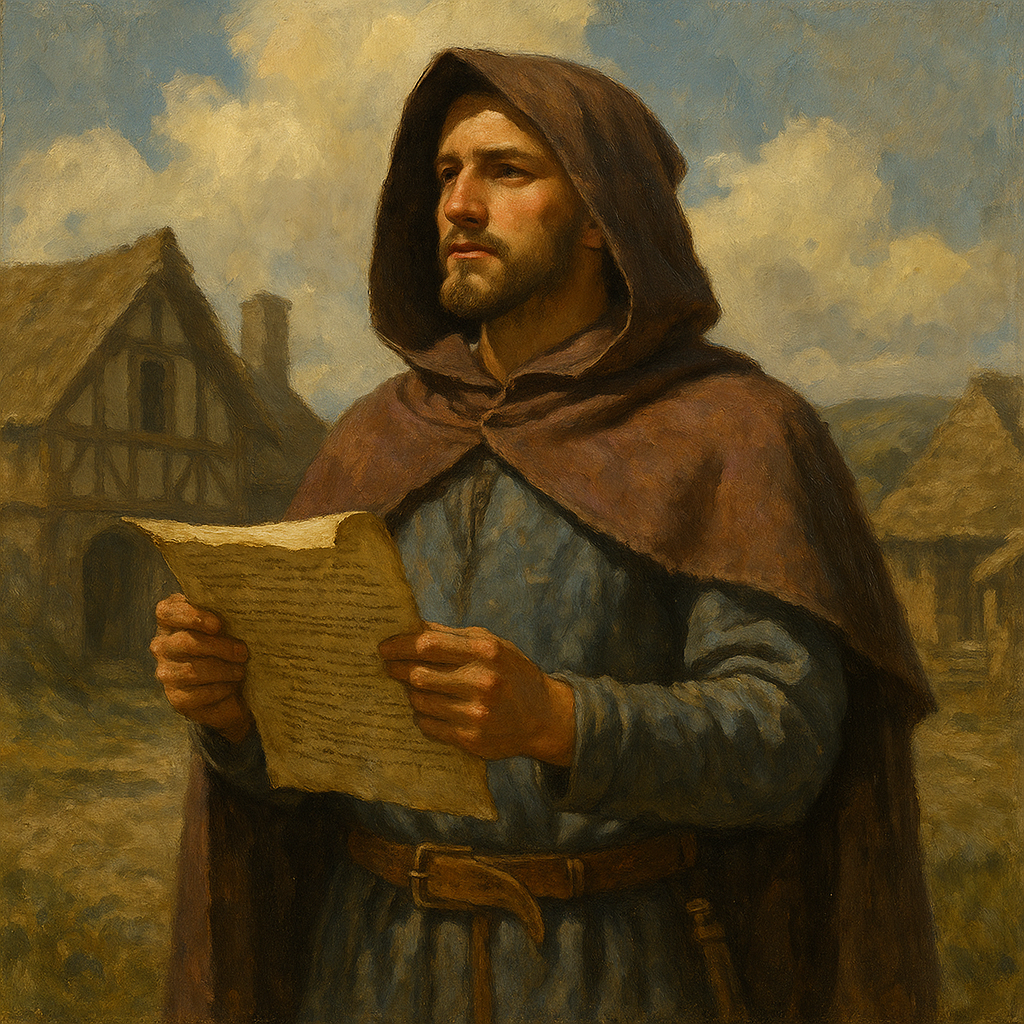
The Everwealthy Language
“A kingdom is held not by steel nor crown, but by the words its people know how to speak.”
The Everwealthy language, most simply called Everwealthy or the Tongue, is the dominant spoken language across the kingdom of Everwealth and its territories. Born from the ashes of The Great Schism and shaped by centuries of famine, conflict, and cultural intermingling, it is the common speech of laborers, merchants, soldiers, beggars, kings, and witch-hunters alike. Though scholars categorize it as a single linguistic entity, any Everwealthy native knows it is more a living, evolving mosaic, a blend of ancient Human dialects carried through war, spliced with loan-words from Dwarfish, Orcish, Smallfolk argot, and the occasional inherited phrasing from the long-dead tongues of the Schism’s earliest rebels. As with most things in Everwealth, the Tongue was not crafted by design, but by desperation. It was forged on bloodied fields, whispered through barricades, shouted over burning ramparts, and carried upon the breaths of those who refused to bow to Elfese dominion. When the masses of refugees forced here who began carving out villages, then towns, then the fledgling threads of what would become Everwealth, they brought with them languages fractured and half-forgotten. In the long struggle to survive, those tongues merged into one. Today, the Everwealthy language is the unifying force of a fractured land. It is a resilient, evocative speech, rich with idioms of hardship, metaphors of hunger and weather, and phrases sharpened by centuries of distrust. It is a language built to be spoken around a hearthfire or in the dark of a ruined cellar, not to be pored over in illuminated manuscripts. Of all the peoples who speak it, only a minority can read or write it, and fewer still can write it well.
Origins and Evolution:
The origin of the Everwealthy language lies in the ancient coalition that rose during the Schism to oppose the Elfese empire’s millennia-long encroachment across the land of Chikara. These future Everwealthy possessed dozens of dialects, some mutually intelligible, many not. When war forced them to unify, their languages and cultures collided violently. Commanders needed a shared tongue to coordinate raids. Farmers needed a shared tongue to barter with new neighbors and newly-arrived refugees. Slaves fleeing Elfese plantations needed a shared tongue to plead for shelter or warn of pursuit. What emerged was not a scholar’s language, nor a poet’s, but a survivalist's, sewn together from words spoken by soldiers, farmers, and the desperate. In the early centuries, the language was fiercely oral; Writing was rare and often viewed with suspicion, as the Elfese used written law and scripture to enforce their rule. Many early revolutionaries considered secrecy a virtue, meaning records were sparse and often burned for safety. This suspicion of the written word survived long after the Schism’s fires died out. To this day, Everwealthy folk treat writing with a mixture of awe, respect, and unease. Most cannot read at all. Many who can read cannot write. And even the literate rely more on memory, stories, and chants than on parchment. As the kingdom solidified, so too did its language. The monarchy eventually attempted to impose a “royal standard,” but this was largely ignored outside the capital. Over time, the version spoken in Opulence became a baseline reference for legal documents, trade agreements, and court proceedings, but regional accents and dialects still color the speech of nearly every settlement. Yet even in its diversity, Everwealthy remains one language, a testament to the unity that once rose in rebellion and has stubbornly endured ever since.
Character of the Language
Everwealthy speech is known for its lyrical cadence, a natural lilt that makes even coarse insults sound like ancient verse. Its structure favors soft consonant clusters, rolling vowel transitions, and intonational emphasis that shifts meaning depending on tone. Many words hold double or triple meanings, especially in rural dialects, where metaphor and superstition often intertwine. It is a highly contextual language. Words for weather also describe moods. Words for hunger describe ambition. Words for fire describe passion, violence, or divine will depending on how they rise in the throat. Everwealthy speakers employ metaphors drawn from common life, fields, storms, beasts, seas, and the scars of the Schism. Many idioms revolve around survival and resilience:
- “Stone in the rain” - Someone enduring hardship.
- “Heart like tinder” - Someone quick to anger or easy to sway.
- “Fog-born” - Someone untrustworthy or hiding something.
- “Ash-mouthed” - Someone who lies without shame.
- “Salt in the wound” - Someone irritating a painful truth.
- “Braid your words” - Speak carefully.
Spoken vs. Written Everwealthy
The gulf between spoken and written Everwealthy is vast.
- Spoken Everwealthy - Spoken Everwealthy is alive, adaptive, and richly emotive. It shifts with region, class, and circumstance. Dockworkers speak it with clipped, rhythmic pace; scholars elongate their vowels; Border scouts mutter it with tense caution; priests chant it like supplication; beggars rasp it like apology. The spoken tongue is shaped by oral tradition, stories passed down over hearthfires, chants repeated in fields during harvest, dirges sung over the dead, and warnings whispered to children about what stalks the dark. Syntax is flexible, word-order fluid, and emphasis often carries more weight than strict grammar.
- Written Everwealthy - Written Everwealthy is rigid, sparse, and deceptively simple. Its script is angular, comprised of sharp strokes and looping modifiers that often confuse novices. Because writing was once reserved for legal decrees, temple codices, and military record, written Everwealthy reads as formal and authoritarian.
Dialects and Regional Speech
Though unified, the Everwealthy language breaks into distinct regional dialects, each shaped by local hardship, superstition, and mingling with non-Human cultures.
- Opulence Cant - The capital’s dialect is the foundation for legal Everwealthy. It is clipped, clean, and comparatively refined. Merchants, nobles, scholars, and bureaucrats favor this mode of speech. Its vocabulary includes many terms for trade, taxes, and social hierarchy, as well as elaborate euphemisms for corruption.
- Bordersword Roughspeech - A harsher dialect shaped by constant conflict along the borders. Words are shorter and spoken with abrupt tension. Many phrases borrow Orcish rhythms and tone. Curse words here are exceptionally creative and often revolve around violence or misfortune.
- Gullsperch Tide-Tongue - A dialect defined by coastal metaphors, smuggler slang, and fluid vowel-shifts. Seafarers speak with rising inflection, giving the impression of perpetual questioning. Many words relate to storms, debt, and hidden dangers in deep waters.
- Cloudrend Stone-Tongue - Influenced by Dwarfish throat-deep sounds, this dialect is dense, slow, and accented with rumbling consonants. Stone-Tongue speakers pride themselves on stoic clarity and often use metaphors involving pressure, mountains, or hidden meanings.
Illiteracy as Culture
In Everwealth, literacy is a luxury. Most folk have no access to education unless they join the Scholar’s Guild, serve the Monarchy, or become apprentices in wealthy households. Farmers, miners, hunters, alchemists, and constables rarely learn to write more than their names, if even that. This widespread illiteracy shapes culture in numerous ways:
- Memory replaces text. Stories are preserved through recitation, song, and ritual phrasing.
- Wills and contracts are spoken aloud before witnesses, not written, to prevent manipulation.
- Folk trust spoken promises over written ones, believing written words serve nobles and guilds, not commoners.
- Superstition fills the void, teaching that writing a person’s name can bind or curse them.
- Symbols replace letters in shop signs, anvil for blacksmith, lantern for cooper, ram’s head for tavern, and so on.
- Priests preach orally, rarely using scripture except symbolically.
- Runes are feared, associated with magick and forbidden forces.
Influence of Other Cultures
Though rooted in ancient Human languages, Everwealthy has absorbed vocabulary from every major race in the kingdom: Dwarfish contributes mining terminology, words for metalwork, and phrases of oath and craft. Orcish lends martial commands, rhythm-based battle slang, and metaphors of blood and honor. Smallfolk Cant adds playful idioms, food-related expressions, and tricky double-meanings. Giants introduces solemn, slow-spoken words tied to nature and memory. Beast-Kin dialects contribute expressive sound-symbolism, especially for weather and emotion. Aquian speech adds borrowed terms for tides, breath, and depth. This infusion makes Everwealthy adaptable and textured, a patchwork speech that mirrors the kingdom’s fractured unity.
The Language of Power
Everwealthy is not only a commoner’s tongue, it is the language of law, ritual, commerce, war, and governance.
In Law and Court
Legal Everwealthy is notoriously obtuse. Judges and magistrates use long, looping constructions to obscure meaning or bolster authority. Many sentences sound more like curses than decrees. This style evolved intentionally, those who cannot read are unlikely to challenge those who can. In Religion Priests of The Knights of All-Faith use a ritualized form of Everwealthy marked by archaic phrasing and reverent repetition. Many holy chants rely on tonal shifts that carry traditional meaning. These tones are more important than the words themselves for most listeners. In Magick casters employ Everwealthy words to anchor intentions, though the language is secondary to the caster’s soul and technique. Even so, many spells include verbal components derived from long-lost dialects no longer understood by modern speakers. In Command The Monarchy’s military developed a rapid, clipped variant known as “Command-Tongue.” Orders are delivered in short syllables meant to pierce the din of battle.
Naming Traditions
Everwealthy names reflect hardship, land, and lineage. Traditional names are often:
- Short and sharp for men.
- Lyrical and multi-syllabic for women.
- Nature- or craft-based for families.
- Locational when tied to heritage.
Social Views on Speech
Everwealthy folk judge character by speech far more than appearance. Tone, pacing, and phrasing reveal everything: trustworthiness, origin, mood, class, ambition, and even courage. Many nobles mock rural dialects, while rural folk resent the clipped arrogance of urban speech. Some prejudices are so deeply ingrained that a wrong accent can get someone arrested as a witch or spy. The language’s structure favors insinuation over directness. Folk rarely speak plainly about curses, famine, or danger. Euphemism is both shield and tradition. Honesty is often delivered in metaphor, threat, or lamentation rather than simple fact.
The Everwealthy Language Today
Despite the kingdom’s instability, Everwealthy remains a cultural anchor, a shared voice among peoples who often have little else in common. In taverns and temples, markets and battlefields, its words bind Everwealth together more sturdily than its laws. It is a language of survivors; Shaped by rebellion, hardened by scarcity, enriched by diversity, bound by memory, feared on parchment, loved in song. In Everwealth, to speak the Tongue is to claim place, history, and identity. It is the first inheritance of every child born in the realm, and often the last breath of those who die defending it. Everwealthy is not just a language. It is the voice of a kingdom still learning how to endure.

Comments