
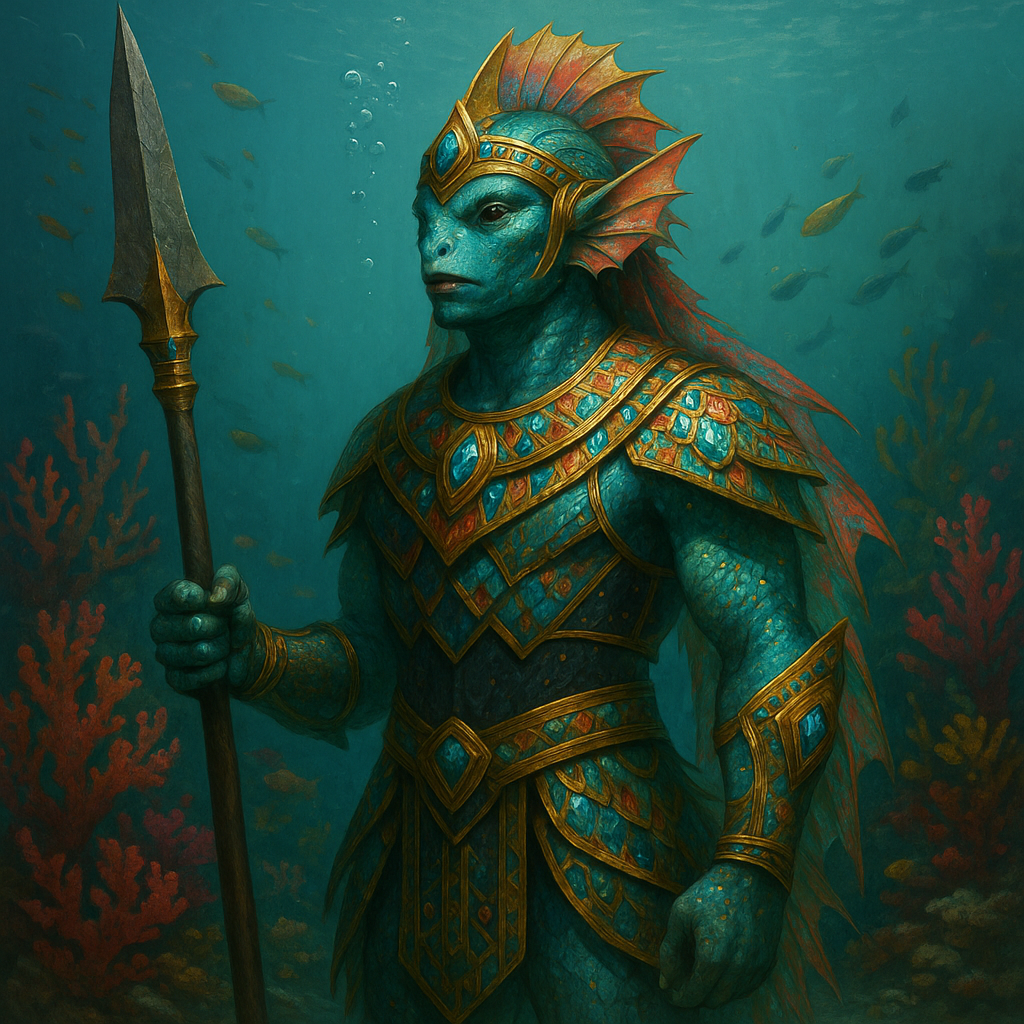
Aquian
"The ocean doesn’t take sides. It just drags you down."
The Aquians are the tide’s oldest children, shaped of the brine itself, when the first waves licked Gaiatia’s stone and would not let go. They are a people who never needed to climb from the sea because the sea was already empire enough, their homeland of Naumos beneath The Laughing Sea, is a place of coral pyramids etched with glass hieroglyphs, reef obelisks crowned with moonlight, and basalt leviathans carved into eel, shark, and whale that stand eternal on the seabed. Their citadels glow with bioluminescence, their tombs are labyrinths that sing when currents pass, and their history is written not in parchment but in reefstone and glass tablets meant to last as long as the ocean itself. For the Aquians, time is not measured by kings, dynasties, or calendars, but by the patience of tides and the breath of trenches. They are a race both beautiful and haunting. Scaled in turquoise and jade, their skins ripple with patterns like shifting tides, their glossy black eyes reflecting the abyss, and their movements as deliberate as ritual. Every gesture is prayer, every silence covenant. They are artisans beyond measure, growing coral into palatial arches, pouring molten glass into prisms that bend light and magick, stringing jewelry from pearl and bone with as much care as a priest sets an altar. Their arms in war mirror their art, tridents, reef-forged sickle blades, helms wrought from conch and pearl, and scale-mail that glitters with glass and gold. On land these seem ornamental, but in water they become the most graceful of weapons. Their wealth lies deep, in pearl vaults and mineral veins pressed into trenches where no surface-born diver can endure. Their armies are the ocean itself, whales as siege beasts, jellyfish clouds as living mines, sharks and eels as vanguard. Even when the goddess Xaethra let loose her armies of Devils across the world of old that let loose The Great Schism at its end, Naumos only watched from the abyss. In modern times, Aquians have become inseparable from the distant islands of Tarmahc, woven into its ruin and its commerce alike. They dive where no Humans, Ursi, or Serpentine can, scouting drowned vaults and receding ridges for relics of its sunken former nations of Alandrior or Omendahl. They walk the broken ports as glass-jewelers, their trinkets luminous as fish scales, their songs drifting through night. They are sailors’ contradiction, the only people who cannot be enslaved, yet whispered to be sellers of slaves themselves. Shackles cannot bind what must breathe saltwater; even if taken in chains, the first glimpse of sea would see them vanish below forever. Yet tales abound of castaways who thought themselves rescued by a passing Aquian, only to be led ashore and sold to serpent-lords for as many gems as could be hung upon the Aquian’s throat. To surface folk, they are both saviors and betrayers, shimmering enigmas who drift between reverence and fear. Naumos endures even as Tarmahc lies shattered. The Aquians themselves say the ocean is older than every nation and will bury every crown. To endure is to obey the sea, and the sea does not take sides. It drags all things down eventually. In this truth, the Aquians have found eternity, and in their eternity, they have become both the most patient artisans and the most patient predators the world has ever known.
Naming Traditions
Feminine names
- Kira.
- Aelira.
- Sholu.
- Mireth.
Masculine names
- Tovan.
- Ryshal.
- Namu.
- Elaros.
Unisex names
- Sael.
- Velo.
- Narei.
- Ishi.
Family names
- Of the Glass Tide.
- Reef-Keeper.
- Shell-Ledger.
- Child of Thir.
Other names
- Saltbloods (neutral descriptor used by surface folk).
- Wavewhispers (used by seafarers, referring to their subtle, secretive nature).
- Drip-eyes (coastal slur, mocking their constant need to stay damp).
- Reefborn (a respectful term of cultural distinction among artisans).
Culture
Major language groups and dialects
Aquians speak Aquatic, a tongue like flowing currents and hollow flutes, often accompanied by hand-flicks or fin-motions. Much like the hieroglyphs of the sands, Aquian script is both pictorial and phonetic, etched into coral and glass to shimmer with meaning in shifting light. Examples:
- “Sha’vai” Peace between tides.
- “Lun’ha maros” I see your light (a formal greeting).
- “Velora deshal” Leave these waters.
Culture and cultural heritage
Aquian culture is ritualistic, solemn, and deeply tied to the sea’s patience. Their homeland of Naumos resembles the old river-kingdoms of memory, but transposed into the abyss: coral pyramids etched with hieroglyphic glass tablets, reef obelisks dedicated to tides and moons, and colossal statues of eel, shark, and whale carved from volcanic basalt. They built not only for life but for eternity, their tombs are labyrinths of reefstone lined with shells that whisper when currents pass, carrying memory into perpetuity. In war, their arms mirror this aesthetic, tridents and sickle-blades of coral-forged bronze, conch-helms inlaid with pearl, and scale-mail woven from glass and gold. Though cumbersome on land, in water they are graceful and lethal. Unlike the landborn, Aquians did not fracture in the Schism. Their society flows along ancient covenants: every act of artistry is preservation, every silence a covenant. Where Tarmahc’s isles rot under sugar, salt, and slave-chains, Aquians in the same harbors display necklaces of molten glass beads and pearl-inlaid breastplates, reminders that not every empire drowned.
Shared customary codes and values
Aquians follow three unspoken tenets:
- Flow where the current takes you. (Harmony with fate).
- What is taken must be reshaped, not replaced. (Preservation of tradition).
- Salt remembers. (Past mistakes and triumphs must never be forgotten).
- Aquians frown upon hoarding, waste, and betrayal. Among their kind, exile is a fate worse than death.
Average technological level
While they lack advanced machinery, Aquians are masters of biochemical and glass-based innovation. Their refined glasswork changed Everwealthian alchemy and architecture alike, introducing techniques for stained glass, reinforced glass hulls, and early diving suits now lost to time. Their tools tend to be coral-grown, bone-sculpted, or glass-poured, emphasizing utility within their watery domain.
Common Etiquette rules
- Never interrupt a speaker mid-thought; the current must complete its course.
- Direct contact is rare. Bows or fin-flick gestures are preferred greetings.
- Gifts are given in shells, never wrapped or boxed.
- It is considered gravely rude to comment on another’s fins or gill structure.
Common Dress code
Aquians favor flowing, translucent garments underwater, strips of kelp-silk or reef-dyed linens. Jewelry, however, is the true marker of status: heavy coral chokers, etched glass bangles, or pearl-lined chestpieces. On land, they wear loose robes that accommodate their fins and facilitate rehydration.
Art & Architecture
Aquian architecture resembles underwater cathedrals. Formed from tamed coral, whale bone, and volcanic stone, their dwellings are winding, luminous sanctuaries, full of echoing tunnels and living murals grown from bioluminescent moss. Their most famous art, however, is glass, formed underwater under great pressure and heat using mineral plumes, shaped into prisms that bend both light and magick.
Foods & Cuisine
A diet rich in algae, kelp, shellfish, and pickled deep-reef plants defines Aquian fare. On rare visits to land, they enjoy citrus and vinegars to balance their briny palates. Aquian food is minimalist, but potent, soups of fermented eel stock, raw mollusk platters, and crystal-clear broths garnished with seafoam herbs. Sweetness is rare and considered an acquired taste.
Common Customs, traditions and rituals
- The Flowing Memory: A ritual storytelling event where ancestors are honored through dance and suspended calligraphy ink in water.
- Tidefasting: A coming-of-age swim to an ancestral ruin or holy reef, alone and without aid.
- The Salt Veil: A funeral rite where the body is left in a salt-rich trench to calcify and become reef.
Birth & Baptismal Rites
Newborns are bathed in a mineral-rich trench pool and sung to by three elders who represent memory, song, and sea. They are named only after their first swim.
Coming of Age Rites
At roughly 25, Aquians undertake the Tidefasting, where they must swim unaided to a sacred ruin and return with a token from within. Success proves their endurance and binds them to their community.
Funerary and Memorial customs
The deceased are wrapped in reef-thread shrouds and lowered into a coral-lined trench. Over weeks, their remains calcify and feed new coral formations, a process seen as honorable reincorporation into the ocean.
Common Taboos
- Surfacing for vanity or indulgence.
- Polluting water sources, even by accident.
- Refusing to wear jewelry gifted by kin.
- Touching another Aquian’s fins without permission.
- Discussing land politics while underwater.
Common Myths and Legends
- The Deep Caller: A mythical Aquian said to speak to sea leviathans and control the tides.
- First Glass: A tale of the spirit Nai’Ira who shaped the first piece of glass from undersea lightning.
- The Bed-Serpent: A guardian beast said to punish Aquians who forsake the old traditions, dragging them beneath the seafloor to suffocate from the weight of their sins.
- Whalewake War: A legend of a past conflict where Aquians rode whales into battle against ancient land raiders.
- The Hollow Reef: A forbidden place said to echo with the voices of drowned oathbreakers.
Historical figures
- Mireth Vashan: The artisan responsible for introducing Aquian glass to surface trade.
- Namu of the Depths: A tactician who allegedly turned back an entire Everwealthy fleet during the Schism using jellyfish clouds and bait currents.
- Ishera the Flowing Voice: A spiritual leader who united three warring reef-tribes through poetry alone.
Ideals
Beauty Ideals
Smooth scale texture, balanced fin symmetry, and jewelry placement are considered key. Bioluminescence is enhanced with oils and polished coral paint for ceremonies. Though more ornamental, the human-like hair at the base of their skull is praised for it's volume and appearance when flowing through water; But these hairs are normally braided or tied to avoid tangling on rock and coral formations.
Gender Ideals
Gender is largely ceremonial, roles are assigned based on skill, not sex. However, certain rites (like voice-callers or tide-weavers) are traditionally performed by those considered spiritually “aligned” with either current or coral, fluid concepts that rarely correlate with biological gender.
Courtship Ideals
Love is a calm tide. Courtship involves shared swims, gifts of glass or bone-carvings, and eventually the weaving of a Finband, a pair of conjoined ornaments worn behind the ears during betrothal.
Relationship Ideals
Partnerships are lifelong currents meant to stabilize the flow. Betrayal or abandonment is considered worse than death. Some Aquian couples maintain separate dwellings to foster autonomy, others cohabitate in elaborate reef dwellings carved jointly.
Interesting Facts & Folklore:
Idioms and Metaphors:
- Salt Memory: Some Aquians inscribe memories onto etched coral tablets, submerging them in sacred trenches to be "read" through resonance by future generations.
- Living Glass: Certain Aquian artisans grow their glass structures underwater like coral, feeding them heat and minerals over decades until they’re “harvested.”
- Finbands of Binding: The most sacred jewelry among bonded couples, a Finband is said to hum faintly in proximity to its twin, used to find one's spouse even in storm-churned waters.
- Shimmering Silence: A cultural practice in which Aquians dive to great depths and remain in meditative silence for days to clear grief, guided only by bioluminescent trails.
- Eelbone Instruments: Aquian songs are often played on flute-like devices carved from eelbone, creating haunting melodies only fully heard underwater.
Related Organizations
- “The tide listens.” A reminder that secrets spoken carelessly may return with consequence. Often whispered before heated arguments.
- “Don't anchor a jellyfish.” Used to describe efforts made in vain, especially when trying to control someone or something inherently chaotic.
- “Your coral is showing.” A cheeky remark when someone reveals personal emotion or vulnerability they were trying to conceal.
- “Let the current braid it.” Encouragement to stop micromanaging or overthinking, let things resolve in their own time.
- “He swims like a warmblood.” A quiet insult toward an Aquian moving awkwardly, emotionally, or acting too much like a surface-dweller.

Comments