
Pyrrhium
"Pyrrhium does not make a weapon stronger. It makes the warrior honest. If you are not enough to bear it, you will break beneath it."
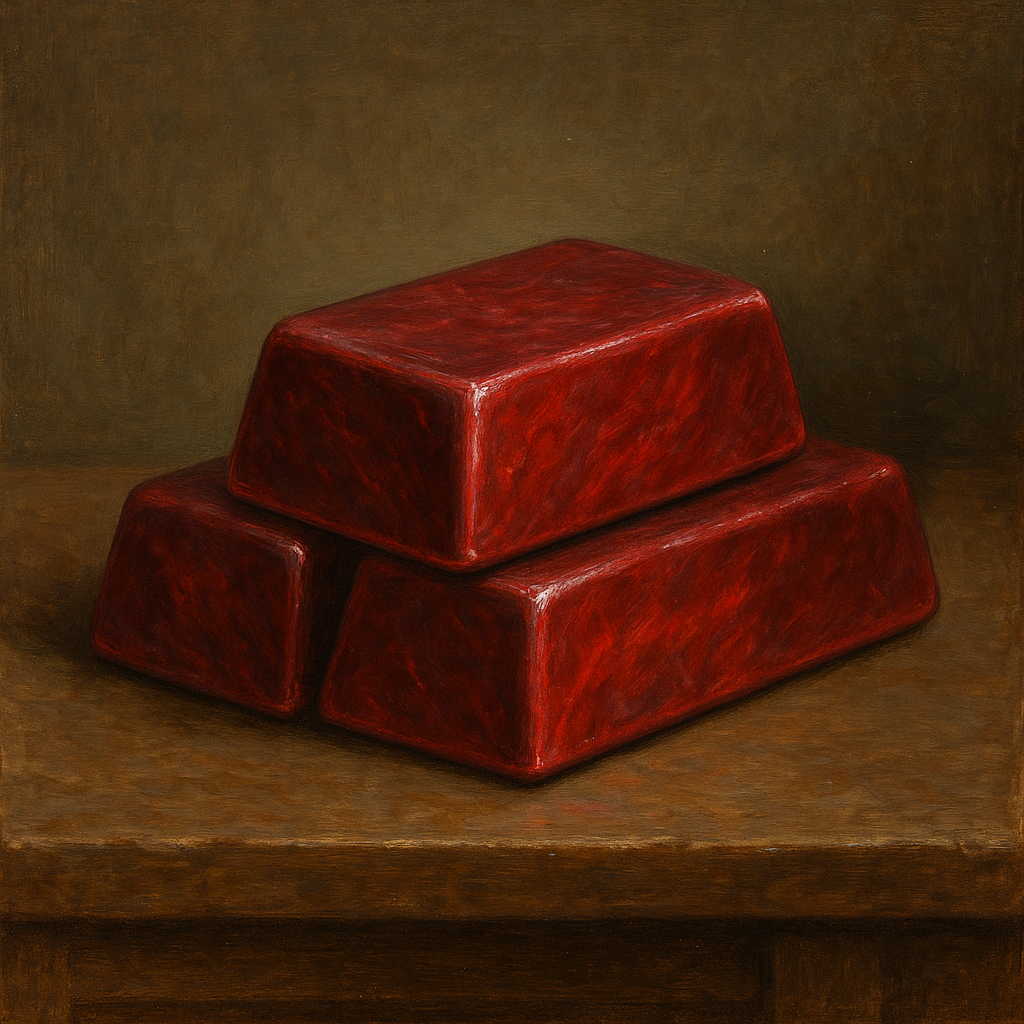
Pyrrhium, a vibrant, crimson-hued metal from the blackness of space, arriving here in balls of fire eons ago; The metal is peculiar, supernatural, without comparison to any metal of Gaiatian origin. Famed for its brilliance, density, and near-limitless capacity to withstand enchantments. It is among the rarest known materials in history, its veins born not of stone beneath our feet, but of fire from the heavens, fallen upon the jungles of Halash. Once the sacred adornment of the ancient tribes of Goblins that lived here, woven into fetishes, trinkets, and ceremonial weapons; It has long since been claimed and monopolized by the exiled Elfese, who transformed Halash into the nation of Kibonoji after their loss of Everwealth in the Schism. To the Elfese, Pyrrhium is more than metal, it is a symbol of their survival, their sovereignty and rewarded perseverance. Pyrrhium blades and armor are legendary for their capacity to absorb, bind, and sustain enchantments that would tear ordinary steel apart. Yet its great strength is matched by an equally daunting weakness, its immense weight. Daggers weigh like longswords, longswords like greatswords, and spears like great metal rods. To wield Pyrrhium is to prove oneself not merely skilled but physically unmatched, a warrior capable of shouldering the burden of a star’s fury. Among the Elfese, the crimson blade is not just a weapon, but a mark of elite station, gifted to samurai, generals, or lone warriors whose names are whispered like curses across borders. Outside of their control, Pyrrhium is almost never seen. To steal it is high treason. To be caught with it, a death sentence.Properties
Material Characteristics
Pyrrhium is a vibrant, blood-red metal with a mirror-like sheen that reflects light like polished ruby. Unlike gold or silver, its luster never fades, and weapons forged from it seem to glow faintly under moonlight, as if remembering the stars from which they fell. When struck, it resounds with a deep, bell-like tone, a sound said to stir ancestral spirits.
Physical & Chemical Properties
- Density: Nearly twice as heavy as steel, requiring enormous strength to wield.
- Durability: Exceptionally resistant to wear, fracture, or rust. Blades remain sharp for centuries.
- Magickal Affinity: Can absorb and hold enchantments indefinitely without degradation. Where steel might unravel a spell over years, Pyrrhium bonds with it seamlessly.
- Drawback: The same density that grants durability makes the weapon unyieldy; weaker wielders exhaust themselves quickly.
Compounds
- Crimson Blades - Enchanted swords wielded by Elfese champions.
- Pyrrhium Spears - Rare battlefield weapons, able to channel lightning enchantments across vast lengths.
- Totem Adornments - Once used by Goblin priests as relics of divine fire, now coveted museum pieces or looted treasures.
- Ornamental Regalia - Reserved for Kibonoji’s highest-ranking samurai and noble houses.
Geology & Geography
Pyrrhium is extraterrestrial, originating from meteorites that struck the jungles of Halash in prehistory. Scattered across the jungle floor, the metal was gathered by early Goblin shamans, who considered it “blood fallen from the sky.” The Elfese, upon conquering Halash and founding Kibonoji, claimed these star-metal deposits amid The Dragons' Back Mountains along it's central spine, swiftly establishing a monopoly enforced by execution and ritual secrecy. Today, nearly all known reserves lie in Elfese vaults or armories.
Origin & Source
Discovered by Goblin priesthoods as a sacred material, Pyrrhium’s early use was ritualistic, adorning fetishes and idols. When the Elfese took Halash, they refined its forging process through rune-binding, heat-shaping, and layered enchantments, allowing for the creation of true weapons. Smiths trained in these methods, with the skills to even learn them, a secret the Elfese government hold most dear, their names and locations not known to the wider public, though rumors exist of forge masters beyond their reaches who can work with it. Its monopoly remains one of Kibonoji’s greatest pillars of power.
Life & Expiration
Pyrrhium is one of the most stable metals ever recorded in Gaiatia. Unlike Hexsteel, which warps and corrupts, Pyrrhium endures, holding both its physical structure and magickal resonance for millennia. Once forged, it does not rust, tarnish, or fracture under natural conditions, its meteor-born purity resists both mundane corrosion and arcane decay.
History & Usage
History
The true beginnings of Pyrrhium are obscured in half-myth and fragmentary record, its arrival traced only to the firestorms that scarred the jungles of Halash when the heavens spat down burning stones. Goblin shamans were the first to gather its shimmering shards, their chronicles, if they can be called such, paint it as blood of the gods, cooled into crimson metal upon touching soil. These early priests wove it into their fetishes, pendants, and ceremonial blades, not yet knowing its deeper potential, only that it carried an undeniable presence. It was not until the dawn of The Lost Ages that Mage-Smiths, drawn to the meteoric fragments like moths to flame, first uncovered Pyrrhium’s greatest secret, its unrivaled affinity for enchantment. Scrolls preserved in ash-tombs speak of crude experiments where the red metal not only held spells indefinitely but grew stronger with them, refusing to fracture or fade. Some claimed it “drank” enchantments, bonding to magick itself as flesh bonds to blood. These discoveries sparked both awe and dread, for while the metal promised limitless power, its crushing weight made it accessible only to the strongest among mortals. What followed is told in pieces, scattered relics, broken accounts, and oral tales where truth bleeds into reverence. What is certain is that from the moment its strength was revealed, Pyrrhium became not just a treasure but a weapon of destiny. Its history has been fought for and written over in blood ever since.
Discovery
The first mortal encounters with Pyrrhium are preserved only in fragments, charcoal drawings etched into Goblin cave-shrines, half-burnt codices salvaged from the Lost Ages, and secondhand accounts whispered by mage-smith apprentices who never lived to see old age. No single source agrees, but together they paint the outline of its revelation. When the first meteors of Pyrrhium crashed into the jungles of Halash, Goblins were the only people bold, or foolish, enough to approach the smoldering craters. What they found were not stones, but veins of red fire cooled into metal, so vibrant it seemed to pulse with its own heartbeat. They carved it into idols and talismans, believing it the crystallized blood of gods. For centuries, it served only this sacred function, too heavy to fashion into proper arms.
Everyday use
Pyrrhium sees little “everyday” use due to its weight and rarity. Only the most elite warriors or priests handle it, and only with reverence. It is a metal for battle, ritual, or execution, not for tools or trade.
Cultural Significance and Usage
To the Elfese, Pyrrhium is proof of divine mandate. To outsiders, it is proof of tyranny. Among Goblin elders, there are whispered curses that the red metal was never meant to be wielded by conquerors, and that its true owners wait in the shadows for reclamation.
Industrial Use
Pyrrhium’s rarity and density make it utterly impractical for mundane industry. It is too heavy for bridges, too costly for tools, and too dangerous for mass ornamentation. Attempts to forge it into civic implements during the Lost Ages (plows, hinges, even coins) were quickly abandoned; the metal warped scales, shattered forges, far too demanding, and potentially risky to use conventionally. Today, its “industrial” use is almost purely symbolic, ceremonial gate-inlays in Kibonoji, temple braziers that never cool, or ritual statues that blaze crimson under moonlight. In all cases, the “industry” is really theater, a display of dominance and divine right rather than practical craft.
Refinement
Raw Pyrrhium does not arrive in veins or ore like mundane metals, it falls from the sky. Meteoric chunks dug from the jungles of Halash are brittle, crystalline, and far too impure to be worked directly. Refinement requires a process known as the Crimson Quenching, where fragments are melted in triple-forges fueled by resinous jungle woods and cooled in enchanted oil pressed from the Bloodfruit tree. Without this oil, the metal cracks into useless slag. The refinement process is so delicate that only a handful of master Elfese smiths are said to know the full rites. Goblin records claim the first forges required blood sacrifice to keep the crimson glow alive, a rumor the Elfese never confirm but also never deny.
Manufacturing & Products
From refined Pyrrhium, the following are crafted:
- Crimson Blades - Samurai-forged swords, halberds, and curved daggers that hold more enchantments than any other weapon material known.
- War-Banners - Rare poles tipped with Pyrrhium heads, their presence alone radiating protective auras over entire companies.
- Star-Inks - Ground Pyrrhium dust mixed with spell-oils, used in scrolls that can hold permanent enchantments.
- Crimson Relics - Totemic jewelry, masks, or reliquaries made for high Elfese nobility, believed to extend the bearer’s aura of authority.
Byproducts & Sideproducts
Slag Ash - A brittle gray-red byproduct that sometimes hums faintly when touched. Alchemists crush it into powders to strengthen weak enchantments for a time, but over-use can damage the weapon permanently.
Blood-Oil Residue - Leftover from the quenching process, this slick crimson-black fluid burns for great periods of time in even harsh conditions like fierce winds, ideal for lanterns.
Star-Dust - The powder scraped during shaping. Highly volatile; inhalation can cause fevers, hallucinations, or even spontaneous spellcasting. Some cults deliberately inhale it to “speak with the stars.”
Crimson Shards - Splintered fragments from failed forging, razor-sharp and often still humming with unstable energy. Banned in Kibonoji's markets trade, yet coveted by rebels as improvised talismans.
Hazards
- Weight: Even the strongest warriors risk injury or exhaustion in prolonged combat.
- Monopoly: Possession outside Kibonoji government approval within their lands is treason, punishable by execution.
- Addictive Reliance: Some Elfese warriors grow so accustomed to Pyrrhium’s magickal saturation that ordinary steel feels “dead” in their hands.
Environmental Impact
The meteorites that brought Pyrrhium scarred the Halash jungles with craters, many of which still fester with warped vegetation and half-magickal beasts. The forging process releases a faint red vapor, harmless in small amounts but said to cause hallucinations if inhaled over time.
Reusability & Recycling
Pyrrhium is almost infinitely reusable, provided the refiner is skilled enough to keep its magickal memory intact. A broken blade can be reforged into a spear, a cracked relic melted into new jewelry, and the enchantments will not vanish. Instead, they bleed into the new form, layering history upon history. This “memory” makes Pyrrhium weapons deeply personal; a warrior’s sword reforged for their child will still hum with the enchantments and kills of the parent. However, the weight of too many reforgings can twist the metal into something unstable, known as Over-Burdened Pyrrhium, a crimson relic that flickers with volatile, unpredictable magick. Because of this, the Elfese strictly control recycling practices. To waste Pyrrhium is heresy; to misuse it is treason. But to reforge it with care is to write yourself into the metal’s lineage, one crimson layer at a time.
Distribution
Trade & Market
- Open Market: None. Officially, Pyrrhium exists only in Kibonoji’s control if they can help it, samples outside of their grasp are often sold immediately to the highest bidder, who come clamoring in waves for miles around to potentially get their hands on it.
- Black Market: Fragments and stolen blades fetch fortunes outside of Kibonoji's borders, but discovery of possessing one within, without the Emperor or his Daimyo's direct approval, means certain death.
Storage
Kept in cooled vaults beneath Kibonoji temples, surrounded by wards. Storing Pyrrhium outside these sanctums often leads to magickal disturbances, as the metal “drinks” ambient energy until stable.
Law & Regulation
- Theft: Treated as high treason within Kibonoji's borders, punished by slow dismemberment or ritual execution.
- Forgery: Only sanctioned smiths of Kibonoji are permitted to work Pyrrhium in it's reach. Few are capable of even attempting to do so beyond it, but are legally just-fine to try so long as they are not within the lands of the Elfese.
- Ownership: Restricted to high-ranking warriors, nobles, and priests.
Py.
Value
Priceless outside of Kibonoji, Pyrrhium’s value lies in its rarity and potential. One blade could pay for a kingdom. One ingot could spark a war.
Rarity
Extremely rare. Every known source is controlled by Kibonoji, and new meteor falls are hunted down by Elfese patrols before others can reach them.
Odor
When freshly cut or struck, Pyrrhium gives off the faint scent of scorched fruit skins and resin, mixed with hot iron. At higher heats, the smell deepens into something almost floral, strange, heady, and unsettling in the forge.
Taste
Sharp, metallic, with a faintly sweet afterbite reminiscent of iron mixed with honey-wine. Those who place it on their tongue report a tingling warmth, as if their blood were trying to surge toward the surface.
Color
A deep, reflective crimson that seems to glow from within. Under starlight, it shimmers as though alive.
Melting / Freezing Point
Softens only under ritual-forged heats around 1,750°C, requiring enchanted bellows or volcanic crucibles to maintain. Freezing is effectively impossible; even in glacial conditions Pyrrhium retains its warmth, as though it remembers the fire of the stars.
Density
22.4 g/cm³ - denser even than gold or tungsten, Pyrrhium carries the weight of a fallen star. A single dagger weighs as much as a longsword, and a full Pyrrhium blade can feel like lifting a fortress wall.
Common State
Solid, found only in fragmented meteorites buried deep in the jungles of Kibonoji, typically locked in crimson-veined stone. Raw Pyrrhium ore resembles cooled magma, cracked black with glowing red seams, until refined in smelting into a mirror sheen.

Comments