
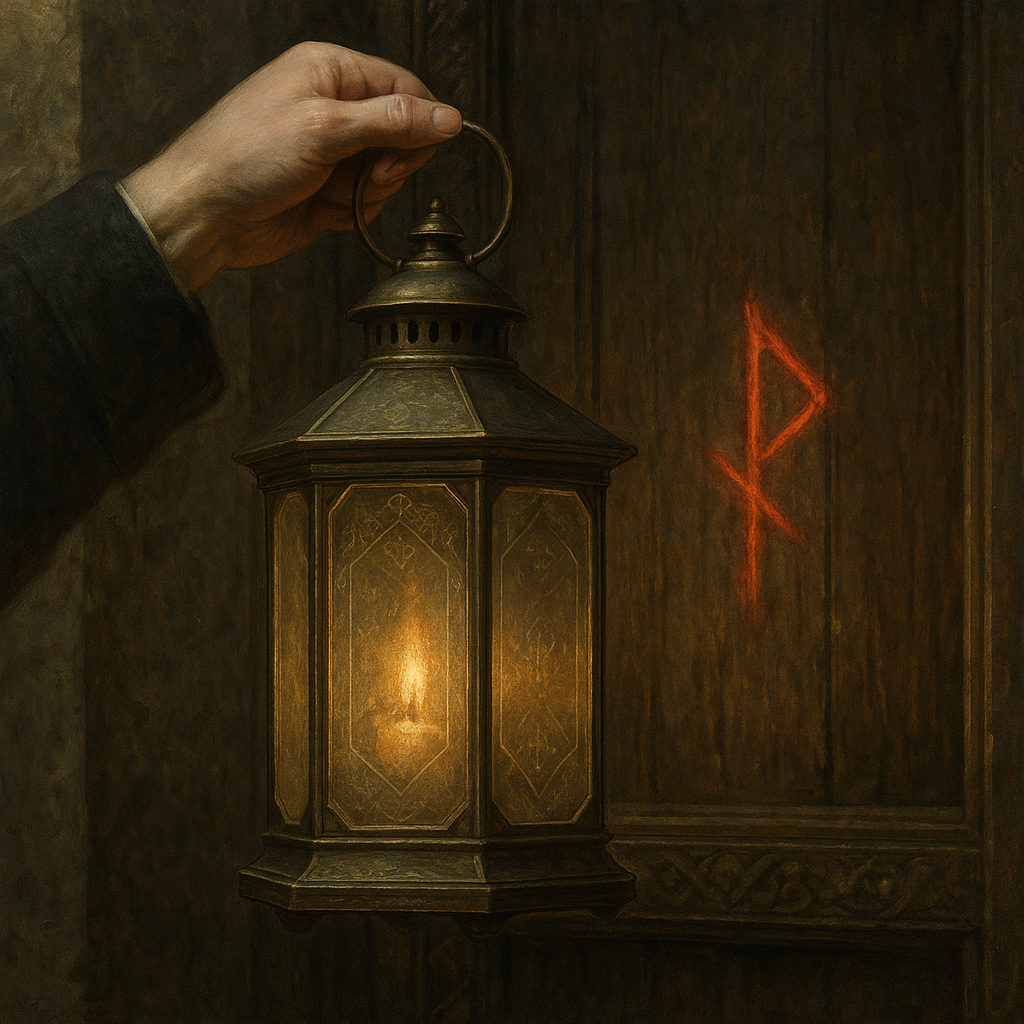
Chime Lantern
“If the lantern sings, a wizard has come.”
Chime Lanterns are relics of an age far brighter than Everwealth now endures. Once commonplace among the policing forces of The Lost Ages, they were the badge and burden of specialized lawkeepers tasked with tracking foes like Witches or rogue mages in a world that teetered perpetually between brilliance and catastrophe. In those days, before The Fall sundered the ground and The Great Schism it created burned civilization to the marrow, thousands of Chime Lanterns hummed in city streets, watchtowers, and judicial chambers. Their soft, crystalline chime, an eerie, bell-like whispered threat from all-around. Today, The Civil Age remembers only scraps of that world. The lanterns that survive are hoarded by The Arcane Coalition, today's magickal regulators, with near-religious fervor; Yet in an era where most relics of the Lost Ages are banned, confiscated, or hidden behind their vaults, the Chime Lantern is the rare exception, a relic the Coalition encourages commonfolk to own. The reason is transparent, an informed public is free labor for a government that cannot police its own streets. If the lantern chimes, someone within range is using, leaking, or attempting to conceal magick. And if someone is concealing magick without a License to Practice Magick, the Coalition will want their corpse. Most lanterns available for sale today, if 'available' can be used for something so scarce, can be found only in the market squares of major cities like Opulence or Merchant's Meet. The rest lie buried in the moss-choked ruins of The Grandgleam Forest, sealed within ancient Elfese civilizations buried there. These remnants of Everwealth's former hosts occasionally cough up a lantern intact enough to be re-lit. But such discoveries are often followed by disappearances, Treasure Hunters swallowed by forest illusions, rangers reporting strange lights, or Coalition agents arriving suspiciously quickly to secure the artifact. The lanterns are fragile, temperamental, and poorly understood by modern artificers, but they work, and sometimes that is enough.
Mechanics & Inner Workings
A Chime Lantern looks like a simple oil lamp at first glance, brass or steel, often dented and stained by age, its glass panels long since fogged by decades of soot and contained magick. But inside the lantern’s heart lies a small disc of fused magickal glass etched with impossibly fine runes. When the lantern’s flame burns, it draws delicate vibrations through this disc, amplifying them into an audible chime when it detects the presence of active magick nearby. The sound is unmistakable, a clear, crystalline ringing that rises from silence to fevered intensity depending on the strength of the spell. Low-level magick produces a faint hum, a casting of dangerous potency turns the lantern into a shrill, trembling alarm. The technology behind this effect is Lost Age craftsmanship, and while scholars understand the theory, arcane resonance detecting fluctuations in aetheric fields, no one alive can reproduce it. Attempts to replicate a Chime Lantern have resulted in sputtering failures, shattered runes, or small explosions. The surviving lanterns operate on decaying components, making each one a precious commodity. A cracked glass disc completely kills the device. A broken rune-etching cripples its sensitivity. And replacing these pieces is impossible, as even The Scholar's Guild lacks the forges, the calibrators, or the long-forgotten alchemical vats that once produced them by the hundreds. So they say.
Manufacturing process
The Lost Age process of manufacturing a Chime Lantern has been pieced together only through shattered documentation and reverse-engineering of surviving specimens. Though incomplete, the workflow is believed to have involved the following stages:
- First, artisans shaped the outer lantern frame from brass or steel, engraving the panels with subtle channel-lines to stabilize the inner resonance. Glassworkers then crafted the magickal glass panels and central resonance disc in alchemical kilns, using minerals and compounds unknown today. While the panels cooled, runesmiths etched microscopic sigils into the disc using rune styluses under magnifying lenses of a quality now extinct.
- Next, alchemical technicians embedded the disc into a coil cradle of copper-silver wiring, each coil positioned precisely to capture magickal fluctuations. This assembly was then inserted into the lantern’s interior and aligned using resonance calibrators to ensure that even the smallest shift in ambient magick would vibrate the disc without shattering it.
- Finally, the wick was treated in stabilizing solution, the oil reservoir sealed, and the lantern was ritually “woken” in a tuning chamber, an environment rich in controlled magickal currents, until it produced the first faint chime. Once awakened, a Chime Lantern required no further enchantment; its sensitivity was permanent.
History
The Chime Lantern originated during the late Lost Ages, in an era when the fear of rogue magick reached a fever pitch. The brilliance of the age, flying Aeroplanes, illuminated cities, instant communication, was built on an unstable backbone of volatile arcane innovation. Thousands of small-scale accidents, catastrophic laboratory failures, and unregulated spellcrafting incidents forced powerful nations to invest heavily in monitoring and controlling dangerous magick users. Thus, the lantern was born, a tool of the law, meant to sniff out spells the way a hound sniffs blood. Officers tasked with policing dangerous spellcasters patrolled the streets with lanterns in hand. Academia used them to screen students. Judges used them in trials. Merchants used them to ensure competitors weren’t cheating. Even commonfolk used them, to expose neighbors, rivals, or lovers dabbling in unsanctioned arts. Entire lives were ruined by a single chime. During The Fall and the ensuing Schism, the lanterns became precious commodities. Soldiers scavenged them to locate Devil sorcery. Warring factions used them to identify spies. Death squads used them to execute mages suspected of collusion with infernal forces. As industry collapsed, so too did the lantern foundries. Factories burned and took the knowledge to craft new lanterns with them.
Significance
Chime Lanterns today occupy a strange dual role. They are relics, yet weapons. Blessings, yet tools of oppression. To the Coalition, they are divine indicators, extensions of their authority, silent judges whose chimes justify raids, arrests, and purges. Coalition field hunters carry them clipped to their belts like badges of office, letting the lantern sing when it detects unlicensed spell work. For the populace, the lantern is an unwelcome necessity. Villages keep one in the town hall. Caravans use them for security checks. Those who fear witches light them at night. Some buy them because the Coalition encouraged it, others because they know what horrors stalk the night beyond the torches. And some, the quietest, keep lanterns hidden so they can warn friends or kin who secretly practice magick. The lantern cannot be fooled by mundane lies, but it can be hoodwinked by clever magicks, or so rumor claims. The unspoken truth is this, the lanterns do not detect intent. They detect magick. It matters little to the flame whether the hand casting a spell intends harm or mercy. A midwife easing a birth, a hedge healer closing a wound, a frightened young mage practicing in secret, every kind of spell sets the lantern singing. And in Everwealth, a song can be a death sentence.
Rarity
Chime Lanterns are exceedingly rare in the Civil Age. Perhaps a few hundred still exist, and only a fraction of those remain functional. The Arcane Coalition controls nearly all documented specimens, dispersing them only to licensed hunters, inquisitors, archivists, and agents tasked with policing unlicensed magick use. A small number occasionally surface in richer markets, always damaged, always expensive, often of questionable reliability. Elsewhere, the only hope of acquiring one lies in delving into the ancient Elfese bunkers beneath the Grandgleam Forest, where Lost Age security caches sometimes yield lanterns sealed in protective cases untouched by time. For commonfolk, a Chime Lantern is a rumor. For the powerful, it is a tool of control. For hedge mages, it is a death knell. To find one is fortune. To light one is the beginning of a hunt.
Weight
2-3 lbs.
Dimensions
Roughly 8" × 4" but designs vary.
Base Price
1-5 Golden Capras (300-500 Silver Capras).
Raw materials & Components
Chime Lanterns are constructed from materials no longer reproducible. Their outer frame is typically brass or tempered steel, hammered into a hexagonal or octagonal cage. Within, four to six fogged glass panels, made from a form of hardened magickal glass unknown to any modern forge, surround the lantern’s heart. The core component is a thin resonance disc, a wafer of fused magickal glass infused with micro-etched runes so fine they appear as frost. This disc is mounted within a cradle of copper-silver alloy wiring, forming a primitive sensor array that channels vibrations from the lantern’s flame directly into the disc. When activated, the assembled components harness subtle fluctuations in ambient magick, transmuting them into the famed crystalline chime. Supporting elements include a wick forged from treated plant-fiber, impregnated with old stabilizing agents that no Guild alchemist has successfully replicated; a small oil reservoir lined with anti-corrosion plating; and the mounting pins that hold the resonance disc suspended in the lantern’s center. Every lantern contains at least one element that defies modern replication, whether the magickal glass itself or the exact rune pattern inscribed within it. For this reason, every surviving Chime Lantern is considered not merely a tool, but an irreplaceable artifact.
Tools
The tools once required to manufacture Chime Lanterns now exist only as relics or fragments stored in vaults of the Scholar’s Guild. Their creation demanded a combination of mundane craftsmanship and Lost Age arcane precision.
Known tools include:
- Rune Styluses - Needle-thin etching devices capable of carving sub-visible sigils into magickal glass without fracturing it.
- Resonance Calibrators - Long-vanished tuning forks used to align the disc’s sensitivity to ambient aetheric vibration.
- Micro-Temper Forges - Compact forges able to heat small glass components evenly without melting their inscribed runes.
- Alloy Winders - Precision rigs that twisted copper-silver filaments into consistent, perfectly spaced sensor wiring.
- Flame Regulators - Devices that infused the wick and oil with stabilizing agents, ensuring a steady burn required for proper resonance.

Comments