

Cornelius Hickter
Genius | Scholar | Inventor | Statesman | Philanthropist | Statistician | Architect | Geographer | Physicist | Theorist | Duelist | Chef | Legend
Sir Cornelius Erasmus Hickter, III
Archivist's Excerpt from Cornelius Erasmus Hickter: A Concise and Quite Credible Biography, CVI 42.4
Excerpt from Entry 8: "A Man For All Hours"
“Were it not for the zeal and fortitude of great Hickter, would not this indomitable beacon of the Expanse, with all rightful splendour of illumined minds, remain in lowly squalor and vain ignorance of its fallen and forgotten predecessors? Doubt it not!”
Orphan Heights holds surprisingly scant records of Hickter, outside genealogical, and those bear little resemblance to one another and are largely believed apocryphal. The following is from the Archive’s entries, unavoidably the sole available source:
Inventor and scholar of Newtonian Physics, Hermetic Philosophy, culinary art, gravitics, Byzantine architecture, algebra, psychology, chemistry, statecraft, non-Euclidean geometry, the works of Plato, Agrippa, 14th Century French literature (and of course Shakespeare), Cornelius Erasmus Hickter would perch along a low wall outside the newly-erected Academy of Science at age eight and question the Scholars on Unified Field Theory. Admitted to the Grand Academy of Science at eleven, his theories on gravitic constants allowed for development of Orphan’s air cycling systems, as well as the Phonometric Orchestra. By twenty, he’d patented Orphan’s first combustion engine, rocking chair, and a popular garlic tomato sauce. One colleague, Stanis Morley, was so affronted by Hickter’s criticism of his work on gravitic echos that he challenged Hickter to a duel. Hickter, being a master of both the fencing blade and the powdergun, handily defeated his counterpart when the latter stumbled over a railing and fractured his leg. Hicker set the bone, made peace, then co-wrote a seminal work on magnetic fields that elevated Morley into notoriety, as well as reconciling his marriage.
Archivist’s Excerpt from: A Tale of Almost Two Cities: Orphan Heights & Related Histories, CVI 42:4
Excerpt from Entry 13: "A Tower, a Dome, a Vision"
Early in Orphan’s history, atmospheric problems in the Expanse multiplied, as did temperature instability (which some called ‘winter’), and as happened whenever anything worth discussion arose, a symposium was called. Propositions from iron-skin houses to fashionable filtration suits were both considered and insulted. One geologist suggested geo-thermal drilling, because of course he did. This angered the Engineers, who reminded the symposium that no such drills existed and they didn’t want to be bothered to invent them. The punching began shortly after. Amid the ruckus, Cornelius Erasmus Hicker arose, cleared his throat, and proposed the construction of both an iron lattice and glass dome over Orphan Towne (which was rejected), and the Heuridium Tower, (which was loudly ridiculed). The math was beyond anything the whole of the Scholary could conjure; despair ensued. Later, while on his nightly constitutional, Hickter experienced a vision, in which reconciled algebraic formulae appeared atop a mountain, alongside a message: In hoc sine vinces, (“By this sine, conquer”). Hickter attributed the revelation to his own magnificent brain, since no observable cause could otherwise be located at the time. He arrived back at the symposium the following hour and declared not only the mathematical solutions to Orphan’s dome quandary, but also the advent of Hickter's Law: Nothing Unobservable Exists. The phrase and the mathematics so beguiled the scholars that a spontaneous parade erupted from the assembly, and Hickter was carried on the shoulders of the Scholars across Orphan amid shouts and clamour all the way to Bellamy Park, where a statue was commissioned, though it took fourteen years to complete and resulted in a readdressing of the pigeon breeding ordinances passed ten years prior. Heuridium and dome construction began the following day.
Excerpt from Entry 17: "A Spire into Thunderhead"
Among the landmark work of the mind of Cornelius Hickter, his second-most impacting legacy—behind Hickter's Law—was surely the concept, design, and erection of the great Heuridium Tower. Simultaneously an Atmospheric Lectral Collector (ALC), observatory, museum, laboratory, and research station, the Heuridium represented all that Orphan Heights aspired to be … pun intended. It was the great achievement of Orphan’s first century of life, and that is saying something, the crown jewel of the Grand Academy of Science, overseen by the rumoured Fifth Marquees of Orphan, but nobody knew who that was.
Once the time of Baron Hiram Alberstein Lorecroft came, and Orphan knew lectral lighting for the first time, the Heuridium was posthumously lit as a splendour of The Expanse, a public relations stunt to raise taxes for the Academy, but it worked. The papers made a big thing of it. By the time of the relevant Sub-Variant Shift of 12473, the Heridium was closed to all public access, except for the Museum of Science & Fabrication on the first level. The upper levels were used only for housing prototypes for terraforming machinery for , but this was mostly bunk. Orphan’s laboratories were very much in use, and the new apex of the great spire housed an observatory-like Armillary mechanism, used for mapping astral patterns and generating a Cymatic Induction Wave, apparently for the purpose of shifting Sub-Variants … or Major ones, since why else would one want to generate Cymatic Induction Waves?
Regardless, this is a troubling prospect for any occupant of The Expanse, past or future, or of any other continent, for that matter. Let the reader consider himself warned.
Mental characteristics
Education
All of it
Accomplishments & Achievements
All of them
Failures & Embarrassments
None of them
Mental Trauma
Only those caused to his inferiors
Intellectual Characteristics
Superior
Personality Characteristics
Vices & Personality flaws
Please...
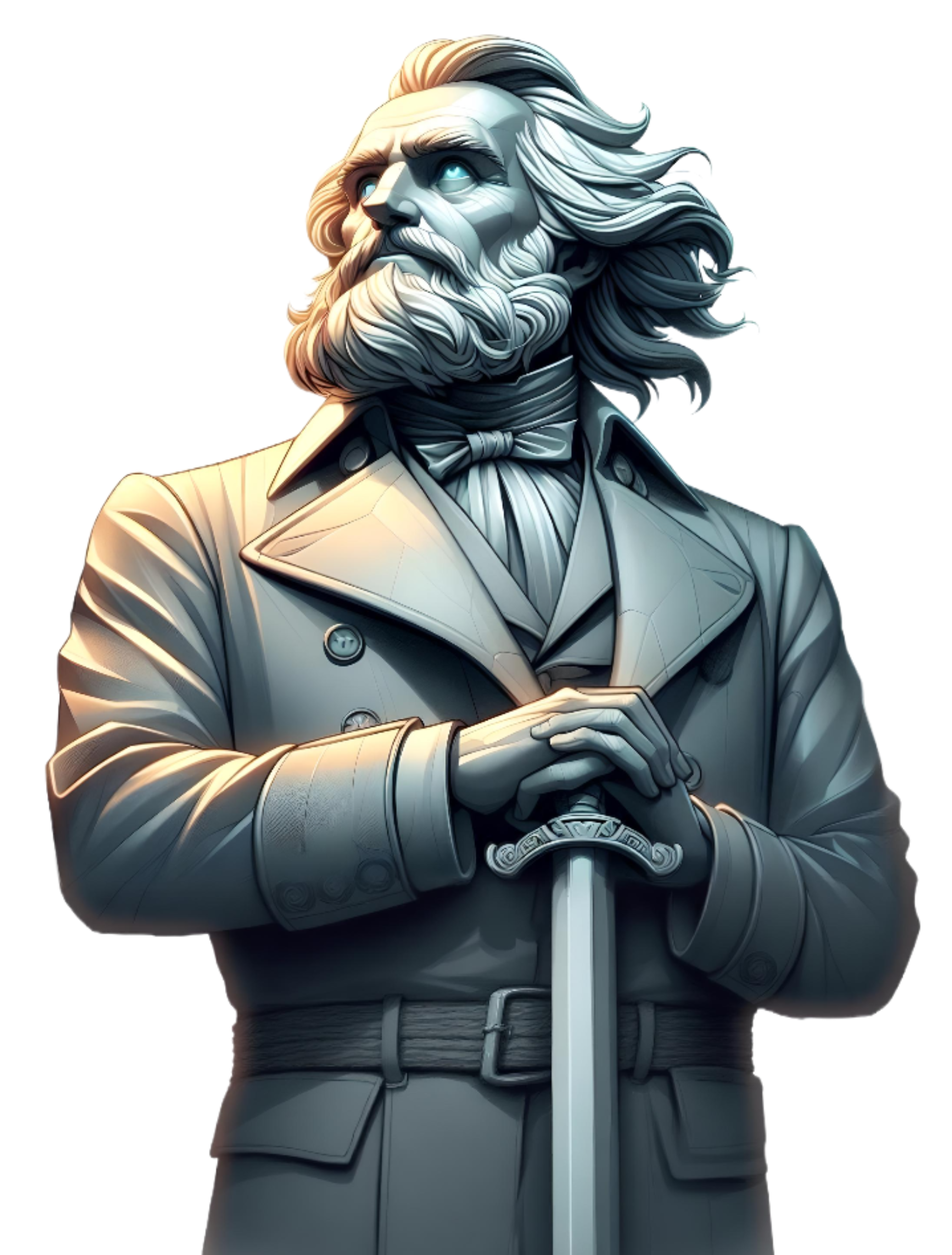
"Nothing unobservable exists"
—Cornelius Hickter
1st Marquess of Astorhill
Professor Emeritus of Particle Physics
Doctor of Utilitarian Chemistry
Professor of 14th Century French Literature
Chairman of the Grand Academy of Science
Grand Whisk of Culinary Arts



Comments