

Gorthoria
History of Gorthoria
The nation of Gorthoria was born out of conflict but sustained through dialogue. Centuries ago, the fertile valleys and vast forests of the region were bitterly contested by human kingdoms, orcish warbands, elven enclaves, and dwarven clans. After decades of bloodshed that left the land scarred, none of the factions emerged victorious. Instead, a gathering was called at the neutral site of Stonehall, where leaders from each people agreed that endless war would only ensure mutual ruin.
This meeting gave rise to the Concord of Stonehall, the founding documents of Gorthoria. Rather than establishing a monarch or warlord, Concord created The Council of Voices —a rotating assembly where every race and major community held representation. Decisions were made not by conquest but by debate, persuasion, and compromise. This unique system soon became known as the Diplomatic Style of Governance, blending tradition, law, and ritualized negotiation into a stable framework.
Over time, Gorthoria flourished as a crossroads of cultures. Its cities became centers of trade, scholarship, and diplomacy, often hosting emissaries from across the continent. Though tensions between races have never fully vanished, the people of Gorthoria have long prided themselves on solving disputes with words before blades.
Today, Gorthoria is recognized as a rare beacon of unity in a fractured world. Its strength lies not in its armies, but in its ability to forge alliances, mediate conflicts, and preserve a fragile peace among peoples once sworn to destroy one another.
Before the Concords.
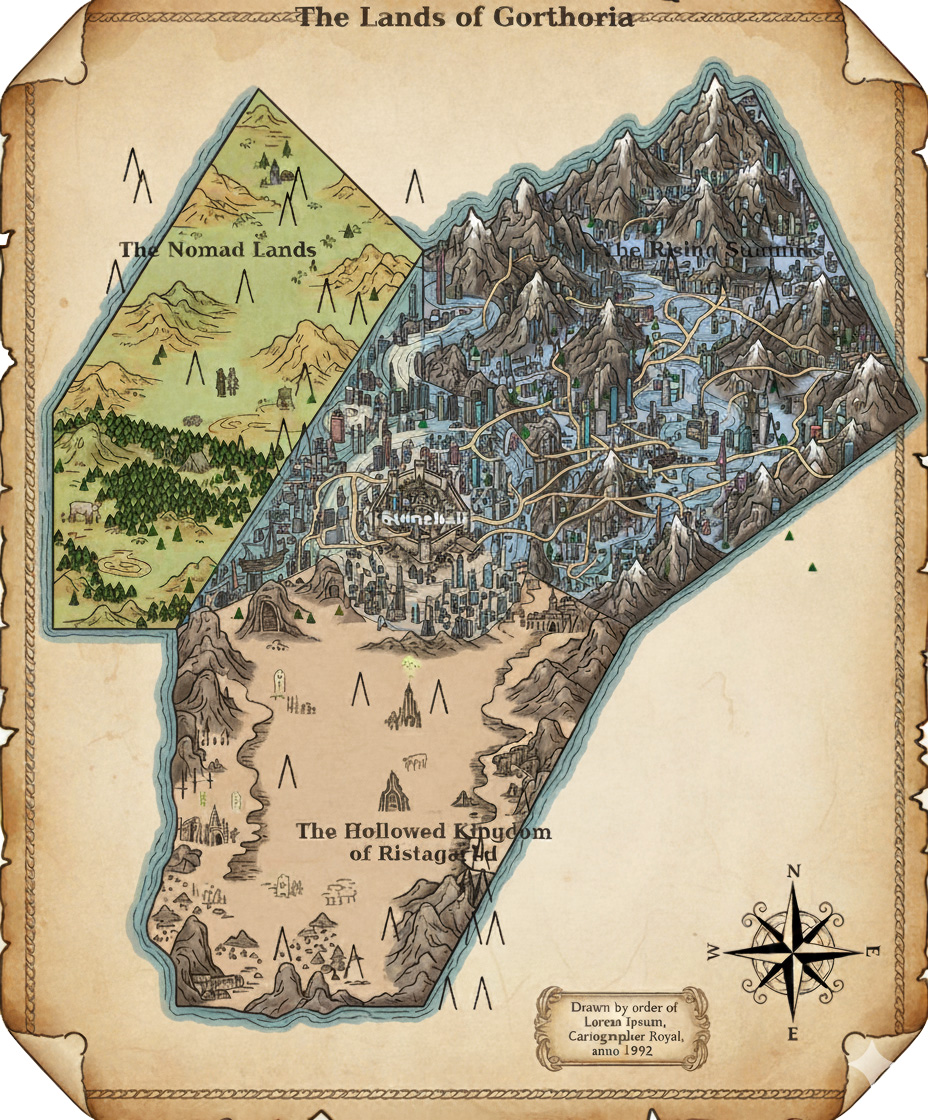
Long before the signing of the Concord, the land that would one day be called Gorthoria was a single, untamed expanse—mountains crowned with snow, forests stretching into eternity, and plains where the wind carried no master’s name. As settlers spread and civilizations rose, the land was not cut by borders of stone or ink, but by the lives and cultures of those who made it their home. Over time, these differences gave shape to three great territories.
To the North-West and West, the rugged mountains and wild forests became the domain of the Orcs, Goblins, and other nomadic peoples. They thrived in the raw, untamed wilderness, living in shifting camps, tribal halls, and strongholds carved into cliff sides. Their lands came to be known as The Nomad Lands, a place where survival demanded strength, and where honor was measured not in wealth but in the ability to endure.
To the North-East and East, the rolling hills and fertile valleys drew the Elves, Humans, and other learned peoples. Here, grand cities rose from stone and timber, universities and libraries flourished, and councils debated the philosophies of governance and magic. This region became known as The Rising Summits , a beacon of knowledge, ambition, and cultural progress, where towers and spires seemed to reach for the skies themselves.
To the South, the sturdy folk of the Dwarves, Halflings, and Gnomes laid their claim. Not content with the surface alone, they dug deep, carving out colossal underground halls and cities that glimmered with gems and glowed with the light of molten forges. These subterranean marvels, equal parts fortress and sanctuary, transformed the southern lands into a kingdom of craft and invention, where artistry and industry went hand in hand which came to be known as The Hollowed Kingdom of Ristagarhd
Though divided in ways of life, the three territories were bound by the same soil and sky—a single landmass, fractured not by oceans, but by culture, ambition, and pride. It was these divisions, both fruitful and perilous, that set the stage for both centuries of strife and the eventual forging of unity under the Concord of Stonehall.
Together, these three territories—The Nomad Lands, The Rising Summits, and The Hollowed Kingdom of Ristagarhd—form the living body of Gorthoria. Their differences remain, yet their shared history under the Concords of Stonehall binds them in fragile unity, a unity constantly tested by ambition, tradition, and those who would see the land fracture once more.






Comments