

Lyra Sterling
First Handmaiden Lyra Sterling (a.k.a. Aria)
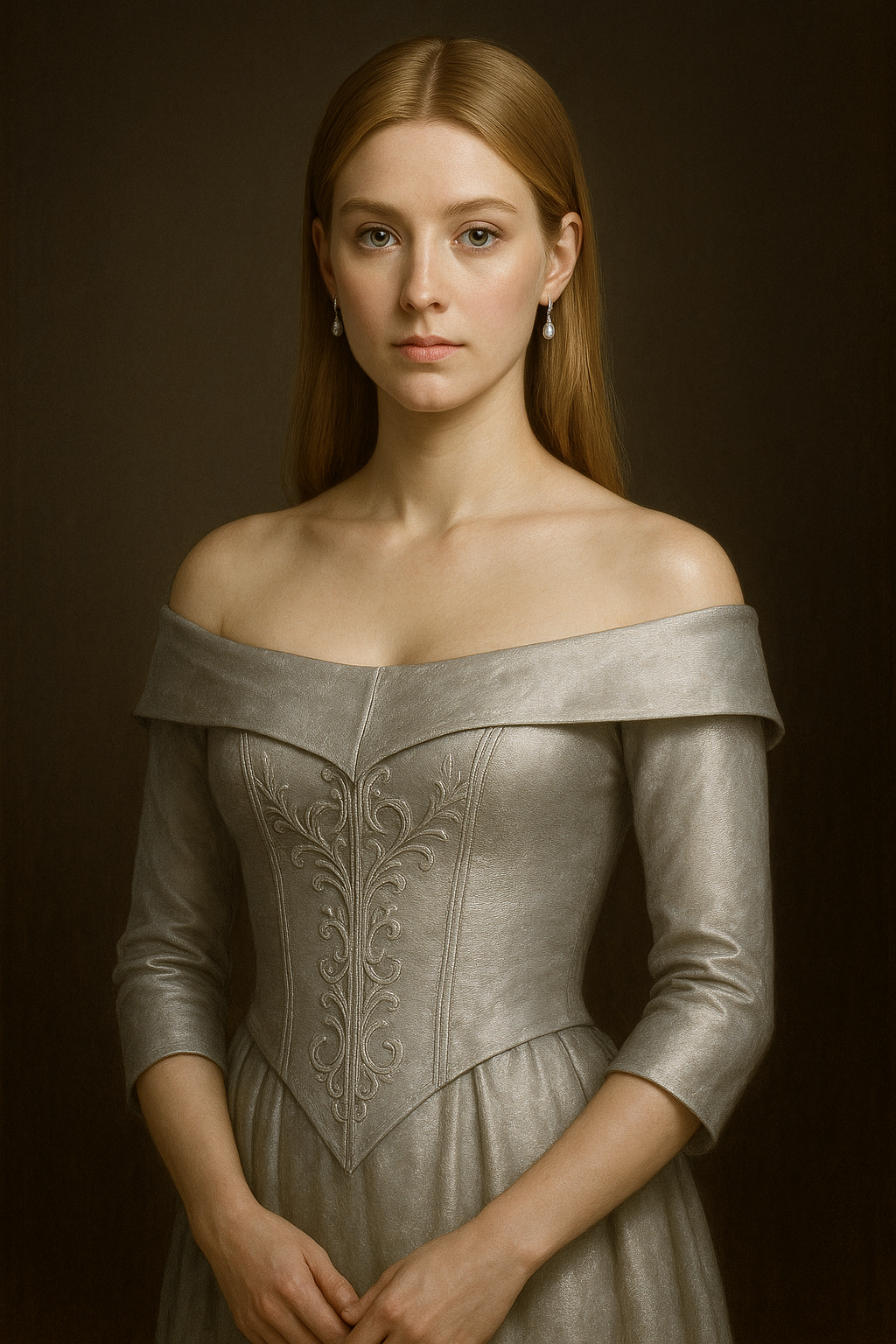
Lyra Sterling (born July 5, 24 BFE) is an Alagorian court official, singer, and songwriter who serves as the First Handmaiden of the Sapphire Throne. A former pop idol known by the stage name Aria, she rose to prominence during the late Reconnection Era and later became a founding member of the idol group AURA.
Born in the city of Erondehl in the Kingdom of Loradel, Sterling grew up during the technological and cultural transformations of the late pre-Imperial period. She entered the music industry in 5 BFE after signing a junior development contract with Shining Star LLC, releasing her debut single “Morningfall” and her first album Shining Through the same year.
Over the next several years she rose in prominence under the stage name Aria, releasing a sequence of commercially successful albums that made her one of the most recognizable young performers in Alagor. In 2 BFE she became a co-founder of the idol supergroup AURA alongside Seraphina Winters and Tessa Rynell. Their sole studio album, No Echo Returns, became a pan-realm success and marked the peak of Sterling’s musical career, cementing her place in the cultural history of the Reconnection Era.
Following the death of King Octavius Athomath at the Tournament of the Supreme in 0 AFE and the subsequent dissolution of AURA, Sterling accepted personal appointment to the royal household of Salena Athomath. Upon the founding of the Sapphire Empire she was formally named First Handmaiden of the Sapphire Throne, a position she has held since.
As First Handmaiden, Sterling has become a prominent figure in the early Imperial court, serving in ceremonial, diplomatic, and representational capacities on behalf of the Empress. While remembered for her earlier role as a performer, she is now primarily regarded as a loyal and enduring servant of the Sapphire Empire.
Early Life
Lyra Sterling was born on July 5, 24 BFE, in Erondehl, Kingdom of Loradel. Her father, Ruen Sterling, worked as a foreman in the city’s blacksmiths’ quarter, and her mother, Elaya Sterling, was employed as a clerk in the local guild registry. She has a younger brother, Cael, whose life remains largely outside the public record.
Erondehl, though spared direct fighting during the Alagorian Civil War, experienced years of economic and cultural aftershocks. Sterling grew up in a stable household during this transitional period, and later recalled that her earliest memories were of streets that “seemed old but newly wired,” reflecting the arrival of Avalonian infrastructure. The Sterling family observed Reshlorain, a winter holiday marked by lantern-lighting and communal feasts; relatives and neighbors often encouraged her to perform songs at gatherings, one of her first semi-public outlets.
Sterling attended Trenwyn Sector School from the age of eight. Among the first schools in Loradel to adopt Avalonian digitized slates and imported lesson modules, Trenwyn gave her exposure to technologies uncommon in her parents’ generation. Teachers described her as diligent and lively, excelling in reading and composition but increasingly drawn toward the arts. While academically capable, she spent much of her free time in school theater productions and dance programs. Notes and sketches on discarded papers frequently included song fragments or rewritten verses of traditional ballads, while her slate devices were filled with copied broadcast songs and imported media.
Her earliest exposure to music came from her mother’s Loradellian ballads, which she memorized and re-worked with her own lyrics. By her preteens she had also become an avid follower of Avalonian popular music, absorbing both melodic structures and stage aesthetics from imported broadcasts. A community center established in Erondehl provided free activities for children of working families, where Sterling studied several instruments and received informal vocal training. Instructors later remembered her as unusually quick to pick up melodies on new instruments and confident in singing before peers.
The family relocated briefly to Frostmere, the Loradellian capital, during her early adolescence, further exposing her to Avalonian modernization. There she attended festivals and performances that reinforced her interest in a professional career. Sterling also traveled regularly to the Kingdom of Valtoria, where her father’s extended family lived. In Valtorik she participated in youth festivals and amateur showcases, occasionally submitting recordings to new broadcast stations hosting competitions.
By age eleven she was performing regularly at community events, and at twelve she recorded a set of demo tracks using borrowed equipment at the community center. One of her festival performances in Valtorik drew the attention of Shining Star Entertainment, a growing talent agency in the city. Company representatives contacted her family directly and arranged an interview, marking her entry into professional development. Initially she appeared in local commercials and, under youth-protection statutes, recorded music for the agency’s junior broadcast circuit without her real name attached. These early projects introduced her to studio work and performance schedules, laying the foundation for her later public debut.
11 to 4 BFE: Career beginnings and Shining Through
Sterling entered a development contract with Shining Star Entertainment in 11 BFE at age 13, joining the company’s junior artist program. She spent six years in training that included vocal instruction, choreography, and stage presentation, while performing anonymously in youth idol showcases and regional contests such as the Valtorik Rising Voices Festival and the Loradel Young Performers Circuit. During this period she also recorded music for junior broadcast channels under protective statutes, which prevented her real name from being used publicly.
On March 3, 5 BFE, Sterling debuted as a solo artist under the stage name Aria with the single “Morningfall.” The track, described by critics as minimalist and emotionally direct, entered the central Alagorian Broadcast Chart at number 14 and peaked at number 3, remaining in the top 20 for 18 consecutive weeks. On April 10, 5 BFE, she released her debut album Shining Through, which blended Avalonian electropop with Loradellian ballad traditions. The album debuted at number 4 on the Alagorian chart and remained listed for 62 weeks, eventually selling the equivalent of 1.2 million units across the Seven Kingdoms.
The album produced three additional singles: “Rise Up!”, “Light Up the World”, and “Ignite the Night.” Each achieved moderate broadcast success, with “Rise Up!” reaching the top 10. Sterling promoted the record with the Shining Across Tour, a six-month regional circuit spanning Valtoria, Dravonell, and Loradel, before joining singer-songwriter Ethan Blake as an opening act on his Fire Within Tour in late 5 BFE. During the tour she and Blake performed a collaborative single, “Unbreakable,” which was later included on a deluxe edition of Shining Through.
In 4 BFE Sterling released her first extended play, Chasing Dreams, featuring acoustic renditions and previously unreleased compositions. A second EP, Together We Stand, was distributed exclusively through the retail chain Marxton inluded fan-favorite track “Boundless Sky.” Both projects expanded her audience and cemented her image as one of the leading young idols of the Reconnection Boom.
4 to 3 BFE: Sands of Time and rising acclaim
Sterling’s second studio album, Sands of Time, was released on March 14, 4 BFE, through Shining Star Entertainment in Alagor. The record debuted at number one on the Alagorian Broadcast Chart and held the top position for eleven consecutive weeks, becoming one of the best-selling albums of the year in the Realm. Its lead single, “Echoes of Tomorrow,” peaked at number four on the central chart, while the follow-up single “Falling Through Stars” reached number two. A third single, “Where the Rivers Meet,” achieved moderate success and gained attention in Avalon, marking Sterling’s first presence on Avalonian broadcast charts, though it did not reach the top ten.
To promote the album, Sterling joined the progressive rock group Ashes of Gelmour as an opening act on their Crownfire Tour before embarking on her first headlining circuit, the Through the Hourglass Tour, which visited over 40 cities across the Seven Kingdoms of Alagor. Critics praised her performances for their polished choreography and live instrumentation, noting a visible shift from youth idol aesthetics toward a more mature stage presence.
Sands of Time won multiple awards in its release year, including Album of the Year from the Alagorian Pop Association and Best Contemporary Recording at the Harmony Star Awards. Sterling was also formally invited to join the Alagorian Academy of Arts and Performance, making her one of the youngest members admitted.
During this period, Sterling began collaborating with artists outside her home kingdom of Loradel. She contributed the song “Starlight Run” to the soundtrack of the Seartorian drama Fire Across the Dunes and co-wrote “No Turning Back” with rising Seartorian rapper Tessa Rynell. The collaboration, bridging audiences between Loradel and Seartor, marked the beginning of their long-term friendship and later group work. Sterling also appeared on “Shadows Awake” by the Alagorian electronic duo Glasslight, which reached number six on the realm charts.
By the close of 4 BFE, Sterling was regarded less as a child idol and more as a leading young woman in Alagorian pop. Commentators noted her growing influence in shaping cross-realm cultural exchange, even as her public image remained tied to the stage name Aria.
3 BFE: Garden of Dreams
Sterling released her third studio album, Garden of Dreams, on March 4, 3 BFE through Shining Star Entertainment. Written entirely by Sterling, the record marked a stylistic departure from her earlier electropop sound, incorporating heavier rock instrumentation and more confessional songwriting. Garden of Dreams debuted at number one on the Alagorian Realm Charts, but its run was cut short after one week when Seraphina Winters’ Beneath the Mask displaced it, beginning a months-long chart dominance. Though Garden of Dreams briefly charted in Avalon, it failed to maintain traction against Winters’ breakthrough success.
Five singles were released from the album, including “Falling Skies” and “Echoes Remain”, both of which reached the top five in Alagor. The third single, “Wildfire Heart”, became Sterling’s most successful to date, peaking at number two before being blocked from the top position by Winters’ “Veil of Light”. The album’s closing track, “Drown the Silence”, attracted critical praise for its raw lyricism and has since been regarded as one of Sterling’s signature songs.
Sterling embarked on the Garden of Dreams Tour, a limited Alagorian circuit beginning in Loradel and concluding in Athomathia. Though smaller than expected, the tour showcased her growing reputation as a live performer, with her headlining performance at the Athomathian Idol Fest later that year regarded as a career milestone. Reports from the period suggested increasing friction between Sterling and Shining Star management over her desire to expand into Avalon, a conflict that fueled speculation about her future with the label.
Despite being overshadowed by Winters, Sterling received multiple honors during this period. She was awarded the Alagorian Pop Association’s Best Female Vocal Performance, and Garden of Dreams won Album of the Year at the Loradel Music Awards. At the Harmony Star Awards, she was nominated in several categories but lost to Winters, who swept the ceremony in absentia.
In mid 3 BFE, Sterling collaborated with Winters on the track “Silent Horizon”, her first formal project with the pop icon. Later that year, Eclipsa Entertainment purchased her contract from Shining Star and placed her into its rotating Mythos Cycle program, where she drew the Phoenix theme for a planned concept project. Winters, already entrenched at Eclipsa, was assigned as her creative partner during the transition. Sterling also contributed the single “Carry the Flame” to the soundtrack of the Alagorian action-drama Ironclad Rebellion and signed endorsement contracts with Marxton Markets and the Trenwyn Crystalwear fashion line. She made her acting debut in a supporting voice role for the animated fantasy Tales of the Healforian Plains.
Her career was increasingly marked by high-profile public appearances. She maintained a visible friendship with Tessa Rynell, with whom she was frequently seen at events, fueling speculation of future collaborations. Rumors of a relationship with singer Ethan Blake circulated following their joint performance of “Unbreakable”, but Sterling dismissed the claims in interviews.
On December 21, 3 BFE, Sterling attended Winters’ concert at Concordia Alagora, held to celebrate the birthday of Crown Princess Irisa Athomath. The event was violently disrupted by a failed kidnapping attempt orchestrated by remnants of the White Knights of the Emerald Queen. Sterling was not injured, but the incident left a lasting cultural imprint. In the aftermath, she joined Winters and Rynell in a January 8, 2 BFE benefit concert for victims and families affected by the attack. The performance marked the trio’s first joint appearance, later retrospectively seen as a precursor to the formation of AURA.
2 BFE: AURA, Phoenix Ash, and Hearts Ablaze
On February 9, 2 BFE, Eclipsa Entertainment formally introduced Sterling as a member of AURA, a three-member idol group with Seraphina Winters and Tessa Rynell. Their debut album, No Echo Returns, released the same day, opened at number one on the Alagorian Realm Chart and remained there for 14 consecutive weeks. It went on to dominate pan-realm rankings, topping charts in Roxabor, Cascadia, and the Dread Coast, while reaching number one on Avalon’s broadcast index for nine weeks. The singles “Eshara Vel’Karesh”, “Veil of Dominion”, and “Karesh Vel’Shara” all entered the top three in Alagor; Eshara Vel’Karesh peaked at number one across four realms simultaneously, the first idol track to achieve that feat. Sterling’s prominence as sub-captain and co-lead vocalist was noted in reviews, with critics praising her “crystalline phrasing” and her arrangement of the album’s Ancient Alagorian chorus lines.
The accompanying No Echo Returns Tour began in March and extended through the year, with stops across Alagor and interrealm stadium dates in Avalon, Roxabor, Cascadia, and the Dread Coast. The group toured aboard the Eclipsa Starliner, a custom-outfitted vessel that doubled as a mobile broadcast hub; their appearances via live link on the Lex Carter Show became a recurring media highlight. Each member was given a solo showcase section during the concerts. Sterling’s sets featured her earlier Aria material alongside her new Phoenix cycle songs.
On March 28, Sterling released Phoenix Ash, a four-track mini-album tied to her Mythos theme of the Phoenix. The project debuted at number two in Alagor and number three in Avalon, held from the top position by No Echo Returns. Singles “Ashes in Bloom” and “Rising Again” both entered the Alagorian top ten, while the ballad “In the Fire’s Wake” peaked at number five in Roxabor. Though commercially overshadowed by AURA, Phoenix Ash was regarded by critics as her most mature work to date, showcasing a heavier rock influence.
Later that year, Sterling released a second solo project, Hearts Ablaze, on October 17. Departing from the rock leanings of Phoenix Ash, it presented a suite of romantic ballads and pop anthems, including “Through the Firelight”, “All We Are”, and “Kiss of Ashes”. The album debuted at number one in Alagor, where it spent nine weeks at the top, and entered the Avalon chart at number three, remaining in the top ten for 21 weeks. Critics noted the album’s lyrical intimacy, which fueled widespread speculation that the songs reflected a personal relationship with Winters. The rumors intensified after Winters kissed Sterling on stage during the Avalon leg of the tour, an incident widely circulated across broadcast networks and fan recordings. Sterling and Winters dismissed the speculation in joint interviews, but their closeness became one of the most reported cultural narratives of the year.
By year’s end, Sterling had become one of the most visible figures in pan-realm music. At the Harmony Star Awards, she received Best Pop Vocal Album for Hearts Ablaze and accepted multiple awards on Winters’ behalf, as Winters again declined to attend. AURA as a group won Group of the Year, while their tour was named Best Live Production. Sterling also contributed the song “Carry the Flame” to the drama Ironclad Rebellion and voiced the character Selira in the animated feature Starlight Odyssey: Legends of Cascada. She continued endorsements with Marxton Markets and Trenwyn Crystalwear, the latter releasing a jewelry line inspired by her Phoenix motif.
Her transition from solo idol to interrealm pop icon was regarded as one of the most rapid ascents in recent cultural history, with ritics comparing AURA’s prominence to earlier cultural juggernauts such as Crystal Aria and Starline, marking them as the most influential idol group of their generation.
1–0 BFE: Public spotlight, AURA’s disbandment, and transition to imperial service
Through 1 BFE, Sterling’s visibility reached its peak. Alongside Winters and Rynell, she remained a fixture across late-realm media, from variety shows to high-profile festival stages. A charity collaboration between the three, Hold the Line, debuted at number one on the Pan-Realm Broadcast Index and was praised for its unified message; critics noted Sterling’s performance as one of her strongest outside the group’s main catalog.
Her growing prominence also made her a tabloid favorite. A playful appearance on The Lex Carter Show ended in a viral moment when she and her bandmates collapsed a chair mid-dance. At a formal gala in Avalon, a wardrobe mishap involving Sterling became a widely circulated clip, later addressed jokingly in interviews. While speculation about a relationship with Winters persisted, it was already fading; instead, attention turned toward the trio’s offstage closeness, with commentators frequently dubbing them the “darlings of the realms.”
In May, Sterling was seated in the royal box at the Tournament of the Supreme when King Octavius Athomath died in a sudden accident. Winters, who had opened the ceremony earlier that day, withdrew from public life soon after, and by the close of 1 BFE AURA formally disbanded.
Following the proclamation of the Sapphire Empire in 0 AFE, Empress Salena Athomath invited Sterling, Rynell, and Winters to consider roles within the new imperial household. Winters declined, but Sterling and Rynell accepted. By year’s end, Sterling was formally appointed First Handmaiden of the Empire, a role that marked her decisive departure from music and entry into political life.
Imperial Service (0 AFE – Present)
Following the coronation of Empress Salena Athomath and the founding of the Sapphire Empire in 0 AFE, Sterling was formally appointed as the First Handmaiden of the Throne. The role, unprecedented in Alagorian tradition, bypassed established court offices and was widely read as a sign of the Empress’s personal trust. Sterling’s appointment marked a decisive break from her musical career, shifting her public identity from idol to imperial attendant.
As First Handmaiden, Sterling assumed both ceremonial and functional duties within the Sapphire Court. She was charged with overseeing the Empress’s private household, coordinating handmaiden staff, and serving as an intermediary between the throne and palace functionaries. Beyond the court, she has acted as Imperial Proxy at state events, representing the Empress at diplomatic conferences and cultural ceremonies across the realms. Commentators often note that Sterling’s background in performance prepared her for managing protocol and public perception, making her an effective figurehead in situations where symbolic presence carried political weight.
Sterling accompanied the Empress on her first series of interrealm visits in 1 AFE, including the historic Summit of Six Realms in Avalaria, where she was praised for her adept handling of ceremonial protocol during tense negotiations. In 2 AFE, she led a small delegation to Cascadia to inaugurate the Sapphire Associatio Center cultural initiative, an appearance later credited with strengthening cross-realm Imperial acceptance.
Her profile rose further in 3 AFE, when a rebel cell attempted an incursion into the Sapphire Palace while the Empress was abroad. According to court reports, Sterling directed the evacuation of several state guests and coordinated with the Sapphire Glaive until regular security forces re-established control. Though she held no military authority, her actions were cited in contemporary coverage as evidence of her “decisive composure,” and she was later awarded the Empress’s Laurel of Service in recognition.
Since then, Sterling has remained a fixture of the Empire’s ceremonial and diplomatic life. She was present at the 5 AFE Sapphire Assembly swearing in, traveled with the Empress during the 6 AFE treaty ratification tour in Roxabor, and presided over the 7 AFE Concordia Arts Festival in Frostmere, where she delivered the opening address in the Empress’s absence.
Though she rarely grants interviews, Sterling continues to attract public attention. Analysts have debated the scope of her influence within the Palace, with some describing her as a “trusted confidante” and others characterizing her authority as largely symbolic. Her transition from idol to imperial figure remains a frequent subject of media commentary, with retrospectives often framing her as emblematic of the cultural shifts between the Reconnection Era and the consolidation of imperial power.
Artistry
Musical styles
Sterling’s discography is frequently described by commentators as marked by deliberate reinvention, with critics often labeling her a “musical shapeshifter” across her active career. Her early work under the alias Aria drew heavily on accessible pop and inspirational anthems aimed at youth audiences, marked by bright arrangements and melodic simplicity. Songs like “Morningfall” and “Rise Up!” embodied a clean, optimistic sound that commentators compared to the child-idol wave of late Reconnection pop.
With Sands of Time and her early solo tours, Sterling incorporated arena-rock and theatrical elements, layering guitars and live percussion into her pop structures. Analysts noted the influence of Avalonian modern rock on her arrangements, and her stage presence was increasingly compared to show-driven performers such as Elandra Kael and the Galewind Collective.
Her stylistic shift accelerated in 3 BFE with Phoenix Ash and her parallel work in the AURA project. Hearts Ablaze emphasized romantic and balladic pop, sparking speculation about Sterling’s personal life through its intimate lyricism and stripped-down instrumentation. By contrast, her contributions to AURA’s Echo Returns cycle showcased her adaptability to symphonic rock and mythic concept work, where her voice was described as “the human tether” to Seraphina Winters’ darker narratives.
Critics often highlight Sterling’s dual identity as both a solo artist and group member: her solo projects leaned toward emotionally vulnerable and melodic ballads, while AURA emphasized her ability to blend into larger, high-concept arrangements. The balance between these roles, particularly her transition from love-oriented pop (Hearts Ablaze) to epic myth-driven compositions (Eshara Vel’Karesh, Karesh Vel’Shara), became a defining feature of her career.
Following her departure from music in 0 AFE to assume imperial service, retrospective evaluations describe Sterling as a bridge figure of the Reconnection Era. Some critics argue her greatest influence was not in innovation but in versatility—adapting seamlessly across genres from radio-ready pop to hybrid rock-orchestral scores. Others credit her with popularizing romantic pop balladry in the early Reconnection years, framing albums like Hearts Ablaze as precursors to the modern cross-realm singer-songwriter movement.
Voice
Sterling possesses a mezzo-soprano vocal range, though she most frequently performs in a controlled alto register. Early reviews of her Aria material described her tone as “light and breathy,” with some critics calling her delivery too delicate compared to contemporaries on the Alagorian pop circuit. Supporters argued that her decision to minimize digital correction gave her recordings a sincerity uncommon in the tightly produced idol industry, noting her conversational phrasing and emphasis on intimacy over precision.
With Sands of Time and her early AURA material, Sterling expanded into more powerful arena-style projection, relying on sustained belts and phrasing designed for live performance. Her timbre was increasingly supported by multitracked harmonies and Avalonian studio effects, including layered reverbs and subtle synth processing, which created the “shimmering” vocal textures that became a hallmark of AURA’s sound.
On Phoenix Ash, she leaned into romantic balladry, emphasizing her middle and lower registers. Commentators highlighted the contrast between her breathy upper tones on songs such as “Embers” and the fuller, darker coloration of tracks like “Ashes to Ashes.” By the time of Hearts Ablaze, she had developed a dynamic approach that alternated between stripped-back, near-whispered delivery and commanding, rock-inflected choruses.
Retrospective assessments of Sterling’s voice became notably more favorable after her transition into imperial service, when critics revisited live recordings of her final tours. Music columnist Cael Renvar observed in 6 AFE that “Sterling’s gift was not raw power but detail — a shift of cadence to show doubt, a softened syllable to convey devotion, a clipped phrase to suggest guarded restraint.” Analysts now generally consider her vocal adaptability, rather than technical virtuosity, to be central to her cultural impact.
Songwriting
Sterling’s fascination with songwriting began in childhood; she often recalled filling school journals with verse-like entries and improvising melodies to help memorize lessons. Family acquaintances noted that she treated household chores as “rehearsals,” turning mundane tasks into opportunities to test lyrical phrasing.
During her formative years under Shining Star Entertainment, Sterling drew on the traditions of Alagorian folk ballads and Avalonian broadcast pop, citing artists such as Caelen Myrr, Elira Vey, and the duo Aethis & Mairen as early models. Critics observed that even her first Aria-era material, including “Morningfall” and “Rise Up!”, bore traces of Avalonian rhythm-pop blended with the intimate cadences of Loradel street poetry.
Unlike many idols of her era, Sterling rarely relied on overtly romantic material in her early career. Instead, her lyrics often blended motifs of resilience, communal identity, and self-assertion, which critics noted gave her music a broader appeal beyond her core demographic. Analysts of the Reconnection Boom have pointed to Sterling’s tendency to anchor songs in collective rather than individual experience, making her work unusually suited to cross-realm resonance once she entered AURA.
Her early albums (Shining Through and Sands of Time) were dominated by adolescent longing and romantic idealism. With Phoenix Ash she shifted toward more introspective themes of devotion, jealousy, and vulnerability, while Hearts Ablaze incorporated motifs of self-assertion and resilience. Within AURA, her contributions often emphasized interpersonal bonds and reconciliation, in contrast to Winters’ darker mythic imagery and Rynell’s combative lyricism.
Scholarly reception of Sterling’s songwriting has been mixed but generally positive. Cultural historian Ilyan Drevos called her “the Laureate of Affection,” praising her ability to make private feelings feel universal. Others have dismissed her writing as overly sentimental, interpreting her focus on romantic entanglements as limiting. More recent reassessments, however, argue that her willingness to foreground emotional interiority challenged conventions of the Reconnection Era, which often privileged spectacle over sincerity.
Performances and Stage
Sterling’s live performances were distinguished by their theatricality and emphasis on immersive settings. Concerts under both her solo career and with AURA frequently incorporated elaborate stage design, blending elements of Alagorian dramatic tradition with cutting-edge Avalonian visual technologies, including projection fields, interactive stage platforms, and synchronized aerial displays. Reviewers often remarked that her concerts felt closer to hybrid theater-spectacle events than conventional idol shows, with Sterling herself positioned at the narrative center.
Unlike many of her contemporaries, Sterling did not rely heavily on choreography. Though she frequently performed alongside trained dancers, her focus was on creating emotional continuity between songs and maintaining direct engagement with her audience. Critics noted her ability to shift from quiet, intimate delivery to commanding stadium-scale performances without losing the sense of connection that defined her early career.
Sterling consistently performed with a core live band assembled during her debut years, many of whom remained with her through the transition into AURA. Onstage, she showcased versatility as a multi-instrumentalist, performing on acoustic and electric guitar, piano, and a traditional Loradel stringed instrument, the selvra, which she introduced to wider audiences during her Sands of Time tour.
Videos and Filmmaking
Sterling consistently emphasized the visual dimension of her music, regarding videos as extensions of her storytelling. In 2 BFE she co-founded Radiance Studios, a small production collective under Eclipsa Entertainment, to oversee creative direction for her projects and those of AURA. Her first credited work was as co-director of the video for “Eclipsed Fate” which critics praised for its cinematic pacing and symbolic imagery.
She quickly became known for personally drafting treatments and conceptual storyboards, often blending mythic motifs with contemporary aesthetics. For AURA’s No Echo Returns cycle, she collaborated extensively with director Valen Oric on a string of high-budget visual epics; among them, the video for “Veil of Dominion” was awarded Best Music Film at the Harmony Laurels and became one of the most streamed videos on EclipsaStream during 1 BFE.
Sterling also explored interactive media. Her “Hearts Ablaze” project was released alongside Starlight Nexus, an immersive holo-experience where viewers could navigate shifting environments synchronized to the song’s verses. The project earned her an Auralis Prize for Interactive Art, marking the first time an idol had been recognized in that category.
By the time of her retirement from music, Sterling had directed or co-directed more than a dozen videos. Her first solo directorial credit, “Phoenix Ash (Abyss Version),” won Best Direction at the Pan-Realm Visual Guild Awards, making her the youngest recipient in the category’s history. Commentators later identified her short-form piece Ashes of Tomorrow—released as a companion to AURA’s farewell performance—as her transition into narrative filmmaking, frequently screened in conservatories as a benchmark of cross-disciplinary artistry.
Her stated influences ranged from Avalonian visual poet Myrin Kael to Cascadian surrealist director Deyla Voren, with critics observing how Sterling’s cinematic sensibilities blended high-concept mythological storytelling with accessible emotional clarity.
Achievements
Sterling has sold more than 4.2 billion certified units across realms, encompassing both solo releases and her work with AURA, making her one of the highest-selling Alagorian artists of the Reconnection Era. Her albums Shining Through and Hearts Ablaze each achieved multi-Diamond certification in Alagor, with the latter spending 94 consecutive weeks on the Kingdom Top 100. As a member of AURA, she contributed to the group’s record-breaking No Echo Returns cycle, which remains among the best-selling albums of the era and established her voice as one of the defining sounds of early BFE-era pop.
On broadcast and streaming charts, Sterling logged eight number-one singles in Alagor and placed 17 songs in the Pan-Realm Top 40 between 5 and 1 BFE. Her most successful solo single, Morningfall, was certified Diamond across three kingdoms and remains one of the most-streamed debut tracks of the period, surpassing 15 billion plays. In Avalon, Hearts Ablaze reached number three on the Realm 200 and introduced her to interrealm audiences, a feat that helped sustain her recognition even after her transition to imperial service.
Across her career, Sterling received 6 Harmony Star Awards, including Breakout Songwriter of the Year and Best Pop Album, and earned Conservatory Laurels for both performance and composition. She was twice nominated for the Pan-Realm Broadcasting Guild Awards and won Best Collaborative Single for Unbreakable with Ethan Blake. During her tenure in AURA, she and her bandmates collectively received more than 20 major honors, including Pan-Realm Tour of the Year and the Avalonian Broadcast Medal for Cultural Impact.
Beyond sales and awards, Sterling’s influence rests in her unusual dual legacy. Critics have noted that few figures of the Reconnection Era matched her ability to bridge mass entertainment with public life. By 0 AFE, she was recognized not only as a leading voice of her generation’s music but also as one of the most visible cultural icons to transition into the Imperial Court, her enduring influence carried as much by her symbolic presence as by her chart records.
In recognition of her actions during the Sapphire Palace incursion of 3 AFE, Sterling was awarded the Empress Laurel of Service, one of the Empire’s highest civilian honors.
Public Image
Sterling is an enduring figure of 4th-millennium popular culture. In her early career she was styled as a “girl-next-door” type, praised for her openness and polite demeanor. Publications described her as a “media darling” with an approachable charm that contrasted with more aggressive stage personas of her contemporaries. Her energetic performances and candid interviews cemented her as a teen idol across realms, and her fanbase developed a reputation for their devotion and playful online culture.
As her career matured, Sterling was increasingly viewed as a pop icon whose personality transcended music. Commentators highlighted her ability to cross demographics, appealing to both younger audiences and older listeners who saw her as a symbol of optimism and stamina in the Reconnection Era. Some critics framed her rise as emblematic of the idol system’s power to manufacture cultural icons, while others defended her authenticity as a performer who thrived on spontaneity and audience connection.
Her abrupt transition from performer to imperial service in 0 AFE divided fans. While some lamented the dissolution of AURA, others praised her appointment as First Handmaiden as a historic shift and celebrated her continued visibility beside the Empress. In popular culture, the move was frequently portrayed with irony and humor, generating memes that juxtaposed her idol past with her political stature.
Today, Sterling is regarded as both a cultural icon of her generation and one of the most recognizable faces of the Sapphire Empire. Scholars note the rarity of her trajectory, positioning her simultaneously as a pop phenomenon and a figure of state authority.
Wealth and other activities
Through her imprint Radiance Studios (est. 2 BFE) and a rights-management vehicle commonly cited as Sterling Works, Sterling oversees creative development and catalog administration for her solo releases and select visual projects. By 8 AFE she held a broad portfolio of intellectual-property registrations across sanctioned registries, including the marks “Lyra Sterling,” “Aria,” “Phoenix Ash,” and “Hearts Ablaze,” as well as logos associated with her Phoenix motif and tour insignia.
Sterling’s peak earnings derived from touring and royalties in 2–1 BFE, with continued income from back-catalog streams, songwriting, and limited licensing. Upon her appointment as First Handmaiden in 0 AFE, she suspended commercial endorsements and transferred day-to-day management of her creative holdings to Radiance Studios, in keeping with household guidelines for outside engagements.
Her known properties are modest for a figure of her profile. Public records list a townhouse in Erondehl suspected to be her childhood home, and a private residence in Frostmere’s North Terrace quarter she has owned since her early career. For interrealm travel she maintains a long-term lease in a high-rise building on Earth frequented by Imperial delegations.
Sterling has supported youth arts initiatives since early in her career. In 1 BFE she helped endow instrument libraries at the Erondehl community center where she trained; in 0 AFE she co-founded the Lantern Fund, providing bursaries for community theaters and after-school music programs across the Seven Kingdoms. She continues to serve as an advocate and fundraiser for the Ninym Memorial Foundation’s youth-arts program, with which she first collaborated during the AURA period.
Endorsements and partnerships
During her music career, Sterling frequently engaged in multimedia promotional campaigns tied to her album releases and tours. In the Aria era (5–3 BFE), she signed early endorsement contracts with Marxton Markets and Trenwyn Crystalwear, both of which integrated her likeness into seasonal advertising and fan merchandise. Marxton released exclusive distribution editions of Shining Through and Sands of Time, while Trenwyn developed a youth jewelry line inspired by her Phoenix motif.
In the AURA period, Sterling expanded her brand partnerships to include Eclipsa Entertainment’s broadcast affiliates, where she appeared in pan-realm promotional spots, and she collaborated with Starlight Nexus Interactive on the immersive Hearts Ablaze holo-experience. Limited merchandise tied to the No Echo Returns tour—including figurines, performance attire replicas, and commemorative crystal-cards—were sold across Avalonian platforms, many of which remain high-value collectibles.
Sterling also launched a signature fragrance line in collaboration with Celestara Luxuries, released alongside her Phoenix Ash cycle. The project paralleled Celestara’s ongoing partnership with Seraphina Winters, with critics noting the unusual moment of two leading idols of the same era developing companion fragrances through the same house. Around the same time, she partnered with Winters’ retail brand Winterswear, fronting a limited-run Aria clothing collection that emphasized bright colors and adaptable stage-inspired designs.
Beyond commercial tie-ins, she participated in cultural initiatives: in 2 BFE, Sterling and her AURA bandmates were named official ambassadors of the Avalonian Youth Cultural Exchange, promoting cross-realm arts programs, and in 1 BFE she fronted a safety campaign organized by the Alagorian Transit Guild. Upon her appointment as First Handmaiden in 0 AFE, Sterling withdrew from all commercial endorsements, with existing agreements concluded by the end of that year.
Ancient Alagorian - Fluent
Alagorian - Fluent
Basic - Fluent
