
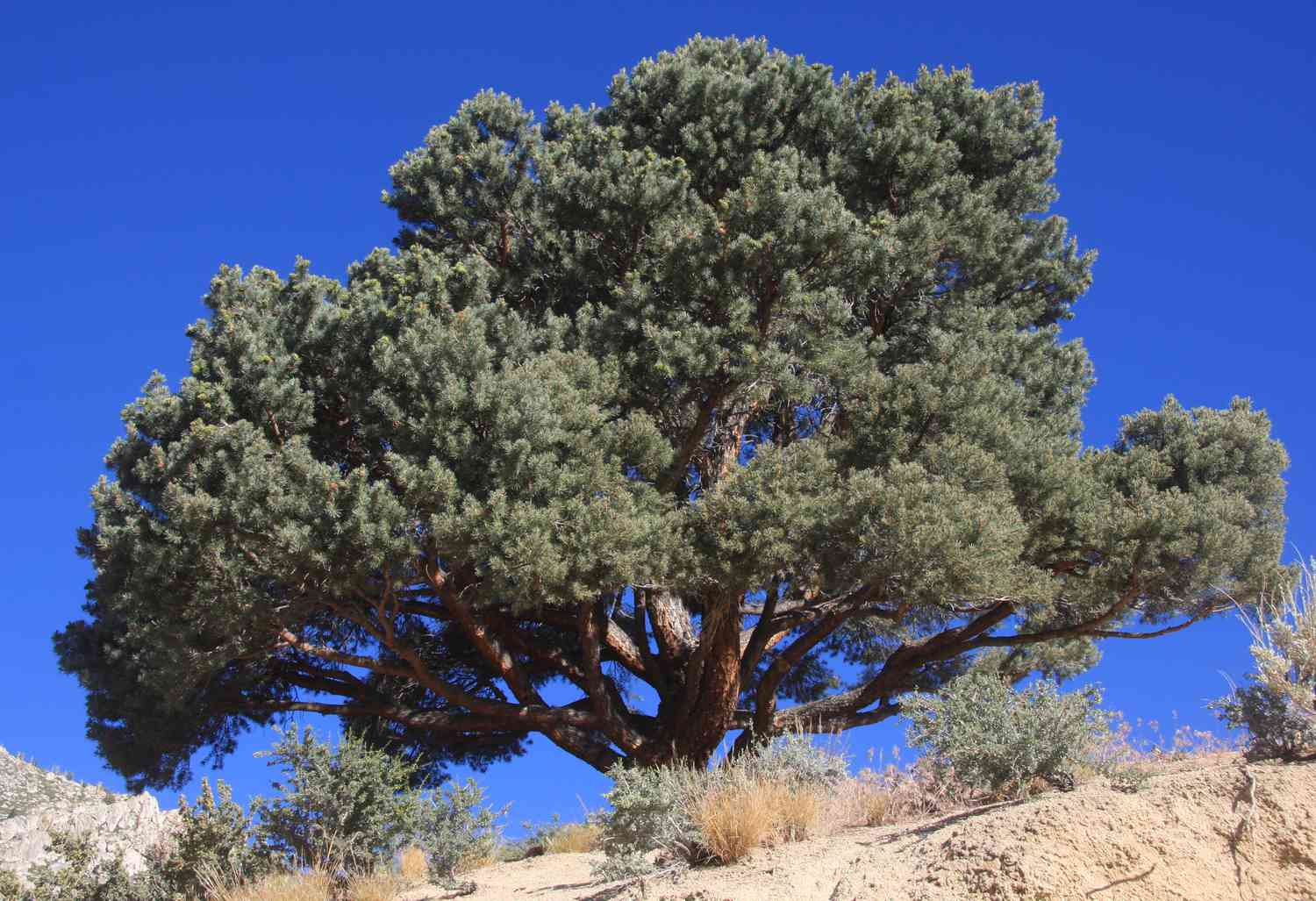
Pinyon Pine Tree
To the Saltfolk, the pinyon pine tree is far more precious than just the sustenance it provides—they are tangible fragments of the lost world, whispered echoes of abundance that seem almost mythical in their harsh reality of salt and scarcity.
One of the most wonderful delicacies for the Saltfolk are its small, cream-coloured pinyon nuts. Pinyon pines are found only on the dangerous periphery of Espera's territory, where the salt flats give way to higher ground and scattered pinyon pines cling to rocky outcroppings. The trees themselves are revered with a sense of lingering wariness, as they grow in the borderlands where The Verdancy might one day reach, making every harvest expedition a calculated risk between the settlement's desire and survival.
The pinyon nuts carry an almost sacred weight in Saltfolk culture. Unlike their usual diet of insects, cactus, and preserved meats, pinyon nuts have a rich, buttery sweetness that seems impossible in their world of harsh flavours and coarse textures. When Maelle Corvain folds them into her rare cookies, she takes one of the desert's most generous gifts and elevates it into something that mirrors the luxuries of the Old World.
The Saltfolk see pinyon nuts as memory seeds, carrying within their shells the ghost-taste of Christmas mornings and abundance festivals that exist now only in the stories of elders. Each nut becomes a small communion with a gentler past, a reminder that the world once offered sweetness freely rather than demanding endurance for every calorie. The very act of cracking open the shell becomes ritualistic—a moment of anticipation before experiencing a flavour that connects them to their ancestors who knew abundance.
They are rationed like precious medicine, often saved for moments of deepest despair or highest celebration. Mothers hide small caches of pinyon nuts to comfort a sick child, and the community shares a handful during union ceremonies to symbolize the hope that love, like these nuts, can somehow flourish even in the harshest conditions. The nuts represent the Saltfolk's complicated relationship with nature—proof that the desert, while demanding, can still surprise them with rare moments of generosity.
In their mythology, pinyon nuts are described as tears of the Salt Mother; crystallized moments of her brief compassion in an otherwise unforgiving existence. They embody the paradox at the heart of Espera's survival: that true luxury lies not in abundance, but in the fleeting, precious taste of something sweet in a world that has forgotten sweetness.
Additional Information
Uses, Products & Exploitation
The Pinyon Pine is a resource of immense, almost legendary, value to Espera. However, unlike the Honey Mesquite Tree found on the valley floor, the Pinyon Pine is a tree of the "high country." It does not grow anywhere near The Badwater Basin.
To utilize it, the Saltfolk have to undertake a major, organized seasonal expedition—a "Piñonada"—migrating from the extreme heat of the lowlands up into the cooler, higher elevations of the Panamint Mountains or Grapevine Mountains. This annual journey occurs in the late summer and early autumn, and is critical for their long-term survival.
Pine Nuts (Pinyon Nuts)
This is the entire purpose of their expedition. Pinyon nuts are one of the most calorie-dense and nutritionally perfect foods in the desert, packed with fat, protein, and essential minerals. They are Espera 's primary source of fat and protein for the winter.
The harvest is timed for late August through October, when the cones ripen, and the Saltfolk work to gather the sticky cones. They are harvested directly from the trees and gathered from the ground. The sealed cones are roasted in the embers of a fire. The heat causes the cone scales to open up, allowing the small, hard-shelled nuts to be shaken out and collected.
The nuts can be eaten raw, but are more often roasted to improve their flavour and shelf life. For the winter, they are stored in their shells in pottery or baskets. They are also ground into a rich, oily paste or Pinyon Nut Butter—a nutrient-dense superfood that is easily transported back to Espera.
Pine Pitch (Sap/Resin)
The sticky, amber-coloured pitch that seeps from any injury to the tree is a priceless multi-tool, and is carefully collected whenever it is found.
Waterproof Adhesive
When heated, pine pitch is a powerful, waterproof glue. Its primary use is for hafting—attaching stone points to spear and arrow shafts. It is also used to repair cracked pottery and seal woven water baskets, making them waterproof.
Medicinal Salve
Pine pitch has natural antiseptic and anti-fungal properties. It is applied directly to cuts, burns, and wounds as a protective, medicinal sealant that keeps out dirt and prevents infection.
Fire Starter
A small piece of hardened pitch is highly flammable. It is an invaluable fire starter, capable of igniting even when other tinder is damp.
Wood and Needles
While living at the high-altitude camp during the Piñonada, the rest of the tree provides for the Saltfolk's immediate needs.
Firewood
Pinyon wood is an excellent fuel that burns hot and produces a distinct, aromatic smoke. It is the primary source of fuel for cooking, roasting the cones, and staying warm during the cool mountain nights.
Tools and Shelter
The wood, though often twisted, is used for tool handles, digging sticks, and the framework for temporary shelters at the piñon camp.
Pine Needle Tea
The green needles are steeped in hot water to create a tea that is extremely rich in Vitamin C. This is a crucial medicine to prevent scurvy and other illnesses, especially during the winter months.
Bedding and Tinder
A thick mat of dry pine needles provides a comfortable and insulating bed on the hard ground. They also serve as excellent, readily available tinder for starting fires.

Comments