
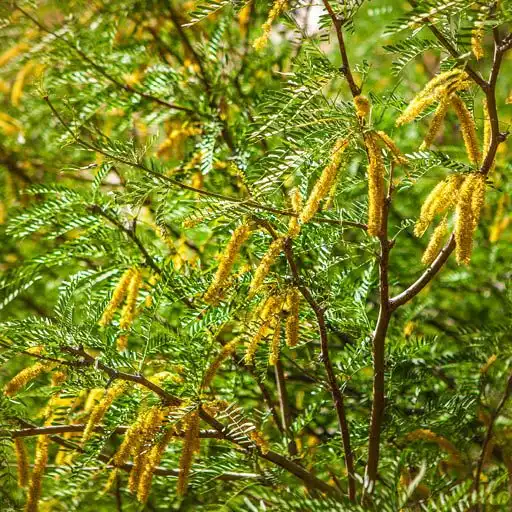
Honey Mesquite Tree
Saltfolk view the Honey Mesquite (Prosopis glandulosa) as a true life-giving resource, arguably the single most important plant for their survival. It is a primary source of food, fuel, medicine, and raw materials. Every part of the tree is used, and its seasonal rhythms dictate Espera's calendar.
Mesquite trees are found in the washes and alluvial fans with subsurface water, like those near Furnace Creek, away from the sterile salt flats of The Badwater Basin.
Additional Information
Uses, Products & Exploitation
Food Source
The most valuable resource from the mesquite is its long seed pods. These pods are surprisingly sweet and highly nutritious, packed with protein, fibre, and carbohydrates.
Flour (Pinole)
The main activity in late summer and early fall for the Saltfolk is the mesquite harvest. The brittle, dry pods would be collected in massive quantities. They then pound and grind the pods—using stone mortars and pestles—into a fine, sweet, and nutty flour known as pinole. This flour is the settlement's staple carbohydrate, the equivalent of wheat or corn.
- Gruel/Porridge: Mixed with precious water, pinole forms a nutritious and filling gruel.
- Baking: The flour is mixed with a little bit of water to form a dense dough, which is shaped into cakes or flatbreads and baked on hot, flat stones raked from a fire.
- Long-Term Storage: Properly dried and stored, mesquite flour is the Saltfolk's primary food source to last through the winter and spring.
- Sweetener: The sweetness of the pods comes from sucrose. The flour is also used to sweeten other foods or to create a sweet, energy-rich drink when mixed with water.
Cooking and Warmth
In the sparse desert, wood is a precious commodity. Mesquite wood is a superior fuel source for the
Firewood
Mesquite is a dense hardwood that burns very hot and slow, making it an efficient fuel for cooking and providing warmth during the surprisingly cold desert nights. Its slow-burning nature means less wood needs to be gathered.
Flavouring
The smoke from mesquite wood is excellent for smoking and preserving meat from any trapped game (like rabbits or rodents), imparting a distinct flavour and helping it last longer.
Medicine and Tools
Beyond food and fire, the tree has become Espera's hardware store and pharmacy.
Black Gum/Sap
The dark amber sap that oozes from the bark is a critical multi-tool. It is used as a strong, waterproof glue to attach stone points to arrow and spear shafts, repairing pottery, and sealing water containers. The gum also has antiseptic properties. It is dissolved in water to make an eyewash for infections, or applied directly to wounds as a protective sealant to prevent infections.
Wood
The hard, durable wood from the Honey Mesquite is ideal for making digging sticks (essential for finding roots or digging fire pits), tool handles, and throwing sticks (rabbit sticks) for hunting small game. While large timbers are rare to find, the sturdy branches are used as posts and beams for building small, durable shelters and reinforcing existing structures.
Bark
The inner bark contains tough fibres that are processed and twisted into cordage or string for snares, nets, and binding.
Leaves
The leaves are steeped in hot water to create Honey Mesquite Tea, a medicinal tea that is used to treat stomach ailments and fevers.
Geographic Origin and Distribution
Furnace Creek Area
Approximately 13 miles north of The Badwater Basin. This is the primary oasis in Death Valley and the most likely place to find substantial groves of Honey Mesquite. The mesquite trees thrive here because the same geological faults that bring water to the surface for the springs at Furnace Creek also provide accessible groundwater for the deep-tapping roots of the mesquite. They are concentrated in the Furnace Creek Wash and surrounding alluvial fans.
Nearby Washes and Canyons
In the immediate vicinity of Espera, Saltfolk also look to the mouths of the canyons cutting into the mountains on either side of the valley for groves of mesquite trees. The closest locations are in the alluvial fans at the mouth of Natural Bridge Canyon and Golden Canyon, which are much closer than Furnace Creek. However, the groves here are significantly smaller, sparser, and less reliable than the major groves near the Furnace Creek oasis. Saltfolk investigate these areas first due to proximity, but the main, life-sustaining resource is further north.

Comments