

Yasimato
Yasimato lies on the southwestern coast of Rabirimyaku, where the mountains descend toward the sea. The city is built upon the mountain’s lower slopes, half earth, half stone, and looks out over the long shores that surround it. To the north the hill rise steep, to the south lie beaches. The sea serves as both border and lifeline, a silent ally that feeds the Hoi but seldom welcomes strangers.
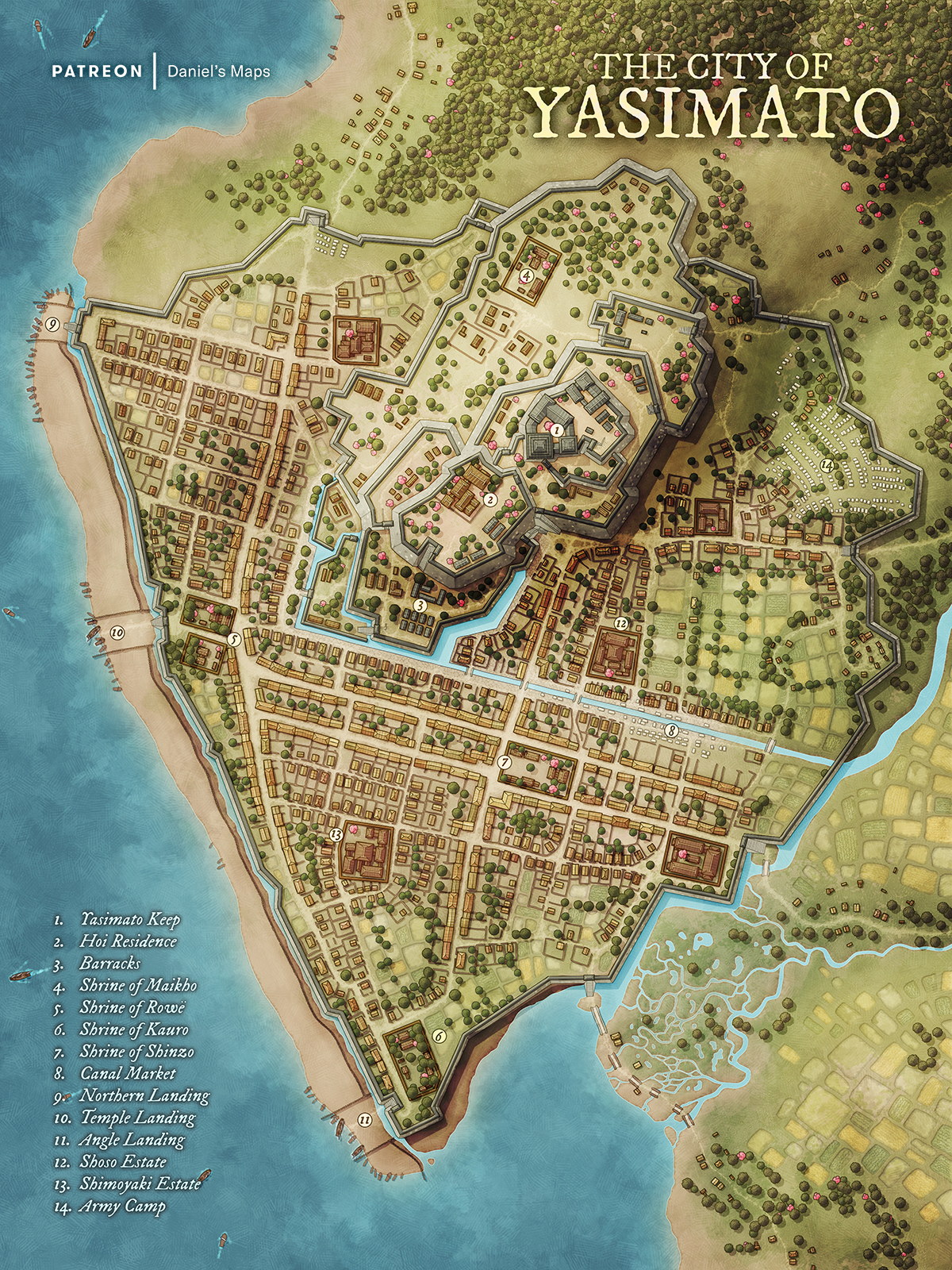
The city has roughly ten thousand inhabitants and is entirely walled. To the west and south the walls follow the coast, while the north and east close against the hills. A river runs along the city’s eastern side, flowing down from the mountains and winding along the foot of the wall before spilling into a marsh near the southern gate. There, rice paddies and wooden bridges mark the road to the lowlands. The river serves as a natural moat and from the castle hill its course can be seen in full.
The northern side of the city is dominated by the castle complex. Yasimato Keep, a tall white tower with dark green roofs, overlooks both the sea and city. The keep forms the core of the Hoi Clan stronghold, built in multiple layers, each surrounded by walls and gates that are only opened together during ceremonies. On a lower tier are the barracks of the garrison; guarding the entrance to the residence of the Hoi daimyō, a restrained palace of courtyards and gardens. In the upper northern court rests the Shrine of Maikho, a small sanctuary of basalt and silver, tended by monks who honor the old God and mountain spirits.
Around the castle, the city spreads in a clear balance between order and growth. In the south and west run straight streets, lined with wooden houses, plastered walls, and small courtyards. Craftsmen, lesser samurai, and fishing families live here. Beyond the western wall lies the shore, where three walled landings connect the city to the sea: Northern Landing, the northern gate for supplies; Temple Landing, where pilgrims and priests arrive at the temples; and Angle Landing, named for the angled stretch of wall that follows the coastline there.
The eastern side of Yasimato is less disciplined. Organic paths wind between rice fields and scattered homes. In times of unrest this area serves as a military camp; today part of the Hoi army still resides here in tents, ready to move out at short notice.
The city holds several walled temples and estates. The most important is the Shrine of Rowë, dedicated to the goddess of storms and change, who represents the wind that shields the mountains and tames the sea. To the south is the Shrine of Kauro, goddess of the sea and secrets, where fishermen make offerings before every voyage. In the central districts is the Shrine of Shinzo, god of mountains and wisdom, whose priests oversee the maintenance of the mountain roads and bridges.
Along the river lies the Canal Market, the commercial heart of Yasimato. Stalls line both sides of the channel that leads toward the castle. The market is guarded by samurai of the Shoso family, an old house once responsible for the river toll. Their residence stands nearby, behind a wall of dark stone. Still more powerful is the Shimoyaki family, whose estates govern most of the eastern paddies.
The atmosphere in Yasimato is one of restraint and routine. Every district has its own bell tower and guard post. At night the city is lit by oil lamps along the walls, and the sound of the sea carries everywhere. Beyond the gates, the land grows quiet and damp, with forests descending all the way to the coast.
The Hoi call Yasimato The City of Mountain and Sea. Its walls are thick, yet not meant to shut out trade. They protect the silence that defines the clan. In the Seven Clans Period, Yasimato remains a rare place of stability. The wars of the south have not touched it. Its power lies not in conquest but in composure. Where other clans march and struggle for influence, Yasimato, silent and steadfast, watches over the mountain passes of Rabirimyaku.
Maps
-
Yasimato


Comments