

Eastern Maikhohoto
The Maikhohoto Sai is a wide, tranquil inland sea forming the heart of Eastern Maikhohoto. Two narrow straits connect it to the outer ocean. The Sai is the center of trade and power; whoever controls its coasts, harbors, and sailing routes commands the fate of the eastern clans.
During the centuries of the Molisihu Shogunate, this was the best-governed region of the realm. For generations, the emperor, the court, and the shogunate shared a fragile but effective balance of power. That changed after the Maikhohan War: the sea ceased to be a unifying artery and instead became the border between emerging provincial powers. The reconstruction of the capital never fully took hold, and the provinces around the Maikhohoto Sai developed into semi-independent domains, each with its own laws and armies.
To the north lies Rabirimyaku, the Labyrinth Mountains, a long ridge rising steeply above the sea. The island is rugged and sheer, cut by narrow valleys and short rivers that empty directly into the water. The Hoi Clan rules from the southern coast, while temples and small pass-towns cling to the mountain roads. Among the rulers of Rabirimyaku there exists an unspoken agreement, that the passes must always be tended with care. No one neglects this duty. In the mountains, honor is measured by the roads one clears. Pilgrims and messengers find rest in hospices along the steep stairway routes. The Hoi are known for their discipline and restraint. During the Maikhohan War, the Hoi remained officially neutral, but their mountain passes were the only safe crossings between the northern and southern armies. This role as indispensable intermediaries granted them lasting authority. In the Era of the Seven Clans, they act chiefly as keepers of order and guardians of the routes that bind the realm together.
Along the southern coast stretch the hills and lava fields of Dorakuro, domain of the Ihto and Hai-To Clans. The land is rich in iron and basalt. Here arose the great smithing guilds that supply the realm with weapons, tools, and armor, all overseen by the Ishi-no-ko, the Stone Children. The coastline is lined with small harbor towns, each with its own forge and bell tower. The Ihto govern the western reaches of Dorakuro. They are proud warriors, stoic, loyal, and bound by honor. Their allegiance to the Molisihu Shogunate during the civil war earned them considerable privileges, but the destruction of Maikhosato left their role ambiguous. They remain the official weaponsmiths of the shogunate, yet in practice have grown ever more independent. In the Era of the Seven Clans, the Ihto defend their influence with steel and discipline. Their harbors are regarded as neutral ground, where even rivals may meet without fear of reprisal.
The Hai-To Clan rules the eastern coasts and harbors, their domain stretching toward Ritorubei, the Broken Bay. The Hai-To control all tolls along the trade routes. Instead of paper treaties, they use lighthouses and torch codes: a single extra flame upon a cape can halt an entire fleet. Merchant ships may sail only during sanctioned moon windows; those who depart outside these days pay double tithes or risk confiscation. The Hai-To command swift coastal fleets and hunt pirates with the same ease with which they enforce trade. Their power rests upon logistics, for those who control the beacon lights, control who sails. Their role in the Maikhohan War, as allies of The Makhoren, granted them religious prestige, which they later turned into economic dominance. In the Era of the Seven Clans, they are undisputed masters of the sea, yet their tolls and control of the convoys bring constant conflict with the Mersoto and Ihto interests inland.
Between sea and mountain stretches Seichi, the Holy Heart, the broad plain where the rivers of eastern Maikhohoto converge. Rice fields, canal roads, and shrines fill the landscape. Here stand Maikhosato, the imperial capital, and Samukura, the fortress city of the shogun. Seichi is the administrative heart of the realm. The Makhoren oversee the rites, the Mersoto Clan enforces authority, and the Molisihu Shogunate struggles to maintain its influence through the army. The scars of the Maikhohan War remain visible: burned districts, abandoned temples, and canal embankments that once served as front lines. Since 1227, Seichi has ceased to function as a single administrative province, becoming instead a patchwork of competing domains. The shōgun still resides in Samukura, but his decrees are obeyed only when they serve local interests.
Maikhosato is a city of processions and great streets. Its broad avenues radiate from two central structures, the Imperial Palace, residence of the Emperor of Maikhohoto, and the Imperial Temple, holiest seat of the Makhoren. After years of war, however, Maikhosato lies in ruin, surviving only as a symbol of power.
The Makhoren dwell at the imperial court of Maikhosato and hold dominion over time, ritual, and legitimacy. They set the calendar, guard the genealogies, and bless every new government. They have no army, yet their approval remains indispensable, without their sanction, no decree is lawful. Their neutrality is fragile, and any alliance that grows too bold threatens their authority. The Makhoren abhor open warfare but wage a quiet battle through sanctions and ritual vetoes. A single declaration of disharmony can halt a campaign or delay a coronation. In the aftermath of the war, however, they lost much temple land to the Mersoto. What remains is largely prestige. They still preside over calendars and coronations, but their sacred role is increasingly ignored by the provinces.
To the west of Maikhosato lies Samukura, the last fortress city of the shogunate. The citadel rises above the river, encircled by many walls. The city houses the army headquarters, weapon arsenals, and the court of the shugo lords. In peacetime, Samukura survives by selling order and discipline, strict laws, well-kept roads, and safety for those who can pay. In wartime, the city seeks favor from the temples, purchasing divine sanction to justify its campaigns. Its rulers understand well: power without blessing is brittle. Today, the city is more garrison than government. The shōgun, now lacking any sort of support, holds court there out of tradition, but his commands rarely reach beyond the city walls.
From Kashuto, their capital on the border of Ritorubei and Kanpaigan, the Mersoto Clan has built a religious authority in Seichi that increasingly resembles worldly rule. Once temple wardens, they now control much of the plain, the granaries, and most of the great temples. Their influence grows at the expense of both the Makhoren and the shōgun. They craft their own policies, decide which Arcane Seals are valid, and command the strongest army in Seichi. During the Era of the Seven Clans, Mersoto has become the most powerful among them. Their soldiers guard the trade routes, their seals regulate nearly all production across Seichi, and their court in Kashuto now serves as the realm’s de facto administrative center. What they approve becomes law; what they reject loses its sanctity.
Rice, salt, and iron are the pillars of the economy. Rice flows to the granaries of Seichi and the capital; iron is exported from Dorakuro and forged in Maikhosato; salt and fish from Ritorubei feed the cities. All are governed by the system of Arcane Seals, ritual licenses that regulate production and trade. A magical seal grants blessing, but also control: excessive use leads to dilution, when rituals fail and merchants are blamed for spreading disharmony.
Since the fall of the shogunate, Arcane Seals are no longer issued from a central authority. Each clan now maintains its own variant, making trade cumbersome but multiplying political leverage. A seal has become as much a coin as a blessing.
Even so, the land has not succumbed to cynicism. The rituals of the seal-bearers still hold real power, they bless the harvests, make the roads safe, and drive monsters back into the wilderness.
The people of eastern Maikhohoto live in rhythm with the land. In the mountains, honor is measured in cleared passes; in Dorakuro, in finely forged steel; in Ritorubei, in the alignment of the coastal lights. In Seichi, all depends upon the balance between ceremony and rule. Those who move too swiftly disrupt the rhythm by which the realm has breathed for centuries.
Yet beneath that rhythm stirs unrest: the seven clans stand in fragile balance. Each commands its own army, seal system, and creed. The sea remains the lifeline of trade, and the border of their ambition. Here, upon the shores of the Maikhohoto Sai, the realm will either come together… or fall apart.
Maps
-
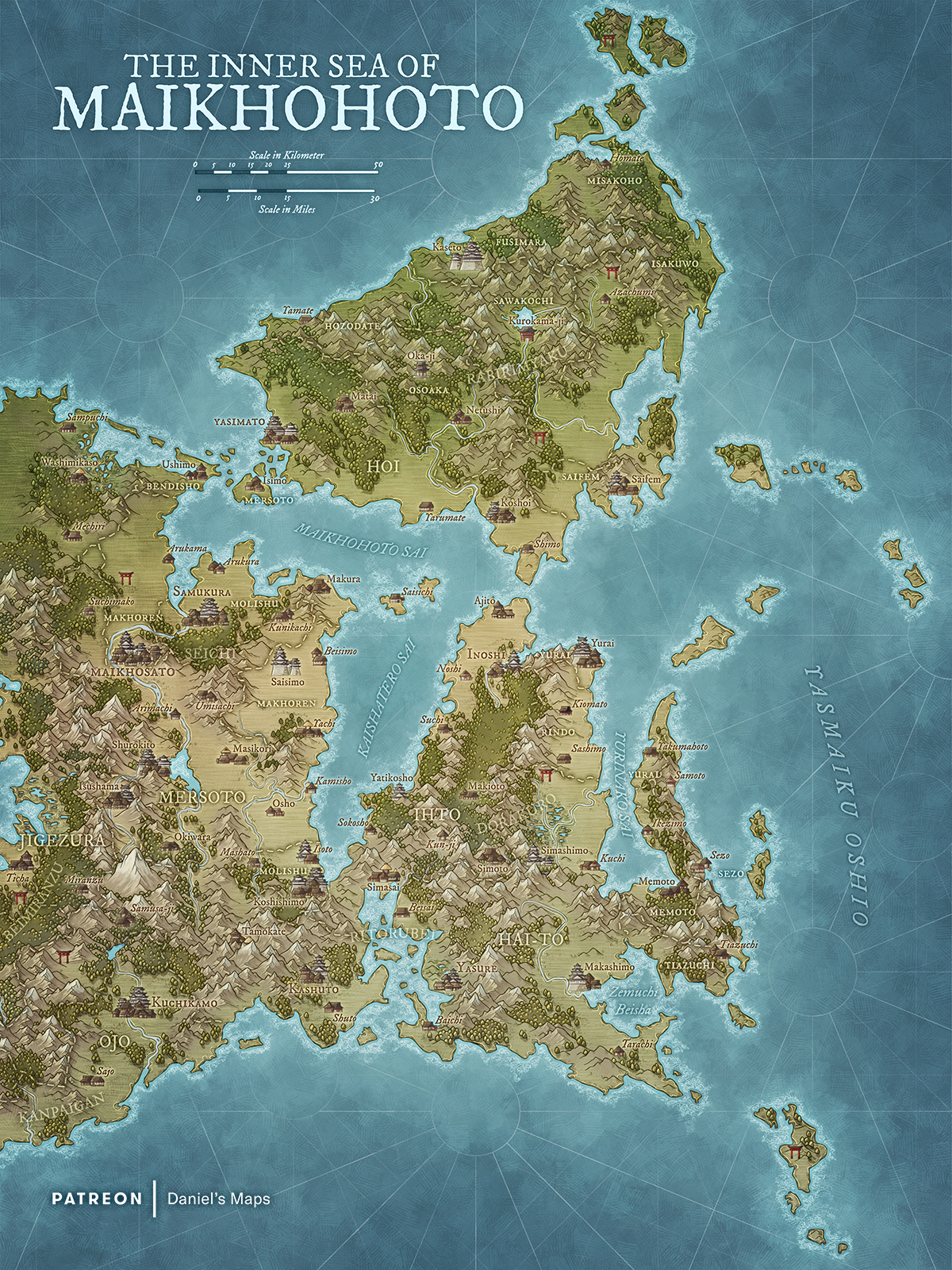
Eastern Maikhohoto
Type
Region
Location under
Included Locations
Included Organizations


Comments