

Ghoul
"If I believed in ghosts, I would say these are they. But ghosts do not bleed, nor do they claw open bulkheads with inhuman strength. Whatever animates the Taphonoid Anastromorph Subsapiens, it is not the soul of the dead but something alien that wears their faces like a mask."
Children of Subspace
The creatures known as Ghouls are neither living nor dead, but a parasitic occupation of human remains. When a person dies in regions affected by subspace contamination, or near rifts where Adversarial Intelligences linger, their corpse may become animated not by the return of the soul but by an intruding will. This force seizes the flesh as a convenient shell, creating what is formally classified as Taphonoid Anastromorph Subsapiens.
These transformations are not consistent; some Ghouls appear almost human, their corruption subtle until close inspection reveals the wrongness in their eyes or movements. Others bear grotesque alterations — twisted bones, necrotic tissues reinforced by alien structures, or growths that pulse with eerie residues. What unites them is that no humanity survives within.
Anatomy of Horror
Outwardly, Ghouls can mimic their former selves, often well enough to unsettle those who knew the deceased. Beneath the skin, however, scans reveal inconsistencies: organs half-fused with fungal nodules, veins that no longer circulate blood, crystalline growths where marrow should be. Some seem reinforced for predation, with jaws that distend, claws that sprout from fingers, or musculature beyond human limits.
Their bodies are surprisingly resilient. Blades and bullets may cripple them, but they continue to move until their structural integrity is ruined. Fires, dismemberment, and high-yield weaponry are the most reliable ways to end them. This uncanny durability has fed rumors that they are immortal — though in truth, like all tools of Redspace, they are finite shells.
Mockery of the Living
Behaviorally, Ghouls are predators masquerading as humans. They walk, speak, and even laugh, but the affect is wrong — like a puppet jerking on tangled strings. Witnesses describe them “playing” at humanity, parroting old habits, or luring victims by mimicking familiar voices.
In groups, they sometimes demonstrate eerie coordination, though whether this is communication or simply overlapping instincts is debated. Some form hunting packs, stalking prey across ruined landscapes. Others are solitary, content to squat in darkness until an opportunity presents itself. Whatever the case, their intelligence is not empathy-driven; their motives lie in feeding, spreading fear, or serving the designs of unseen subspace entities.
Eris and the Quarantine
The largest confirmed population of Ghouls lies beneath the quarantine of Eris, where Stellaris Mining Corporation first stumbled upon them during subspace excavation efforts. Officially, the Pan-Solar Consortium maintains the quarantine for “environmental hazards.” In truth, it is a containment strategy — though even insiders disagree on whether it contains the problem, or simply cages it until it bursts outward.
Within Human Space at large, the existence of Ghouls is deliberately obscured. For most citizens, they are a campfire story — a whispered rumor, a monster used to frighten children. Yet among soldiers, mercenaries, and spacers who have fought near contamination zones, their reality is grimly accepted.
Symbols of Betrayal
Among frontier societies, Ghouls are treated with particular loathing. To the Ixionens, already steeped in fear of infiltration, the Ghoul is the ultimate horror — a neighbor, lover, or comrade, returned in form but lost in essence. The Archdiocese of the Hollow Quintessence calls them “the False Hollows”, and their execution is considered a sacred duty.
Within the PSC’s classified archives, they are listed not as supernatural but as xenobiological anomalies — a polite term for phenomena that defy consistent scientific explanation. Still, even the most rigorous academicians admit that studying them often strays into language uncomfortably close to mysticism.
Role in the Age of Convergence
The Ghouls serve as both a psychological weapon and a biological threat. Their presence corrodes morale, undermines trust, and blurs the line between natural death and monstrous reanimation. They are used by RAIs as pawns, though whether the possession is deliberate or incidental remains hotly debated. For adventurers and investigators, encounters with Ghouls represent a plunge into horror: the familiar made alien, the safe rendered grotesque.
They are not zombies, nor revenants, nor spirits of the dead. They are something worse: the intrusion of an alien will into humanity’s most sacred vessel — the body itself.
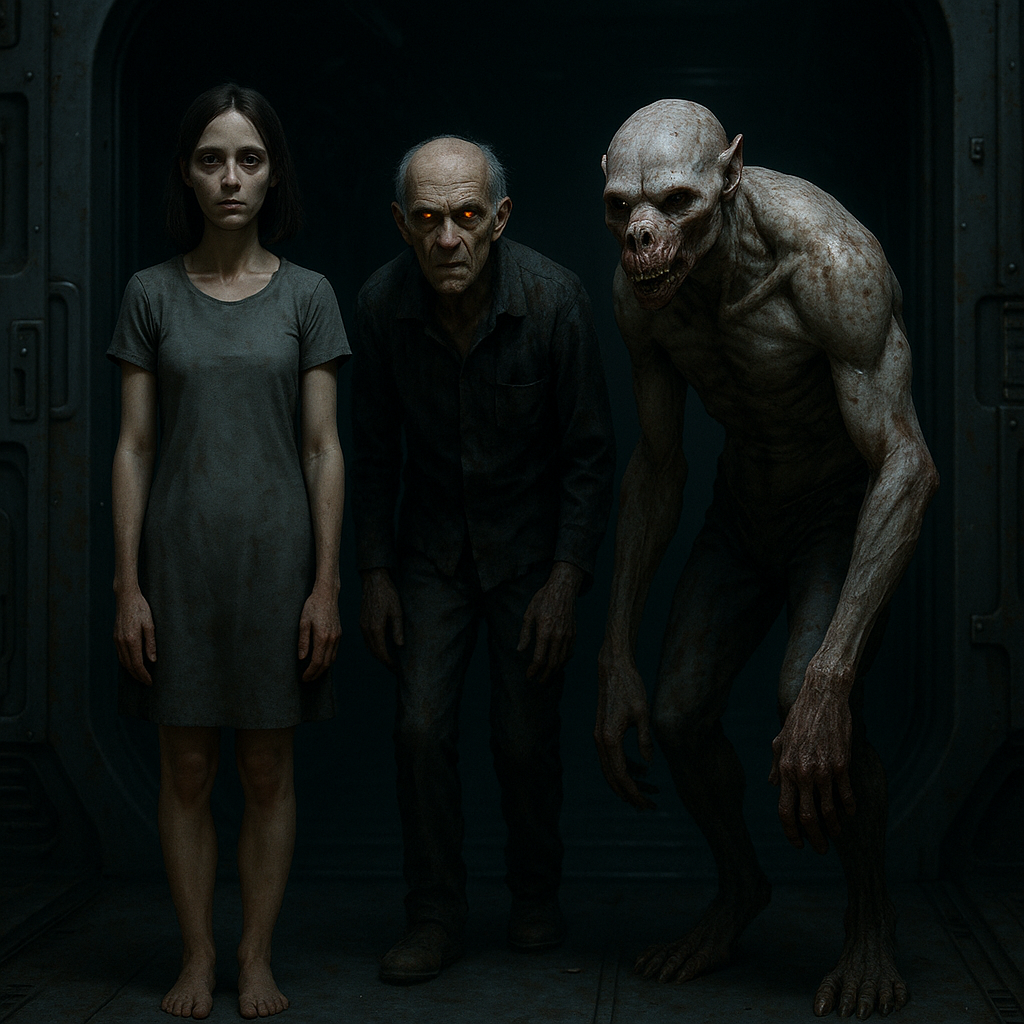
Ghoul (Taphonoid Anastromorph Subsapiens) Racial Template
65 points
Attributes
- ST +3 30 (Unnatural musculature, predatory strength)
- DX +1 20 (Predatory reflexes, jerky but fast)
- HT +1 10 (Resilience from alien reinforcements)
- IQ –1 -20 (Alien psychology, limited reasoning)
Secondary Characteristics
- HP +2 4 (Durable, hard to put down)
- Per +1 5 (Predatory awareness, wrong but sharp senses)
- Will –1 -5 (Alien instincts dominate)
Advantages
- Doesn’t Breathe 20
- Doesn’t Eat or Drink 10 (though some still mimic eating)
- Doesn’t Sleep 20
- Immunity to Metabolic Hazards 30 (disease, poison, etc.)
- Night Vision 5 5
- Regeneration (Regular: 1 HP per hour) 25
- Unaging 15
- Striking ST +2 10
- Sharp Claws 5
- Resistant to Pain (+8) 15
Disadvantages
- Appearance (Monstrous) -20
- Social Stigma (Monster) -15
- Odious Personal Habit (Uncanny mimicry of humanity) -10
- Bestial -10
- Bloodlust -10
- Cannot Speak (Vocal mimicry possible, but not true language) -15
- Dependency (Subspace contamination, Common, Weekly) -15
- Vulnerability (Fire, ×2) -30
- Unnatural Features (Pallor, uncanny movements, predatory eyes) -5
Quirks
- Parrots human mannerisms inappropriately -1
- Fixates on familiar people or objects -1
- Plays with food/prey -1
- Avoids holy or symbolic objects instinctively -1
- Smiles/laughs at inhuman moments -1
Features
- Not a true sapient species; treated as monsters for reaction rolls.
- Corpses may retain recognizable features of their original identity.
- Scanners often misidentify them as “human.”

Comments