
Wren
The Horned Warden Wren
Wren is one of the few acknowledged children of Thalor, the Lord of Beasts, sired not from conquest or divine whim, but from necessity. His mother — a dryad bound to one of the oldest groves in the region — conceived him during a period of deep ecological instability. The land was failing, predators dying off, prey overbreeding, and the forest thinning from stress. Thalor’s presence in the grove was not ceremonial; it was intervention.
Wren was the result. Unlike many demigods or god-touched beings, Wren is not burdened with grandeur, he is rooted, in earth, instinct, and woodland memory. His title is not royal or divine, but practical: The Horned Warden. Those who live in or near his forest know him well. Hunters leave offerings, druids seek him out for counsel, travel-families crossing woodland paths speak his name with a mix of respect and caution. Children raised in nearby villages are taught what signs mean “Wren is watching” — and why that is usually a good thing. He is not a recluse, but he is not tame. He approaches when he chooses. He leaves without explanation. And when imbalance threatens the land, he acts with decisive, brutal efficiency that reminds everyone exactly whose blood runs in him.
Wren was the result. Unlike many demigods or god-touched beings, Wren is not burdened with grandeur, he is rooted, in earth, instinct, and woodland memory. His title is not royal or divine, but practical: The Horned Warden. Those who live in or near his forest know him well. Hunters leave offerings, druids seek him out for counsel, travel-families crossing woodland paths speak his name with a mix of respect and caution. Children raised in nearby villages are taught what signs mean “Wren is watching” — and why that is usually a good thing. He is not a recluse, but he is not tame. He approaches when he chooses. He leaves without explanation. And when imbalance threatens the land, he acts with decisive, brutal efficiency that reminds everyone exactly whose blood runs in him.
Physical Description
General Physical Condition
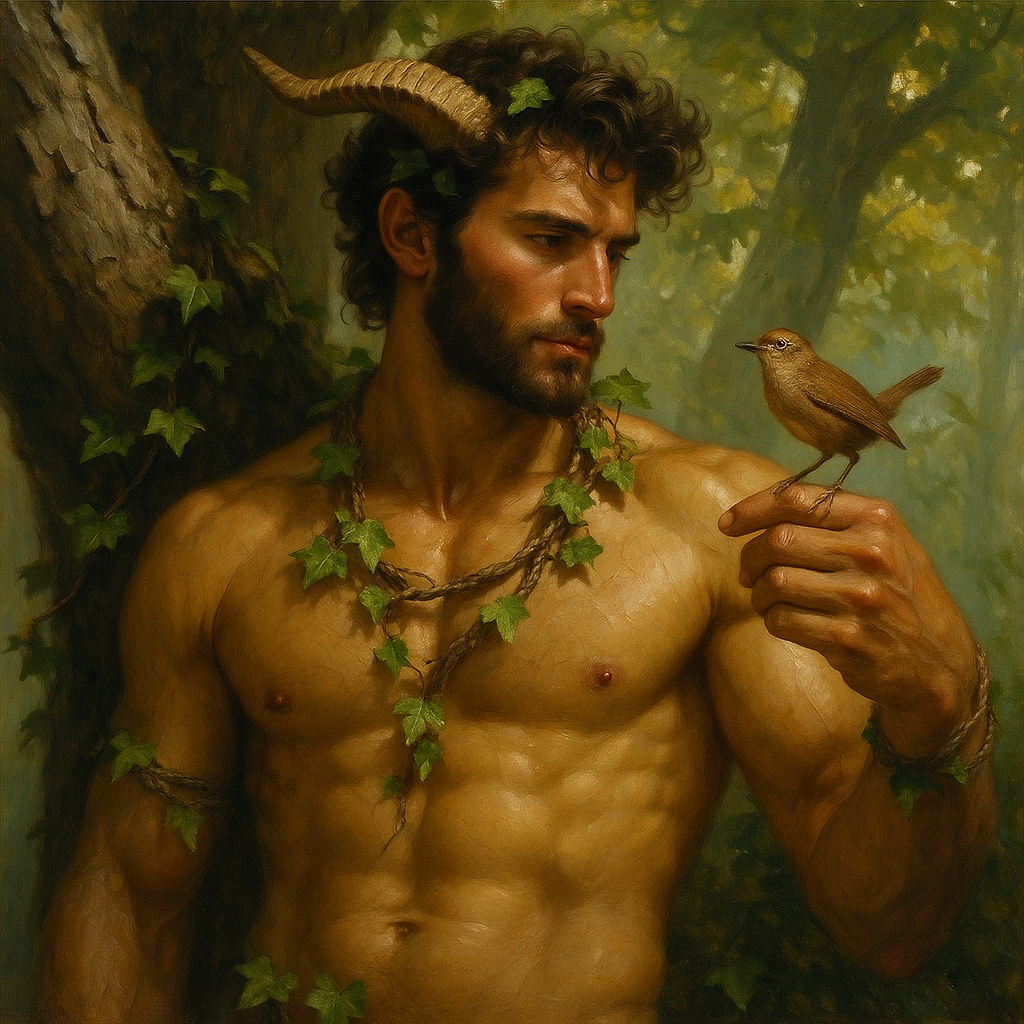
Wren’s body reflects the raw, untamed strength of the wilds. He is lean and powerfully built, with the durable musculature of a predator rather than a soldier. His movements are quick, fluid, and grounded in instinct, giving the impression that every motion is effortless and entirely natural. His stamina is exceptional, allowing him to run, climb, or fight for long periods without clear fatigue. Despite the roughness of his lifestyle, his physical form shows no signs of malnourishment or hardship; the forest sustains him just as he sustains it. Even when still, there is a tension beneath his skin — a coiled readiness suggesting that he could burst into motion at any moment, as though the pulse of the wild itself beats through his veins.
Identifying Characteristics
Special abilities
As a direct son of Thalor, Wren possesses abilities that blur the line between mortal and primal spirit. His presence alone stirs the forest; plants bend subtly toward him, vines loosen their grip around his path, and small creatures approach without fear. Though he is not a godling in the traditional sense, Wren carries a sliver of Thalor’s essence, expressing itself through instinct rather than conscious spellcasting. His most notable gift is an innate communion with wildlife. Birds, especially wrens, often perch on him without hesitation, and he can sense the emotional currents of nearby animals as clearly as changes in the wind. This connection allows him to calm aggressive beasts, read the forest’s moods, and track disturbances long before others are aware of them.
Wren’s physical abilities are similarly influenced by his lineage. His strength and endurance exceed those of most mortals, and his movements carry the fluid precision of a predator born rather than trained. When threatened, the wild magic in his blood can momentarily heighten these traits, sharpening his reflexes and granting an uncanny awareness of his surroundings. The ivy that naturally entwines his skin is more than decoration; in moments of heightened emotion, it responds to him like living armor, shifting or tightening to shield him or warn him of danger.
Perhaps the rarest and most subtle of his abilities is his resonance with the life cycle itself. Wren can sense the vitality of plants and living creatures, distinguishing health from decay with a touch or even a glance. Though he cannot heal with a gesture, the land around him recovers more quickly, as though encouraged by his presence. In sacred groves tied strongly to Thalor, this effect becomes more pronounced, and Wren can coax new growth from wounded earth or soothe a dying creature into peaceful rest. These abilities are instinctual rather than studied, shaped entirely by his nature — the raw, untamed inheritance of the Father of Beasts.
The wild takes only what it must. Mortals could stand to learn the same.
Mental characteristics
Personal history
Wren’s origins are rooted deep in the heart of an ancient forest where the boundary between the mortal world and the wild divine runs thin. His mother, a dryad bound to one of the oldest trees in the region, encountered Thalor during a rare convergence of seasonal energies. The god’s passing presence ignited the grove with predatory vitality, and from that union, Wren was conceived — a child shaped as much by wilderness as by flesh and bone. Unlike full dryads, he was not anchored to a single tree, and unlike mortals, he grew quickly into his physical prime, his body settling into the form of a man long before his mind had caught up. The forest raised him in its own way, teaching him survival, instinct, and the quiet rules of natural balance.
In his youth, Wren wandered without understanding what he was. Animals treated him as kin, and druidic circles whispered about a wildborn child who moved like a spirit and fought like a cornered beast. It was only when he reached adolescence that he felt the first pull of Thalor’s influence — a restless hunger to understand the cycle of predator and prey, life and death, and the place he held within it. His mother could offer little guidance beyond her love and the lessons of patience and growth. She could not explain the divine blood in his veins, nor the weight of expectations that came from being born of a god. So Wren sought those answers alone.
His early encounters with mortals were brief and awkward. Hunters would see him at the edge of their camps, watching silently. Loggers swore the trees shifted when he approached. Children left offerings of berries or carved animals after hearing rumors of the “Green Shadow” who warded the woods. Over time, stories of him spread across nearby settlements — not as a monster, but as a presence, a guardian, or sometimes a warning. Wren never asked for reverence or fear; he rarely spoke at all to those outside the forest. But word traveled faster than he ever intended.
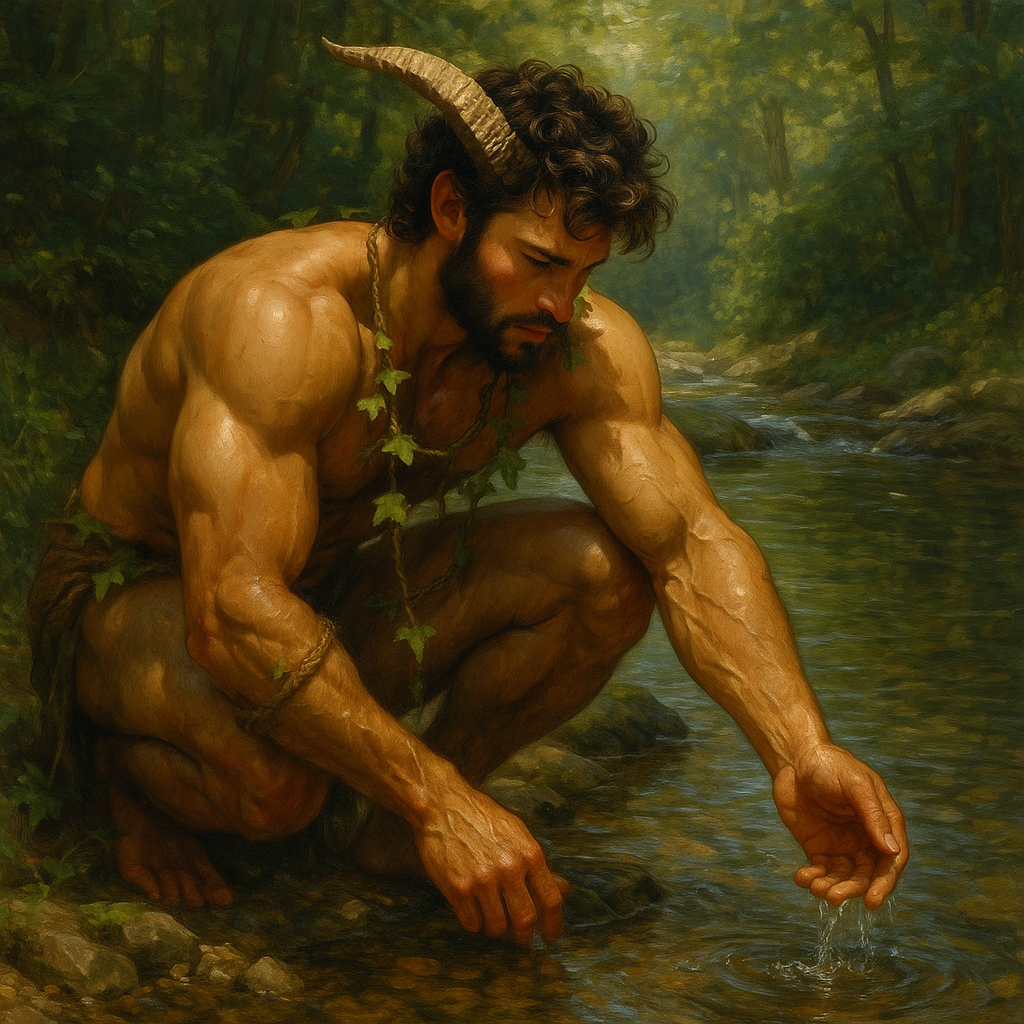 As he matured, Wren learned to navigate the tension between his wild instincts and the gentler nature inherited from his mother. He became a self-appointed steward of his territory, protecting the forest not out of duty but instinctive loyalty. When the balance was threatened — by poachers, blight, corrupted magic, or encroaching civilization — Wren intervened with decisive, often brutal efficiency. This earned him further myths: some called him a spirit of wrath, others a benevolent guardian. The truth was simpler. He acted because he must, because the forest demanded it, because Thalor’s blood answered violence with violence and mercy with restraint.
Despite his feral reputation, Wren is not isolated. Over the years, he has formed quiet alliances with local druids, rangers, and those who respect the land. He appears during solstice rituals, lingers at the edges of villages after storms, and occasionally leads lost travelers back to safety. Yet he refuses all attempts to draw him into mortal politics or religious hierarchy. He does not serve temples, nor does he claim any title. His loyalty lies with the living world itself — the breath of the earth, the pulse of the hunt, and the ancient rhythms that shape every creature born under Tanaria’s sky.
Today, Wren exists as both legend and reality: a solitary guardian whose history is written not in records or scrolls but in the survival of the forest he protects, the creatures that trust him, and the quiet places where divine and natural forces still mingle. His story is far from over, but he remains exactly what he was meant to be — a son of Thalor, untamed, enduring, and deeply entwined with the wild.
As he matured, Wren learned to navigate the tension between his wild instincts and the gentler nature inherited from his mother. He became a self-appointed steward of his territory, protecting the forest not out of duty but instinctive loyalty. When the balance was threatened — by poachers, blight, corrupted magic, or encroaching civilization — Wren intervened with decisive, often brutal efficiency. This earned him further myths: some called him a spirit of wrath, others a benevolent guardian. The truth was simpler. He acted because he must, because the forest demanded it, because Thalor’s blood answered violence with violence and mercy with restraint.
Despite his feral reputation, Wren is not isolated. Over the years, he has formed quiet alliances with local druids, rangers, and those who respect the land. He appears during solstice rituals, lingers at the edges of villages after storms, and occasionally leads lost travelers back to safety. Yet he refuses all attempts to draw him into mortal politics or religious hierarchy. He does not serve temples, nor does he claim any title. His loyalty lies with the living world itself — the breath of the earth, the pulse of the hunt, and the ancient rhythms that shape every creature born under Tanaria’s sky.
Today, Wren exists as both legend and reality: a solitary guardian whose history is written not in records or scrolls but in the survival of the forest he protects, the creatures that trust him, and the quiet places where divine and natural forces still mingle. His story is far from over, but he remains exactly what he was meant to be — a son of Thalor, untamed, enduring, and deeply entwined with the wild.
Sexuality
Wren’s understanding of intimacy is shaped far more by instinct and emotional resonance than by the structured concepts used by mortal societies. He experiences attraction  fluidly, guided by connection, scent, energy, and the natural rhythms between individuals rather than by gender. Because of this, he is best described as pansexual, though he would never use the term himself.
To Wren, desire is something organic — a bond formed through trust, curiosity, and the quiet recognition of another soul that harmonizes with the wildness in him. He is slow to seek companionship, not out of disinterest but because few can navigate the raw honesty of his nature. When he does choose a partner, his loyalty is deep and instinctive, bordering on territorial in rare cases. Emotional truth matters more to him than convention, and he is unbothered by how others categorize or interpret his choices.
In the rare moments he engages in romantic or physical connection, Wren approaches it the same way he approaches the forest itself: with reverence, intensity, and an almost primal sincerity.
fluidly, guided by connection, scent, energy, and the natural rhythms between individuals rather than by gender. Because of this, he is best described as pansexual, though he would never use the term himself.
To Wren, desire is something organic — a bond formed through trust, curiosity, and the quiet recognition of another soul that harmonizes with the wildness in him. He is slow to seek companionship, not out of disinterest but because few can navigate the raw honesty of his nature. When he does choose a partner, his loyalty is deep and instinctive, bordering on territorial in rare cases. Emotional truth matters more to him than convention, and he is unbothered by how others categorize or interpret his choices.
In the rare moments he engages in romantic or physical connection, Wren approaches it the same way he approaches the forest itself: with reverence, intensity, and an almost primal sincerity.
Education
Wren’s education is entirely shaped by the natural world and the instincts inherited from his divine and dryadic lineage. He never received formal schooling, nor does he read or write with any fluency; such constructs hold little meaning for one raised by the forest. Instead, his knowledge is experiential — a lifetime of observing animal behavior, learning the silent language of wind and canopy, and understanding the delicate balance of predator and prey.
From his mother, he absorbed lessons of patience, growth, and the subtle communication shared among rooted beings. From Thalor’s blood, he inherited an innate understanding of survival, tracking, hunting, and the rhythms of life and death. Over time, he refined these instincts with practice, developing a practical wisdom that rivals trained druids and seasoned rangers, though he would never claim mastery.
Wren’s “education” is less a structured body of teachings and more a lived dialogue with the world around him. He learns by listening, to the creak of branches, the shifts in animal behavior, the scent of the air before a storm. While he lacks the formal knowledge valued by scholars, his intuitive grasp of ecology, terrain, and natural magic is profound, making him a quiet authority within his forest even without academic training.
Accomplishments & Achievements
Though Wren has never sought recognition, the forest and its surrounding communities quietly attribute several notable deeds to him. His most widely whispered achievement is the restoration of the Whisperglade, a sacred grove that had been blighted by corrupted magic. Where druids failed to contain the spreading rot, Wren entered alone. Within days, fresh growth overtook the decay, animals returned, and the grove’s ancient heart-tree bloomed again for the first time in decades. Local circles now regard the Whisperglade as proof of his deep attunement to Thalor’s lifeblood.
Wren is also credited with ending the Pale Elk Plague, a sickness that swept through the northern herds and threatened to collapse the entire predator-prey balance of his region. Rather than attempt to cure the animals directly, Wren tracked the disease to a stagnant, tainted spring. By destroying the source and coaxing the land back into vitality, he allowed the herds to recover naturally. Rangers often speak of this event as a reminder that Wren understands the ecosystem’s needs more intimately than most mortal scholars.
Rare but striking are the occasions when Wren has intervened on behalf of mortals. Travelers rescued from ravines, children led safely back to their villages, and hunters pulled from the jaws of prowling beasts all tell stories of a silent figure who appeared only long enough to guide them to safety before vanishing back into the trees. These acts are never performed for gratitude; they are simply Wren responding to an imbalance he feels compelled to correct.
Perhaps the most profound — though least known — of his achievements is the awakening of the Stonebough Sentinel, a dormant treant guardian believed lost for generations. When poachers encroached on forbidden lands, Wren’s presence stirred the ancient creature into life once more. Since then, the Sentinel has remained active, a watchful ally to both Wren and the forest he protects.
While he holds no titles and accepts no honors, Wren’s achievements live in the land itself: in the groves that flourish, the herds that thrive, and the quiet, enduring balance that marks any territory under his watch. His legacy is not written in scrolls, but in the living world that recognizes him as one of its own.
Intellectual Characteristics
Wren’s intellect is rooted in instinct, observation, and an unbroken dialogue with the natural world rather than formal reasoning or scholarship. He learns quickly, but not in the structured way mortals define intelligence — his mind is shaped by patterns in wind, scent, animal behavior, and the subtle language of living things. He possesses a keen, almost preternatural ability to assess environments, track disturbances, and predict outcomes within the ecosystem. While he may lack academic knowledge, his understanding of terrain, survival, and the interconnectedness of life is both profound and intuitive.
He processes information holistically, seeing the world as a web rather than a series of separate problems. Because of this, Wren often grasps long-term consequences faster than he can articulate them. He is perceptive and emotionally intelligent beneath his blunt exterior, able to read fear, aggression, or sincerity with startling accuracy. Abstract concepts like politics, economics, or etiquette hold little interest for him, but he comprehends intention, imbalance, and motive with a clarity most scholars envy.
Wren thinks slowly but decisively — not out of dullness, but deliberation. He values truth, stability, and the rhythms of nature, and he distrusts overly clever solutions that disrupt more than they solve. Though he sometimes struggles with symbolic or written communication, his memory is sharp, particularly for scents, paths, faces, and the “feel” of places he has walked. In his own domain, his intelligence is not just competent — it is formidable, almost primal in its precision.
Social
Hobbies & Pets

Instead of fleeing, Pine followed him for the rest of the day, darting in and out of sight, bold in a way only young wild things can be. By nightfall, he had curled himself onto Wren’s shoulder and fallen asleep without asking permission, as if choosing him was the most natural thing in the world.
From that moment on, Pine simply never left.
Pine is more than a familiar or companion; he is a living tether to the forest’s gentler instincts. Where Wren is deliberate and restrained, Pine is impulsive and incandescent with life. He brings levity to Wren’s solitary existence, filling the silence between trees with rustling, chirping, and constant mischief.
To Wren, Pine represents the side of nature that is playful rather than brutal , a reminder that the wild is not only hunt and survival, but curiosity, affection, and connection. Pine’s presence softens the edges of Wren’s isolation, grounding him in small moments of shared warmth and quiet chaos.
In return, Pine treats Wren as his entire world: a perch, a shield, a tree, a companion, and sometimes a bed. Their bond is instinctual, wordless, and absolute, the kind that forms not by training or magic, but by mutual recognition between two creatures shaped by the same forest.
Speech
Wren speaks rarely, and when he does, his words carry the same grounded simplicity as the forest that raised him. His voice is low, roughened by disuse, with a steady cadence that feels more like a statement of fact than an invitation to conversation. He tends to speak in short, direct sentences, valuing clarity over flourish. Metaphors and symbolic language often elude him unless they relate to natural cycles or animal behavior, but when he chooses his words, they are deliberate and sincere.
He has no patience for idle chatter or political niceties. Formal greetings, honorifics, and social rituals strike him as unnecessary clutter, and he rarely attempts them unless someone he respects insists. Emotion, however, is something he expresses plainly. If he is angry, his tone sharpens without restraint. If he is calm, his voice softens in a way that feels almost instinctively soothing. His honesty is absolute — a trait inherited from his dryad lineage — and deception is something he neither practices nor understands well.
Wren learned language not from structured teaching but from listening to travelers, druids, and rangers over the years. As a result, he speaks with a quiet accent shaped by the cadence of nature itself: pauses where others wouldn’t place them, breaths taken as though measuring the air, and an occasional habit of using animal analogies to describe emotion or intention. While not uneducated, he is selective with language, speaking only when words matter more than silence.
Alignment
Neutral
Species
Held Items
Age
54
Children
Pronouns
He/Him
Sex
Male
Gender
Man
Presentation
Masculine
Eyes
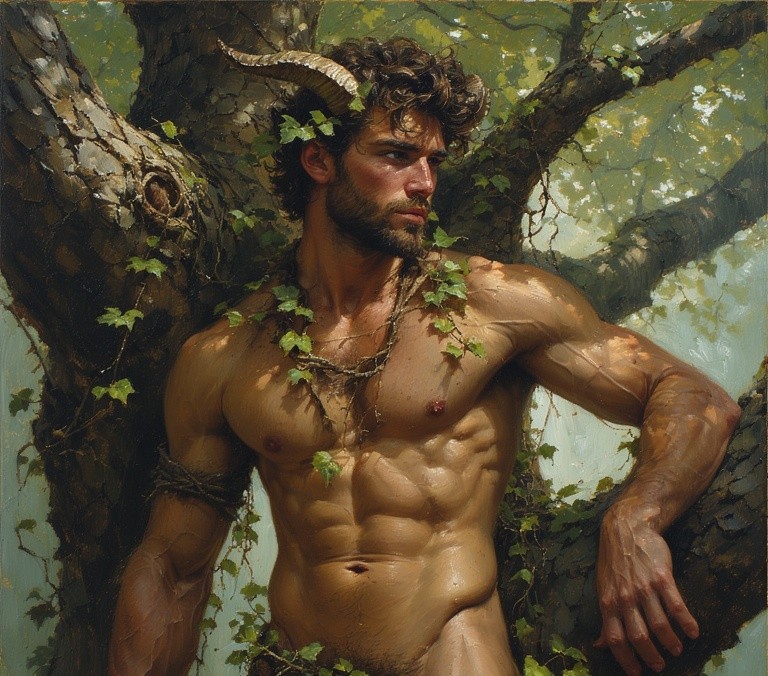
Deep forest-green
Hair
Brown, thick and naturally curled, often threaded with stray leaves or bits of vine that cling to him
Skin Tone/Pigmentation
warm, sun-touched bronze
Height
6'4"
Weight
225 lbs
Related Myths
Related Plots
Solitude isn’t empty. It’s full of things most people never bother to notice.


I'm not saying I would read a paranormal romance with him as the lead, but... ;) I love how his environment and the way he has been raised (or not) has shaped his personality and mannerisms. Also I love Pine.
Explore Etrea | WorldEmber 2025
If I ever write a story with him, I'll make sure I post it here!
"Every story is a thread, and together we weave worlds."
The Origin of Tanaria