
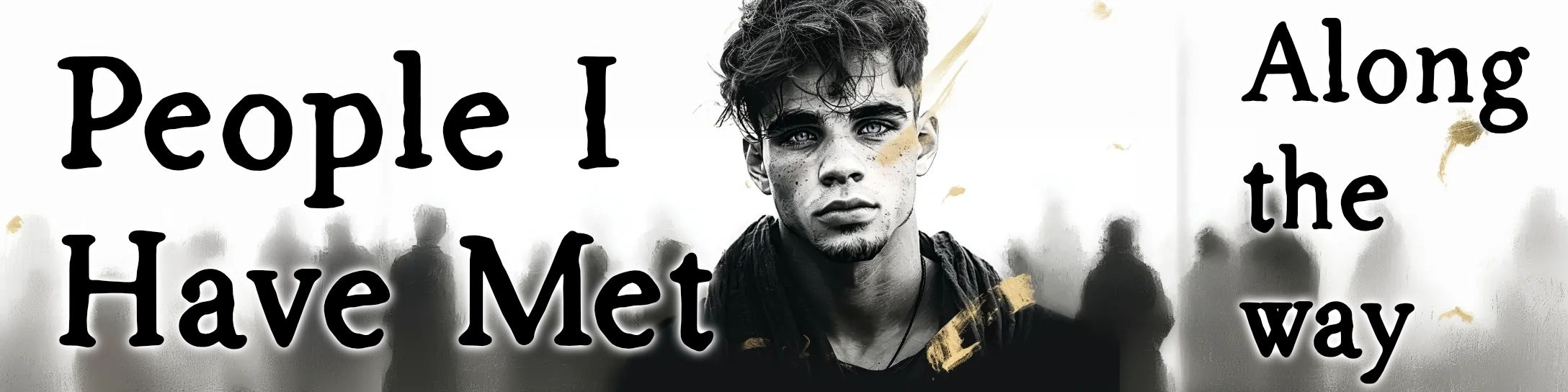
Iulian
Iulian syn Loka i Yagi (a.k.a. Julian Loka, Jules Yaga, Julian Lokaga, Julian Kolp)
Interview Begin
Julian, thank you for sitting with me. We've known each other for a long time, but this is the first time we are really talking about you. So, tell me about yourself.
I have lived long enough to notice that most lives are shaped less by decisive moments than by small refusals. I refused to stay where I was too easily understood. I refused positions that required me to lead when supporting was sufficient. I refused to narrow myself into a single, durable version of who I was meant to be. These are often mistaken for acts of wisdom. They were not. They were habits. I learned them early, practiced them without thinking, and only later recognized what they had done to the shape of my life.
I was raised in a place where stories were not told for comfort. They were practical. They explained where danger accumulated, which absences mattered, and what kinds of silence deserved respect. My mother did not teach by explanation. She allowed me to watch until I no longer needed one. From her I learned that attention is a form of care, and that survival does not always require resistance. Sometimes it requires waiting long enough to see what changes on its own.
My father did not vanish all at once. He thinned. That is the most accurate word I have. Each time he returned, he stayed a little less. His presence seemed to require effort, as though remaining in the world demanded more from him than it once had. From this I learned something I did not understand at the time: that love does not always hold. Sometimes it loosens deliberately. When he was finally gone, I did not feel abandoned. I felt responsible. Remembering him became a task I accepted without being asked.
I have spent much of my life moving. This is often described as restlessness, though it has never felt that way to me. Movement keeps me oriented. When I remain too long in one place, my sense of self begins to dull, as if repetition hardens the edges of it. Walking, writing, and working with my hands prevent that. They give time a shape. Without them, it tends to blur.
People sometimes assume I am reserved because I am withholding. That is a misunderstanding. I am reserved because I am paying attention. Over time I learned how to speak when it mattered, how to persuade without insisting, and how to step forward without remaining in view. These were not skills I sought. They were required, repeatedly, by circumstance. When people speak of courage, they usually mean action. I have found endurance more difficult, and more useful.
If there is any consistent thread in my life, it is not power, inheritance, or fate. It is continuity. I have tried to live in a way that allows me to recognize myself when I look back. Not as a hero, and not as a warning. Simply as someone who noticed what was happening. If I am remembered at all, I hope it is not for what I was capable of doing, but for what I chose not to do. There are worse outcomes than leaving the world slightly quieter than you found it.
When people speak about you, they often begin with what you are not. You are not loud. You are not easily placed. You do not arrive with a story already prepared.
That sounds like kindness disguised as uncertainty. I’ve learned to accept both. Most people want to know what something is for before they decide how much attention to give it. I’ve never been very good at providing that answer in advance.
You give the impression of listening even when nothing is being said.
That’s usually when the important parts happen. Silence has structure. It tells you where someone expects resistance, or reassurance. If I seem attentive, it’s because I’m trying to understand what hasn’t yet been asked of me.
You were born in Ukraine, right?
Not then.I know the habit-you’re not wrong to use the name people recognize. It just wasn’t one we had yet. When I was born, it was forest and river and marshland. Trade routes without maps. Villages without borders. Names came later, and they changed often. I remember land more clearly than allegiance.
Does that make it difficult to speak about home?
No. It makes it easier. Places are more honest before they are claimed.
Your family-your parents-feature strongly in how others describe you, even when you don’t.
That’s probably because they left deeper impressions than I did. My mother never tried to make herself approachable. She believed that safety came from clarity, not comfort. She watched everything. She expected me to do the same. I don’t remember being taught so much as being corrected gently, over and over, until the right response became habit.
My father was quieter in a different way. He didn’t insist on space; he occupied it lightly. When he began to fade, there was no clear beginning to it. He spoke less. Then not at all. He still smiled, for a while. I learned then that disappearance doesn’t always announce itself. Sometimes it simply waits until you stop looking for it.
Was that loss formative?
It was instructional. I learned that attachment can loosen without breaking, and that love doesn’t always demand permanence. Remembering him became a practice. Writing things down came later, but the impulse was the same-to keep something from slipping entirely out of reach.
You’ve lived through periods of enormous change. Does time feel different to you now?
Time feels layered. I don’t experience it as a line so much as a set of overlapping impressions. Certain moments stay close. Others recede quickly. Without routine, without movement, it becomes difficult to tell one decade from another. That’s why I walk. That’s why I write. They give time texture again.
Have you been in love?
Yes. A few times. Not often.I don’t experience it the way people expect. It doesn’t arrive loudly, or all at once. It accumulates. I notice that someone’s absence changes the shape of my days. That I adjust my routines without realizing why. By the time I recognize it as love, it’s usually already rooted.
Do those relationships last?
Nothing does. Some ended because time took us in different directions. Others because I stayed too long after I should have left. I don’t regret them. I regret the moments when I mistook endurance for devotion. Love shouldn’t require you to disappear in order to persist.
Does that make connection difficult?
Sometimes. People often assume restraint means distance. It doesn’t. It just means I arrive slowly.
Anyone special that stands out?
That depends on what you mean by special. If you mean memorable—yes. If you mean discussable—no. I don’t kiss and tell. Some connections deserve privacy, even after they’ve ended.
You rarely speak about ambition.
I’ve never trusted it. Ambition tends to substitute velocity for direction. I’m more interested in equilibrium-knowing when something is about to tip, and whether a hand on the scale will make it better or worse. Most situations don’t require heroics. They require patience.
Observers often note that you step back when others step forward.
Someone has to remain in the room when the noise is over. I’ve found that support lasts longer than authority. If I can help someone do what they were already meant to do, that feels sufficient. Ownership complicates things. It invites expectation.
And yet people remember you.
That part is less within my control. I think it’s because I don’t hurry people. I stay. I notice details they don’t expect to matter. When someone feels fully heard, even briefly, it tends to linger longer than spectacle.
You’ve witnessed violence, famine, upheaval. How do you carry that?
By not turning it into a lesson. People like to extract meaning from suffering as if it makes it manageable. I’ve learned that some things are simply endured and then set down. I remember enough to remain careful. Forgetting everything would be dishonest. Remembering everything would make living impossible.
Is there anything you still can’t forget?
Yes. The sound of a place after it has emptied. That quiet is different from peace.
How would you describe yourself, if asked directly?
I usually try not to answer directly. But since you’re here-I pay attention. I prefer accuracy to certainty. I intervene when harm feels imminent and withdraw when my presence would distort the outcome. I’ve made mistakes by waiting too long and others by acting too quickly. I don’t believe endurance makes suffering noble, and I don’t believe meaning is something you extract by force. If there’s a pattern to my life, it isn’t power or lineage. It’s consistency. I try to remain someone I recognize when I look back. That’s not always comfortable, but it’s preferable to becoming impressive.
If you could change something about how you’ve lived, what would it be?
I would leave earlier.Not from places, but from moments that had already finished. I’ve stayed too long out of loyalty to what something used to be. Learning when to let go without resentment took me longer than I like to admit.
And what do you hope is recorded about you?
That I was careful.That I left things a little quieter than I found them.
That I noticed.
End of Interview
Relationships
Click for Full Biography
Physical Description
Special abilities
Iulian’s abilities are inherited unevenly from both parents and shaped further by temperament rather than ambition. None manifest as sudden or spectacular; they emerge quietly, often mistaken by others for coincidence, intuition, or skill. He is keenly aware that overt displays draw attention, and so his use of power tends toward subtlety, conservation, and retreat rather than domination.Elemental Witchcraft (Maternal Lineage)
From Baba Yaga, Iulian inherited a limited but instinctive command of natural forces. His witchcraft is not ritual-heavy nor incantatory, but practical and situational—coaxing rather than commanding. He can influence earth, air, fire, and water in small, localized ways: calming winds, encouraging flame to catch or gutter, drawing moisture from the air, or softening soil. These effects are never large-scale and cannot be sustained indefinitely. They require proximity, focus, and an understanding of the environment already present. He cannot create an element from nothing, only guide what already exists.Physiological Shape Adjustment (Paternal Lineage)
Inherited from Loka, this ability allows Iulian to alter his own physical form within strict constraints. He may adjust facial features, hair color, skin tone, posture, and proportions in order to blend into surrounding populations. These changes are bound by conservation of mass; he cannot significantly increase or decrease his body weight without consequence, nor can he assume forms outside the human range. The process is gradual rather than instantaneous and requires concentration. Overuse leads to fatigue and sensory disorientation.Sensory Compulsion
Rather than creating illusions, Iulian can influence the sensory perception of a small number of individuals—typically no more than five at once. This influence may affect sight, sound, touch, or emotional sensation, causing a person to perceive something that is not physically present or to miss something that is. Each individual experiences the effect privately; observers not targeted perceive nothing unusual. This ability functions through focused intent and proximity and cannot override deeply held beliefs or strong will indefinitely. Its ethical use troubles Iulian, and he employs it sparingly.Perceptual Obscuration (“Blending”)
In moments of stress or danger, Iulian can diminish his perceptual presence, causing others to overlook or forget him in crowded or complex environments. This is not true invisibility; rather, it is a subtle manipulation of attention combined with minor physical adjustment. He becomes part of the background—unnoticed unless directly sought. This ability is short-lived and mentally taxing, often used as a means of escape when overwhelmed.Longevity and Agelessness
From his father’s side, Iulian does not age in a conventional sense. His body stabilizes once maturity is reached, showing minimal physical change over centuries. Injury still harms him, illness can weaken him, and fatigue affects him as it would any human. He is not invulnerable. His immortality is passive rather than regenerative; he heals no faster than normal and must still avoid harm.Pattern Recognition and Intuitive Insight
Though not supernatural in origin, Iulian’s capacity to recognize patterns borders on the uncanny. He identifies social, symbolic, and systemic structures quickly and often predicts outcomes before others see the shape of events forming. This insight is not infallible and is vulnerable to emotional overload or unfamiliar cultural contexts. He often understands that something is wrong before he understands why.Liminal Traversal (Latent)
Iulian possesses the inherent capacity to move between worlds, though this ability remains dormant for most of his life. It is not something he can initiate without external conditions being met—specific places, times, or convergences must align. When it eventually manifests, it is experienced less as travel and more as dislocation, requiring recovery and adaptation afterward.Mental characteristics
Personal history
Iulian was raised at the edge of the world rather than within it—between forest and road, hearth and wilderness, presence and absence. His earliest memories are not of lessons or rules, but of watching: listening to conversations he was not meant to join, observing the way people moved when they thought themselves alone. Baba Yaga did not raise him as a witch raises an apprentice; she raised him as one raises a survivor, teaching him how to notice what others overlook and how to endure solitude without mistaking it for abandonment. The loss of his father came gradually, without ceremony. Loka did not vanish; he thinned, appeared less often, spoke less, until one day he was simply no longer there. Iulian learned early that attachment did not always end in rupture, but in quiet subtraction. This understanding shaped his path through history. He traveled often, attached himself lightly to people and places, serving as helper, companion, or witness, but rarely as central figure. When history demanded names and roles, he adopted them briefly and then let them go.Sexuality
Iulian’s experience of attraction is slow, infrequent, and deeply contextual. Desire does not arise for him from appearance or novelty, but from sustained emotional presence—shared silence, mutual understanding, and the sense of being seen without performance. When attraction does occur, it is directed almost exclusively toward men, though even then it remains secondary to trust and intellectual or emotional intimacy. Physical intimacy, when it happens at all, is meaningful rather than habitual. He does not seek it, nor does he feel diminished by its absence. Across centuries, others have sometimes misread this reserve as disinterest, aloofness, or repression. In truth, it reflects a temperament that values connection over consumption and depth over immediacy. Love, to him, is something that grows sideways, not forward.Education
Iulian’s education was informal, accumulative, and uneven by design. Baba Yaga taught him what was necessary to survive—languages overheard and practiced, symbols recognized before they were explained, practical knowledge learned through repetition rather than theory. He learned to read and write early, not as a mark of status, but as a way to anchor thoughts that might otherwise scatter. As he moved through different regions and eras, he absorbed knowledge opportunistically: apprenticing himself to craftsmen, scribes, monks, healers, and travelers. He rarely pursued formal instruction to completion, preferring instead to learn just enough to function competently and then move on. Over time, this produced a broad but selective education—deep in certain subjects, cursory in others, and shaped as much by curiosity as by necessity.Intellectual Characteristics
Iulian’s mind is pattern-oriented and associative. He excels at recognizing structures—social, symbolic, linguistic—and predicting how they will shift under pressure. Puzzles, riddles, and systems come easily to him, not because he seeks mastery, but because his mind naturally looks for coherence. He often arrives at conclusions intuitively and struggles to explain the steps that led him there. Time, for him, is not experienced linearly. Ideas learned centuries apart coexist comfortably, sometimes to his detriment when he forgets that others do not share the same temporal frame of reference. His humor occasionally reflects this disjunction, drawing on references long obsolete or assumptions no longer shared. Writing and drawing serve as grounding practices, allowing him to externalize thought and restore order when the world becomes overwhelming.Morality & Philosophy
Iulian’s moral framework is pragmatic but deeply empathetic. He values fairness over law, intent over outcome, and consistency over doctrine. Rules, to him, are tools rather than truths, and he evaluates them by their effects rather than their origins. This has placed him at odds with rigid institutions across history, though he rarely opposes them openly. At his core, he believes that suffering is not instructive by default, and that endurance alone does not confer virtue. He intervenes when he believes harm can be reduced, but avoids grand gestures or ideological crusades. His philosophy is shaped less by abstract ethics than by accumulated observation: that people are rarely evil, often frightened, and frequently mistaken—and that remembering this is itself a moral act.Personality Characteristics
Motivation
Iulian is motivated less by ambition than by equilibrium. He seeks situations where tension can be reduced, misunderstandings clarified, or harm quietly averted. This does not stem from a belief that the world can be fixed, but from a personal intolerance for unnecessary suffering. When he intervenes, it is usually because he believes his presence can make a difficult situation slightly less damaging. On a deeper level, he is driven by the need to understand himself through continuity. Writing, walking, and remembering are not hobbies but stabilizing practices. He is motivated to leave traces—not monuments, but moments of coherence—so that when he looks back across centuries, his life forms a line rather than a scatter.Savvies & Ineptitudes
Iulian is adept at reading environments, systems, and subtext. He understands how groups function, how power flows, and where pressure points lie, even when he chooses not to act on that knowledge. He is skilled at languages, practical problem-solving, mediation, and tasks requiring patience and attention to detail. In unfamiliar situations, he observes first and speaks later. He is notably inept at sustained performance. Long-term deception, rigid social hierarchies, and environments that demand constant emotional signaling exhaust him. He struggles with sudden change, loud or crowded settings, and expectations that require him to repeatedly assert identity or status. When overwhelmed, he may withdraw without explanation, leaving others confused or offended.Likes & Dislikes
Iulian prefers quiet movement: walking roads, riverside travel, small boats, and solitary journeys. He enjoys writing, drawing, puzzles, pattern-based crafts, and tasks that produce tangible, incremental progress. He values one-on-one conversation, shared silence, and spaces where he can observe without being observed. He dislikes confinement with strangers, performative social rituals, unnecessary cruelty, and ideological certainty. He is uncomfortable with spectacle, both violent and celebratory, and avoids environments where attention is currency. He has little tolerance for noise used as dominance and finds enforced cheerfulness more draining than open hostility.Virtues & Personality perks
Iulian is patient, consistent, and deeply attentive. Once he commits to a person or task, he follows through with care and reliability. He is honest by default and does not manipulate lightly, reserving influence for situations where he believes the outcome justifies the intrusion. His restraint makes him trustworthy, even when his nature is not fully understood. He possesses a rare steadiness under pressure. In crises, he becomes calmer rather than more reactive, allowing others to orient themselves around him. His long view of history grants him perspective that tempers fear and urgency, often helping those around him make better decisions simply by slowing down.Vices & Personality flaws
Iulian avoids confrontation to a fault. His desire to minimize harm can lead him to delay action too long, especially when intervention would require visibility or authority. He is prone to self-erasure, choosing support roles even when leadership would be more effective, because being seen feels more dangerous than being wrong. He can be emotionally opaque, even to those he cares for. His difficulty articulating internal states may come across as distance or indifference, and he sometimes underestimates how much reassurance others need. When overwhelmed, he may disengage entirely, retreating into routine or solitude rather than addressing conflict directly.Social
Social Aptitude
Iulian is socially capable but not socially effortless. In one-on-one interactions, he is attentive, thoughtful, and often disarmingly sincere. He listens more than he speaks and tends to remember details others forget, which can create a sense of quiet intimacy. People often feel understood in his presence without being sure how that understanding occurred. In groups, his aptitude diminishes sharply. He finds layered conversations, shifting social cues, and competitive attention draining rather than stimulating. While he can mask effectively—appearing polite, engaged, even charming—this comes at a cost. Prolonged exposure to crowded or performative social environments leads to withdrawal and fatigue. As a result, he structures his life to minimize unnecessary social friction, preferring depth over breadth in relationships.Mannerisms
Iulian’s movements are economical and deliberate. He tends to keep his hands occupied—resting them on a walking staff, clasping them loosely, or engaging in small, repetitive tasks when still. When listening, he often looks slightly away rather than maintaining direct eye contact, though he will meet another’s gaze briefly at moments of emphasis or sincerity. He favors stillness over gesture. Expressions are subtle and often delayed, as though he processes emotion internally before allowing it to surface. In unfamiliar settings, he positions himself near boundaries—walls, doorways, edges of rooms—where he can observe without being surrounded. These habits are rarely conscious, but they are consistent across time and place.Hobbies & Pets
Iulian has always preferred the company of animals to that of people. Over the centuries, he has kept dogs, cats, ferrets, and other small companions—creatures that respond to consistency rather than performance. Animals provide him with uncomplicated presence and routine, and he is attentive to their needs with a gentleness that contrasts with his reserve among humans. His hobbies function primarily as grounding practices. Writing and drawing are his most enduring habits, used to order memory and stabilize emotion. He also enjoys puzzles, pattern-based crafts, long walks, and repetitive manual tasks that occupy the hands while quieting the mind. These activities are less about mastery than regulation; they allow him to remain present without becoming overwhelmed, anchoring him when the world grows too loud or diffuse.Speech
Iulian speaks plainly and with precision. He favors clear language over ornamentation and rarely embellishes a point unless asked. His tone is calm and even, though it can become unexpectedly dry or literal when he attempts humor. He does not interrupt and often pauses before responding, not from hesitation but from consideration. His speech occasionally betrays his long memory. He may reference concepts, metaphors, or turns of phrase that feel slightly out of place for the era or audience, adjusting only after realizing the disconnect. He dislikes speaking at length to groups and avoids rhetorical flourishes, but in private conversation he can be quietly persuasive, grounding his arguments in observation rather than passion.
It's my world too. You're just a squirrel trying to get a nut
Connections
Date of Birth
14 October 912 CE
Year of Birth
912 CE
1114 Years old
Birthplace
Mama's Hut
The forest–wetland borderlands of the Pripyat basin, in the deep woodlands later known as Polesia, in what is now northwestern Ukraine.
The forest–wetland borderlands of the Pripyat basin, in the deep woodlands later known as Polesia, in what is now northwestern Ukraine.
Spouses
Griete
(spouse)
Arnaud
(partner)
Asa
(partner)
Basilio
(lover)
Elias
(intimate)
Alys
(intimate)
Siblings
Children
Sex
Male
Sexuality
Omnephilic
Gender
Male
Presentation
Adult man in his early to mid 20s
Eyes
Clear, pale blue—often described as crystal or glasslike. His gaze is observant rather than searching; people rarely notice when he is watching, but when he does meet someone’s eyes, the effect is immediate and difficult to forget.
Hair
Dark brown to near-black, worn short and simply. Texture ranges from straight to softly curled. He alters length and styling subtly over time to blend with local norms, never favoring ornamentation or fashion.
Skin Tone/Pigmentation
Light to olive-toned, with a natural warmth that gives the impression of constant sun exposure. His complexion carries subtle freckles or weathering depending on era, making his exact ancestry difficult to place at a glance.
Height
5'6" - 5'8"
Weight
140–150 lb
Travel Timeline
| From | To | Place |
|---|---|---|
| 912 | 939 | Mama's Home |
| 939 | 975 | Praha (Prague region, outskirts) |
| 975 | 978 | Brno |
| 978 | 1015 | Philippopolis (Plovdiv) |
| 1015 | 1018 | Adrianopolis (Edirne) |
| 1018 | 1055 | Constantinople (peripheral quarters) |
| 1055 | 1065 | Nicomedia |
| 1065 | 1085 | Thessalonica |
| 1085 | 1090 | Dyrrhachium (Durrës) |
| 1090 | 1100 | Brigantium (Galicia; A Coruña region) |
| 1100 | 1110 | Lucus Augusti (Lugo) |
| 1110 | 1120 | Burdigala (Bordeaux) |
| 1120 | 1125 | Rotomagus (Rouen) |
| 1125 | 1135 | Londinium (London outskirts) |
| 1135 | 1165 | Oxenforda (Oxford outskirts) |
| 1165 | 1185 | Eboracum (York) |
| 1185 | 1215 | Colonia Agrippina (Cologne) |
| 1215 | 1245 | Argentoratum (Strasbourg) |
| 1245 | 1275 | Vienna (Wien) |
| 1275 | 1305 | Buda |
| 1305 | 1340 | Cracovia (Kraków) |
| 1340 | 1370 | Regensburg |
| 1370 | 1400 | Nürnberg |
| 1400 | 1430 | Bruges |
| 1430 | 1460 | Gent |
| 1460 | 1490 | Canterbury (outskirts) |
| 1490 | 1495 | Calais |
| 1495 | 1500 | Bruges |
| 1500 | 1504 | Basel |
| 1504 | 1507 | Mediolanum (Milan) |
| 1507 | 1525 | Florentia (Florence) |
| 1525 | 1545 | Venetia (Venice) |
| 1545 | 1575 | Ragusa (Dubrovnik) |
| 1575 | 1605 | Constantinopolis (return, periphery) |
| 1605 | 1620 | Smyrna (İzmir) |
| 1620 | 1628 | Athenae (Athens, outskirts) |
| 1628 | 1630 | Roma (Rome, Trastevere margins) |
| 1630 | Tir na nOg |




Comments