

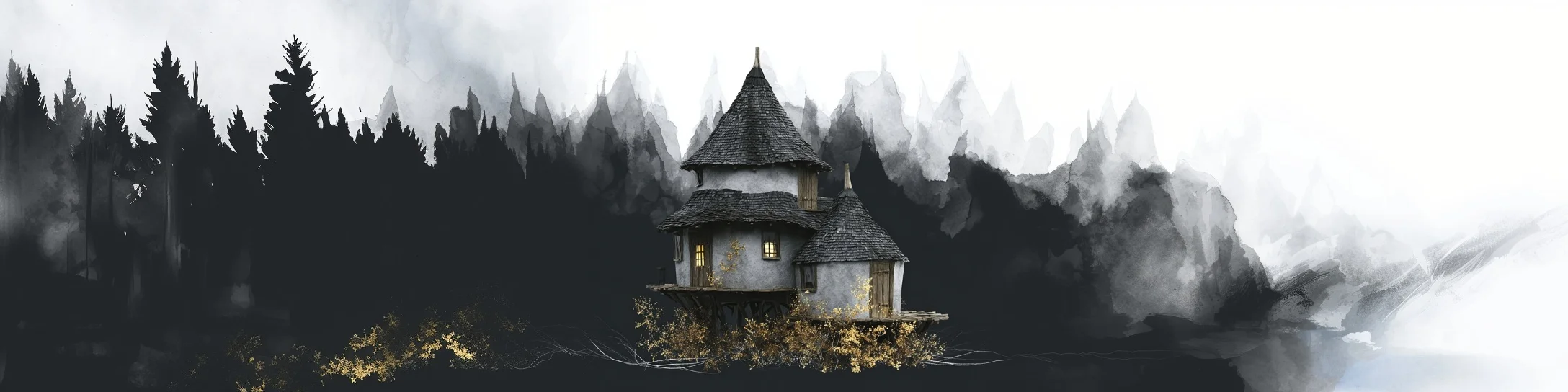
Mama's Hut
The house in the forest was never meant to be found.
That much becomes clear to anyone who tries to reach it twice. Paths that once seemed obvious lose their logic on return, game trails fold back on themselves, and landmarks shift just enough to make certainty impossible. The house does not move, but the forest is not obliged to remember how one arrived. Those who later insist the dwelling turned, or wandered, or changed its facing are not lying so much as describing the failure of routes to remain faithful.
When the house is reached, it presents itself plainly. It is not large, not symmetrical, and not finished in any sense that implies finality. The earliest structure forms the heart of it: a compact, serviceable dwelling built to meet immediate needs rather than future ones. Its walls bear the marks of repair more than decoration, and its shape reflects the constraints of terrain and weather rather than aesthetic ambition. It was enough, once.
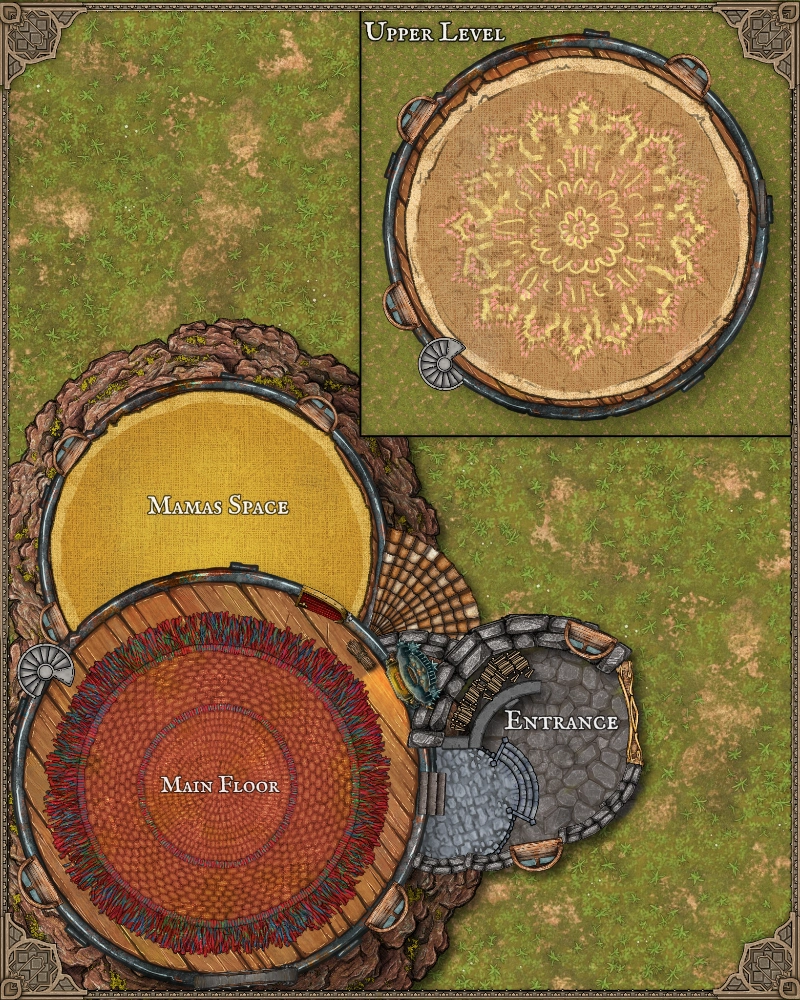
Entry is gained through a closed outer space set deliberately apart from the main living area. This entrance is narrow, sheltered, and practical. Wood is stacked there to keep it dry. Tools are stored within reach. In the colder months, animals are brought inside—not as guests, but as living heat and necessity. This space buffers the rest of the house from wind and snow and keeps what little warmth exists from being wasted. Nothing here is ornamental. Everything earns its place.
Beyond it lies the main floor, the oldest inhabited space, where daily life unfolded and continues to leave its residue. The floor is layered with rugs and woven coverings, not for display but for insulation. Walls are hung with textiles and tapestries that trap warmth and dull sound, their patterns worn thin by time and smoke. Light is uneven and soft, shaped by small windows and firelight rather than design.
The hearth sits in the corner between the main living area and what would later become Mama’s Space. It is the structural and thermal center of the house. Built solidly, it heats both spaces on the lower level and draws warmth upward into the floor above. It is used for cooking, for drying, for mending, and for gathering. Nothing in the house is more permanent, and nothing has been left untouched by it.
The main floor has no fixed purpose beyond being lived in. Sleeping happens where it is warmest. Work surfaces appear and disappear as needed. Storage takes the form of baskets, shelves, hooks, and stacked containers, arranged for access rather than symmetry. The space is full, but not crowded in a modern sense. What exists here exists because it is used.
Mama’s Space was added later, when the house ceased to be sufficient in its original form. It lies beyond the hearth, separated by what was once an exterior wall. The change is subtle but perceptible. The air is quieter here. The light is more controlled. This area was built not to expand function, but to preserve self. It offers distance without isolation, retreat without abandonment. When the house became loud, this space allowed silence.
Above, reached by a stair added only after much of the lower structure was already worn into familiarity, is the upper level. This was built for Iulian, and it shows. The construction is less conservative, the angles less settled. The space was designed to catch rising heat and daylight, and to hold a life that was still unfolding. Here, belongings are fewer, but possibility is greater. The room adapts as he does, shifting from sleeping space to work space to refuge as needed. Nothing here is fixed except the intention behind it.
Throughout the house, there is a sense of accumulation without excess. The clutter is that of a 10th-century life: layered, reused, repurposed. Nothing is kept because it might be useful someday. Everything already is. The house does not contain secrets so much as memory, embedded in wear patterns, soot marks, and the way objects settle where hands most often reach.
Stories told by those who never entered claim stranger things. They speak of rotation, of movement, of a dwelling that refused to face the same direction twice. These tales arise easily when paths fail and bearings collapse. To stand outside the house is to feel watched, not by the building, but by the forest that allows it to exist where it does.
After Tata’s departure, the house does not change in structure. What changes is its meaning. It remains inhabited, warmed, maintained. It becomes less a shelter made by necessity and more a record of care left behind. It does not ask to be remembered, nor does it resist being forgotten.
It simply stands, as it always has, ready for those who belong there—and indifferent to the rest.




Comments