Saliana
“Del Acero Renacemos” (From Steel we are reborn)
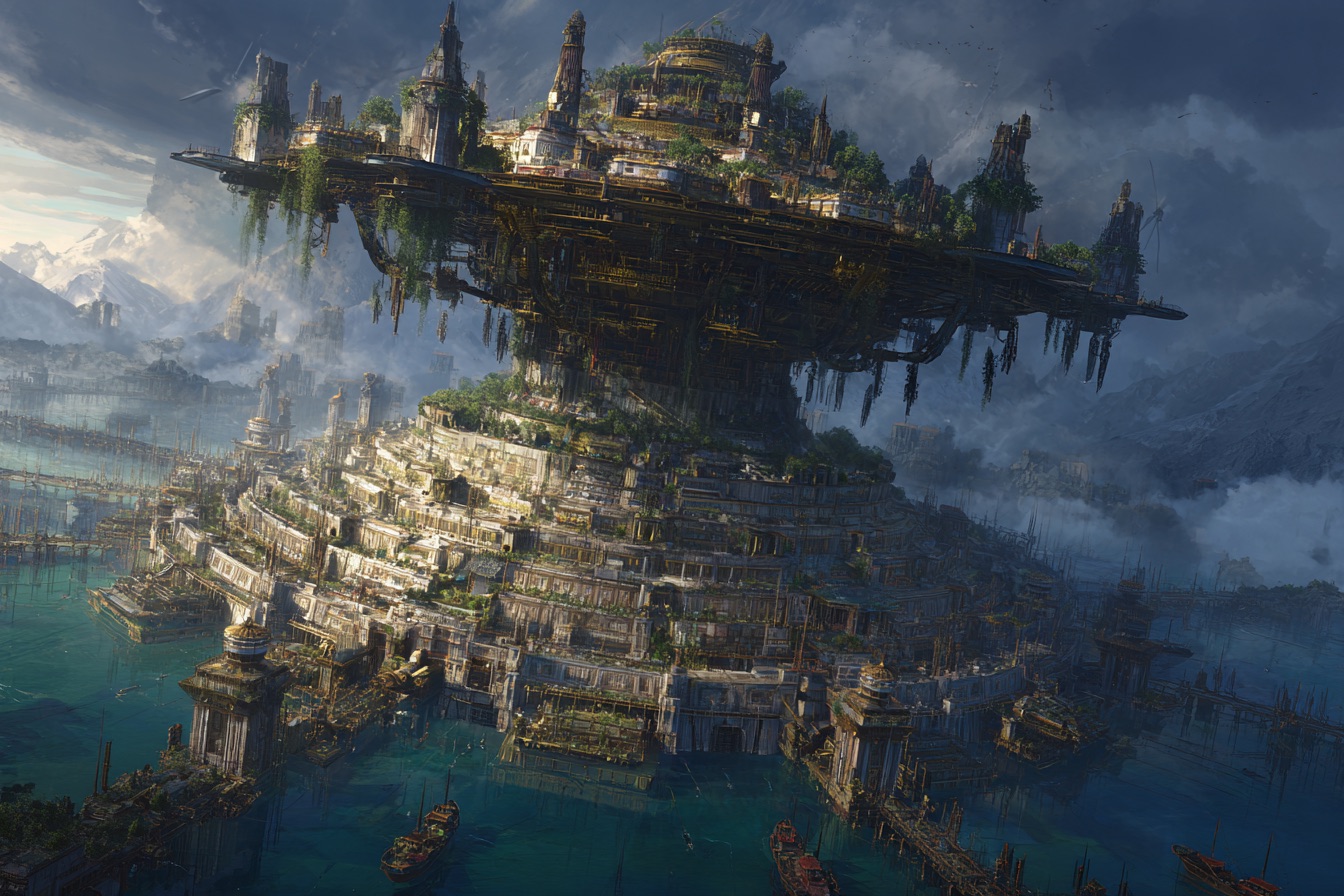
Saliana stands like a monument to survival, transformation, and ambition. Once conceived as a necropolis—an eternal resting place for Espen’s fallen—this colossal city has since become one of the most breathtaking and imposing settlements in Nyria. Second only to Castella in size among the island-cities of Espen, it rises from the waves like a titanic mountain of stone, steel, and will: a testament to what desperation and ingenuity can achieve when the world ends and refuses to stay ended.
It is ruled with an Iron hand and unwavering authority by Archduke Mateo de la Sombra, a nobleman whose lineage stretches back to the ancient Fuerza tribe, one of the thirteen founding peoples of Alada itself. Under his command Saliana has evolved from sanctuary to powerhouse—an arcology where the living thrive in the shadow of the dead.
Origins in Stone and Sacrifice
Before The Burn reshaped the world, Saliana was known by another name: Templo de los Soldados Perdidos, the Temple of the Lost Soldiers. Carved into and atop a mountain overlooking the Altian Ocean, it was crafted as a monumental ziggurat designed to house the remains of one hundred and fifty thousand soldiers. The La Sombra family dedicated it to the war dead of Espen as an offering to Solis, believing that by honoring their sacrifice, their spirits would be carried into the Eternal Light. Wide terraces were built to hold tombs, and the inner chambers were carved with funerary inscriptions and reliefs depicting campaigns fought across the archipelago. It was never meant to be a city for the living.
Then the world burned.
As firestorms and rising seas consumed coastlines, refugees fled inland and upward. The half-finished monument became a bastion. Those who reached it—more than ninety thousand souls—found refuge behind its thick walls and heavy stone façade. When the water climbed to its base, the ziggurat became an island. When food and space ran thin, desperation bred invention. Construction platforms were chained together and repurposed into floating steel plates around the structure, giving birth to Saliana’s first crude harbor and early defensive ring.
From there, Saliana grew.
The central upper section was expanded skyward into a spire, then widened outward in reverse, forming an inverted pyramid atop the original sacred Terraces of the Fallen. Four enormous support pillars anchor it to the summit like the legs of a titan, while deep below, corridors and chambers were carved through the mountain’s heart. What began as a necropolis became an arcology. The dead still lie entombed in the lower strata, but above and below them pulse the arteries of a living metropolis.
The City as Arcology
Over the decades since, Saliana has grown relentlessly. The central section was built upward into a tower, later expanding outward into a massive inverted pyramid balanced atop the original ziggurat by four colossal support pillars. Beneath the structure, workers carved deeper into the mountain, creating underground districts and coal mines to fuel the forges. In less than a century, the city has tripled in mass, becoming one of the most ambitious constructions in modern Nyria.
Saliana is a place of vertical life: tomb-chambers in the lower ziggurat converted into homes, markets and hallways; mid-levels reworked into terraces, workshops, and barracks; and the inverted pyramid above filled with gardens, manufactories, noble chambers, and the central seat of power. The most prestigious tier is the uppermost palace — Palacio Sombraverde — from which Archduke Mateo rules with strict discipline and militaristic efficiency. His governance is severe yet effective, and crime within the city borders is nearly nonexistent.
Architecture, Defenses & Power
Saliana’s very shape serves as its Armor. Tiered and sloped walls make direct assault nearly impossible, while the steel harbor ring allows naval units to reposition quickly to any side of the island. In wartime, the platforms can detach into fortified rafts, forming a defensive crown around the city like interlocking shields. The four pyramid-supports contain barracks, armories, and vertical firing shafts lined with Crossbow ports and electrum-charge channels to repel climbers or invaders.
Energy flows through Saliana via massive vertical rotor-mills, adapted from Edison quad-copter principles. Ocean winds drive enormous blades, powering pumps, Electrum lighting, and the mechanical lifts connecting the city’s levels. Hanging gardens spill greenery over balconies and terraces, irrigated through aqueduct systems that recycle water through hydro-purification alcoves. They cool the stone in summer and feed the populace in part, supplemented by shipments from the Archduke’s twenty-five subordinate settlements.
Though resources are scarce, deep veins of coal under the city fuel its great forges. Here, master smiths produce Weapons and armor of renown across Nyria — sun-etched blades, blackened steel cuirasses, and lamellar shields prized for their durability and craft. This export is Saliana’s lifeblood, and much of its wealth and influence flows from it.
Points of Interest
Saliana is a city carved from grief and reforged by need, and its most notable sites reflect both the sanctity of its origins and the fierce ambition that carries it forward. Visitors often remark that the city feels built in three directions at once — down into the mountain, up toward the sky, and outward over the waves — each layer holding places of significance that define its character.
Terrazas de los Caídos (Terraces of the Fallen)
Once mausoleum platforms intended for Espen’s war dead, the Terraces have become serene memorial gardens where stone sarcophagi stand in long rows like silent witnesses. Electrum lanterns cast amber light across polished inscriptions, and offerings of white flowers and small sun-charms adorn the tombs. On remembrance nights, thousands gather here with candles that shimmer like a sea of stars, and low mourning horns echo through the stepped chambers. It is said no voice dares rise above a whisper on these terraces — the dead command reverence still.
Catedral del Carbón (The Coal Cathedral)
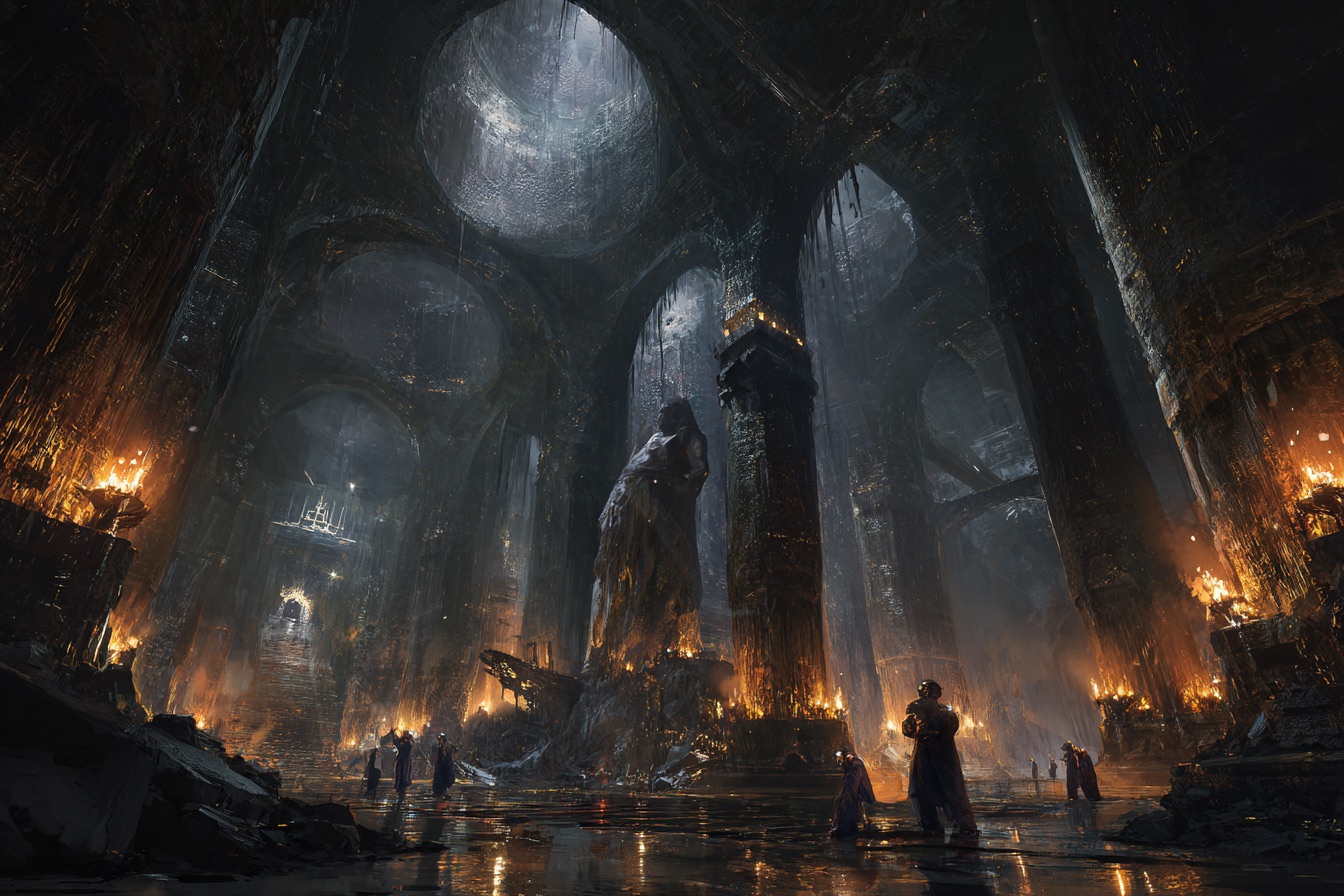
Far beneath the public halls lies a cavern vast as a temple, its pillars formed from untouched ribs of glittering coal. Miners speak softly in its depths, for the cathedral hums with a sacred dread, its air thick with incense used to bind the dust. A colossal relief of Solis — carved into the black seam itself — watches over the workers like a god sculpted from shadow. Lanternlight catches on flecks of ore like stars in a midnight sky, and the rhythmic echo of pickaxes becomes a slow, solemn hymn.
Terrazas del Cielo (Sky-Terraces)
Between the ziggurat and the inverted pyramid bloom gardens that seem to float upon the wind. Vines spill like emerald waterfalls from balconies, heavy with fruit and perfume-sweet flowers. Pathways of lacquered wood and wrought iron curve through greenery, offering sweeping views of the ocean and the harbor ring. At night, bioluminescent lantern-pods glow pale blue between the leaves, turning the terraces into dreamlike hanging forests — a paradise suspended above stone and sea.
Palacio Sombraverde (Sombraverde Palace)
Crowning the inverted pyramid, the palace of Archduke Mateo rises in black marble and electrum like a blade poised toward heaven. Banners of the Fuerza tribe hang in its vast audience hall, and prototypes of early Forgeplates stand flanking the throne like silent steel titans. From the crystalline viewpoint of the throne chamber, the Archduke surveys the entire arcology — its terraces, its defenses, its harbor — every part illuminated like facets of a single weapon. Rumor whispers of a vault beneath the palace where relics, forbidden arms, and unfinished inventions sleep in chained brilliance.
Las Puertas del Yunque (The Anvil Gates)
Guarding the harbor ring, these colossal steel jaws control all naval approach to the city. When closed, the gates lock together with the weight of mountains, and rotating ballista-turrets atop their battlements can sink ships before they near the stone. Dockyards bustle below with artificers, sailors, and armored barges clanging against mooring chains. At dawn, the fog hangs low over the water, and locals swear they sometimes see pale spectral silhouettes drifting just beneath the surface — soldiers of the necropolis, still standing watch.
Sala de Luz de Hierro (Hall of Ironlight)
Headquarters of the Smiths of Saliana, the hall is marked by a towering relief of hands forging a sword still molten at its core. Inside, hammer-rhythms strike like a heartbeat, apprentices labor in rows beneath volcanic heat, and senior alchemists chant formulae into vats of glowing alloy. Deeper chambers are sealed behind electrum doors where few may enter — the Vat Chambers where Forgeplates are shaped, etched and fused, and the Chamber of Red Sparks where experimental armor is tested with volatile intensity. To learn here is to bleed and burn — and rise stronger.
El Núcleo de los Osarios (The Ossuary Core)
Buried beneath even the lowest crypts is a place few claim to have seen. This sanctum holds the earliest soldiers entombed before the Burn — the founding dead of Saliana. Their shields form a wall like a horizon of bronze suns, and wax seals of old Espen press red against their sarcophagi. Priests say the souls here do not rest easily; sometimes in the deepest silence one hears footsteps of phantom battalions marching through the dark. The living need not venture here unless summoned — yet when the city trembles, some swear the shields shift.
The Smiths of Saliana
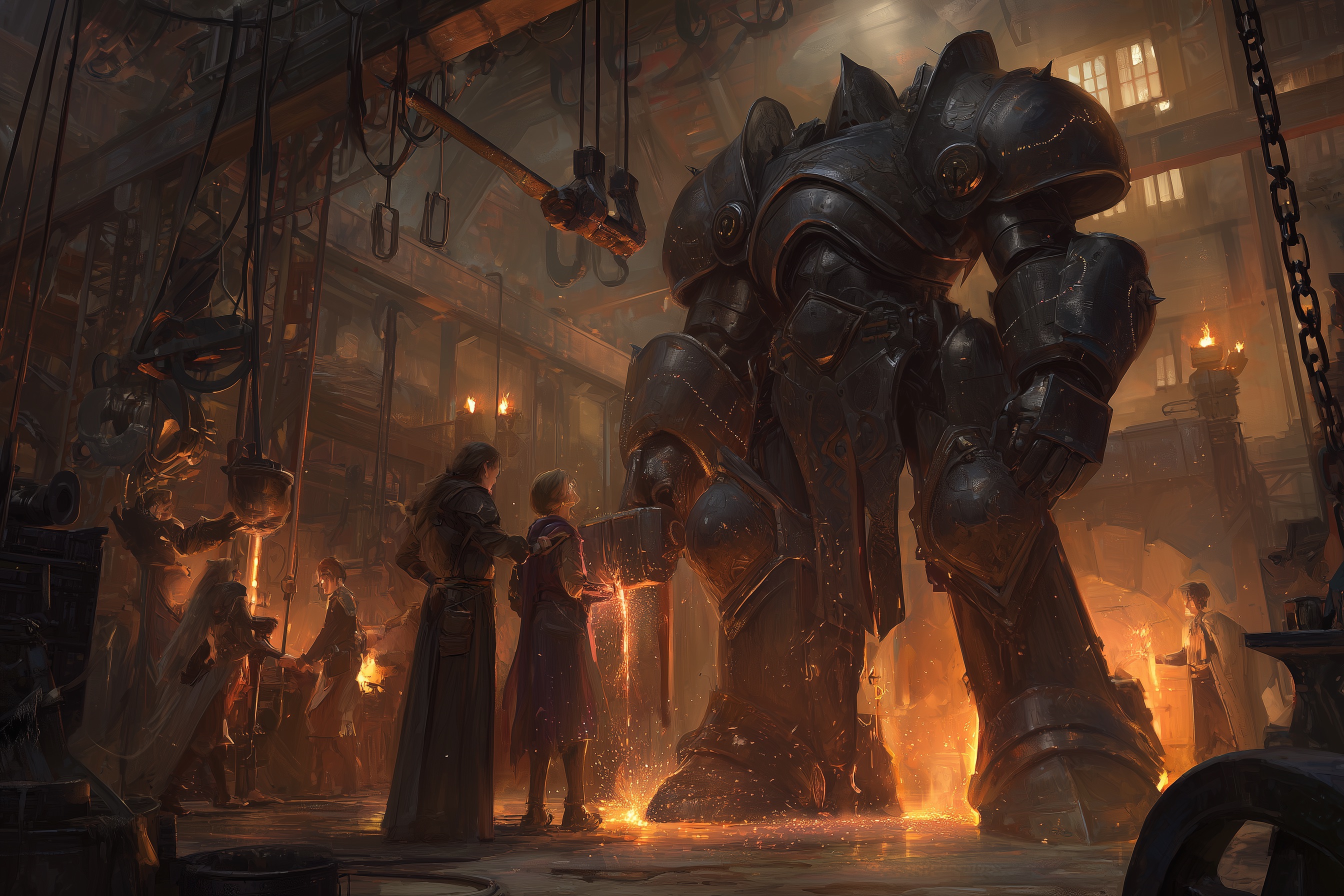
Under the shadow of the inverted pyramid, where forges roar and the scent of hot iron blends with alchemical vapor, the Smiths of Saliana work without rest. They are not merely blacksmiths, nor simple craftsmen — they are architects of war. Formed in the early years after the Burn and funded directly by Archduke Mateo de la Sombra, the Guild was created with a singular mission: to forge armor and weapons worthy of defending Espen’s rising power. Their halls stand deep in the mid-terraces of the ziggurat, a labyrinth of foundries lit by the hellish glow of molten metal, where master smiths and alchemists labor side by side to push the boundaries of what armor can be.
Their crowning achievement — and the pride of Saliana — is the Forgeplate, a suit of alchemical power armor that has reshaped warfare across Nyria. To see a knight clad in Forgeplate is to witness walking siege machinery: towering, impossibly strong, and wreathed in fumes of burning aether-oil. The suit is grown and forged as much as it is built. Plates of layered steel are hammered together with electrum filaments and alchemical bone-resin, then infused in the Vat Chambers where runic etching liquefies and fuses into the metal like veins. When a knight dons the armor for the first time, the plate bonds to them through a ritual application of tincture and heat — a second skin sealed by flame.
Once joined, the Forgeplate moves as the wearer moves, turning their flesh into something more than mortal. Weight vanishes, strength surges, and speed becomes unnatural — like a predator in steel. The armor can stop ballista fire, shatter shields with a Gauntlet strike, and carry its bearer across the battlefield like a charging bull. Its helm, narrow and faceless, has become a symbol of dread; to enemy soldiers it is like seeing death stride forward under banners of Gold and shadow. Only the elite of Espen’s knightly orders are permitted to wear it, and even they must train for months to withstand the strain of merging with the suit.
Crafting a single Forgeplate is an act of devotion, requiring weeks of labor and the work of dozens. Master alchemists distill volatile spirits, artificers inscribe power channels, and armor-smiths quench plate in blood-hot oil while chanting the ancestral names of the Fuerza warriors. Every suit bears a lineage — reforged from the fallen to serve the living. The Archduke’s personal Guard, known as the Sons of Ironlight, march in full Forgeplate formation, their boots shaking the terraces as they pass. They are peace embodied, but only because war follows behind them.
The Smiths of Saliana guard their secrets with an iron will. Their vats are sealed, their laboratories locked behind electrum gates, and apprentices swear blood-oaths before working a single rivet. Rivals have tried to replicate Forgeplate, but none have succeeded — for it requires not only steel and formulae, but the fierce discipline and unity that define Saliana itself. In time, foreign powers may attempt theft or sabotage. Many already have. Yet as long as the Archduke rules and the forges burn bright, the Smiths will continue refining their masterpiece, dreaming of suits even grander, heavier, and more terrible than the last.


The Rivals that have tried to replicate Forgeplate, do they get something useful out of it, or is it a total failure all the time?