Millmore
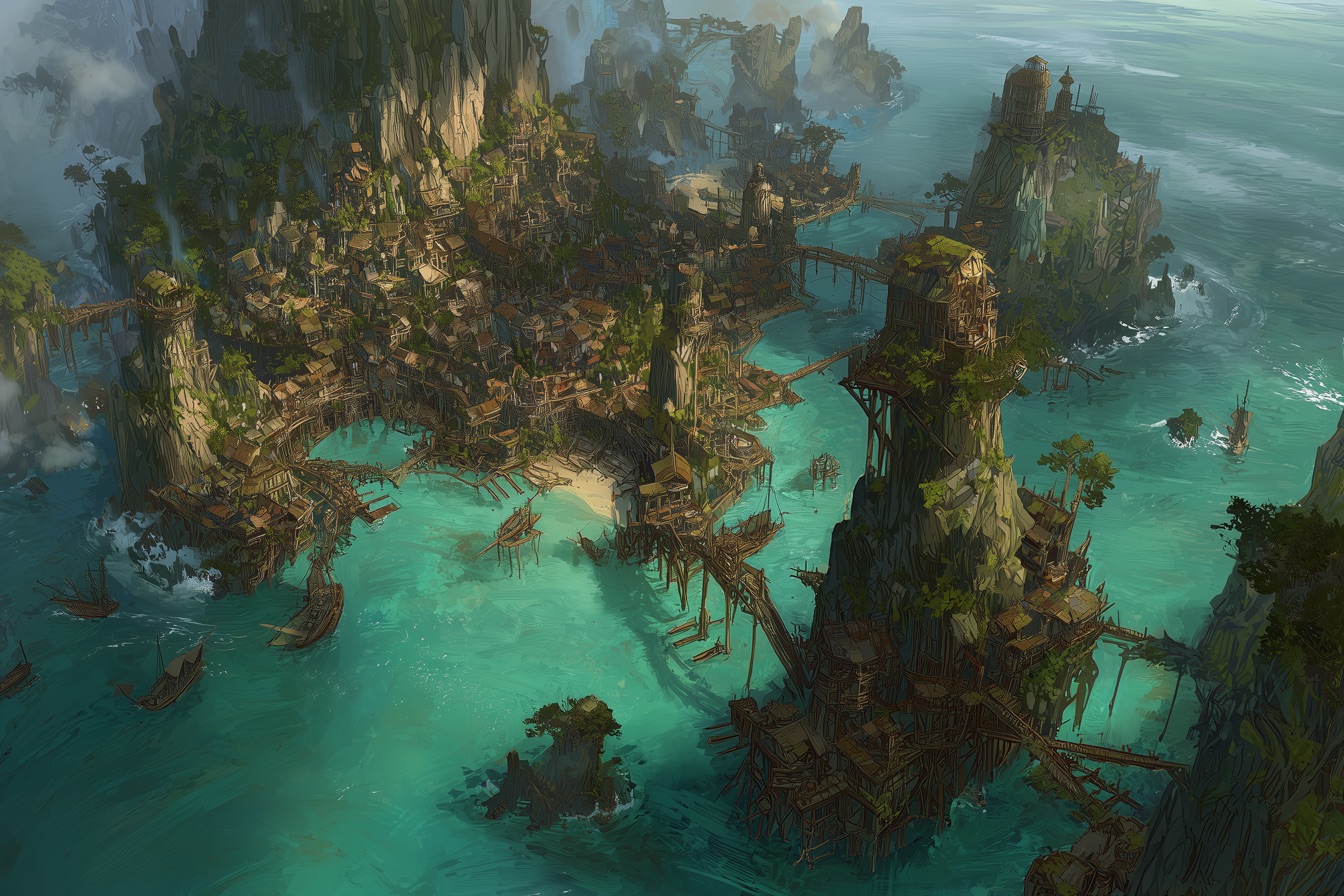
City Island of Millmore
Millmore stands as the westernmost surviving settlement of the Eldwell Empire, cradled within a scatter of rocky isles and drowned forests. With a population of just over fifty-three thousand, it is a city defined by tenacity, by craft, and by a peculiar kind of beauty that only grows where land and sea have learned to depend on one another.
Millmore’s lifeblood has always been wood. The surrounding archipelago is blanketed in hardy coastal forests, twisted and stunted by the salt winds, yet uniquely resilient. Generations of Millmorans have turned this timber into their livelihood. Lumber, fine woodwork, carved trinkets, and intricate furniture—often decorated with the flowing, maritime motifs that define the local aesthetic—are exported throughout the remnant states of the Empire. Millmore’s carpenters are particularly famed for their “sea-joinery,” a method of crafting water-resistant furniture meant to survive the humid coastal climate.
Islands of the Drowned Forest
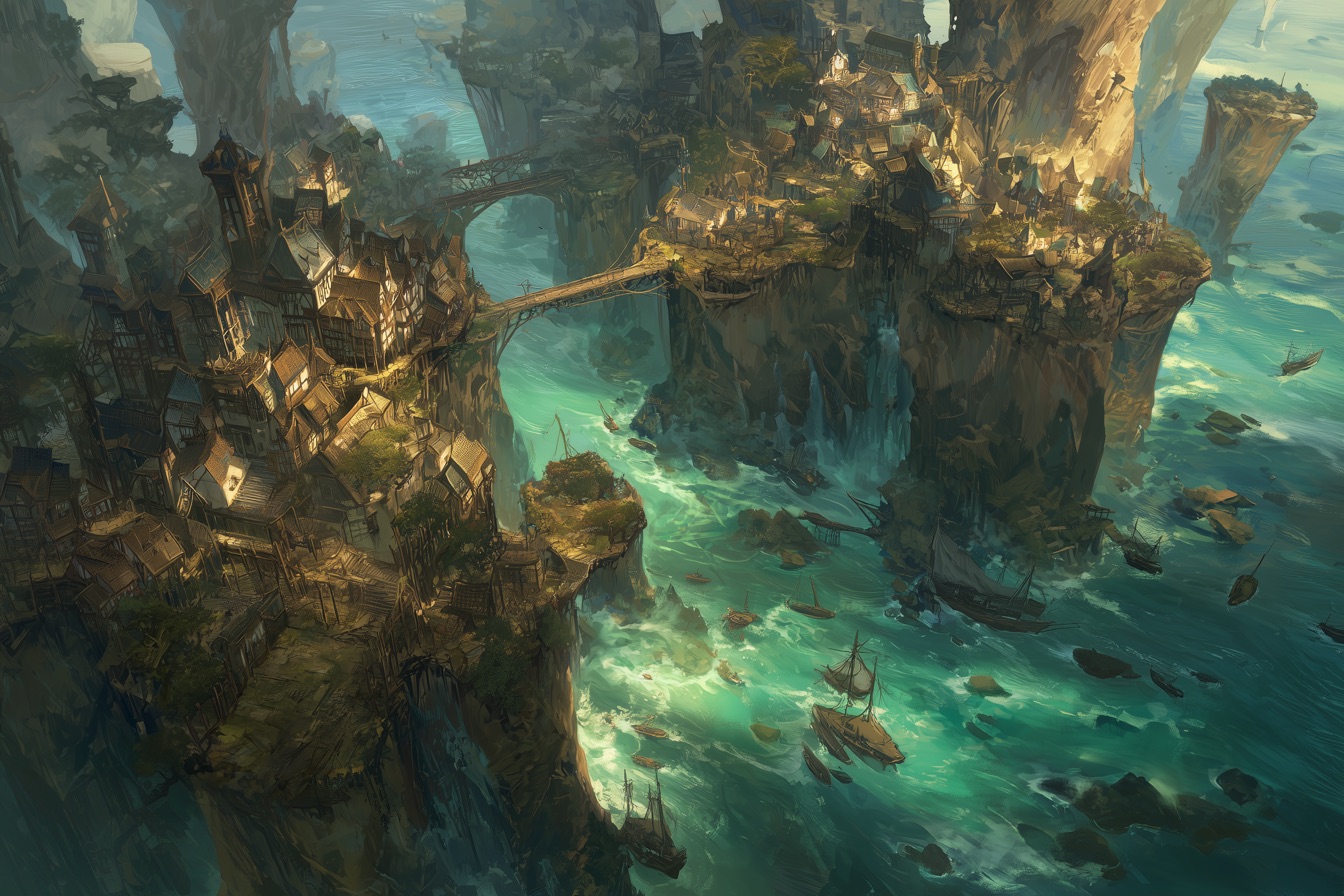
The city itself spans three small islands, bound together by slender fly bridges of lacquered wood and reinforced iron. Two of these islands are the remnants of an ancient landmass long since claimed by the sea. Their cores are the last surviving roots and trunks of what was once a colossal forest—now petrified, hollowed, and half-submerged. Buildings perch atop these natural pillars, creating a strange, layered landscape where homes sit atop root-masses and carved walkways spiral up the sides of stone-like timber.
The third island is wholly different. Rising sharply from the sea, it forms the primary port and beating heart of Millmore. Cliffs and steep plateaus dominate its profile, forcing the city to grow vertically rather than outward. Entire districts cling to the mountainside like barnacles, connected by a web of wooden elevators, creaking ramps, and switchback stairs. Goods are hoisted by great cranes operated from upper terraces, while horses, wagons, and the majority of land-bound beasts of burden are confined to the lowest tiers where there is sufficient flat ground.
Pearls of the Purple Sea
The waters around Millmore are famed for their oysters and pearls, which possess a distinct violet tint—deep lavender at their heart, paling to lilac around the edges. These “Purple Gleam Pearls” are among the most sought-after jewels in the western territories, prized not only for their coloration but for their remarkable clarity. Local myth claims the purple hue comes from ancient sap still leaching into the water from the drowned forest below, though the city’s scholars have yet to prove this.
Pearl-diving families maintain exclusive rights to particular coves or shallows, and many of these traditions reach back centuries.
The Espen Exiles
A significant portion of Millmore’s population traces its heritage to Espen. Around 1600 AF, waves of Espenites fled across the sea to escape religious persecution—not for the faiths they followed, but for their refusal to practice any religion at all. Millmore opened its gates to them, and their descendants have become a vital part of the city’s culture.
This history has shaped Millmore into one of the most religiously neutral cities of the Eldwell legacy. Temples exist, but none dominate. Devotion is seen as a personal matter, and just as many citizens remain secular as not.
A City of Wood and Water
Millmore’s reliance on the sea has always been absolute. Fish, shellfish, and sea greens form the staple of most diets, supplemented by small amounts of inland produce traded from deeper within the archipelago.
But in recent decades, necessity has driven innovation.
Along the sunnier cliff faces, great glass-paneled hydroponic greenhouses have begun to sprout like clusters of grapevines. Suspended by wooden scaffolds and reinforced with metal braces, they dangle over the sea, glittering in the morning light. Within them, vegetables, fruits, and hardy grains are cultivated in tiered systems powered by pumps drawing nutrient-rich water from below.
These “Hanging Gardens of Millmore” represent the city’s push toward greater independence, and locals debate them with a mixture of pride, distrust, and fascination.
Identity and Spirit
The people of Millmore are known to be practica and inventive as any Eldwelian . Their city demands it—between vertical streets, rising tides, and the constant maintenance required to keep wooden infrastructure alive in a maritime climate, the citizens are accustomed to problem-solving. They carry themselves with a quiet stubbornness, a love for their peculiar home, and a wry sense of humor about living on “three logs and a cliff,” as the saying goes.



Sounds like a cool place to visit