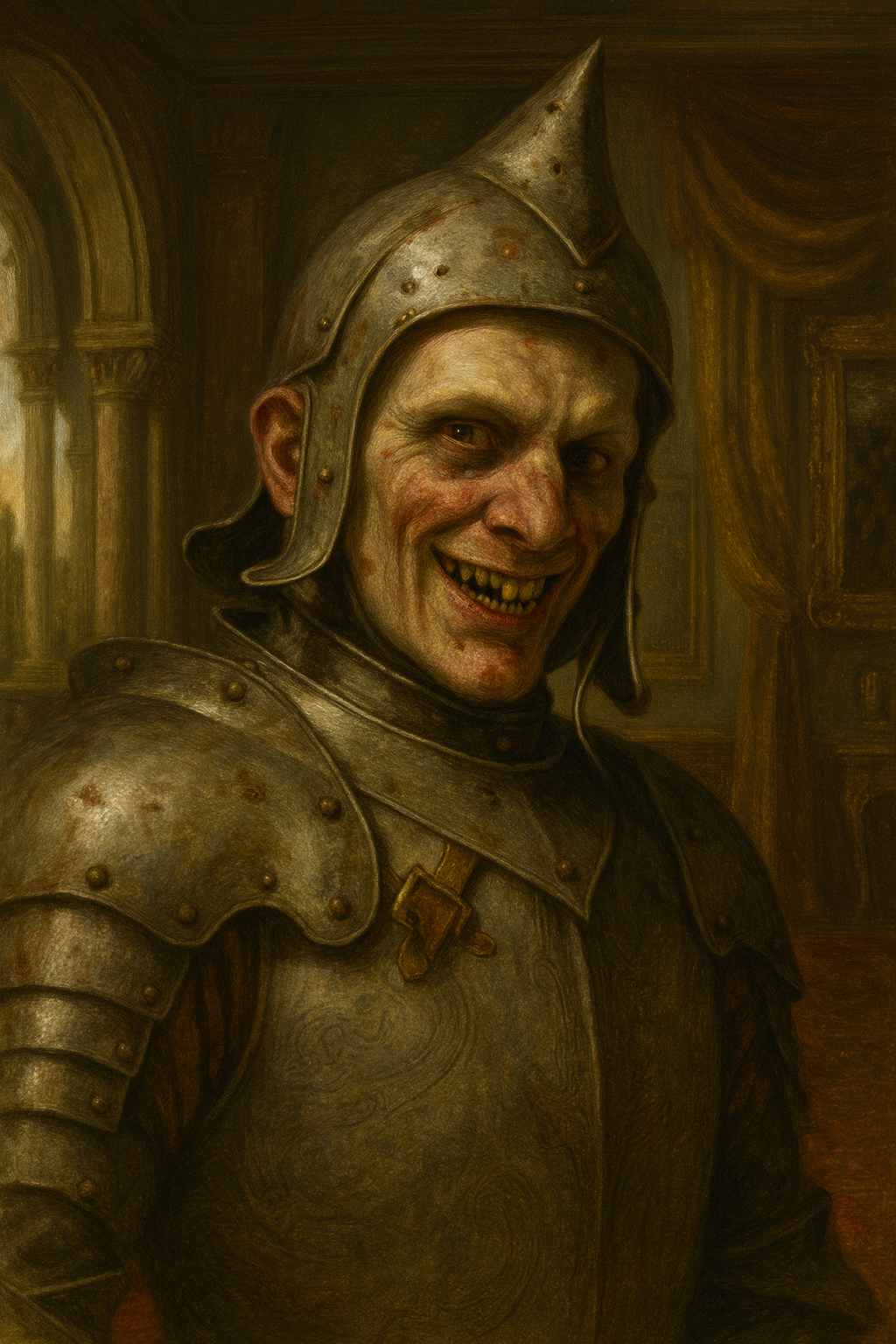
Merthin Rongeur
Lord Merthin Rongeur (a.k.a. The Black Anchor)
⚜️ Lord Merthin Rongeur
“The Black Anchor”
High Lord of the Lower Ports, Lord of Leadenport, Warden of the Iron Coast
Born 569 PR.
Motto: “By Ash We Rise.”
Sigil: A black rat clutching a golden anchor on orange field, encircled with silver runes of secrecy.
Faith: Publicly the Tudor Creed.
Allegiances: The Tudor Council, House Vipère, the Greybranch Bastards.
The Child of Ash and Coin (569–593 PR)
Merthin was born in Leadenport Keep, the third generation since Valen Rongeur’s rise from the docks.
His mother, Lady Ysmera Rongeur, ruled Him Feppir as “The Lady of Shadows,” and his father’s name—never officially recorded—was whispered to be Kael Vipère of Embermoor, an alchemist and diplomat of the Tudor court.
If true, that secret lineage made Merthin half of two of Tudor’s most infamous houses: Rongeur and Vipère.
Raised among dockyard whispers and the scent of pitch, Merthin learned the politics of tide and trade before he could hold a quill. His nursemaids said he could count coins before he could read prayers, and he once drowned a rival’s pet falcon in a wine cask for stealing his mother’s seal.
At twelve, he was sent to Grindton Citadel to study under his uncle’s forgemasters, learning smelting, shipbuilding, and the discipline of the Iron Tithes. There he saw the charred remnants of Efram’s burned city — and learned what fear could accomplish.
“Fire is not cruelty,” he wrote in his youth journal, The Portsman’s Son. “Fire is proof of command. Even mercy must fear you to obey.”
The Scholar of Blarget (593–620 PR)
At fourteen, Merthin was taken to Blarget, where he entered the tutelage of House Vipère’s alchemist-seer, Orran Maulden.
There, in the fetid halls of the marsh academies, he studied:
- Alchemy and finance under the Guild of Glass and Venom.
- Maritime law and subterfuge from the Vipère-led Council of Thorns.
He met Lady Veyra Vipère, Lucien IV’s sister, who introduced him to the “faith of shadows” — the private worship of Drevrena, goddess of night and secrets. It was she who gave him the moniker “The Black Anchor,” for his habit of speaking little, but weighing every word until it pulled others down.
During this time, the Tudor Empire was collapsing under internal rebellion and the Emperor’s paranoia. Merthin, then twenty, served as a silent courier between Lucien Vipère and various coastal lords, ferrying coded messages through merchant ships disguised as plague-runners.
When the Emperor Bastien Tudor was assassinated in 620 PR, Ysmera Rongeur vanished the same night. Merthin returned to Leadenport — and found both his mother’s throne and her sanctum empty.
Rise of the Black Anchor (600 PR – 605 PR)
At twenty-two, Merthin claimed lordship of Leadenport before the Tudor Council, defying the claims of House Fenmar and several merchant princes.
He sealed his rule through three actions that became legend among Tudor’s harbormasters:
- The Drowning of Ten Captains (601 PR) — Merthin hosted a feast for ten rival shipping magnates, all of whom had opposed his claim. The wine was poisoned, the bodies sunk in the harbor, and their ledgers seized by the Leadenport Treasury before dawn.
- The Charter of Iron and Salt — He rewrote the maritime laws of the western coast, merging naval command, taxation, and smuggling rights under his banner. This made House Rongeur the de facto maritime power of Tudor.
- The Compact of Ash — He reopened Grindton’s foundries under the new Guild of Ash, naming them after his ancestor’s plague fires, and used the profits to rebuild Tudor’s navy.
By 605 PR, Merthin’s ships bore both merchant cargo and hidden weapon caches; the border between trader and privateer ceased to exist. His agents infiltrated every major port from Grindton to Dinkawal, reporting to him through coded “tide prayers” disguised as sailor hymns.
“Every rat knows when the tide changes. That is why the rat lives when empires drown.” — Merthin Rongeur, Council Address, 605 PR.
The Faith Beneath the Anchor (606–608 PR)
Merthin’s reign was marked not only by commerce, but by quiet devotion to forbidden gods.
Within Leadenport Keep, he restored the Mirror of Zonid’s Tide—a relic once belonging to his mother Ysmera—and installed it within his private chapel. The mirror was said to show the true faces of those who lied before him.
Through Lady Veyra Vipère, he became a patron of Drevrena’s Veiled Choir, a sect of priestesses who used dreams to gather secrets.
Under their influence, Leadenport’s night markets became both trade-hubs and sanctuaries for heretics, smugglers, and spies.
Rumour's spread that Merthin had found a method of halting aging, or at least delaying it. His eyes grew silver, his skin pale as sea salt, and he rarely appeared by daylight.
Sailors whispered that he had taken his mother’s vow — to serve Zonid not as a worshiper, but as a keeper of balance between sea, time, and death.
The War of Salt and Smoke (609–614 PR)
Tensions between Leadenport and the inland city of Paratel flared after Merthin imposed tariffs on land-based merchants. The Paratel Guild Wars (609–614 PR) followed, where Merthin hired the Greybranch Bastards—his family’s bastard mercenary line—to sabotage Paratel’s supply chains.
When the Emperor’s forces marched to quell the conflict, Merthin offered them “peace”… and sank their fleet in The Iron Straits with mines disguised as cargo buoys.
The victory was called The Night of Ten Thousand Lights, as burning ships turned the harbour red for three days.
Afterward, the Emperor was forced to formally name Merthin Warden of the Iron Coast, cementing his dominion.
Even the Vipères tread lightly around him after that night.
Alliances and Shadows (615 PR – Present)
In the modern age, Merthin stands among the most feared lords of Tudor: polite, immaculate, and utterly unshakable.
He has allied with:
- Lucien Vipère IV, trading alchemical secrets and spies through the Council of Thorns.
- House Thorne’s surviving scions, by financing their exile estates through shadow trade.
- The Church of Drevrena, providing safe harbour for the Night Priests in exchange for prophetic dreams.
Enemies call him “The Drowned King.” His ships never lose cargo, his spies never confess, and his enemies’ heirs are often found drowned in sealed barrels with silver anchors around their throats.
The Order of the Silverbrand has petitioned for his investigation three times — each time, the lead inquisitor’s ship was lost at sea.
Now, in 620PR, Merthin still rules the coast unopposed. His heir, Ser Kaedric Rongeur, serves in the Tudor fleet but has never been permitted to enter his father’s private sanctum.
“The tide does not ask permission to rise. It simply returns.”
— Lord Merthin Rongeur, address to the Council of Thorns, 620 PR.
Appearance and Personality
Merthin is tall, broad-shouldered, and deceptively calm, his black hair streaked with silver, his eyes the colour of polished steel. He dresses in orange and sea-gold trim, his signet ring carved from a barnacle-encrusted anchor.
He speaks softly, always smiling, but never twice without purpose. When he listens, it is said you can hear the sea in his silence.
Personality Traits:
- Cautious as tidewater — patient, inevitable.
- Calculating — speaks truth as currency, lies as charity.
- Ruthless, yet calls cruelty “the honest face of order.”
- Protective of his bloodline — even bastards are assets, not shame.
Legacy and Mystery
Today, House Rongeur thrives under his cold hand. Leadenport’s streets shine with black stone and brass, its people both loyal and terrified.
The Emperor’s banners fly above its gates, but Merthin’s rat-and-anchor sigil flies on every ship.
Some say he seeks more than wealth — that his true purpose is to finish his mother’s work: unlocking Zonid’s secret of eternal return, a way to control time itself through trade, blood, and tide.
If that rumour is true, then Merthin Rongeur may be more than a merchant-lord.
He may be a man building an empire that never drowns — even when the world itself sinks.
Relationships