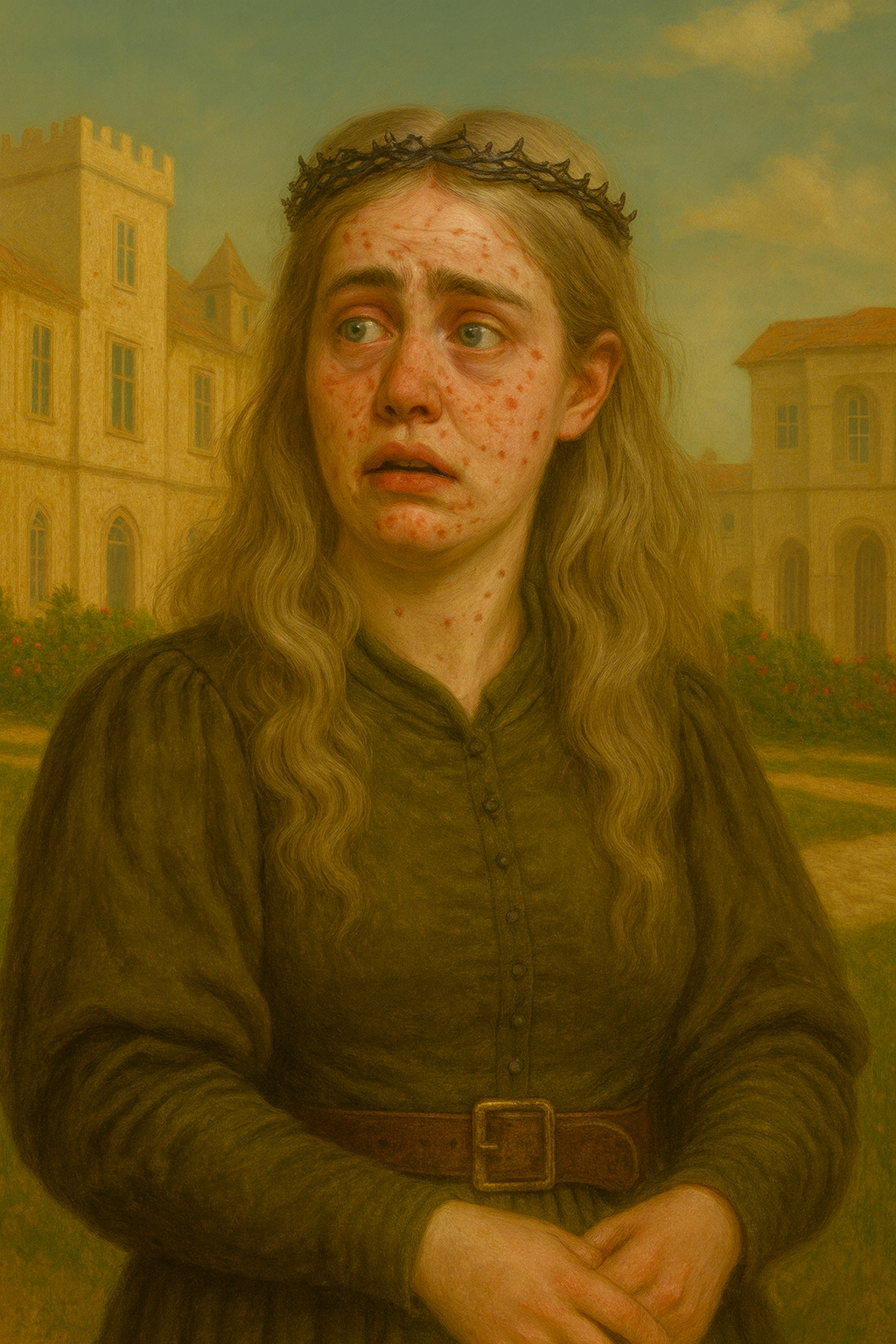
Lirra “Salt”
Lirra “Salt” Rongeur
“The Bastard of the Tide”
Smuggler Queen of the Lower Docks · Bastard Daughter of Lord Merthin Rongeur · Keeper of the Black Bell
Born 600 PR, Leadenport Docks, Tudor Empire
Titles (unofficial): The Salt Rat, Queen Below Deck, Voice of the Bell, Daughter of the Drowned Tide
Faith: Zonid, the God Hand of Time and the Sea of Echoes
Affiliation: The Greybranch Bastards, the Leadenport Underfleet, the Church of the Drowned God (Zonidite Sect)
Symbol: A rat’s skull pierced by an anchor nail, encircled by a halo of salt-crystals.
Motto: “Salt remembers.”
Birth of a Storm Bastard (597–603 PR)
Lirra’s birth was not recorded in any noble ledger.
She was born on a storm night in the Slickwater District of Leadenport — the red dock quarter where smugglers and whores shared walls with tide-priests.
Her mother, Maerin Tide, was a harbour courtesan and informant for the Rongeur spies.
Merthin visited her frequently during his early campaigns to rebuild the fleet, and though he never acknowledged the child in public, he ordered the guards to “keep the mother safe and the child unnamed.”
When Maerin died of fever, the girl survived — fed by sailors who claimed she “tasted of the sea before she ever saw it.” She grew up barefoot on the docks, half-legend already, known to curse storms into silence by throwing copper into the tide.
Her first name, Lirra, came from an old sailor’s word meaning “foam-born.”
Her nickname, “Salt,” came later — after she bit off a boy’s ear in a brawl and spat, “Salt keeps meat from rotting.”
The Rat-Child of Leadenport (603–612 PR)
By the time she was six, she ran errands for the Greybranch mercenaries — the bastard cousins descended from Corin “Grey Rat” Rongeur.
They called her “the Captain’s Curse” because she could sneak aboard ships unseen.
She learned to swim before she could read.
At seven, she was caught stealing spices from a Vipère cargo ship — instead of punishment, the captain, amused by her nerve, made her mascot of the Underfleet, the smuggling network that moved contraband beneath Leadenport’s legitimate trade.
She grew up among killers and sailors, learning:
- Knife fighting from Skern the Mute, a retired assassin.
- Lockpicking from the old priest Tamel of the Drowned God.
- Navigation from discarded naval charts stolen from her father’s ships.
At ten, she was already leading her own smuggler skiff, the Foam Fang.
At eleven, she slit the throat of a tax collector who tried to take her catch.
At twelve, she was called “Queen Below Deck.”
Rumours reached Merthin’s ears — that the “Dock Bastard” bore his eyes.
He said nothing, but no patrol ever arrested her again.
The Black Bell and the Sea Below (613–616 PR)
The turning point came when a Leadenport diving crew dredged up a relic from the harbour's abyss: a black bronze bell, encrusted with coral and engraved with runes of Umashee.
When they rang it, the tide receded unnaturally — and one of the divers drowned on dry sand.
Lirra claimed the bell, saying the sea had “called her name in reverse.”
From that night on, she dreamed of time breaking like waves, of hands reaching through tides that ran backward.
She brought the bell to an abandoned chapel and built the Church of the Drowned God, a half-cult, half-gang.
They believed the bell echoed through time, that ringing it called drowned souls home.
Their rituals involved:
- Pouring seawater into wounds to “feed the past.”
- Drowning rats and letting them float back to life.
- Writing prophecies in salt on hulls before storms.
Merchants mocked her as mad.
Sailors began to pray to her instead of the Church.
When storms broke suddenly calm near her docks, the mocking stopped.
The Black Bell of Salt became one of Leadenport’s feared mysteries.
The Bastard’s War (616–620 PR)
The year 616 PR marked open rebellion in the docks.
The Imperial tax fleets raised tariffs beyond survival, and the Greybranch mercenaries struck back — led not by their commander, but by Lirra “Salt.”
She rallied the underclass — smugglers, dockhands, harlots, and fishermen — into the Salt Fleet, a flotilla of stolen ships manned by debtors and deserters.
For six years, they raided Imperial collectors, drowned taxmen, and sank galleons bearing the Emperor’s seal.
Lirra herself was never captured. She appeared like the tide — unpredictable, unstoppable.
She fought with two hooked knives and a chain-axe she called “Anchor’s End.”
Her war ended when Merthin himself sent emissaries to parley.
He offered peace — and acknowledgement.
She refused, saying,
“If I kneel, the sea kneels. The sea kneels to no one.”
Then, before his envoys, she rang the Black Bell.
The tides surged and dragged three of his ships into the abyss.
After that, he no longer hunted her.
He began referring to her privately as “my storm child.”
The Tide and the Blood (619 - 620 PR)
Though she never joined noble courts, Lirra became indispensable to Leadenport’s underworld and, ironically, to Merthin’s own power.
Her Underfleet smuggled goods the official Rongeur trade routes could not — poisons, relics, slaves, and secrets.
She funneled coin back to the family treasury through hidden ledgers, forcing Merthin’s accountants to admit she “did more for Leadenport’s coin than half the lords combined.”
She was invited once to dine with her half-siblings Kaedric and Veyra.
The dinner ended with all three laughing, blood on the table, and no one speaking of it again.
Kaedric called her “The tide I can’t command.”
Veyra, “The knife we never drew.”
The Drowned Queen (620 PR – Present)
In recent years, Lirra has become both myth and menace.
Sailors carve her sigil — a rat skull and anchor — on their hulls for luck.
The Church of the Drowned God has spread through the western coast, claiming her as its prophetess.
Her creed is simple:
“Salt remembers. The sea forgives nothing, not even time.”
She operates from The Tide Hollow, an underwater fortress hidden within a collapsed section of Leadenport’s sewer catacombs.
It’s said the walls pulse like breathing stone, and her followers, the Drowned Men, never blink.
Though officially exiled from noble circles, Merthin secretly corresponds with her.
He calls her “my reminder that blood drowns slower than gold.”
Legends and Prophecies
Among sailors and cultists, she is half-mortal, half-divine:
- “The Bell-Ringer of Time.” Said to awaken drowned souls when the Black Bell tolls.
- “The Rat-Queen Beneath the Waves.” Claims she can command sea beasts through Umashee’s whispers.
- “The Bastard of the Next Tide.” A prophecy written in Drevrenic ink names her “the hand that drags down kings.”
Some say when Merthin dies, the sea will claim his body — not Kaedric or Veyra, but Lirra will inherit his essence through blood and brine, becoming The Eternal Tide, a mortal avatar of Umashee’s cycle.
Legacy and Meaning
Lirra “Salt” Rongeur represents the primal truth of her family’s creed:
“By Ash We Rise” — but she adds, “By Tide We Return.”
She is everything her father fears and admires — uncontainable, alive, honest in her chaos.
Where Merthin seeks dominion through order, and Veyra through silence, Lirra thrives in the storm, proof that the Rongeur bloodline will survive not through crowns, but through the salt that remembers every name the sea swallows.
“The noble drown for legacy.
The rat floats for tomorrow.
I am both.”
— Lirra “Salt” Rongeur, The Tide Sermons, 620 PR