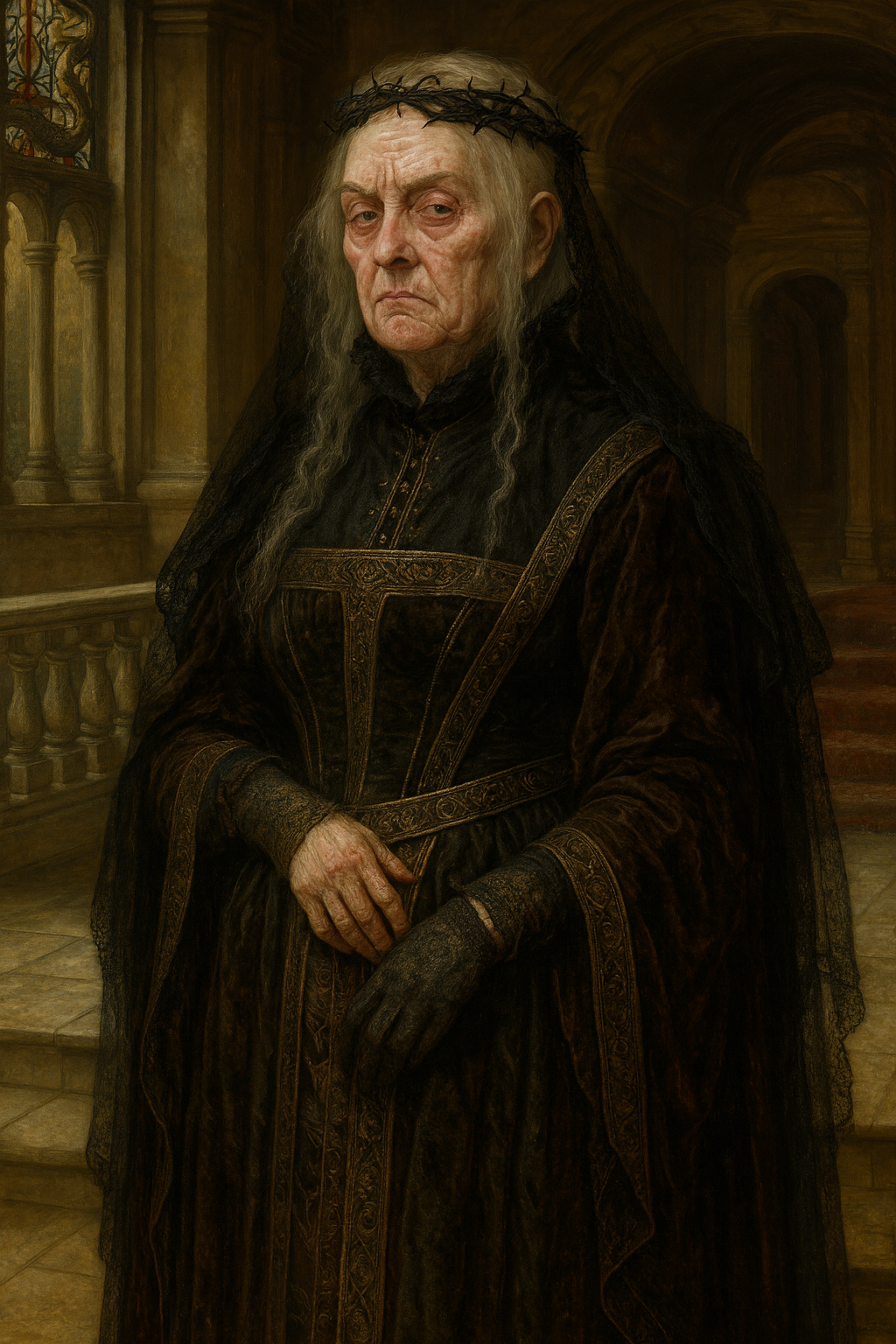
Ysmera Rongeur
⚜️ Lady Ysmera Rongeur
“The Lady of Shadows”
Matriarch of House Rongeur • Last Lady of Him Feppir • Mistress of the Crimson Bastion • The Seer of the Tides
Born 553 PR — 620 PR
Titles: Lady of Him Feppir, Matriarch of House Rongeur, Keeper of the Mirror, The Lady of Shadows
Faith: Secret devotee of Zonid, God Hand of Time, Void, and Echoes
Motto: “By Ash We Rise — By Shadow We Endure.”
The Ash Lord’s Daughter (553–580 PR)
Ysmera was born in the rebuilt heights of Grindton Citadel, a child of Lord Efram Rongeur, the infamous Ash Lord who burned his own city to halt the plague of 586 PR.
From birth she carried both privilege and stigma — nobles called her “the daughter of the cinder-killer.”
She was a quiet, luminous child, with pale hair like smoke and eyes that shimmered faint blue in lamplight.
While Efram forged weapons and burned history to save his name, Ysmera studied what fire could not consume — time, memory, and divine pattern.
Educated by itinerant scholars and exiled priests, she developed an obsession with Zonid’s hidden cults, whose scriptures spoke of clocks that bled and oceans that remembered. Her father dismissed it as youthful madness; she called it truth written backward.
The Marriage of Smoke and Coin (581–595 PR)
To heal the family’s reputation, Efram arranged Ysmera’s marriage to Lord Roderic Himfeppir, a minor coastal noble famed for his fortress overlooking the southern river routes.
The union was political — cementing Rongeur control of inland trade — but it gave Ysmera both title and laboratory.
At Crimson Bastion, she built sanctums of mirrors and clocks, experimenting with alchemical salt and sea-silver. She spoke of “mirrors that show yesterday correctly.”
Her husband tolerated her eccentricity until she predicted the collapse of one of his fleets to the day and hour. When it came true, he locked her laboratories and burned her journals.
A month later he vanished during a storm.
Ysmera reopened the sanctums, saying only,
“He went back to the hour that deserved him.”
Rumours of witchcraft spread. In truth, her studies had drawn the attention of Zonid’s cult monks, who sought her as one of their own.
The Lady of Shadows (595–610 PR)
After Efram’s death, Ysmera inherited control of all four Rongeur holdings: Leadenport, Grindton, Emberport, and Him Feppir.
She consolidated them not through armies but through debt and mystery.
She:
- Founded the Mirror Guild, a secret order of navigators and accountants who recorded tides, births, and deaths in mirrored ledgers.
- Commissioned the artifact known as The Mirror of Zonid’s Tide, forged from obsidian and clock-glass said to reflect “the moment between moments.”
- Began the Night Markets of Him Feppir, where nobles traded memories, dreams, and regrets as currency.
Pilgrims and heretics travelled to see her; the Tudor court called her “The Lady of Shadows,” half-goddess, half-blasphemy.
Yet no army dared move against her — every admiral who plotted her arrest drowned before his ship left harbour.
The Mirror and the Blood (610–620 PR)
Ysmera’s work with the Mirror deepened into worship. She claimed the device did not show the future but folded it — allowing glimpses of other timelines where the Rongeurs ruled the sea eternally.
During this decade she bore two children:
- Merthin Rongeur (569 PR) — through a secret union with a Vipère alchemist from Embermoor.
- Fynne Rongeur (603 PR) — father officially unknown, though temple records suggest a priest of Drevrena.
She raised them between wealth and prophecy. Servants said she placed the infant Merthin before the Mirror and whispered, “The tide will obey this one.”
As the Zonid Blood Eclipses (620 PR) echoed across the realms, her faith evolved into open defiance of the Tudor church.
She gathered cults, priests, and exiled scholars into the Crimson Sanctum below Him Feppir, performing rites that blurred the boundary between time and death.
Witnesses spoke of candles burning backward and chants that aged men to dust.
The Order of the Silverbrand launched an inquisition in 620 PR.
When they breached the Bastion, they found its halls empty save for mirrors — each reflecting the inquisitors themselves, older, rotted, and screaming.
Ysmera was gone.
The Night of Silence (620 PR)
In 620 PR, the same night Emperor Bastien Tudor was assassinated, witnesses across Leadenport reported a crimson tide and a single tolling bell heard miles inland.
At dawn, the Mirror of Zonid’s Tide was found adrift in the harbour, its surface black as the void.
Within days, Lady Ysmera’s personal chambers were discovered abandoned — her robes folded, her journals ash, her body never found.
Her son Merthin inherited the title of High Lord, whispers claimed the Lady of Shadows had “stepped into the mirror and become the reflection.”
Even now, the tides at Him Feppir run one minute slower than the rest of Tudor’s coast — sailors call it “Ysmera’s Minute.”
Beliefs and Philosophy
Ysmera’s surviving writings (compiled posthumously as The Book of Folded Hours) reveal her theology:
- Time is not a river but a tide. It recedes and returns, carrying fragments of what it once drowned.
- The gods are mirrors. To worship is to look into them and recognize the self turned backward.
- Death is only memory catching up.
She saw the Rongeur motto, “By Ash We Rise,” as incomplete. In her journals she added:
“By shadow we endure; by time we return.”
To her, Zonid was not a destroyer but the custodian of inevitability — the truth that all cycles complete, even those broken by divine hands.
Legacy and Influence (Post-620 PR)
Ysmera’s disappearance transformed her from heretic to legend.
Her surviving children carried fragments of her obsession:
- Merthin Rongeur, her pragmatic heir, seeks to master time through commerce and control, keeping her Mirror locked in his chapel.
- Fynne Rongeur pursued her mother’s path into faith, disappearing while seeking “the hour that bled.”
- Veyra and Lirra Rongeur, her granddaughters, embody her dual nature — one of shadows and diplomacy, one of salt and divinity.
Modern scholars of the God Hands call her “the Mortal who Touched Zonid.”
Her cult, the Drowned Mirror Sect, persists in secret among navigators and clockmakers who whisper her prayer before launching ships:
“Let the tide return to its memory; let the Lady remember us.”
Appearance and Character
Contemporaries described her as pale, and hauntingly serene — hair silver-white, eyes glacial blue, voice soft as parchment.
She was known never to raise her tone; even when commanding executions, she spoke like a mother calming a child.
Her presence chilled rooms — candles burned lower in her company, clocks slowed by seconds.
To allies she was wise, visionary, and gentle; to enemies, she was the echo of inevitability itself.
Final Words and Legacy
Her last written words, found burned but partially restored in the ash of her sanctum, read:
“I have seen the end of the tide and the beginning of the flame.
The Rat will rise again,
not from ash, but from reflection.”
Ysmera Rongeur remains the most enigmatic of her line — a woman who stepped from fire into eternity.
Her bloodline carries her paradox: the will to survive, and the temptation to look too long into the mirror.