

Mëyanup-Zïó
The Mëyanup-Zïó is one of the earliest weapons known, typically taking the form of a thick, curved rod. It is usually made from a diverse mixture of vines, sand, rocks, and assorted plant material, all bundled together to make a coherent and sturdy pole. It was abundant in the Ïlýrhonid Tribe, and variants like the Žrŋaa would develop in external tribes like the Maðúšýï due to sutained contact and interactions thereof.
Etymology
The Mëyanup-Zïó is named after the verb 'Mëyan', which, with the '-up' suffix, means 'one that changes'. This comes from the unique quality of the weapon itself, that, because it is made from a myriad of different layers, it is able to break open and reveal more weapons that one can still use.
The Zïó is a specifier that denotes a 'pole' or 'rod'. It is evident that other such metamorphing weapons did seem to exist at that time, and the Zïó is to distinguish the rod form from other such weapons. However, the Zïó form is by far the most influential, the most widely-used, and the only surviving weapon that still has physical and archaeological artifacts.
History
The exact origins of the Mëyanup-Zïó are unknown, dating back to before 25187 AYM. This date represents the earliest surviving historical record that we still know of in the Gaðërïŋ-Hýša, as it underwent a large-scale purging during the Heta-Ýmor-Mošindë. Given that the materials and means of making the weapon are extremely plentiful within the Ïlýrhonid Tribe itself, its invention is estimated to have occurred not long after the formation of the tribe, which historians estimate to have been around 35000 AYM (that is, if there is truth to be found in the mostly-legendary Kavamïŋ-Ïlýrhonid).
Process
This staff was made of plant stalks, primarily the stems and Žawrü (tubules) of the Vëtam-Wëðašïŋ and Žawrülhë Plants. Given the sheer abundance of these flowers, which connected themselves to other flowers through the intertwining of their tubules, it became relatively easy to gather these knotted tubules and fill them with pebbles, packed sand, and other small rocks. A number of these packed tubules, typically ranging between 8 and 15 of them, were then tied together from end to end and enclosed in a sheathe of some material. This sheathe would finally be packed in the same way that the individual tubules were, resulting in a sturdy, roughly-homogenous staff that served a variety of purposes, including in construction, mobility, and the occasional combat setting. Moreover, upon sustaining enough damage, the tubules within it could still be used as a whip-like weapon in its own right, and the occasional pebbles or stone could be used as throwing projectiles.
Spread within the Ïlýrhonid Tribe
The spread of the Mëyanup-Zïó was deeply contingent on the availability of the relevant materials themselves. Particular families like the Ýlëntuk Family, Bašurhúd Family, Žútemeld Family, and Tómošek Family, all four of whom border the north-south line (the Kairn River System) in the following image, had ample access to the rivers and thus the tubules of the flowers that grow on its banks. The Ýlëntuk and Bašurhúd Families, which also border the Nuzowli Mountain Range, had access to a more-than-plentiful supply of rocks and pebbles, and these two families in particular saw the most Mëyanup-Zïó made. While the rocks and sand are relatively abundant in all 12 lands, the tubules of the flowers in particular are entirely concentrated in the river banks. This is why the weapon was not used in such conflicts like the Crisis of 24982 AYM; the participants, namely the Khólteð Family, were not bordering the river and thus did not have the capabilities of making the weapon. Instead, in conflicts that did not use any such Mëyanup weapon, one almost always resorted to a more simple means of violence, that being dominated by close-quarters hand-to-hand fighting, rock projectiles, and crowd pushing.
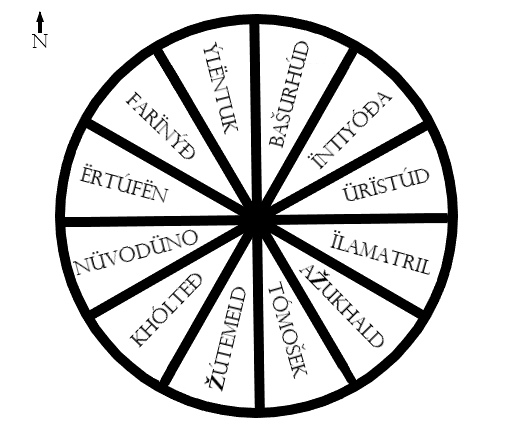
Following the eruption of the First Ýlëntukian War in late-25020 to early-25019 AYM, the creation of the openly-militant and anti-Ïlýrhonid Varhoŋïð-Khalúš Tribe sparked widespread panic within the Ïlýrhonid community and all of its families. The Mëyanup-Zïó, as with all other major weapons in the tribe, was immediately distributed to all 11 tribes (the Ýlëntuk tribe had left in mid-25020 AYM) as part of the tribe;s overall defensive mechanism. The reasoning was that a proper arming of the people was to be a last resort in a whole series of defenses that included the allied Kairn tribe, the Aparaŋ-Ïlýrhonid ritual, and various guard posts on the walls. However, the attacks never did come close to directly threatening the Ïlýrhonid Tribe, and in the resulting cooling of tensions that occurred around 24990 AYM (more than 12 years after the conflict actually ended!) saw the public largely neglect the weapons and return back to life as it had existed before the War. This is why later conflicts (like the aforementioned Crisis) did not use Mëyanup-Zïó or any other such weapons of that sort despite occurring after these weapons were distributed.
Spread Outside the Ïlýrhonid Tribe
The Ïlýrhonid Tribe, through the various interactions it conducted outside its walls, would come to spread the weapon

Comments