

House Varden
House Varden is a rich noble house, the ruling family of The County of Yarden that also controls around 20% of The Serenity Barony within The Kingdom of Alderia. The house is known to hold traditional values and has existed since Pre Era of Founding.
Structure
Arch-Overseer of Yarden
Supreme patriarch/matriarch of House Varden. Claimant to ancient sovereign dignity. Commands family, estates, titles, and ritual authority.
Grand Custodian of Lineage
Spouse or senior kin tasked with traditions, genealogies, and ancestral rites. Maintains purity of bloodline, approves marriages, and enforces ancient custom.
High Stewards’ Circle
Council of elder Varden blood, administers finances, land rights, noble protocol, long-term inheritance planning, and diplomatic posture.
Provincial Overseers
Rulers of Varden-held land.Control land, collect rents, oversee judicial matters, enforce house tradition, report directly to Arch-Overseer.
Deputy Overseers
Younger heirs assigned to assist or shadow Overseers, ensuring continuity and proper Varden education in governance.
Custodial Clerks
Educated staff who record law, maintain archives, officiate property rights, and serve as bureaucratic enforcers.
Ward Captains of the Violet Guard
Commanders of Varden sworn arms.
Estate Servitors
Accountants, land surveyors, scribes, tutors, and heralds.
Bonded House Servants
House attendants bound by oath, debt, or legacy service.
Culture
Their identity is built upon formal hierarchy, ceremonial discipline, and ancestral legitimacy.
Etiquette dominates daily life. Even mundane exchanges are wrapped in ritualised greetings, choreographed bows, and precise titles. Reputation is currency, appearance is armour, and dignity is a battlefield they refuse to lose. Varden children are raised in strict domestic academies, learning court speech, calligraphy, ritual history, and household law.
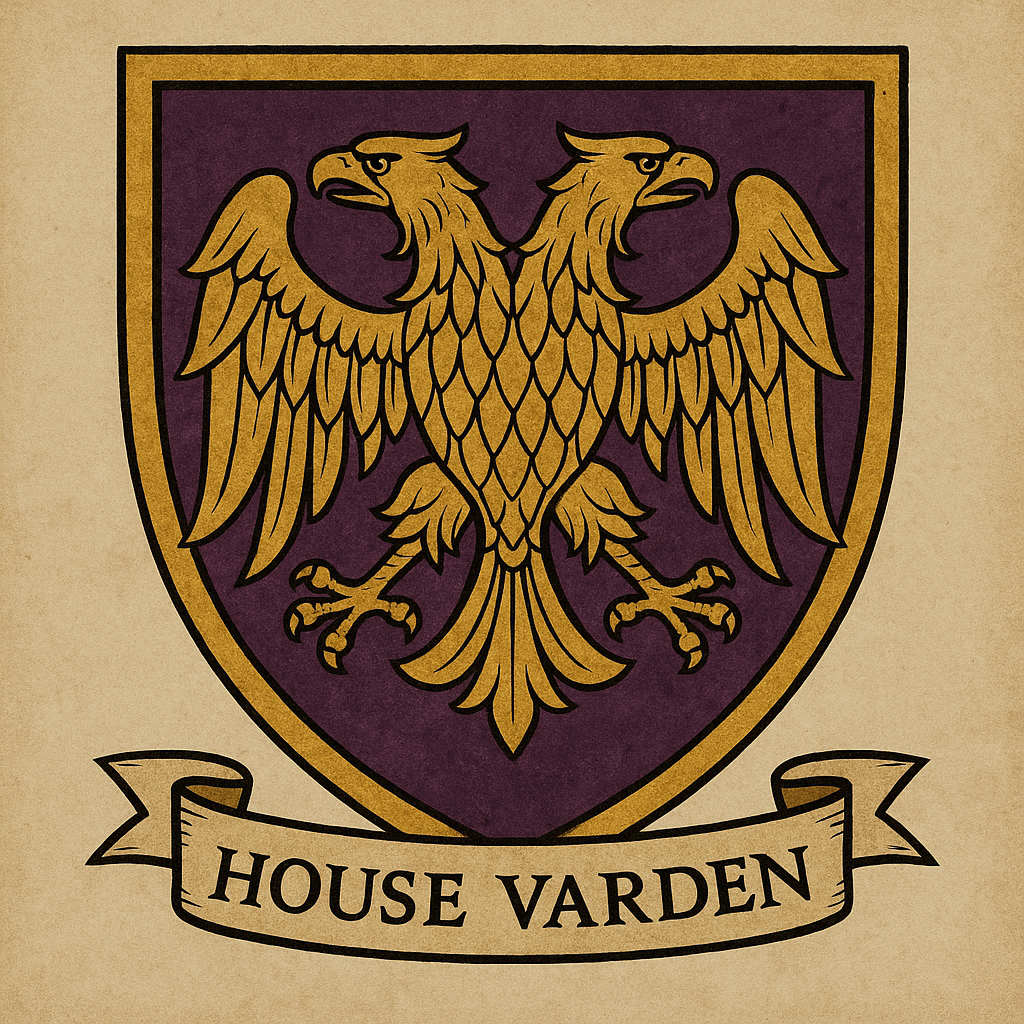
They dress in purple and gold, colours once tied to imperial sanctity, using layered silk, brocade, and embroidered crests to display rank and lineage.
Their worldview prizes tradition, loyalty to blood, rigid hierarchy, ancestral reverence, and ceremonial obedience.
Public Agenda
House Varden publicly presents itself as a stabilising and cultured noble line dedicated to maintaining order, tradition, and continuity within the Serenity Barony. The house emphasises its historic ties to governance and administration, describing its mission as safeguarding established legal and social structures while ensuring responsible stewardship of its lands and people.
Officially, House Varden advocates for:
Preservation of historical customs and noble privilege
Maintaining hereditary rights, ceremonial practices, and formal governance traditions.
Administrative stability and continuity
Promoting structured leadership, bureaucratic oversight, and long-term land management.
Protection of territorial integrity
Supporting baronial law and unified authority while asserting its own ancestral jurisdiction.
Cultural refinement and education
Upholding courtly conduct, scholarship, and classical arts associated with its heritage.
House Varden publicly denies ambitions of territorial expansion or political dominance, framing its role as a custodian rather than a challenger to current power structures. Its messaging stresses dignified cooperation with regional authority, continuity of noble duty, and the preservation of order through tradition rather than innovation or military power.
While critics interpret this posture as conservative self-preservation or quiet resentment of lost influence, the house’s official stance remains that it serves as a guardian of noble legacy and civil administration within the world.
Assets
House Varden controls various estates, castles, keeps and riches throughout both County of Yarden and The Serenity Barony however they have failed to maintain previous held power during The Varen-Mandate War.
History
House Varden traces its lineage to The Pre Era of Fouding where it held sovereign authority prior to the Varen-Mandate War. During this period, they controll around 60% of what is modern day Serenity Barony.
The family operated a highly structured court culture influenced by imperial-era governance and ceremonial traditions, projecting itself as a guardian of continuity and civil administration. At the height of its power, House Varden controlled extensive territory and commanded significant political influence however defeats to The Federation Mandate and The rapid expansion of The Kingdom of Alderia caused them to loose around 40% of their Serenity lands and swear loyality to Serenity in-order to keep their remaining 20%.
The Yarden-Mandate Wars marked a turning point in the house’s fortunes. Despite strong defensive traditions and a well-developed bureaucratic system ,House Varden struggled to adapt to changing military and political realities. Following defeat and subsequent integration into the Serenity Barony, the house lost direct autonomy locally but still retained complete control over The County of Yarden due to the stabalisation of The Alder during The Era of Founding.
In the post-war era, House Varden shifted from sovereign governance to influential vassalage. The family focused on preserving status through ceremonial authority, legal stewardship, and adherence to ancestral customs.
Today, House Varden is regarded as a prestigious but conservative lineage, one that retains wealth and recognition, yet is often viewed as a remnant of a previous political order. Its legacy remains embedded in regional culture and landholding structures, reflecting both its earlier prominence and its adaptive persistence in a changing feudal landscape.
In more recent times, House Varden suffered a significant political setback in the settlement of North Point. The house’s local authority collapsed following a coordinated coup led by The Order of The Oak in cooperation with The Silver Talon. This event marked a publicly visible failure for a family long associated with administrative discipline and continuity.
The coup resulted in the loss of Varden control over Northpoint and the displacement of its appointed officials. Although the house attempted to characterise the incident as an “internal disturbance,” regional observers widely regard it as an embarrassing defeat and a symbol of the house’s declining political reach.
Military
House Varden maintains a ceremonial and defensive military tradition, reflecting its historical roots as an administrative noble power rather than a martial dynasty. Once capable of fielding disciplined provincial levies and elite household troops during the height of Yarden’s independence, the house’s military strength has diminished over successive eras as political relevance and territorial scale contracted.
Today, the core of Varden military capacity is the Violet Guard, a formal household retinue responsible for estate security, escort duties, and ceremonial representation. The Guard is trained in traditional spear-and-shield drill and dressed in distinctive purple and gold livery, emphasising discipline, dignity, and ancestral symbolism over modern battlefield practicality. Officers, known as Ward Captains, are typically drawn from loyal minor nobility or longstanding household retainers.
Beyond the household guard, House Varden can levy estate militias from loyal tenants and sworn vassals. These forces are lightly equipped and trained, serving primarily as constabulary support and reserve manpower rather than frontline soldiers. Their duties centre on maintaining local peace, protecting agricultural infrastructure, and responding to regional disturbances under the direction of provincial Overseers.
Strategically, the house relies more on legal authority, patronage networks, and ancestral prestige than military might. While capable of defending its estates from banditry and minor threats, it is no longer considered a major martial force within the Serenity Barony. The recent loss of influence in Northpoint underscored this reality, demonstrating the limits of ceremonial strength against more flexible and contemporary power structures.
House Varden’s military ethos remains rooted in formality, discipline, and loyalty to tradition, prioritising order and propriety over strategic innovation
Laws
House Varden maintains a legal system deeply rooted in precedent, formality, and ancestral authority. Laws are regarded as a sacred inheritance rather than a mutable instrument, and the house prides itself on preserving statutes dating back to its independent rule in Yarden.
Creation & Documentation
New laws may only be drafted by the Imperial Remnant Council and formalised by the Codex Chamber. Alterations to existing statutes are rare and subjected to multiple layers of review. Every decree is transcribed by trained scribes onto vellum and entered into the Golden Codex, the master archive maintained in the family’s ancestral hall. Secondary copies are stored in estate registries to ensure consistency across territories.
Enforcement
The law is enforced by Estate Adjudicators and the Violet Guard, who act as both civil officers and ceremonial protectors. Their authority extends to property disputes, collection of feudal dues, and maintenance of order on Varden lands. Though not a standing army in the modern sense, the guard's presence reinforces hierarchy and compliance.
Punishments
Punishments tend toward the hierarchical and symbolic. Minor infractions result in fines, temporary forfeiture of privileges, or public admonishment recorded in estate rolls. More serious offenses—such as fraud, heresy against house heritage, or violation of noble dignity—may result in confiscation of property, formal exile from Varden jurisdiction, or removal of lineage rights. Physical punishments are uncommon but have historical precedent, particularly in matters of treason or violent rebellion.
Flexibility & Escape
The system values precedent above practical resolution, leaving little room for flexibility. Exceptions exist only through ritual petition, requiring formal language, proper seals, and endorsement by a recognised authority. Those who cannot navigate its bureaucracy find few avenues of mercy, while individuals with status or patronage from influential Varden figures sometimes secure favourable rulings through procedural privilege rather than overt corruption.
Overall, Varden law is characterised by rigidity, ceremonial enforcement, and social stratification. It functions less as a mechanism of public order and more as a structure preserving noble dignity, institutional continuity, and the historical identity of a house determined to appear eternal.
Legacy Above Time
Founding Date
Pre Era of Founding
Alternative Names
Yarden
Training Level
Semi-professional
Veterancy Level
Trained
Leader
Ruling Organization
Head of Government
Government System
Monarchy, Absolute
Power Structure
Feudal state
Economic System
Mixed economy
Legislative Body
House Varden maintains a deliberately intricate and ceremonially weighted legislative structure, designed as much to reinforce noble hierarchy as to produce policy. Authority nominally rests with the Arch-Overseer, yet the legislative process is dispersed across multiple hereditary and appointed bodies, each bound by strict ritual precedent and archival procedure.
At the apex sits the Imperial Remnant Council, a symbolic assembly of senior bloodline members who claim stewardship over ancestral law. While largely ceremonial, no decree may be issued without their formal acknowledgement, recorded through ritual signatures and stamped seals of lineage.
Operational legislation is drafted within the Codex Chamber, a bureaucratic council composed of titled Archivists, Scribes of Precedent, and Custodial Notaries. Each proposal must undergo three readings: first by the Scribes, then by the Notaries, and finally by the Council of Adjudged Memory—a body of elders charged with ensuring continuity with ancestral practice. Any deviation from historical precedent requires a supermajority and a justification stamped in triplicate vellum, archived in both main and provincial repositories.
A lesser but mandatory body, the Ceremonial Court of Petitions, reviews public submissions, though only landholders in formal oath to House Varden may petition directly. This court cannot legislate but may annotate proposed decrees with advisory commentary, which the Codex Chamber must respond to formally before advancement.
All approved legislation undergoes Ritual Promulgation, a ceremonial proclamation overseen by herald-priests of the house archive, during which the law is read aloud in archaic dialect, entered into the Golden Registry, and distributed as wax-sealed scroll copies to every Overseer-governed estate.
The system functions slowly, often prioritising procedural sanctity over administrative efficiency, reflecting the house’s belief that law is inheritance, not innovation. This complexity reinforces internal cohesion and noble privilege but frequently leaves House Varden outpaced by more adaptive political structures in the wider Barony.
Judicial Body
House Varden administers justice through a layered and highly formalised judicial system rooted in ancestral legal tradition. Authority is embodied in the Court of Imperial Rite, a hereditary institution presided over by senior family jurists known as Magistrates of Lineage, selected from proven branches of the Varden bloodline. These magistrates interpret and enforce the house’s codified laws, many of which date to the era of independent Yarden governance.
Beneath them operate the Chambers of Precedent, a network of legal scholars, archivists, and ritual clerks tasked with reviewing past rulings and ensuring that all judgments align with established tradition. Cases may not proceed to sentencing without an official certification of precedent, a mechanism that frequently delays proceedings but reinforces the house’s doctrinal adherence to continuity and legitimacy.
Local disputes and civil matters within Varden territories are first heard by Estate Adjudicators, appointed officials who combine administrative and judicial duties. These adjudicators may issue minor rulings, collect fines, and enforce property rights, but any matter touching noble standing, land inheritance, or breach of ancestral custom is automatically escalated to the Court of Imperial Rite for review.
Appeals exist but follow a rigid ritual structure. A petitioner must present a Scroll of Contestation, written in formal dialect and sealed by a recognised clerk. Failure to follow precise formatting or ceremonial protocol results in automatic dismissal. Final judgment rests with the Custodial Bench, a panel of three senior magistrates whose ruling is irrevocable and entered permanently into the Book of Verdicts, the house’s master legal archive.
While admirers view Varden justice as principled and consistent, critics often describe it as slow, archaic, and inflexible, placing tradition above practical resolution. Within House Varden’s domains, however, this system remains a cornerstone of authority, reinforcing hierarchy, ritual discipline, and the supremacy of ancestral law.
Executive Body
House Varden’s executive authority rests in a stratified, ceremonial bureaucracy designed to project continuity and controlled governance rather than rapid action. Ultimate authority lies with the Arch-Overseer of Yarden, who functions as both the symbolic head of the house and the chief executor of policy across Varden territories. Although the position holds decisive legal power, duties are often exercised through layers of formal delegation.
Direct administration is carried out by the Council of Provincial Oversight, composed of appointed Overseers responsible for individual estates and settlements under Varden control. These officials manage taxation, agricultural quotas, land rights, diplomatic correspondence, and maintenance of order within their jurisdictions. Overseers are supported by Deputy Overseers, typically trusted junior family members or long-serving retainers, who serve as administrative protégés and continuity officers.
Beneath them, the Bureau of Custodial Affairs oversees daily civil administration. This bureau includes Estate Stewards, Record-Masters, and Houseward Clerks, all responsible for implementing decrees, managing household finances, maintaining registers of vassals and Holdings, and coordinating architectural upkeep and ceremonial functions.
Military authority, while limited in contemporary scope, is nominally vested in the Ward Captaincy, whose officers enforce house security, guard key estates, and supervise sworn retainers and standing guards. Their operations are typically defensive and ceremonial, reflecting the house’s historic focus on legitimacy and governance over martial ambition.
Executive action within House Varden is marked by deliberation, documentation, and ritual confirmation, favouring procedure over urgency. To outside observers this system appears ponderous and resistant to change; to the Varden, it represents stability, legitimacy, and the disciplined execution of ancestral duty.
Location
Neighboring Nations
Related Species

Comments