Atesi
Atesi is the primary city of the Dacci people. It is laid out in a long strip inside a valley, Botel, that drains from both ends into a 25-acre inland lake, called Wagalpan. Wagalpan is fed by subterranean springs, but it is also replenished by the drainage of watershed in the immediate vicinity, all of which drains into it. The unique geography creates a defensible position, despite the city's lower elevation relative to the surrounding terrain.
Demographics
- Humans (primarily Dacci): 87%
- Orcs (Nadho): 11%
- All Others: 2%
Government
About once every twenty-five years, forces within Dacci culture will get restless and begin speaking of revolting against the Empire. This has happened three times, the most recent being in 1402 LE. In the wake of the last bout of unrest, the Empire deposed the government of Atesi, and installed a permanent military governership there under the leadership of an Utepavir.
This military government sees to order, but also to the administration of the local state. It had proven popular with the Dacci whose primary complaint against the Empire had always been a lack of attention and resources. This military government provided both.
Unfortunately Rogiqan agents were able to work with Atwabeia to foment unrest anyway. The military government was overthrown briefly in 1430 LE. Eight days later, Tola Eppova personally crushed the rebellion and imposed a newer, more brutal, more authoritarian version of the military government. It rules with a bronze fist. Magic is outlawed, except for that which derives from Stronus. Worship of other gods is permitted, but viewed with suspicion.
Defences
Atesi is surrounded by a strong wall. The top of the wall is below the rim of Botel, which would tend to make defenders vulerable to attack from above; however, the walls are outfitted with buttressed stone and clay coverings that protect the walls from attack from above, whether via projectiles or by fire.
Infrastructure
Streets
Atesi boasts three major roads: Soagum Praoptima, the street which connects the Daccian Way from the west to the Dintana Way to the east and the capital; Bimgupe Praoptima, the street that leads northward out of the city to the Dagea Way, leading northward toward distant Rozga; and the Edepviusaux Optima, the road that leads to the top of the northern wall of Botel, where the legionary garrison is located, outside the city, proper. All three of these streets are broad, on the order of about fifty feet across, and well paved, in the same manners of the imperial highways.
Secondary streets are cobblestone and about twenty-five feet in width. The remaining byways of the city are simple mud and range from eight to twelve feet in width.
Sanitation
Atesi has the most advanced drainage system of any major city in the empire. The military government has excavated, at a great deal of expense and effort, an extensive subterranean sewer system. They keep in clean and repaired, all of which is deeply necessary to prevent flooding, given the unique topography of the city and its immediate surrounds. Since Lake Wagalpan is the lowest point of the Botel Valley, the sewer drains into a vast underground chamber deep within the earth, below the water table that supports the city.
Districts
The Upper Valley District
Character: Prosperous middle-class district housing Atesi's successful Dacci merchants, master craftsmen, and professionals who have thrived under imperial rule while maintaining cultural identity.
Location
: Terraced into the upper slopes of the northwest quarter of Botel Valley, overlooking the city center and lake below.Demographics: Primarily successful Dacci families, wealthy artisans, business owners, and select imperial officials who appreciate quality.
Key Establishments:
- The Merchant's Compass - Professional networking tavern for business dealings
- The Golden Vintage - Refined entertainment venue with cultural performances
- The Ember's End - Traditional Dacci gathering place harboring sophisticated resistance sentiment
- The Pantheon - Co-temple serving six deities, creating tension with magical restrictions
- The Golden Wheatfield Guesthouse - Discreet lodging for cautious travelers
- Imperial Shrine of Stronus - Government-sanctioned temple at district's edge near North Gate
Political Dynamics:
The district embodies the complexity of imperial occupation - residents have prospered economically but face cultural and religious restrictions. The educated, wealthy population represents the most dangerous form of potential resistance: organized, well-funded, and strategically minded rather than desperately reactive.
Religious Tensions: The Pantheon's worship of knowledge deities (Cror̂m, Ora), justice-focused Provimus, and magically-associated Seled and Quiarspa creates philosophical conflicts with imperial magical bans, while the nearby Stronus shrine symbolizes imperial oversight.
Significance: This is where Atesi's "dangerous" conversations happen - not in desperate taverns, but in comfortable establishments where intelligent, successful people make careful plans. The bourgeoisie with resources, connections, and legitimate grievances against imperial cultural oppression.
The Lakeshore District
Character: The prestigious central district surrounding Lake Wagalpan, serving as both the city's luxury commercial heart and a stark symbol of imperial dominance over traditional Dacci culture.
Location: Built around the the western and northwestern shore of Lake Wagalpan at the center of Botel Valley, with prime real estate offering views of both the lake and surrounding city.
Demographics: Almost exclusively human. Imperial officials, wealthy merchants, visiting dignitaries, and the service workers who cater to them. Few traditional Dacci families can afford to live here.
Key Establishments
- Wagalpan Fish Market: Exclusive fish market selling fish from Wagalpan. Pricing can exceed 10 gp/lb, and there is a strict daily limit on what can be bought and sold each day.
- The Drained Cup: Upscale tavern serving the wealthy, featuring the 200 gp Wagalpan Trout special.
- Fishmonger's Row: Premium fish vendors. Located on the western edge of the fish market. Collectively, they purchase between half and three-quarters of the daily allotment of lake fish daily, to take the scarce resource (the lake is only 25 acres, and the city population is far too large to support that) and amplifies the effect. They destroy several hundred pounds of fish daily.
- The Counting House (Temple of Cisquia): This temple was built in 1300 LE as an imperial project. The traditional Dacci don't revere Cisquia, but their Calpiian overlords do.
- Dome of the Imperial Court: This is both where Tola Eppova rules from, as well as the venue for the literal legal courts for Atesi specifically, and Dacciia, at large.
- The Imperial Jail
- Imperial Administrative Offices
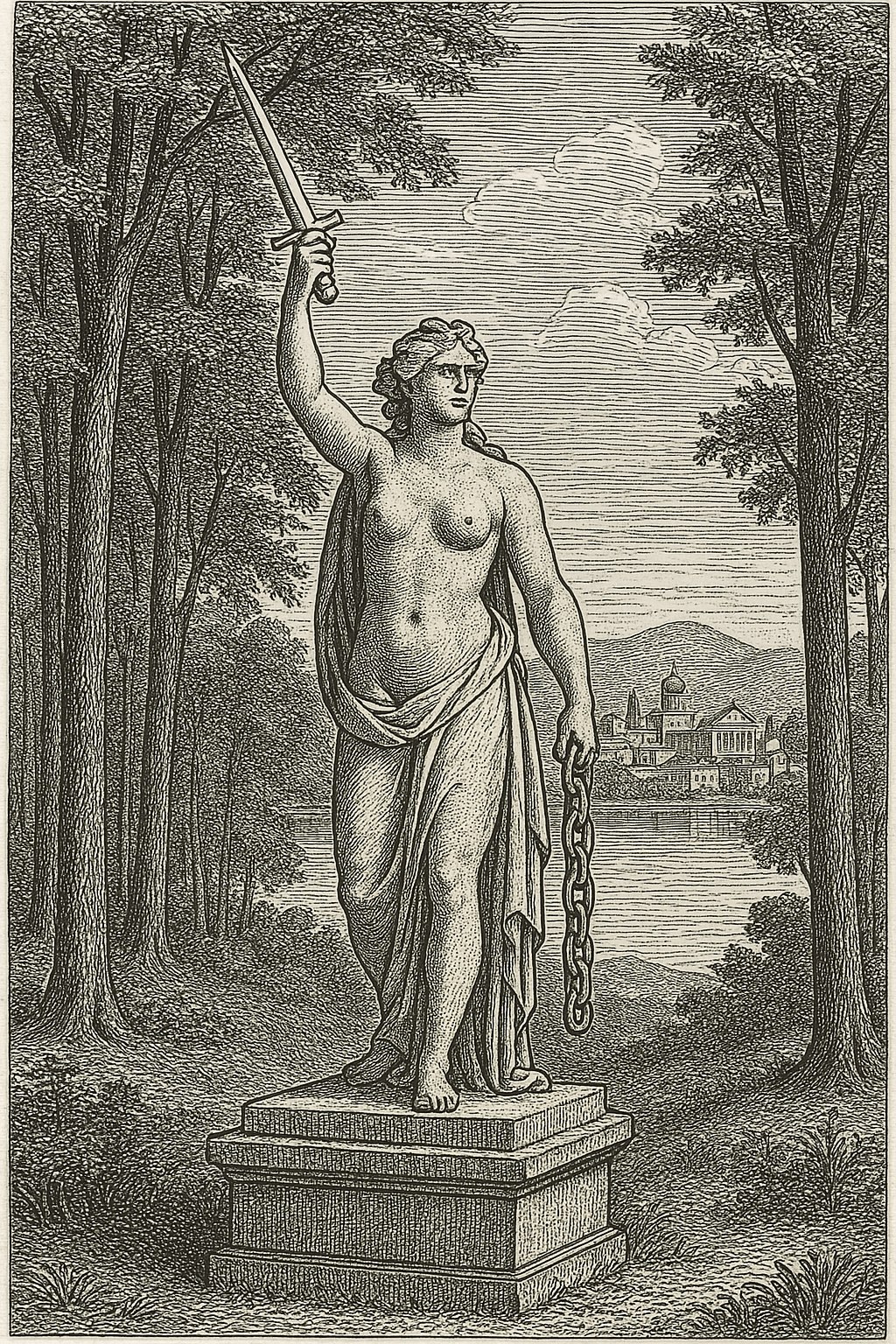
- The Statue of Tola Eppovia Qulia Ativia: This marble statue was erected quickly after Eppova suppressed Her̂idia Dacciia. It features her, in heroic semi-nudity, wielding a sword over her head in one hand and holding a chain in the other. It is erected on the site within the once sacred Grove of Bermedicus on the lakeshore, where Eppova personally executed Atwabeia Appelcima Sicca Pala.
Symbolic Landcape, Cultural Complexity, and Significance
The district presents layers of cultural domination and resistance. The Fertilium of Bermedicus - an authentic Dacci temple - stands as a witness to the desecration behind it, where Eppova's statue towers over the blood-soaked remains of a sacred grove. This creates a powerful visual narrative: traditional Dacci faith facing imperial violence and triumph.
The Boepum Theater represents early collaboration, while the surviving Fertilium embodies enduring Dacci tradition. The juxtaposition of authentic worship, collaborative entertainment, and imperial monuments creates a complex cultural battlefield in a single district.
The district serves as both the empire's showcase of power and an inadvertent preservation of Dacci-imperial tension, where traditional temple priests conduct daily rituals in full view of their people's greatest humiliation.
The Westgate District
Character: Dense working-class commercial district serving as the primary processing hub for western trade traffic. Very crowded and economically active district, characterized by maximum use of available urban space.
Location: Southwestern section of the city, just south of Soagum Proptima and the West Gate, bounded by the city wall to the west and extending eastward toward the lake. The district fills the available space between major infrastructure elements, creating natural density due to geographic constraints.
Demographics: Working-class Dacci artisans, small merchants, teamsters, stable hands, inn workers, and imperial functionaries. High population density, with multi-generational families living in compact quarters above their shops and workshops.
Key Establishments
- The Soagum Wayhouse: Main travelers' lodge. Maintained by the Empire for economic reasons.
- The Brass Legionnaire: Imperial-themed tavern popular with soldiers and loyalists
Economic Role
Major part of Atesi's commercial processing. Small-scale manufacturing, repair services, and trade support are clustered here to serve merchant traffic.
History
The city was founded as a trading post by the Dacci people in 1150 LE, following the end of The Dragonwars. It rapidly grew into the chief settlement in Dacciia.
1291 LE, the Calpian Empire invaded the lands of the Dacci and besieged Atesi, which was eventually conquered in a brutally costly assault by the imperial legions in 1295, after holding out for four years.
In 1316 LE, the Dacci briefly rebelled under the leadership of an organization called Qupin Dacciia. The rebellion was quickly quelled and hundreds of innocent civilians perished in the fighting.
In 1364 LE, Qupin Dacciia again led a rebellion against the Empire. This time they held out for two years before being crushed at the Battle of Belus.
Another revolt occured in 1402 LE, again led by Qupin Dacciia. This time they were brutally supressed, the civilian populace of all of Dacciia, including Atesi, was gathered and subjected to Decimation, in which they were divided into groups of ten, which drew lots. The nine who drew the white stone were forced to bludgeon the one who drew the black stone to death. This gruesome and violent punishment was followed by the establishment of the Military Government of Dacciia and the formation of the Daccian Legion.
Since that time, though resentment from the Decimation remained, the Military Government made significant infrastructure improvements, instituted a working civil bureaucracy and generally improved living conditions throughout Dacciia, including in the city of Atesi, so public opinion had begun to shift in favor of the Empire and away from Qupin Dacciia.
Those improvements in relations where shattered in 1430 LE. Hoping to benefit from the chaos caused when The Divinity of Rogiq suddenly arose, ripping Rozga away from the Empire, the leader of Qupin Dacciia, Atwabeia Appelcima Sicca, whipped up dissent within Daccian society with astonishing speed. On 10 Ins, 1430 LE, she led a force of Daccian veterans, supported by Nadho orcs, in a surprise attack on The Legionary Government of Dacciia. Their surprise was complete and the Utpavir and his forces were put to the sword. Atwabeia declared herself R̂idia of Dacciia.
Eight days later, Qupinor Eppova, the Tola of the Calpian Empire, with an escort of seven warriors arrived in Atesi via magical means. Aided by her magic, she gathered all the leaders of the so-called revolution and executed them on the shore of Walpagan. She wielded the sword herself. As she is no warrior, their executions were far from clean, but the message was clear. The Empire was back, and its leaders were not afraid to handle rebellion brutally and personally.
Eppova has established martial and theocratic law, declaring Dacciia a Principality of the Empire (Tolusaux Dacciia) under her personal rule. Magic is prohibited unless it provably originates from her ancestor, Stronus (she is a direct descendant of Cuncedam and is an Aasimar).
She has subverted The Radiant Sun, the local church originally dedicated to Stronus, to worship of Asedisus, the Dark Sun. Within it, she has established a sect of fanatics - The Pyre. Their purpose is to be a kind of magical secret police within the Tolusaux, dedicated to the eradication of other faiths and the purge of magic within Atesi. Paradoxically, they do so by taking on magical abilities.
Following the assassination of Lâinus of Saercumar, Tola Eppova marched on Saercumar, assaulting it and razing it to the ground. The R̂oldavus had forbidden this, so doing so was an act of treason. On 21 Clictuns, 1431 LE, R̂oldavus Etpimcemus visited Atesi, meeting with Eppova. He withdrew the Empire's protection from Dacciia and disinherited Tola Eppova, but did not order her execution. This effectively made Dacciia independent. Tola Eppova renamed the region the Tolusaux of Atesi and now rules it as a free sovereign.
Architecture
Architecture
Building Materials
The Dacci primarily build in fired clay bricks and in timber. Stone is reserved for temples and government buildings, and even they are often only partially stone. Common roofs are flat, while wealthier people or special buildings will have terra cotta shingle roofs.
Building Design
Homes are built on a two story plan. The lower floor is the kitchen and common area. The upper floor is dedicated to sleeping areas. Government buildings are similarly two-story affairs, with meeting rooms and audience chambers on the lower floor and offices, libraries, etc., on the upper floor. Temples are single story, though their vaulted ceilings will sometimes cause them to be the tallest buildings in the community.